• About

Unwanted Advice: Reflections from a Self-Appointed Life Counselor

~ Caminante, no hay camino. Se hace camino al andar. Wayfarer, there is no way. You make a way as you go. (Antonio Machado)

Unwanted Advice: Reflections from a Self-Appointed Life Counselor

Category Archives: Aesthetic philosophy

“You were my death / you all I could hold / when all fell away from me.” Paul Celan

27 Saturday Oct 2012

Posted by summermlee in Aesthetic philosophy, Art, philosophy, poetry

≈ 5 Comments

Tags

"The Gaze of Orpheus", "The Instant of My Death", art, death, Derrida, George Steiner, language, Maurice Blanchot, Paul Celan, poetry, Summer Mei Ling Lee, World War II

It is hard to know what this thread is, as it weaves through my recent travels. The only way to understand it more is to start about here.

Because, Blanchot says, in order to write, one must be already writing. “One can only write if one arrives at the instant towards which one can only move through space opened up by the movement of writing.” He writes this in reference to Orpheus, and that Orpheus needed music to descend to the underworld to rescue his love, a precise metaphorical homage to artistic creation. As it happens in tragedy, the moment he gazes at his beloved, he loses her, but experiences perhaps a moment of freedom: “[He] frees the work of his concern, frees the sacred contained in the work, gives the sacred to itself, to the freedom of its essence, to its essence which is freedom (for this reason, inspiration is the greatest gift).”

That is why a particularly masterful work of art recalls the fact that it could not have been — if we are vulnerable enough to let our art be art, let our hearts be touched, and to sense the present moment. Steiner is particularly fascinated with art’s ability to give presence to that which is absent and profoundly otherwise: “The arts, and music above all, give to man the freedom from his otherwise mortal city.” It is where humans can “surpass their condition.”

Blanchot, as with Paul Celan, knew Orpheus’ gaze in his own life, and both had stood within the “breath-turn” between absence and presence. Towards the end of his life, Blanchot wrote this letter to Derrida, who deeply understood occupied France:

“July 20. Fifty years ago, I knew the happiness of nearly being shot to death.”

As Blanchot was removed from his home by soldiers and placed in front of a firing squad, he experienced a “feeling of extraordinary lightness.”

Blanchot writes of the man who experienced this moment, “He was perhaps suddenly invincible. Dead — immortal. Perhaps ecstasy. Rather the feeling of compassion for suffering humanity, the happiness of not being immortal or eternal. Henceforth, he was bound to death by a surreptitious friendship.”

Blanchot, a stand-in for Orpheus, penned this “Instant of My Death” from the stance of a young man’s testimony, a fiction that is the leap of literature, one step removed from his own life. Perhaps he did so because it had been posited since classical Greece that the image of the thing is more beautiful than the thing it represents. But likely more so because he used his art to go to the depths of this underworld experience, the shadow-side of being human.  So at the moment of writing his death — as if Orpheus might describe it in 3rd person narration — at the moment he gazes back at Eurydice, he is free.

Tonight, I sit in my midnight bed, reading-lamp dim, and I hear the the approach of husky breathing that is my son, who turns his inhalations to exhalations without self-consciousness yet, who has ambled out of his bed and his room, guided by slivered lines drawn through sleep-puffed eyes, one hand viced to his blanket. He is just awake enough to know the path to my bed, and he is asleep before I have finished picking his warm, softly surrendered body up into the bed next to me. His breathing returns to the quieter rhythms of sleep and I wonder what impulse wakes him and directs him to my company. Years ago, during a particular grueling time (though there would be worse yet), I woke myself yelling for my mom. Calling for her as if she was down the hallway, like a child needing rescue from a bad dream. The impulse for words that call out for salvation is deep, even as I know that my faith in words, in salvation also, is constantly asunder.

“(At every turn, language traps us within the labyrinth which we are calling on language to elucidate).” George Steiner, Grammars of Creation.

(My recent installation, “Saigyo’s Moon.” Projection of flying birds on eggshells.)

“Believe in the holy contour of life.” Jack Kerouac

05 Friday Oct 2012

Posted by summermlee in Aesthetic philosophy, Art, Nature, philosophy, poetry, Uncategorized

≈ 5 Comments

Tags

art, Heidegger, Jacques Prevert, painting, poetry, To Paint a Portrait of a Bird

Pour faire le portrait d’un oiseau

— Jacques Prévert

Peindre d’abord une cage
avec une porte ouverte
peindre ensuite
quelque chose de joli
quelque chose de simple
quelque chose de beau
quelque chose d’utile
pour l’oiseau
placer ensuite la toile contre un arbre
dans un jardin
dans un bois
ou dans une forêt
se cacher derrière l’arbre
sans rien dire
sans bouger…
Parfois l’oiseau arrive vite
mais il peut aussi bien mettre de longues années
avant de se décider
Ne pas se décourager
attendre
attendre s’il faut pendant des années
la vitesse ou la lenteur de l’arrivée de l’oiseau
n’ayant aucun rapport
avec la réussite du tableau
Quand l’oiseau arrive
s’il arrive
observer le plus profond silence
attendre que l’oiseau entre dans la cage
et quand il est entré
fermer doucement la porte avec le pinceau
puis
effacer un à un tous les barreaux
en ayant soin de ne toucher aucune des plumes de l’oiseau
Faire ensuite le portrait de l’arbre
en choisissant la plus belle de ses branches
pour l’oiseau
peindre aussi le vert feuillage et la fraîcheur du vent
la poussière du soleil
et le bruit des bêtes de l’herbe dans la chaleur de l’été
et puis attendre que l’oiseau se décide à chanter
Si l’oiseau ne chante pas
c’est mauvais signe
signe que le tableau est mauvais
mais s’il chante c’est bon signe
signe que vous pouvez signer
Alors vous arrachez tout doucement
une des plumes de l’oiseau
et vous écrivez votre nom dans un coin du tableau.

——–

To Paint a Picture of a Bird

First you paint a cage
With its door open
Then paint
Something nice
Something simple
Something lovely
Something useful
For the bird
Then set the canvas against a tree
In a garden
In a grove
Or in a forest
Hide behind the tree
Without speaking
Or moving…
Sometimes a bird arrives quickly
But equally it may take many years
Before it chooses to
Don’t be discouraged
Wait
Wait many years if needed
The speed or tardiness of its arrival
Has nothing to do
With the success of the picture
When the bird arrives
If it arrives
Observe the most profound silence
Wait till the bird enters the cage
And when it has
Gently close the door with your brush
Then
Erase all the bars one by one
Taking care not to touch a feather of the bird
Then paint a picture of the tree
Choosing the loveliest branches
For the bird
Paint the green leaves too and the wind’s coolness
The dust in the sunlight
The sound of insects, in the grass, in the summer heat
Then wait for the bird to choose to sing
If the bird won’t sing
That’s an adverse sign
A sign that the painting is bad
But if it sings it’s a good sign
A sign you can sign your name
Then very gently you’ll detach
A feather from the bird
And write your name in a corner of the painting.

“We never come to thoughts. They come to us.” Heidegger

“Language simply ceases… The poet enters into silence. Here the word borders not on radiance or music, but on night.” George Steiner

17 Monday Sep 2012

Posted by summermlee in Aesthetic philosophy, Art, music, Nature, philosophy, poetry, Uncategorized

≈ 7 Comments

Tags

art, bird watching, birds, George Steiner, music, nature, Rilke

The outskirts of Tahoe National Forest. I followed the early morning mists of little winged bugs along the edge of a forested reservoir, a small cohort of Audubon’s Warblers chasing them also. With a mind galloping through what if’s and what-nots, I sat next to their cathedral, a half-dead tree once under the water line. Its branches stretched arthritically out towards that which feeds it but also puts it asunder. One by one every species of woodland bird worked its way out of the dense pine forest to that diminuitive tree. They would land with a pause, flit a little, perhaps taking a careless bug in this gathering place, then sail down below to the stony water edge. They were singing me stories of wretchedness, of betrayal and harshness from those who didn’t believe they know better. They described predators with only few survival skills who violate their homes, even when their bellies are far from empty. But they also sung of the little joys of sunlight, improbable births, childlike pauses, and cool reservoir water. Fiercely aching nights and warm morning updrafts. And times when every species and variety of plant and bug is available, and times when their children grew silent in the cold. Warblers, nuthatches, wrentits, chickadees, flycatchers, a few I didn’t know, and a rufous sided towhee — the little delicate species, the singers. My favorites. For years this lasted. I have been devoted to them.

Someone once said that birds remind him of an existence before human civilization, of times outside of wars, laws, buildings. Before human suffering and its impulsive response of further suffering. But these birds were not solely of the sweetness of summer, though they had the resilience and the evolutionary wisdom to live as if that was all they knew. Because today it was summer.

(A photo from my studio, by Shae Rocco).

It seemed my birthright to make an offering. Give something, though those little birds of course needed nothing. Steiner reminds that art is free, gratuitous, not for anything, so much so that every artful creation calls forth an awareness that it might not have been. So somehow turning this moment into a drawing or even writing seemed superfluous, like a scarf around Rilke’s torso. And it is.

Because in this moment I also felt like I might not have been, that everything I’ve done and made might have been otherwise. I felt humble, like the chanters of holy songs, whose talents are free and freely given. So, for whatever reason, because I was perfectly alone, I began to sing. My mom would be excited to know I quietly sang songs from her faith, maybe because that foreign language seemed as intimate and yet dispossessed as the birdsong around me — it contains a hint of something inextricable even as it is unknown. And despite my usual anxiety of needing more, I had a moment of needing nothing, a necessary condition for gift-giving, even if it is song-giving. Towards everything surrounding the birds and all the radiating objects and memories and people I know and knew. And as the scene pulsated, the birds neared me one by one as part of their ritual, into otherwise lethal distances. A Townsend Warbler landed a few inches above my head. After that a Kinglet slid down to the frayed end of a branch four inches from my eyes. Another Audubon’s Warbler almost upon my shoulder. They exerted themselves to me. And so I cease to sing.

” — for here there is no place that does not see you. You must change your life.” Rilke

“Everything that can be thought at all can be thought clearly. Everything that can be said at all can be said clearly. But not everything that can be thought can be said.” — Wittgenstein

01 Saturday Sep 2012

Posted by summermlee in Aesthetic philosophy, Art, Nature, philosophy

≈ 3 Comments

Tags

art, Being, dead birds, memoir, painting, philosophy, silence, susan Sontag, Wittgenstein

In the yard of my childhood home, a robin drunk from devouring over-ripe cherries on our tree, flew into our bay window that must have held an attractive illusory world, so much so that more than a few birds met that hard, bludgeoning reality. And after struggling for air on the ground below, it became still and lifeless. My mother, sensitive to the meekest of life forms, gathered the corpse and her two fledgling daughters for a funeral. A hole was dug, and as I watched the corpse of the bird descend into the dirt void, my mom said words, words of ritual, wishing that this bird would be in peace.

That robin’s life, unlike the other carcasses of animals on roadsides or worse, was made sacred to me, and the abyss into which some part of this bird, the part besides feathers and flesh, inhabited when it was into the ground became the eternal question mark.

My mentor describes the pre-classical Chinese pictogram of sacred as a person standing on earth, on one’s toes, reaching for the sky, the heavens. The sacred cannot be without the earth, the mundane requirements of being human, but it also has the urge for beyond such knowing.

Eventually and logically, that became the case for those beings lying unceremoniously in rotting ditches who by my eyes were not made sacred. And a moment of heightened attention in a car passing by was, and continues to be, my attempt to sacralize, because it feels necessary that we would all be given the mere gift of attention as we disappear.

Finally this week, it was this scene that appeared to me in my own ritualized space of art-making in my studio, where I stared upon the flocks of quiet, often dissolving, single, little dead birds I’ve painted over and over for the last 7 years. After enduring the dissonant if not polite questioning and dismissal from others and myself — amidst a cultural popularization of cute birds on every sundry item available (“put a bird on it”) — I was partially decoded.

And luckily, also this week, I read an essay by Susan Sontag, who fully understands the impulse to make art “towards the ever-receding horizon of silence.”:

“One result is a type of art which many people characterize pejoratively as dumb, depressed, acquiescent, cold. But these privative qualities exist in a context of the artist’s objective intention, which is always discernible. To cultivate the metaphoric silence that’s suggested by conventionally lifeless subjects (as in much of Pop Art) and to construct “minimal” forms which seem to lack emotional resonance are in themselves vigorous, often tonic choices.”


(My painting: “Bird Elegy #1″ (detail), 2012.  14″ x 19” Watercolor on Paper)

But my recent writing/searching has drawn my attention to the fact that all things, especially the experience of love, are of a continual parting. Perhaps that impossible constant attention to that coming and going, the making sacred of every moment and every thing that makes a heartbeat, that presences and reaches into us, and then dissolves into silence — Heidegger’s clearing and gathering and clearing — that is a  glimpse into the untranslatable state of Being.

For now, I can only handle my little birds.

“It seems unlikely that the possibilities of continually undermining one’s assumptions can go on unfolding indefinitely into the future, without being eventually checked by despair or by a laugh that leaves one without any breath at all.” Susan Sontag

And when we imagine wings that come and go / What we see is a house / And a wide open window. – May Sarton

23 Thursday Aug 2012

Posted by summermlee in Aesthetic philosophy, music, Nature, philosophy, poetry, Uncategorized

≈ 8 Comments

Tags

Bachelard, birdsong, childhood home, dead sparrow, Gadamer, Heidegger, Home, May Sarton, memoir, music

If Goethe is right, and architecture is frozen music, home is a song we have learned by heart.

My friend reminds me that learning things by heart insists upon rhythm, the heartbeat, and that the experience of the present moment is rhythmic.

One beat has to end for the next to begin. And like his favorite piano concerto, we don’t know when this note ends, and there is much tension in the space before the next. And life is marked by a gentle sadness when that moment ends and dissolves into the next moment. That, according to Bugbee, life is haunted by a continual parting. Proust says these moments are connected to places that also don’t exist anymore: “The places we have known do not belong only to the world of space on which we map them for our convenience. None of them was ever more than a thin slice, held between the contiguous impressions that composed our life at that time; the memory of a particular image is but regret for a particular moment; and houses, roads, avenues, are as fugitive, alas as the years.”

And that was the fugitive feeling I have had recently. First, I was at a dinner where a friend made a lovingly-prepared pot roast. Tomato and herbs infused a slow-cooked meat I’ve not experienced since I was living in my childhood home. The warm, familiar smell wrapped its arms around me as I sat in this modern-day apartment, just as my mother’s filled our evening home when I was a child. The smell invoked something so palpably nostalgic that one part of my self remained in a distant past even as I carried about in the present-tense conviviality. My friend sitting next to me also was piqued by the memories of childhood dinners; someone who I happened to have first met when I was 6 years old. We have witnessed each other grow and shed several versions of ourselves, though there is something from which we struggle not to stray.

It recalls Gadamer’s notion of festival — that there is an enduring in the perishing. There is continually a moment that we wish could be retained, held onto for just another moment longer, even though it can never be. It is a “consciousness of human frailty,” when we are aware of the rhythms of our life and the fact that they end. “Every festive joy, yes, every joy, is perhaps the other side of an inexpressible, unutterable.” And every beat of the heart is inseparable from its opposite — silence; nothingness.

And then I gave into the urge to drive by my childhood home this week. I was in the area, where a chaparral dustiness meets the crisp coastal breeze and tugs at me. As did the autumnally-filtered light of a sun beginning to arc lower in the sky. And there predictably sat the home on the corner of middle-suburbia covered with mature trees and gridded off by narrow streets. The house, like the area, is shinier and more regal than the more humble and equitable times known before Silicon Valley bubbles and exorbitant housing prices. The home was still incredibly intimate, yet completely estranged from me — the current occupants undoubtedly using it in their own way in a sort of betrayal of the past. Because, like everything else, my home had to give way to their home. Like the tightly woven, straw nest that fell off the side of our house a few months ago. Next to it was a darkly stippled egg, intact, but belonging now to the unknown.

The nest fell from the eaves of my new home of the last 13 years. Soon, as with every year, the winter flock of Golden-crowned Sparrows and their one loyal Fox Sparrow friend returns to our feeder. One year our cat in her boredom slaughtered the Fox Sparrow, and after I grieved its dark, hopeless body in my hand, I decided not to slaughter the cat. A few years later, a new Fox Sparrow somehow rejoined the flock. I’ll never know how.

Fox Sparrow song

This is the home which presses itself into my son whose foundational memories will be part of the architecture, as the architecture is part of his psyche. And eventually, the most eventual fact of all, my life will give way also. So dramatic-sounding, I know, but the remembrance of which always relates to Heidegger’s astonishment that I exist rather than not, that leads to Hamill’s loving a little bit more, because one of us will die. And the moment when the stars begin to burn through Mary Oliver’s sheets of clouds so that I may write about it here, with words that are little houses, as they dissolve away also. That things come and go, it brings about wonder:

“Celebration … is self-restraint, is attentiveness, is questioning, is meditating, is awaiting, is the step over into the more wakeful glimpse of the wonder — the wonder that a world is worlding around us at all, that there are beings rather than nothing, that things are and we ourselves are in their midst, that we ourselves are and yet barely know who we are, and barely know that we do not know this. – Martin Heidegger, Polt

“Words … are little houses.” Bachelard

04 Saturday Aug 2012

Posted by summermlee in Aesthetic philosophy, Art, Nature, philosophy, poetry, Uncategorized

≈ 8 Comments

Tags

Bachelard, birdsong, ephemerality, George Steiner, monrtality, nature philosophy, nests, poetry, Saigyo, Sheila Ghidini

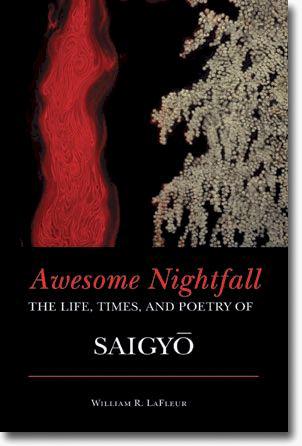
The 12th century Japanese poet, Saigyo, lived in horrific times of war, chaos, and scandal. He descended from a lineage of warriors, and after violent service to the Emperor, he took up the robes of a monk and the pen of a poet to both understand and release the straits of human-ness, his metaphorical and literal bloodstained past, the limits that all humans are born into.

In both life and writing, he became a homeless wanderer. And it was during these unceasing peregrinations between mountainous temple sites and towns that he used the ability of nature’s images to capture all that matters through deceivingly simple words.

An ancient field

and in the sole tree starkly

rising to its side

sits a dove, calling to its mate:

the awesome nightfall.

In his poems, words as single ideographs balloon with layers of meaning, and no one meaning stabilizes over another. What we think is important becomes indistinguishable as night falls. What remains there is the gift of the dove’s birdsong lilting in the dissolution of light — into awesome darkness.  As Sam Hamill writes, thoroughly intimate with Saigyo and profoundly aware that song might be the last thing heard, that words are the springboard into nothingness:  Those that I love are more beautiful because one of us will die.

I recall the moment driving home from the hospital after giving birth to our son, a process that even in good circumstances is seismic to the foundation. And in my case, I exhausted myself to the point of an acuity of my mortality. So there I was, dispossessed, with one foot still in the non-world, while my family packed up the days-old baby asleep into his carseat, also with one foot in the non-world. We were heading home.

Oddly, our destination in my mind’s eye was my childhood home. Driving down the familiar coastal route, I only saw my childhood living room with the wretched, green upholstered chair that I spent so many hours in, there under the expansive pane of glass through which was our neglected garden, littered with robins pecking at unwanted cherries. Even when it became clear that this was not indeed where we were heading, that the last time I stepped foot in this house was decades ago, I could not understand how to get to my current home, the one “known” for the last third of my life. I experienced a moment of homelessness.

Of course my literary hero, George Steiner, drawing on writers ranging from pre-classical Chinese poets to Holocaust survivors, professes this homelessness, that we are always guestworkers, “frontaliers in the boardinghouse of life,” regardless any distraction from this eventuality. It is the same for Dante, in his love for Beatrice, who travels through the three realms of the dead. And that the epic narration of Odysseus is in his journey, the textual death occurs when he reaches home.  Chuang tzu’s free and easy wandering, which is incredibly not free, nor easy.

Because we are human. We need a home. If we are to have a home, according to Bachelard, it would be like the fragile nest. Every precariously woven-together twig and dried straw comprise our human desire to hope for the future, and the precious eggs it cradles — but also the acceptance of its propensity to decay, fall apart, to be destroyed — to be ephemeral. The nest acknowledges the potential for me to be without the soul-killing need to push against Being, distracted from where the beauty of it lies. I have exhausted myself in my will to make things certain — because, as I am reminded in my changeling son, the infinite little losses in my body, my relationships, my art-making, and how in this moment right here is the possibility of perishing — words are anything but certain.

(Sparrow, by Sheila Ghidini. http://sheilaghidiniprojectspace.com/home.html)

“When you are philosophizing, you have to descend into primeval chaos, and feel at home there.” Wittgenstein.

“The grammars of creation are, in the final analysis, those of the erotic, of shaping intellect and psyche in a condition of Eros (the Logos, in the arms of love…).” George Steiner

15 Sunday Jul 2012

Posted by summermlee in Aesthetic philosophy, Art, Nature, philosophy, poetry

≈ 2 Comments

Tags

Anne Sexton, art, Clement Greenberg, creation, creativity, George Steiner, poetry, Professor Alice Bach, Tarkovsky, words

This entry wrote itself this morning on my jog, in the valley tucked away from the ocean shore. There in the chapparal valley are my kindred birds, families of quail fused together. One adult male is always vigilantly poised atop a signpost or garbage can, alertly standing guard over the small herd of fuzzy fledglings and their preoccupied surrogates pecking in the dry grass. I always regret that I must pass through them, causing them to scatter like field mice into the brambles that line the creek. The brambles where I know lurks a chubby, yet insatiated bobcat.

Despite being worn, I chose to heave myself up from the valley floor, along the switchbacks that ascend the side of a sun-lit mountain. Along the way, as predictable, I become anxious of whether I am able to reach the summit, that it is always longer and farther than I remembered. I try to recall that if I just attend to what is going on around me, go inward into my thoughts, even the burning in my legs, I will be less aware of the draining heaviness of the future tense.

Such is using any medium to create. A self-consciousness of one’s tools can turn them into the bars of a prison. We have developed bars around these lights of vulnerable creativity, sometimes so ornamental that others approve of them so much as to make us invest more and more in them. Yet the bars restrict and the air is stagnant therein, allowing only precarious involvement on the thin breath of things.

They amount to a gilded cage, polished to a mirror surface enclosing the songbird. This is the self-image of Narcissus, the trap of self-congealing. Even if it might provide both protection and adoration from the Crowd, the illusion of a subsistent self does not allow ephemeral song to take wing.

(Scene of the Bellmaker, from the film, Andrei Rublev, by Tarkovsky)

I sensed a predictable relief when I reached the top of the summit this morning, because yet again, I got to where I didn’t think I could go, and even more, I was yet surprised by the expansive view of the valley floor below extending to the sea. It occurred to me that there are summits that are exponentially harder to reach than my little hill of this blog, arriving upon its first birthday. How I curb my vulnerabilities and borrow from convention throughout is damning. And the more arduous and improbable to overcome this, the more solitary it might be to reach it — and the less likely anyone else can confirm it. Even the parasitic and invulnerable art critic Clement Greenberg said, “All profoundly original work looks ugly at first.” I have not the courage for this freedom to be ugly, nor the freedom to not be anything at all.

But it stands that I am grateful for my tribe of friends who stand guard over this endeavor, as it works its way through its awkwardness and conventional shortcomings.

I am profoundly in the arms of love.

(This poem was sent from Alice Bach, the first ever to stand guard over my writing)

Words, by Anne Sexton

Be careful of words, even the miraculous ones.

For the miraculous we do our best,

sometimes they swarm like insects

and leave not a sting but a kiss.

They can be as good as fingers.

They can be as trusty as the rock

you stick your bottom on.

But they can be both daisies and bruises.

Yet I am in love with words.

They are doves falling out of the ceiling.

They are six holy oranges sitting in my lap.

They are the trees, the legs of summer,

and the sun, its passionate face.

Yet often they fail me.

I have so much I want to say,

so many stories, images, proverbs, etc.

But the words aren’t good enough,

the wrong ones kiss me.

Sometimes I fly like an eagle

but with the wings of a wren.

But I try to take care

and be gentle to them.

Words and eggs must be handled with care.

Once broken they are impossible

things to repair.

“All our heart’s courage is the echoing response to the first call of Being which gathers our thinking into the play of the world.” Heidegger

09 Monday Jul 2012

Posted by summermlee in Aesthetic philosophy, Art, Nature, philosophy, poetry

≈ 9 Comments

Tags

birds, Morris Graves, poetry, Saigyo, suffering, the moon, the muse

It is funny how the muse works. Even as I am distracted by the art-killing, mundane requirements of life, something persists to whisper to me. Thankfully. Even if those whispers are drowned out by the storm-like babel of Rilke’s crowd, they emerge almost imperceptibly like fragile threads of lace woven by frail hands into the dwindled still moments of my life. Little by little, something clearer and compelling forms itself together. Like a glimpse of Virginia Woolf’s pattern. And then I wonder regretfully what art could compose itself had I been able to listen more.

Tonight there is something about the moon. Except that it is so foggy here I cannot actually see it.

Last week at the shelter support group, we presented education on domestic violence to the women who are living there, escaping it. We try to instill a framework of what they experienced, perhaps so they can avoid it in the future, but also to reassure them that what they experienced was real, and that many, far too many, have experienced it also. As has become routine, we end this session with asking them what is a healthy relationship — a question most have not considered, nonetheless those who have wrangled with an almost lethally unhealthy one. But this evening, some of the women had definite ideas.

It came time to go around the group for their closing thoughts. One woman, the newest to the household, had been stone-silent the entire group. Just when I thought she would pass her turn, she began slowly to speak. She glared into my eyes and said that our discussion had been hard. It made her feel hurt, but also ignited an anger towards the person who had hurt her. She wanted vengeance even. She wondered how could someone begin to consider healthy relationships when they are mired in a bad one. To the point where it is no longer clear what is healthy and what is not. That we begin to become unhealthy too, starting to do abusive things ourselves because of what we experienced, over and over. How can we even hope for a good relationship, she asked, in a way that embarrassed me in the philosophically-flawed notion of future-tensed hope. She pleaded, but not in a way that warranted an answer, other than the tears welling all around the table. All I could do was put my hand on her arm and say that I was so happy she had responded.

That night driving home, the moon was so low and radiant in my horizon so as to be a guiding beacon for my car. And perhaps because I was tired and raw, the moon conjured something romantic, melancholy, poetic. At first I wanted to explore an annoying litany of philosopher ideas to articulate my connection to this strange, glowing disk hovering incredulously over the skyline. But what most came to mind, to the part of me that wants to translate these moments, is that simply, the creme-lit, distant landscape is a place I will never visit. Completely unreachable. Yet it persists in my darkening sky so predictably that civilizations could measure their time by it, more accurately than by the sun.

The next day, a friend wrote me an incredibly poetic email from her artist retreat in the countryside. It was correspondence tending to the heartening and savory details of nature available to only those who know true and enviable solitude. And of course it was full of Birdness. In it, she mentioned that I might like a talk that her Zen Buddhist teacher gave on suffering, as it is my relentless theme of late. As I listened to his illuminating talk, I received a hint sewn into the pattern. Her teacher read the poetry of the medieval poet, Saigyo — a poet almost obsessively concerned with the moon. A symbol of enlightenment, the beauty in the breath-taking and indescribable culmination of accepting the painfully ephemeral and suffering nature of being human. Always there, but practically unreachable.

Winter has withered

Everything in this mountain place:

Dignity is in

Its desolation now, and beauty

In the cold clarity of its moon.

This is what the muse left me this week. I know it’s not my job (nor am I able) to weave it so tightly together with meaning and language that it would suck the air out of the atmosphere and extinguish the moon one might see tonight, the moon throughout one’s entire life. But I am astonished that somehow a poet, from across the divide of 1,000 years and immeasurable distance, reaches to me through the chatter and knows intimately the miraculous moon that guided me home that withered night.

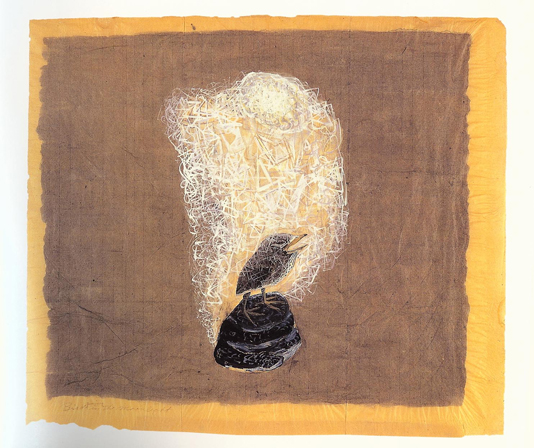
(Bird Singing in Moonlight, 1938, by Morris Graves)The rest of the poem is here:

http://ladynyo.wordpress.com/2012/04/12/mirror-for-the-moon-a-little-poetry-of-saigyo/

“The narrow bridge of art…” – Virginia Woolf

22 Friday Jun 2012

Posted by summermlee in Aesthetic philosophy, music, philosophy

≈ 4 Comments

Tags

chapel of the chimes, Columbarium, death, Garden of Memory, Laurie Amat, music, Oakland, summer solstice, Virginia Woolf

On the day with the longest daylight of the year, the Northern Solstice, I found myself surrounded by thousands of dead people. Yes, I am probably over-working the mortality theme of late into an insipid pulp, what with all of its depressing seriousness. But at the columbarium in Oakland tonight, the chapels,  cloisters, and crypts filled with the remains of the dead carried the very alive music of more than 30 musicians, as apparently happens every solstice.

In following our ears to the next musician around each corner, we worked our way through the names of bookended lives lining the niches, hallways and courtyards built almost as an ascending and descending gothic maze. Corners and alcoved places exist for the bereaved to experience a meditative solitude away from others, while the constant light through open ceilings and skylights reminds of an other place, and of human smallness. Tonight, the meditators, the remembering, were music-makers.

Among the more recently interred, an accordionist sat on a metal folding chair in a marble alcove and played accomplished polkas and waltzes and even a French classic — the same song I heard on a lively street behind the Notre Dame of Paris. Then, I sat looking at candy colored tulips in the sunny, cathedral garden, while couples cooed at the river, tourists gawked at the sentinel and soaring architecture, and locals ambled on their itinerant paths to bakeries, friendly meetings, work duties. Such aspirating and pumping accordion music is of a buzzing life, even as it was played tonight among the dead. The borderline absurdity of this accordion music in what is usually a solemn and silent, heart-heavy and self-reflective space was almost sublime. Like the last scene of Life is Beautiful, when the parade of humanity, and a boy full of life, marches out of a death camp.

And there was an incredibly serious experimental piano player, in a long hallway of glass-enclosed rows of urns, pounding and trilling her piano in utter dissonant refrains. Our toddler son was fascinating himself in the gurgling, concrete memorial fountain situated a few feet in front of her, and during a particular dark and howling section of her work, he crooned his neck up to the opening in the ceiling, and sang, Bubbles, Bubbles, Buuuuuuubbbbbbles, as if to commune with the alienating musician and her intentionally awful and emotionally grueling composition.

And of course, the moment of Being. I ducked into a light-filled crypt, where written passages of St. Luke adorn the stacks of shelved lives reduced to a plaque of name and date, a date far enough in antiquity that nothing is remembered of them except their grave marker. There, a welcoming, professionally-attired woman, Laurie Amat, gracefully filled the space of the dead with her operatic voice, lilting and trembling and belting and reverberating against the stone architecture. Her melodic voice ushered me in, but as she faced the places that contained the dead, her audience, I knew that I was superfluous. Her talents were refreshment for those who cannot sing or listen anymore. She was an instrument upon which an aliveness came home to acknowledge, to reach even, the realm of the unalive. It was a remembrance for the forgotten. And it was a reminder that I, like the thousands surrounding me who are reduced to ashes, urns, plaques and one or two mementos left by a dwindling number of adoring survivors, last for just a second on this earth — just like one of her perfectly pitched, honeyed notes as it disappears into the ethers, like the note before it. At first it hurt to let go of all that my self thinks is important, those empirical requirements of the everyday. And yet, the more I disappeared into the moment, I didn’t care that I was gone, forgotten. In fact, I relished it.

“If again we should find if we took a walk with our friend that he is alive to everything — to ugliness, sordidity, beauty, amusement. He follows every thought careless where it may lead him. He discusses openly what used never to be mentioned privately. And this very freedom and curiosity are perhaps the cause of what appears to be his most marked characteristic — the strange way in which things that have no apparent connection are associated in his mind. Feelings which used to come single and separate do so no longer. Beauty is part ugliness; amusement part disgust; pleasure part pain. Emotions which used to enter the mind whole are now broken up on the threshold.” Virginia Woolf

“When he walks out into the rising dawn or looks out into the event-filled evening and when he feels what is happening there, all situations drop from him as if from a dead man, though he stands in the midst of pure life.” Rilke

17 Sunday Jun 2012

Posted by summermlee in Aesthetic philosophy, Art, philosophy

≈ 3 Comments

Tags

Araya Rasdjarmrearnsook, art, death, Father's Day, Heidegger, phantoms of Asia, Rilke

Rilke says it best that without solitude, the meditative place for the fostering of one’s inner life, there can be no art. No love, either. Love, he writes, is standing guard over another’s solitude.

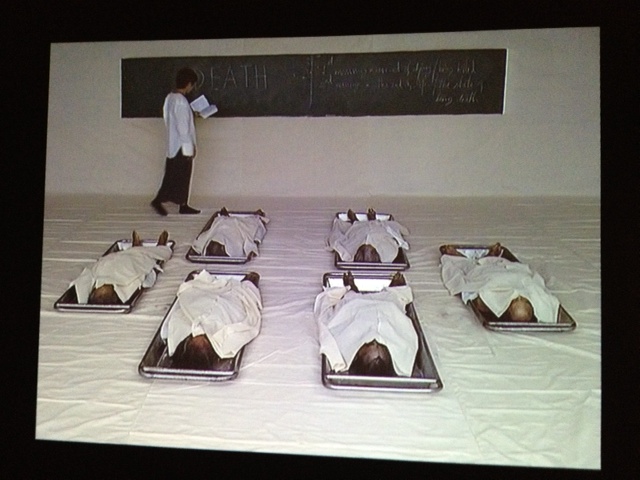
I found a moment to go to the Phantoms of Asia exhibition in the Asian Art Museum, where I encountered this video, entitled, The Class, by Araya Rasdjarmrearnsook. The artist is in essence, lecturing the six dead bodies on death. It is no accident that from where we sit, we are in the same audience as the dead people. At some point, my body will be that corpse lying on a tray. And it is there that I sat uncomfortably energized, feeling that anxiety, or Angst as Heidegger put it, that I am a being-toward-death.

While there is a dark humor pervading this piece, like when the artist asks a cadaver, What was that you said?, it is only a small bit of the profundity that this video reckons with. For me, the fact that the artist, a stand-in for the living, is teaching the dead about death — those who know deeply about it but cannot say —  hits on a facet of human nature that is confounding and all too ubiquitous. The living, in their attempt to colonize and conquer death, deaden and dull life itself.  As Steiner summarizing Heidegger says, those who rob us of the anxiety of death alienate us from life. Because, afterall, “the taking upon oneself, through Angst, of this existential ‘terminality’ is the absolute condition for human freedom.”

My friend, sitting next to me in front of this video, said plainly that she wished she had chosen to see her dead father’s body when she was given the chance, to have closure with his death. I responded carelessly that when she had had the opportunity, her father might have been dead too long and maybe the body was too removed from who he was when alive.

Two weeks later, last night, my undigested subconscious regurgitated before bed, filling my mind with thoughts about my own father. Yes, it’s Father’s Day today, but I haven’t thought of him on the past 3 or 4 such occasions. As some of you know, my ending with my father was not fairytale, but instead riddled with anger, doubt and a feeling of homelessness. But I did have meaningful time with him after he died. Although I was policed and hurried out of my vigil by his new vulturous step-family, I had a moment of loving contemplation over his peaceful body.

I realized last night that this time with him was one in which I could reflect on his life and in those incredibly condensed minutes, to feel the totality of him part from my totality. But last night I also realized that in those moments I worried about him as he faced his abyss. That I heard how he was anxious moments before he died. And I wish something or someone was with him, that he wasn’t totally alone in his leaving. Because it is a leaving that is utterly alone, and utterly into the unknown. And because of all that he was to me, for better or for worse, and because he faced this unspeakable time alone, probably doubting love, like we all might, I wish someone stood guard over him. I wish him love.

And maybe that’s all we can do for the dying — and we are all dying — because to do anything else is to rob one of life: “The inalienability of death — the plain but overwhelming fact that each must die for himself, that death is one existential potentiality which no enslavement, no promise, no power of ‘theyness’ can take away from individual man — is the fundamental truth of the meaning of being.”

In solitude, most critically felt at death, we experience freedom. Rilke’s artists and lovers of the everyday seem to know that freedom is contingent on an acceptance of our mortality and a quotidian comfort with the unknown — and even to let go enough to stand guard over someone else’s solitude. A constant homecoming, if we are brave enough. I’m not sure my father was brave enough until he was forced to be, and god knows I am not either.

“‘The wandering, the peregrination toward that which is worthy of being questioned, is not adventure but homecoming.’ Man, in his dignity, comes home to the unanswerable.” (Steiner on Heidegger)

← Older posts
Newer posts →

Enter your email address to subscribe to this blog and receive notifications of new posts by email.

Join 619 other subscribers

Recent Posts

  • “Experimenters in the passages between worlds.” Vinciane Despret, Au Bonheur des Morts
  • “The terrifying groundlessness, the eradication of all violences. To be embraced by that which doesn’t know us and in that unknowing caresses us and truly loves us. We might become anything at all, something wildly other than what we are encountered by. A world that truly loves us by not presuming what we want or what shape we will take before we show up… We will be held when we are not known from the start.” — Dr. Marquis Bey
  • Images dream within us, a reverie is a world of expansion.
  • “For the natural world, the ethical responsibility is that being alive gives existence to others.” Vinciane Despret
  • “We meet in the freedoms of each other.” – Takeyoshi Nishiuchi

Archived Posts

Blog at WordPress.com.

  • Subscribe Subscribed
    Unwanted Advice: Reflections from a Self-Appointed Life Counselor
    Join 215 other subscribers

    Have a WordPress.com account? Log in now.

  • Unwanted Advice: Reflections from a Self-Appointed Life Counselor
    View site in Reader
    Manage subscriptionsSign upLog in
    Report this content
    Collapse this bar
Loading Comments...