• About

Unwanted Advice: Reflections from a Self-Appointed Life Counselor

~ Caminante, no hay camino. Se hace camino al andar. Wayfarer, there is no way. You make a way as you go. (Antonio Machado)

Unwanted Advice: Reflections from a Self-Appointed Life Counselor

Tag Archives: Being

“The terrifying groundlessness, the eradication of all violences. To be embraced by that which doesn’t know us and in that unknowing caresses us and truly loves us. We might become anything at all, something wildly other than what we are encountered by. A world that truly loves us by not presuming what we want or what shape we will take before we show up… We will be held when we are not known from the start.” — Dr. Marquis Bey

06 Monday Jul 2026

Posted by summermlee in Aesthetic philosophy, Art, Birds, Nature, philosophy, Uncategorized

≈ 1 Comment

Tags

art, Étienne Souriau, Being, birding, birds, birdsong, birdwatching, Crossings, death, Dr. Marquis Bey, homecoming, nature, painting, philosophy, Photography, Summer Lee, Summer Mei Ling Lee, tragedy, travel, Vinciane Despret, Virginia Woolf

Last year, there were vireos, grosbeaks, and warblers raining down on me with their song, from their canopy above a steep climb through the pine and aspen canyon, Ouray of the San Juan Mountains. This year a fire erased it all and was still burning as we flew out above the plumes, our pilot making a rubbernecking route as we departed. As we peered out down onto the devastated mountains, my sons held my hand as we ascended, a tradition they still abide by. And I saw the woman behind me from the corner of my eye, crossing herself.
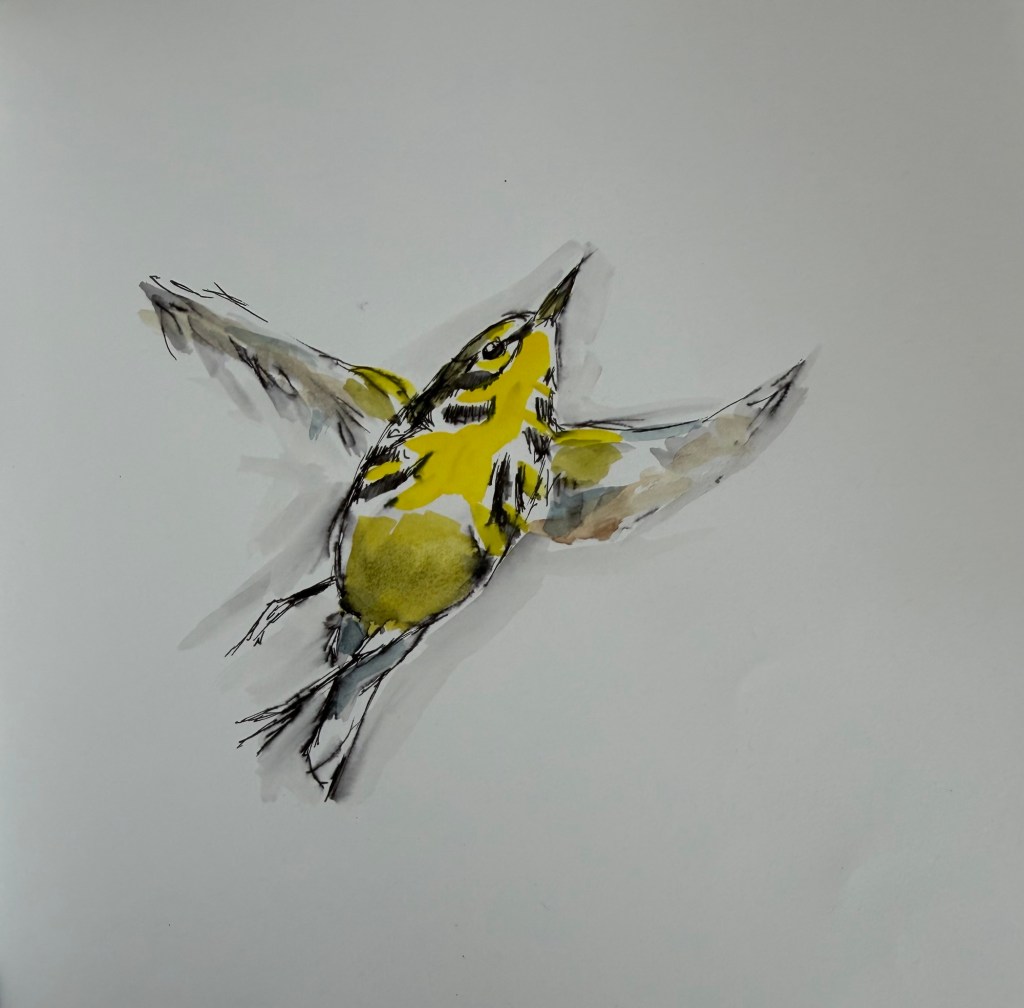
Prairie Warbler, 2025, by Summer Mei Ling Lee

Joseph drove me from that place I freed myself from, where he was a day laborer. He had to change his shirt before he got into the van, where I waited in my impatience to break away. I was reborn like when I collected my kids and my things and my self worth and flew away from her smoldering apartment.

Joseph apologized for keeping me waiting and asked where I was going. Though he meant which hotel, I said I wanted to see his Zambia. Minutes later we were deep in conversation in the local open market. The open aluminum and wood stalls were humming at mid day with babies sleeping in the piles of vegetables and housewares, and women walking in groups with their bags and baskets. I bought vegetables from his aunt, peanuts from a man and his son, and I can’t remember what else, but in a short time his van was full of food. I told Joseph to bring it all home to his wife, what would I do in a hotel with any of that anyway. I was down to my last $20 USD in kwacha, a week’s wages for the better off there, when Joseph said he had understood me now. The last spot he took me was under a tree where women sat on the ground with some vegetables. He told me these women had to take a bus for two hours to arrive to that patch of dirt at the end of the market, to try and sell what little they had. I said for him to pick someone and give her my last bit of money. In a few minutes, he returned to the van with a fistful of onions he threw onto the pile of food. He said the woman was very grateful, told him to tell me thank you, but she had to give me something in return.

I would understand soon that many Zambians were orphaned young, and that famine lingered. They didn’t come out and tell you this directly but a few sentences in and they were missing their mother who was a good church singer, who even while dying asked her son if he had eaten something.

During our drives around the area, Joseph became less a guide and more a confidant. Joseph had some disappointment with his wife, the unfairness at his workplace, the different ways Zambians did things. How his young parents got sick, one after the other, and died. One evening, a story came up that he said he hadn’t told anyone. He had been taken in by an aunt who was mean, making him choose between school and food. He told me more than a few times that he knew what hunger was. He said one night when he was a boy he was dreaming and a voice told him to get up and walk the road. It was 2 am but he did it anyway, along a red dirt road just like the one we were driving along. Pitch darkness except his headlights and our imaginations. He said that he walked about a hundred yards and found coins lying in the dirt. It was enough to let him eat the next day. The next morning no one believed him and he didn’t try to convince them. I said it was an angel, thinking silently to myself about his parents somewhere in a different mode of existence. He said from then on he started to believe in a god, that there was something bigger than all of us that we couldn’t make sense of. His god was loving.

Ten years ago when I had to move thousands of miles away from my native land, I found a nest that fell to the ground in the yard of the home I was about to leave, I separated the fibers and fluff of the nest and sewed them into fifty cards and sent them to everyone across the country and the world who had given me a sense of home. When I told her about the project, she told me, you had to become displaced to find your family.

Soon after my time with Joseph, I found myself on four continents within a few months, and home became that tiny piece of driftwood I once photographed, where a Common Tern perched forty miles out at sea with no hint of land anywhere on the horizon.

Adrienne said this is where the utter vastness of patterning arrives to us in 3D rendering. I said Virginia Woolf called it the hidden pattern behind the cotton wool of daily life. I droned on about miracles, and she said: yes, they occur in the crossing, when the pattern breaks through and reminds us of what we are normally cut off from. And then she sent me a poem where multiple realities are happening all at the same time, the most superficial one being a young girl declining a stranger’s invitation.

Are there unlived lives?

Joseph tells me in the same sentence that he is ready to leave the earth, and that he adopted and is raising two orphans of his own.

And yesterday, emerging from the smoke of the western Colorado fires, the Black Grosbeak and the Yellow Warbler alight upon branches within feet of each other and despite everything, sing each other into being.
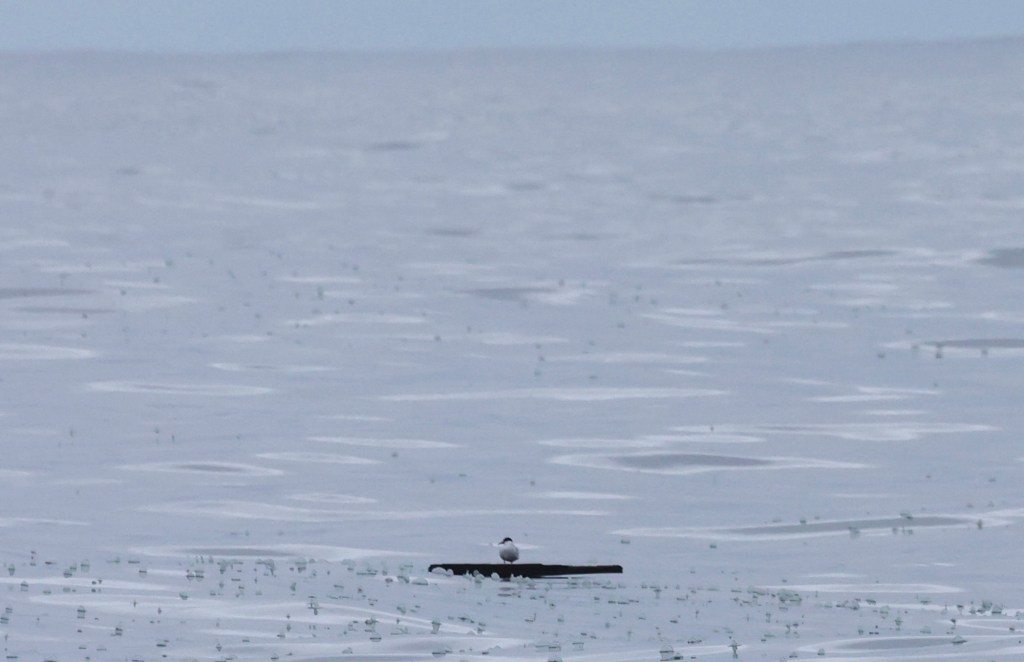
Common Tern, 40 miles west into the Pacific Ocean by Summer Mei Ling Lee, 2026

“Endure, O mystery of being that I might pull threads from your veil.” Wislawa Szymborska

12 Friday Oct 2012

Posted by summermlee in philosophy, poetry

≈ 1 Comment

Tags

Being, Pierre Jean Jouve, poetry, Wislawa Szymborska, writing

Under A Certain Little Star

My apologies to chance for calling it necessity.
My apologies to necessity in case I’m mistaken.
May happiness not be angry if I take it for my own.
May the dead forgive me that their memory’s but a flicker.
My apologies to time for the multiplicity of the world overlooked
each second.
My apologies to an old love for treating the new one as the first.
Forgive me far-off wars for taking my flowers home.
Forgive me open wounds for pricking my finger.
My apologies for the minuet record, to those calling out from the
abyss.
My apologies to those in railway stations for sleeping comfortably
at five in the morning.
Pardon me hounded hope for laughing sometimes.
Pardon me deserts for not rushing in with a spoonful of water.
And you O hawk, the same bird for years in the same cage,
forever still and staring at the same spot,
absolve me even if you happened to be stuffed.
My apologies to the tree felled for four table legs.
My apologies to large questions for small answers.
Truth, do not pay me too much attention.
Solemnity, be magnanimous to me.
Endure, O mystery of being that I might pull threads from your
veil.
Soul, don’t blame me that I’ve got you so seldom.
My apologies to everything that I can’t be everywhere.
My apologies to all for not knowing how to be every man and
woman.
I know that as long as I live nothing can excuse me,
because I myself am my own obstacle.
Do not hold it against me, O speech, that I borrow weighty words,
and then labor to make them light.

— Wislawa Szymborska

20121012-163732.jpg
(My recent installation, ink and video on fabric.)

“Write now for the sky/ Write for the arc of the sky/ And may no black lead letter/ Veil your literature”
— Pierre-Jean Jouve, “À soi-même”

“Everything that can be thought at all can be thought clearly. Everything that can be said at all can be said clearly. But not everything that can be thought can be said.” — Wittgenstein

01 Saturday Sep 2012

Posted by summermlee in Aesthetic philosophy, Art, Nature, philosophy

≈ 3 Comments

Tags

art, Being, dead birds, memoir, painting, philosophy, silence, susan Sontag, Wittgenstein

In the yard of my childhood home, a robin drunk from devouring over-ripe cherries on our tree, flew into our bay window that must have held an attractive illusory world, so much so that more than a few birds met that hard, bludgeoning reality. And after struggling for air on the ground below, it became still and lifeless. My mother, sensitive to the meekest of life forms, gathered the corpse and her two fledgling daughters for a funeral. A hole was dug, and as I watched the corpse of the bird descend into the dirt void, my mom said words, words of ritual, wishing that this bird would be in peace.

That robin’s life, unlike the other carcasses of animals on roadsides or worse, was made sacred to me, and the abyss into which some part of this bird, the part besides feathers and flesh, inhabited when it was into the ground became the eternal question mark.

My mentor describes the pre-classical Chinese pictogram of sacred as a person standing on earth, on one’s toes, reaching for the sky, the heavens. The sacred cannot be without the earth, the mundane requirements of being human, but it also has the urge for beyond such knowing.

Eventually and logically, that became the case for those beings lying unceremoniously in rotting ditches who by my eyes were not made sacred. And a moment of heightened attention in a car passing by was, and continues to be, my attempt to sacralize, because it feels necessary that we would all be given the mere gift of attention as we disappear.

Finally this week, it was this scene that appeared to me in my own ritualized space of art-making in my studio, where I stared upon the flocks of quiet, often dissolving, single, little dead birds I’ve painted over and over for the last 7 years. After enduring the dissonant if not polite questioning and dismissal from others and myself — amidst a cultural popularization of cute birds on every sundry item available (“put a bird on it”) — I was partially decoded.

And luckily, also this week, I read an essay by Susan Sontag, who fully understands the impulse to make art “towards the ever-receding horizon of silence.”:

“One result is a type of art which many people characterize pejoratively as dumb, depressed, acquiescent, cold. But these privative qualities exist in a context of the artist’s objective intention, which is always discernible. To cultivate the metaphoric silence that’s suggested by conventionally lifeless subjects (as in much of Pop Art) and to construct “minimal” forms which seem to lack emotional resonance are in themselves vigorous, often tonic choices.”


(My painting: “Bird Elegy #1″ (detail), 2012.  14″ x 19” Watercolor on Paper)

But my recent writing/searching has drawn my attention to the fact that all things, especially the experience of love, are of a continual parting. Perhaps that impossible constant attention to that coming and going, the making sacred of every moment and every thing that makes a heartbeat, that presences and reaches into us, and then dissolves into silence — Heidegger’s clearing and gathering and clearing — that is a  glimpse into the untranslatable state of Being.

For now, I can only handle my little birds.

“It seems unlikely that the possibilities of continually undermining one’s assumptions can go on unfolding indefinitely into the future, without being eventually checked by despair or by a laugh that leaves one without any breath at all.” Susan Sontag

“To all and to none.” Heidegger

31 Thursday May 2012

Posted by summermlee in Aesthetic philosophy, Art, Nature

≈ 4 Comments

Tags

Being, Catherine Fairbanks, empathy, Film, George Steiner, Hiedegger, injured animals, nature

Yesterday, I found myself singing Twinkle Twinkle Little Star with my family just as we have done many times over, but this time our tone was gentle and elegiac because our intended audience was a dying rabbit in a cardboard box, wrapped in my jacket. I know, for those who know me, that yes, it seems like injured and dying animals flock to me, but it might just be that this is the condition we all are in: living in the borderlands where a dominating human presence presses up against nature’s tenuous domain.

The bunny, who happened to be lying in the dirt path on our routine evening walk, seemed to have a leg injury and a scratch on the nose, perhaps a result of predation by a cat, a coyote, a raptor, a bicyclist, who knows.

As occurred to me when a bloodied raven worked his way out of my green Whole Foods bag onto the front seat of my car, I again had a fear of driving off the road if the bunny might leap from the box into my lap. But I reasoned that it was more likely this bunny, lying awkwardly in such bad shape and with an inherent fragile heart, was dead.

A few miles into the drive, wondering if indeed Bunny was still alive and finding my NPR show jarring, I decided to peel back the fabric to see what Bunny was doing. And there suddenly was a fur-lined, big, black, round eye staring straight up at me — and a look of fright and curiosity and concern exchanged between us. I quickly covered Bunny back up.

I immediately recalled the image of another big, round, animal eye that had also poignantly looked up at me. An adult pelican, with an injured wing wrapped in a towel, sat on my lap as my friend drove us to the same shelter. En route, feeling the bird’s heart rate progressively calm, I peeled back the warm, wet towel to glimpse Pelican. Pelican’s eye was questioning and fearful, and I decided the darkness of the towel was more comforting than my own questioning, strange, and incredulous face.

So it seems fitting that I have been thinking about an amazingly beautiful film recently screened at the Experimental Film Festival in Portland, by a friend and colleague, Catherine Fairbanks. You can watch it for yourself here.

http://catherinefairbanks.com/artwork/2397516_Transference_is_a_Tough_Row_to_Hoe.html

"Transference is a tough row to how."

Catherine wonders whether attempts at empathy reach an impasse or dead end; the failure to completely reach another.  And yet her beautiful imagery and wistful narrative embodies a transcendent poetics of the human condition. As Heidegger writes about this impasse, there is something about a thing that cannot be appropriated by us. Like walking out towards a horizon. We occupy that horizon, yet there is an out there that remains away from us. Likewise, a horizon, or object or thing, has a thereness that precedes our cognition of it. But he also describes those moments where we glimpse something otherwise, when a thing things itself. For example when the presence of his Van Gogh painting, beyond its pigment and canvas and brushstrokes, reaches into our being. Or when the culmination of instruments, rhythm, and tones arrives in an untranslatable and indescribable music that stirs something within. Steiner says we experience this presence “‘[i]n moments of great despair when things lose all their weight and all meaning becomes obscured,’ or in flashes of vital brilliance.”

“We feel, we know, urges Heidegger, that there is something else there, something utterly decisive. But when we seek to articulate it, ‘it is always as though we were reaching into the void.'” It is the possibility that the horizon, the impasse between two beings, is only the something we know — the consciousness of objects. Because also therein we are offered (and it almost always feels like a gift) “an opening to what is beyond the horizon of such knowing.”

The felt love between the two mythological entities in the lake surrounded by a loving voice; the moment of knowingness between the birds and animals and myself; and a lighting that occurs between a passage of painting and the viewer. Indeed, says Heidegger, without these moments, we forget to be astonished.

“The world’s darkening never reaches to the light of Being.” Heidegger

Enter your email address to subscribe to this blog and receive notifications of new posts by email.

Join 618 other subscribers

Recent Posts

  • “The terrifying groundlessness, the eradication of all violences. To be embraced by that which doesn’t know us and in that unknowing caresses us and truly loves us. We might become anything at all, something wildly other than what we are encountered by. A world that truly loves us by not presuming what we want or what shape we will take before we show up… We will be held when we are not known from the start.” — Dr. Marquis Bey
  • Images dream within us, a reverie is a world of expansion.
  • “For the natural world, the ethical responsibility is that being alive gives existence to others.” Vinciane Despret
  • “We meet in the freedoms of each other.” – Takeyoshi Nishiuchi
  • “Those with wings, those without, / the ghosts of the heart / — whose hunger is a dress for my song.” — Brigit Pegan Kelly

Archived Posts

Blog at WordPress.com.

  • Subscribe Subscribed
    • Unwanted Advice: Reflections from a Self-Appointed Life Counselor
    • Join 214 other subscribers
    • Already have a WordPress.com account? Log in now.
    • Unwanted Advice: Reflections from a Self-Appointed Life Counselor
    • Subscribe Subscribed
    • Sign up
    • Log in
    • Report this content
    • View site in Reader
    • Manage subscriptions
    • Collapse this bar

Loading Comments...