• About

Unwanted Advice: Reflections from a Self-Appointed Life Counselor

~ Caminante, no hay camino. Se hace camino al andar. Wayfarer, there is no way. You make a way as you go. (Antonio Machado)

Unwanted Advice: Reflections from a Self-Appointed Life Counselor

Tag Archives: writing

“For the natural world, the ethical responsibility is that being alive gives existence to others.” Vinciane Despret

24 Saturday May 2025

Posted by summermlee in Aesthetic philosophy, Art, Birds, Nature, philosophy, poetry

≈ 9 Comments

Tags

art, birding, birds, birdwatching, death, Joy, nature, philosophy, Photography, poetry, Summer Lee, Summer Mei Ling Lee, therapy, Vinciane Despret, wildlife, writing

Chestnut-backed Chickadee is very dutiful to the nest in our backyard, one that we have followed for years via the bizarre technology of micro-cameras in nest boxes and our large screen TV. Precariously late in the season this time around, she laid two eggs and sat on them for over three weeks, not realizing the eggs were no longer viable. I tried very hard not to associate this failure, our first ever, with the invisible warfare around me. But the experience of her tiny, formidable body in the middle of the night pulsing rhythmically on those two non-viable eggs crescendoed into a menacing dread.

Eventually the internet registered an obituary for my therapist, confirming that she succeeded finally in terminating our sessions for the reason she said, and not because she needed a big excuse to overcome my refusal. She made it 10 months after the day she left me that voice message explaining she needed to end our 10+ year project. When I found the obit, I immediately replayed that voicemail to join the real voice to the disembodied voice in my head that arises when things are emotionally grueling. This time around, I heard what I missed before: she was holding the space for me when she was reckoning with only 10 months of space ahead of her.

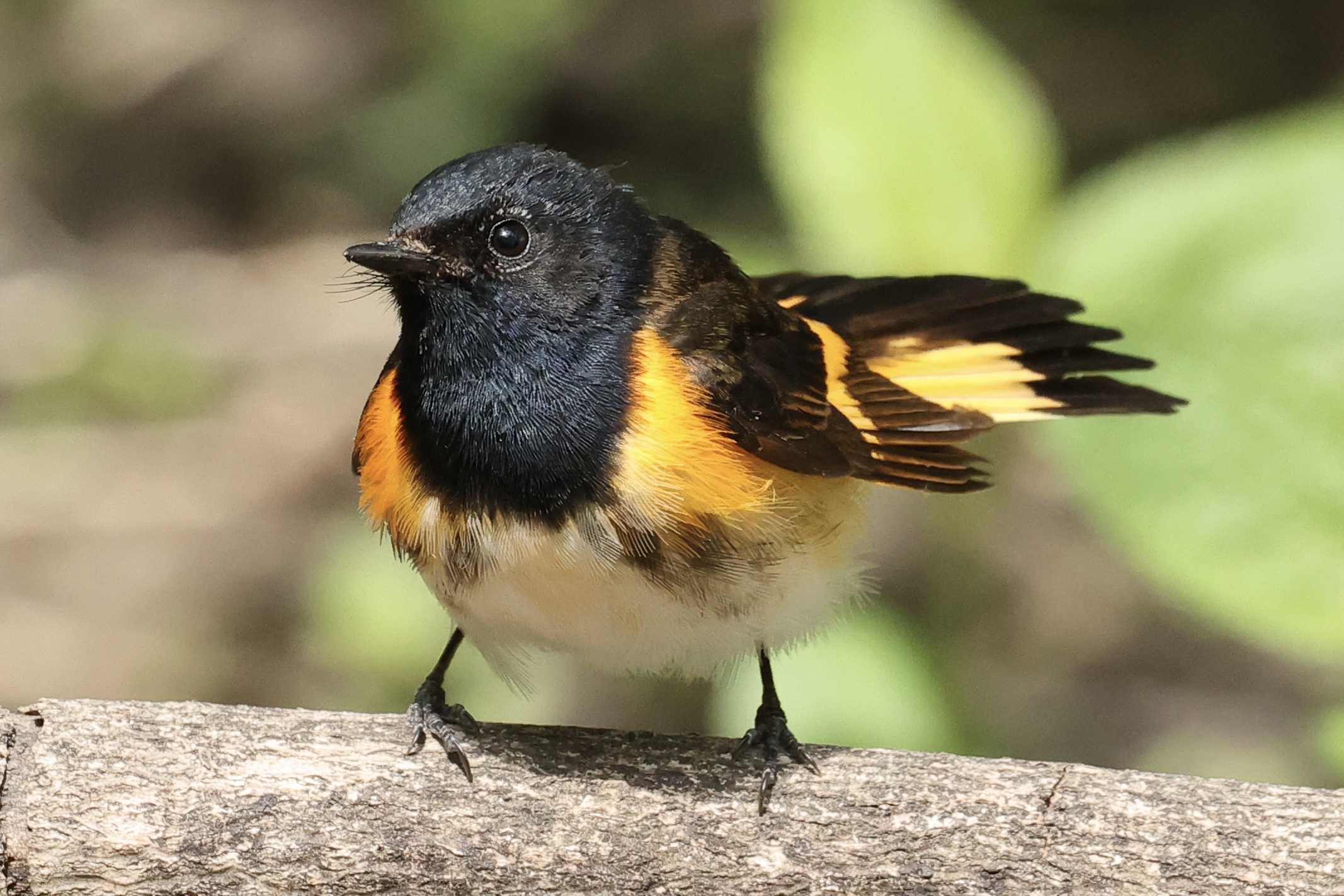
American Redstart, North branch of the Chicago River, May 2025, by Summer Mei Ling Lee

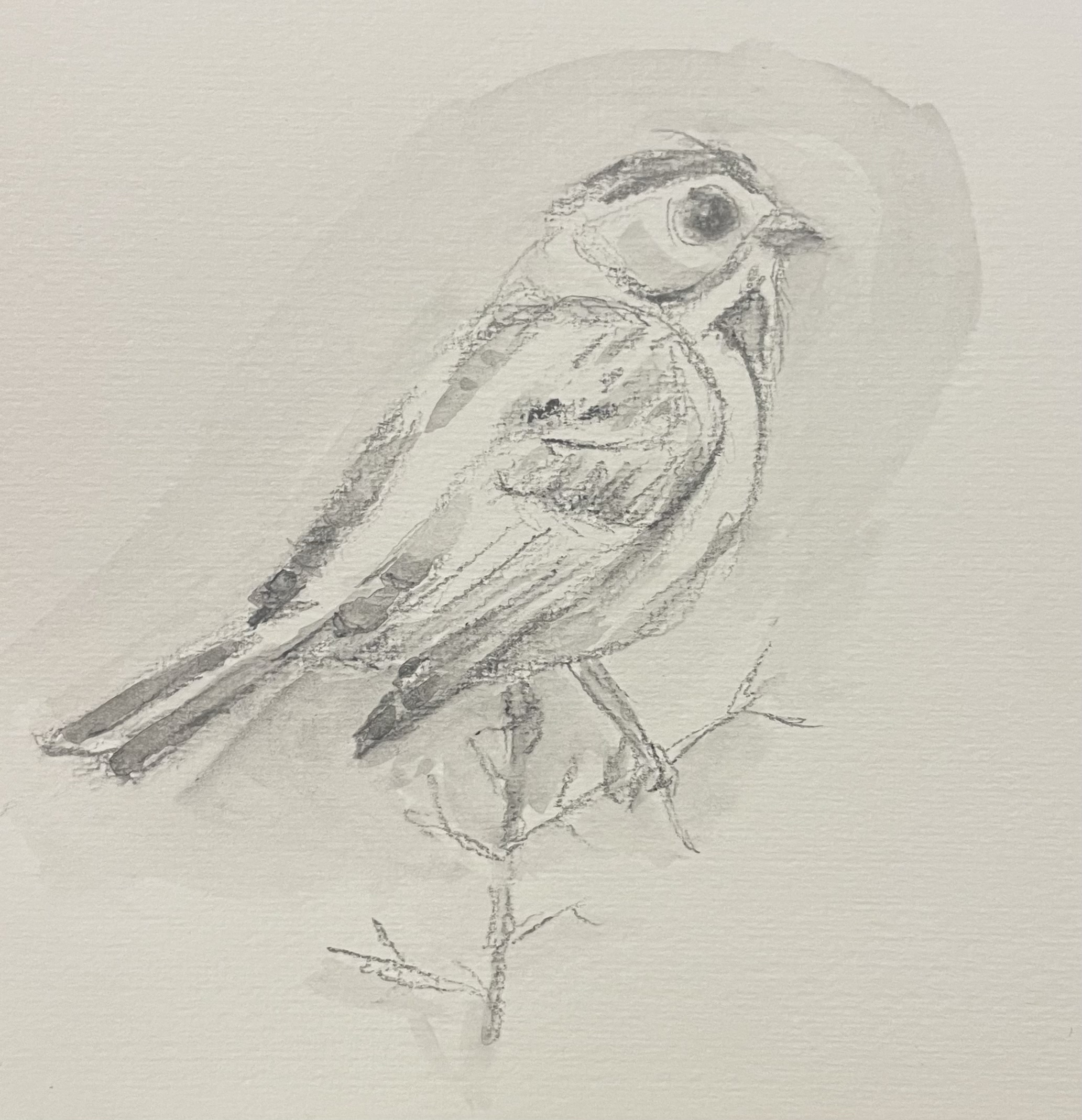
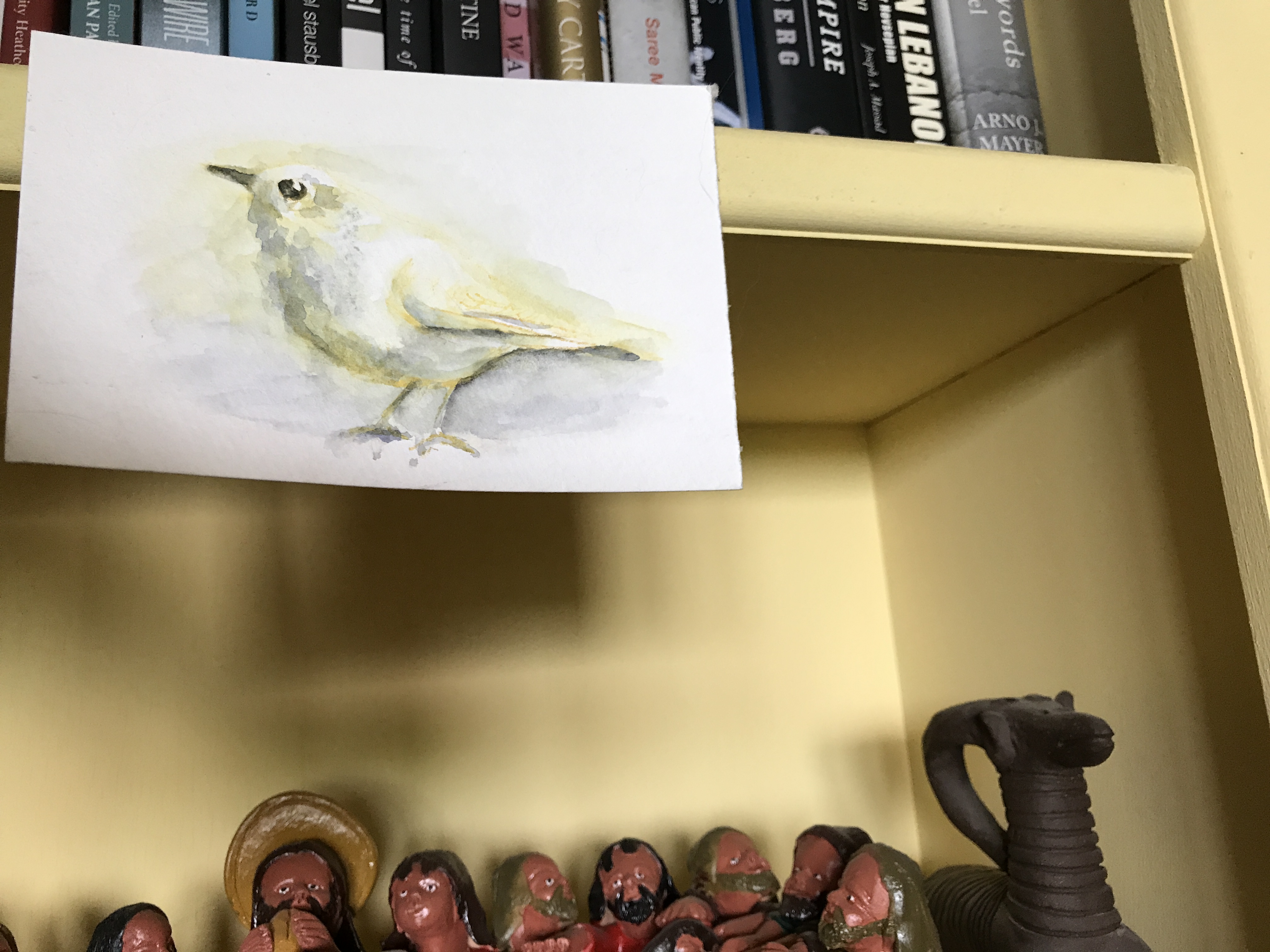
I was in London when she called, and had just sat breathless through one of those explosive Italian operas where people cheat and lie for dumb human reasons, and then the most innocent die while the egomaniacal people are guilty too little, too late. So I had a lot to cry about, losing her as a therapist and the world imminently losing a good soul. I drew her a bird that came out faint and shy-looking, with big eyes, and singing, probably a good simulacrum of her. Behind it, I wrote a William Stafford poem and told her she was the coach I always wanted to see down the third base line when I had to go up to bat, bases loaded, two outs, several runs behind, and someone just handed me a bat with a hole in the middle of it. She knew well the type of coaches I mostly had who motivated players through tyranny or perfectionism, like my inner one. I reminded her of the times early on when she had me call her first thing in the morning to let her know if I had faced the specters in the dark night of the soul. We both know she never billed me nonetheless mentioned how those calls were not in the schedule.

She answered back to my bird card on Christmas Eve saying in her midwestern way that my words meant a great deal to her, and added her best wishes as we moved from the darker part of the year into the growing light.

Back to a few days ago, what I could hear most of all in that voicemail, is that she seemed fulfilled to reflect on how much I had grown in those 10 years, and as with the best gifts, the beauty of our work was there not because of anything I particularly did, but as an aleatory result of her long career of studying, listening, and supporting hundreds of people long before I even came along.

I took these tears back to the bridge overlooking the north fork of the Chicago river, a river whose direction was reversed in the industrial age, because that seemed easier than stopping the pollution of it. My therapist and I had many reveries about rivers. My favorite ones being about smashing into the banks, sometimes recklessly, and needing to course-correct. At times, I think she was white knuckling the oars for me more than I was.

Her bird drawing, by Summer Mei Ling Lee, 2024

Now over this bridge and this river, warblers of twenty-plus species and an endless palette of colors filled the trees along the banks as far as one could see downstream, like bits of popcorn flitting over the water from the greenery and back. And as not often happens, my fellow birders in our exuberant yearly reunion fell silent. I thought of Craig, to take his palpable silence around all the trailbends of the area and summon him here.

I am sorry that I want so badly and try every time to put words to these moments: these fragile, tiny, colorful birds dropping down out of the darkness, somewhere along the middle of their thousand-mile migrations, just where I happen to be. How we greet them, try to still them, what they say to us. And then what we say to each other. Even to those who are no longer here.

When I returned home with a camera heavy with hundreds of blurred warbler photos, my boys’ hands tired of feeding Chicago chickadees, I overcame my dread and turned on our chickadee TV. Oh god, I mumbled as her body was still curled on that nest, breathing heavily. “What is it, mama?” She still doesn’t know.

As the day opened up, she finally moved off the nest to go forage for a snack. And there in her place were 5 more eggs.

“The subject is only the transient addressee of the verb which seizes it. Every subject is in a becoming not only of their own action but in the multiplicity of actions that overflow them.” Interview with Vinciane Despret, Grimté, January 23, 2023.

“Not tears of fear but of grief. She wept as we weep once or twice in our life. Tears that carry amniotic fluid and sea salt and the dreams of sirens in them, that hurl truth, sorrow and defiance into this world, all at once. As she wept, she wiped the tears over her bruised and muddied body. As the tears made tracks, her skin started to gleam. Clean and bright again.” Martin Shaw

31 Sunday Mar 2024

Posted by summermlee in Aesthetic philosophy, Art, Birds, Nature, philosophy, Uncategorized

≈ 3 Comments

Tags

art, birding, birds, birdwatching, grief, Martin Shaw, nature, painting, philosophy, poetry, Smokehole, Summer Lee, Summer Mei Ling Lee, wild, Wilderness, writing

Because the vagrant snow bunting had appeared in my yard before waking, I knew when she called that he was dead. And upon hearing her voice, I began sounding like a strange bird, just uttering no, no, no. As if songs can magically push out reality and hold back time for just a moment.

What’s hard about this one is that he was inside that cathedral with me for many years, and I can still see him running back for me when the most rarest or most gorgeous bird was ahead and I hadn’t caught up yet. And of course, how he told my sons the exact trees where the chickadees were waiting so they could feed them from their hands. How I would wake up and say let’s drive out hours into the prairie to see this lifer and he would always beat me there. And now without warning except for the apparition of a snow bunting we had seen one windy day together two years ago, the cathedral is more empty. With that disappearance, my ancient rituals — timed with spring and fall migrations to welcome the beings from thousands of miles away as they pass through — have fallen into obsolescence.

And here is the ritual of writing, which lately (I apologize) tends to be predictably filling out absences with words. Because he told me, nothing can better bring back a presence than by just the uttering of it.

Nathan sent me some words about the stories we need in our lives and are less and less being told. And in those time-tested tales there is always a moment when we are thrown into the belly of the whale or into the dark woods or what have you. The writer says we are most cautious now of that wilderness, even having chopped off our hands to stop touching what is alive, and asks us to go sit willingly in the wild places and listen to what speaks to us.

I am using words here to listen, deep in another wilderness, sent here by the loss of a soul that scaffolded me, who saw hundreds of birds by my side as I looked at them too. Who sent me birds in every form, and delighted in my birds. And tried as he could to birdwatch in these stupid writings here. I have nothing to offer here because I am still in the wilderness listening, covered in mud, bruised in the middle of me, and seeing ghostly figures in the distance, those who I miss. They somehow feel nearer and nearer to me as I approach my own disappearance.

And yet, by some grace, so much gratitude, there is thanks for those who are waiting in the nearby village, full of love and mercy and words and bird feathers for me. Coming back to tell me they also can hear a beautiful bird just ahead, and they will help me find it.

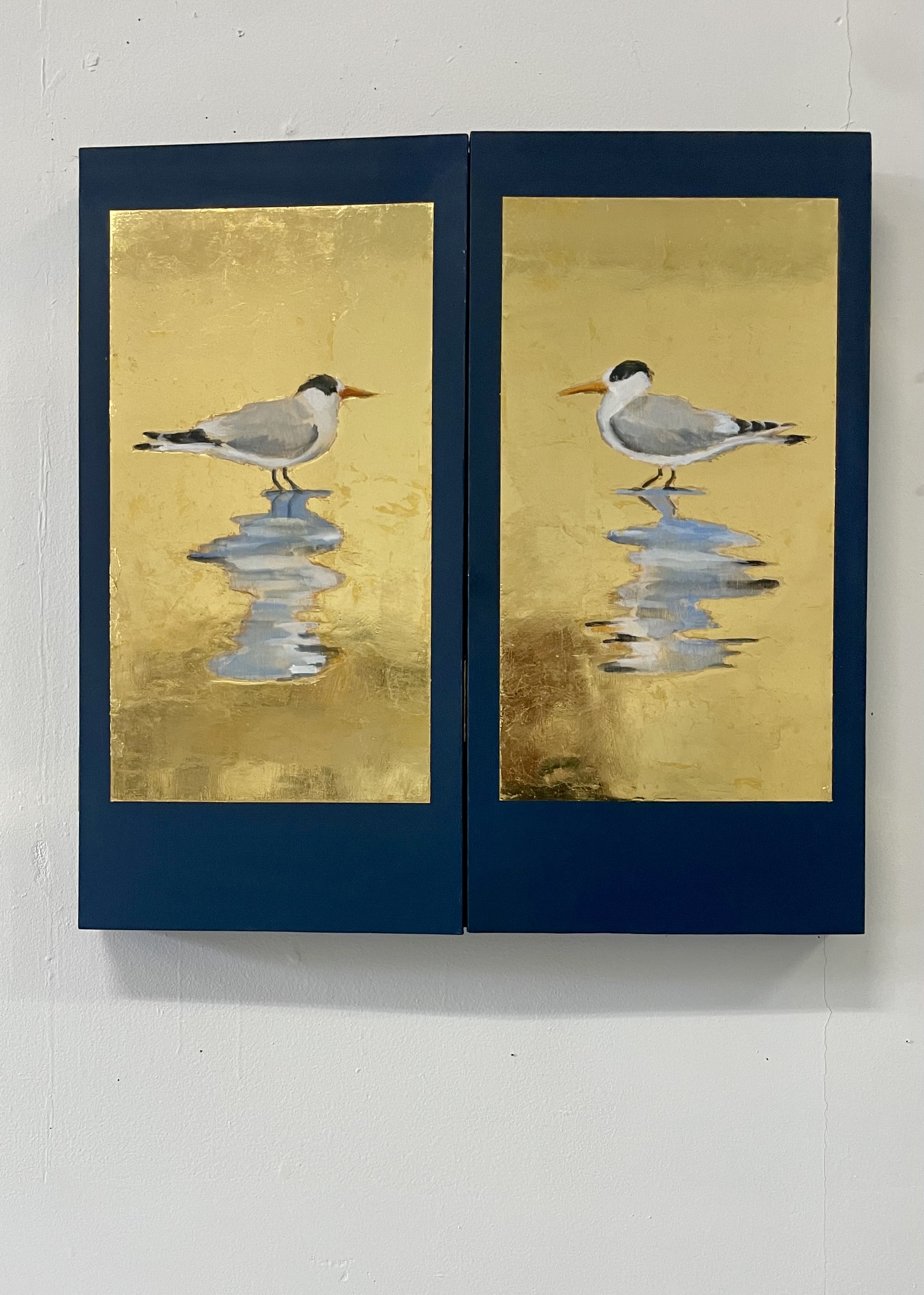
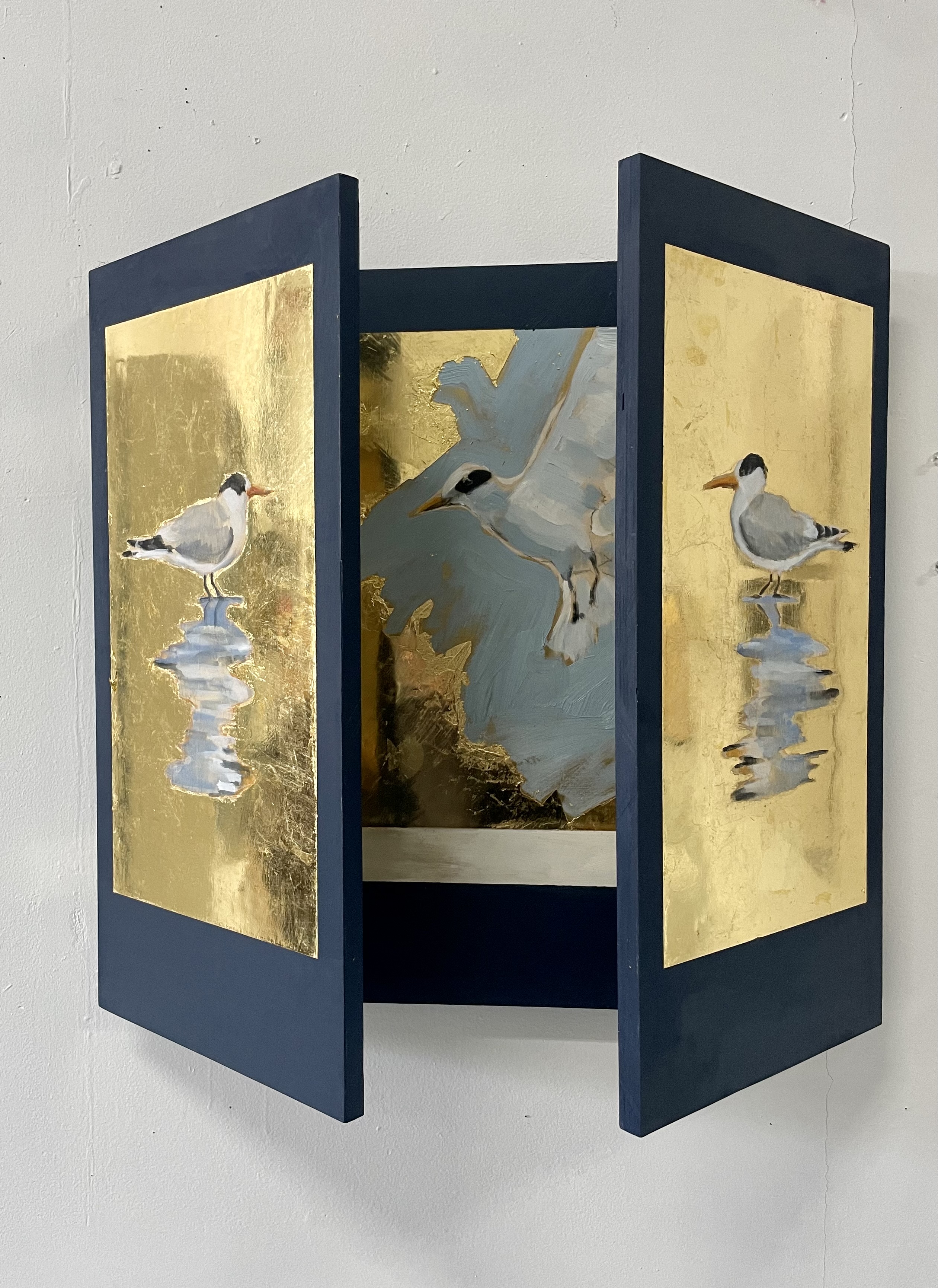
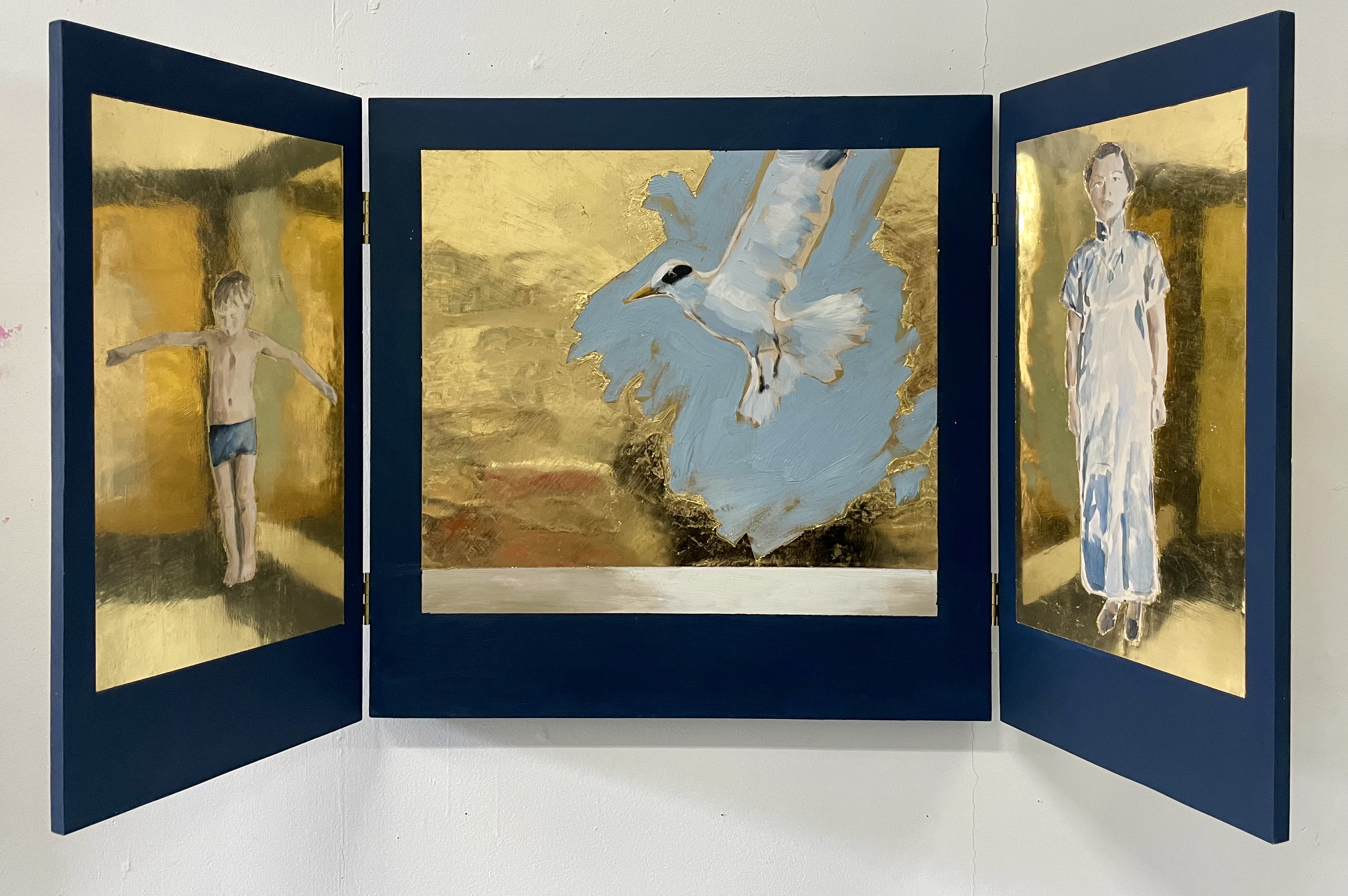
(Annunciation, 2024 by Summer Mei Ling Lee. 23.5 k gold, watercolor and oil paint on wood panels.)

“To be wedded to the wild means some part of you — maybe a large part — guards your solitude like we guard an endangered owl, tells stories as much for the benefit of the lively dead as the moribund living, makes wayward choices many view eccentric, is capable of sustained generosity, has flashed your teeth and counted costs, has dragged meat back to the cave under the moonlight, has stalked all of Russia with only a line of Anna Akhmatova for company. To be wedded to the wild means you have curated a doorway beyond societal expectation of the perpetual, grinding tic of acting nice. That you have recognized discipline as the essential companion of the wildness, that sobriety and ecstasy have made a pact.

That is how good art gets made.” Martin Shaw, Smokehole

“But these blinds birds made of paper could not recognize my father. In vain did he call them with the old formulas, in the forgotten language of the birds — they did not hear him nor see him. All of a sudden, stones began to whistle through the air. The merrymakers, the stupid, thoughtless people had begun to throw them into the fantastic bird-filled sky.” The Night of the Great Season, Bruno Schulz.

27 Friday Oct 2023

Posted by summermlee in Advice, Aesthetic philosophy, Art, Birds, Nature, philosophy, Uncategorized

≈ 2 Comments

Tags

Alice Bach, anthropocene, art, birds, birdwatching, Bruno Schulz, Connection, creative drive, creativity, Donna Haraway, nature, painting, philisophy, Summer Lee, Summer Mei Ling Lee, Vinciane Despret, writing

She asked me earnestly, in the context of a conversation about the war in the Middle East, does a bird I see also bring about the despair that birds are vanishing.

Counting birds is perhaps a futile defense against their disappearance. Even according to the software that I use to collect bird sightings, the bird closest to me doesn’t count. Neither do the birds in the wild who are escapees — and aren’t we all an escaped being of some sort? Nor do the birds who are introduced here and are considered invasive. Colonial human projections run everywhere, even into the bird world.

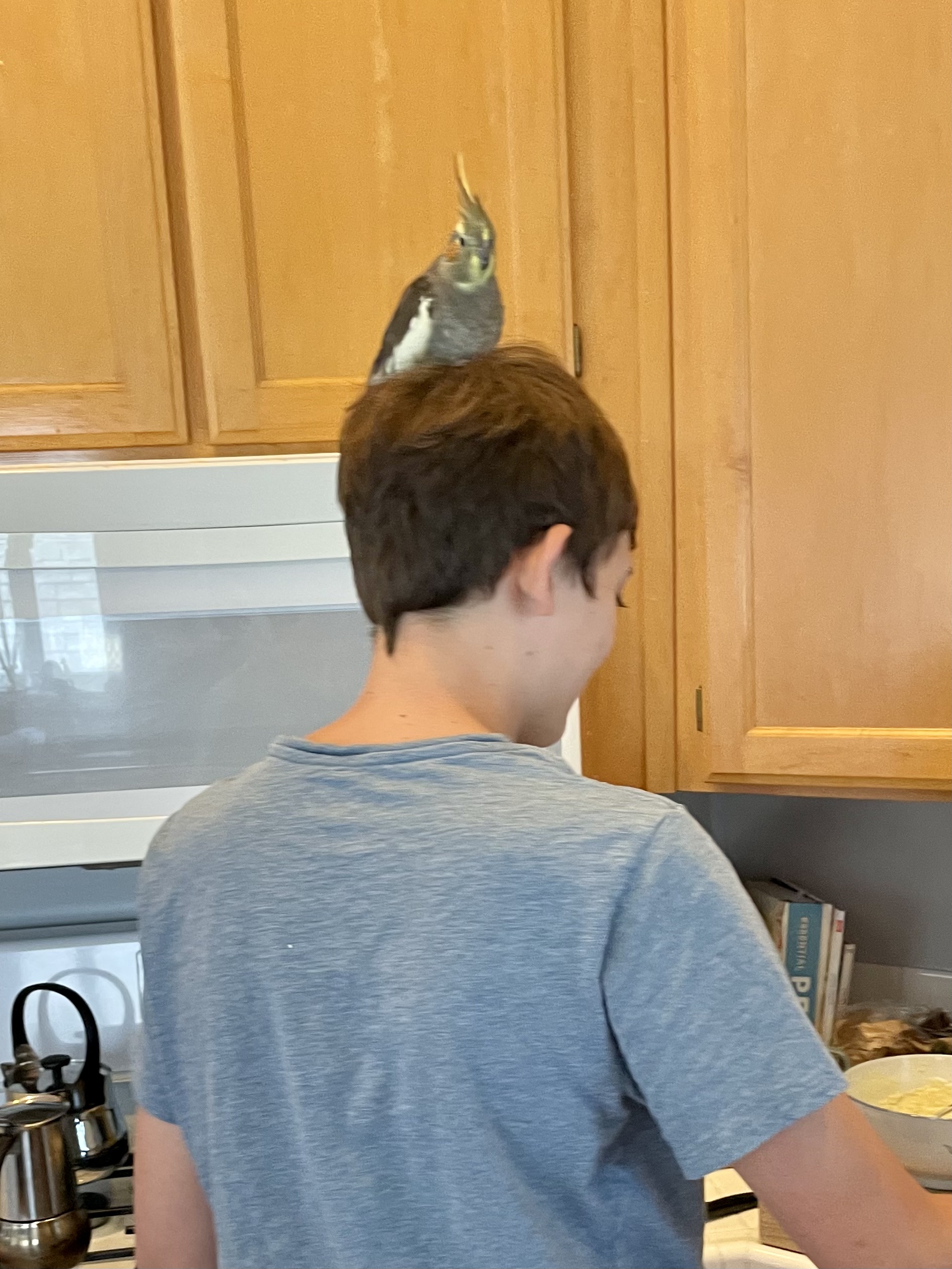
The bird in closest proximity, my son’s pet bird.

I listen to a lot of Vinciane Despret these days who speaks about the creative drive in relation to birds and the dead. She describes when a bird dies on the surface of the ocean it feeds life down into the depths of the ocean floor, and that for the natural world the ethical responsibility is that being alive gives existence to others.

Writing, a story, then puts words in a certain order to bring something into existence that was formerly a blank space on this screen. And some of us know that an animal can leave a similar trace, Despret describes, as in the way birds manage time with song, or a wolf paw print in the mud leaves pheromones. She adds, these traces are just the beginning of a story. And these are ephemeral stories (my favorite artists play with ephemerality), just like an oral history but no less important than the ones written down. She asks us, what capacities did the bird or the wolf have to acquire in order to live with each other. And as my great aunt Marguerite reminds us, what did the 5 generations of people before me enact upon each other, and is in turn enacted upon me?

Forgive me as I use more of these words to sweep up the mess of words I am creating.

Sometimes, the words people send me, the feathers they find, the scribbles, underlined passages, my memories of their presences and absences: they swirl into words and form a clearing where I glimpse the hidden pattern of things. And before it slips away I have to give testimony: these words, the paint, the connections we have, they all play upon me, just as pianists describe how a piano at some point plays them. Just like Alice, now gone, is still in my words reverberating here. Just how the birds in the field this morning made me late to the studio, where I hear the upstairs woman raging from her cage. And how my son chirps like his pet bird when he makes a bid for my connection.

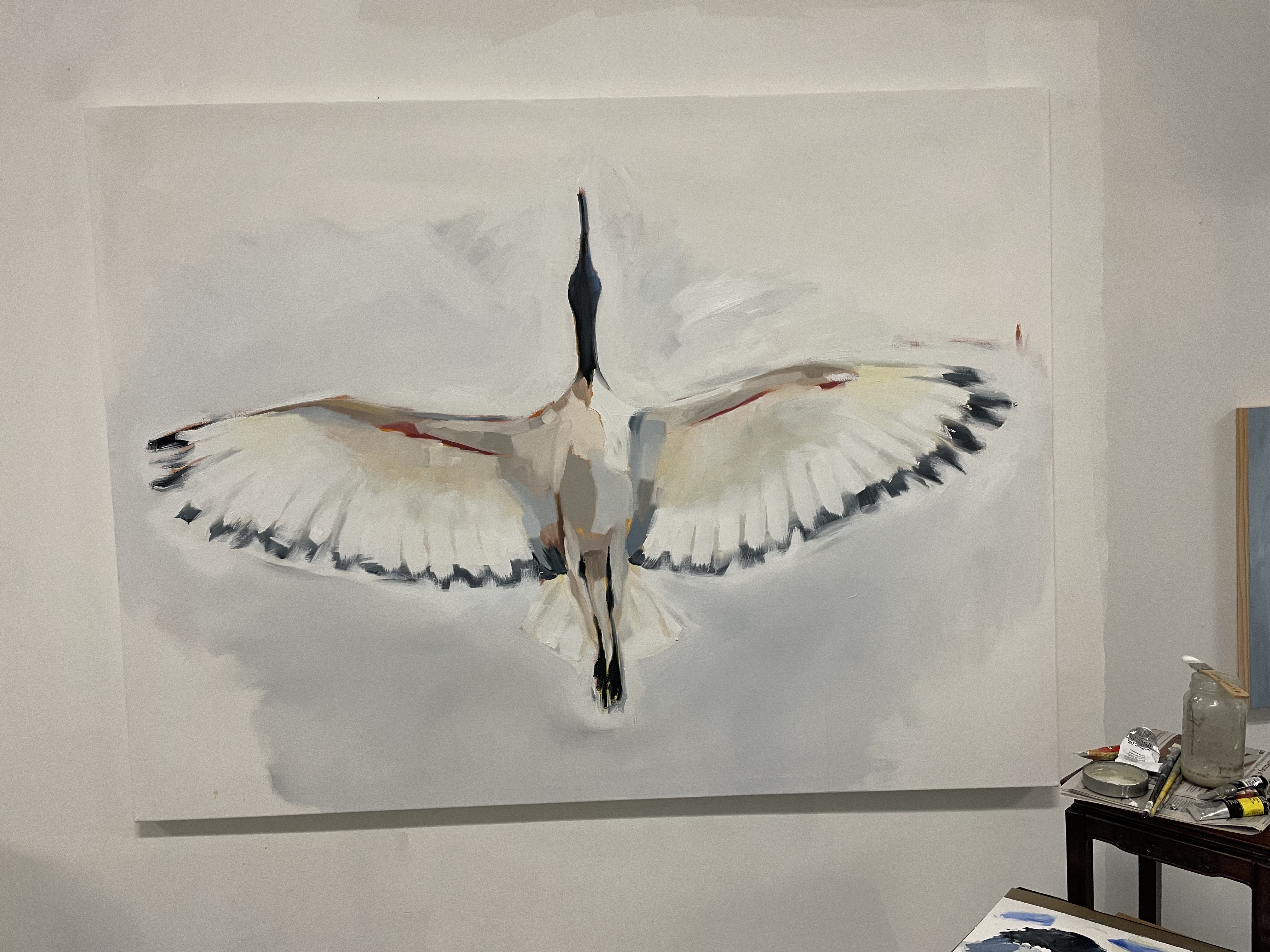
A painting in progress, 2023. Summer Mei Ling Lee.

What is wondrous is that there are luxuries and gifts that you and the birds have shown me. That a feather is for warmth, but it doesn’t need to glint in the sun as metallic blue only for survival. And when Caroline sends me the image of one fallen along her walk, there is a ballooning of connection to her and all things. As is when Nathan says the birds outside his home were reflected inside and every line of writing he has lovingly sent me. The image of a list of every creature that Eva painted onto a hidden board of a home she was leaving forever: There is pleasure in singing — and no, not every part of a song can be minimized down to utility or survival. If you have ever heard a bird sing outside of mating season, after a cold night when the low sun casts warmth, even before the bugs start rising, you know. What is extra, luxurious, is beauty. And now, through these words that will up and disappear, I can see some inkling of the productivity of my life, never measured by wage or even number of paintings, or for sure approval. I count “birds” because it reveals a network here available to me and those I love, but really available to all, some discovered beauty in living and singing it. And we never know for sure how it sinks to the bottom of an ocean and feeds another soul. (And if you have followed me this far you know this is not a beauty of artifice). I want to measure my life in terms of this beauty. “Life, she loves living.”

Picture of a bird I sent Alice on her bookshelf, 2017.

“The subject is only the transient addressee of a verb which seizes them.” — Donna Haraway

“The Infinite Cage” — Joron

07 Tuesday Feb 2023

Posted by summermlee in Aesthetic philosophy, Art, Birds, Nature, philosophy, poetry

≈ 5 Comments

Tags

art, bird watching, birds, birdwatching, death, Home, memoir, migration, nature, painting, philosophy, Photography, poetry, Summer Lee, Summer Mei Ling Lee, words, writing

(With a few words in a note to me, she tore open the blank space here, and asked me to write again. Her gesture brought tears, in both senses of the word, and so it starts with tears — because it involves breaking the icy river, the cowardly reluctance to thaw it, to think it isn’t always flowing underneath.)

(Santa Croce ceiling bird.)

Beauty, Nathan reminds me.

What of my small experiences wants words to land them here. What birds would touch down from untouchable sky in order for me to see them, count them, photograph them, devote myself to them.

Because now these birds seem wild and unbelonging like the work that sits months waiting for me in my studio.

Last week we made a strange reunion of local birders on the back porch of a stranger’s house, to peer over a fence into the neighbor’s yard to glimpse a young Summer Tanager eating desperately at the feeder. He was undoubtedly wayward and far from home territory because of the onslaught of coastal storms. We were welcomed into that space and to each other, with only a quick mention of the mass shooting that had happened the day before shattering our small town. Then, the bird arrived, and as Eva describes, we wandered into the center of the circle of wonder. Summer Tanager was the greeting.

How often I delude myself to be disconnected from it all. And as Eva exclaims more loudly, impatiently, because the most obvious is the most difficult — we are always in the circle of wonder, never outside it — and we can indeed find center. Never by our own narrow volition, but by wandering.

(Red Phalarope by Summer Lee, a pelagic bird brought inland by storms, 2023.)

But I want words for those birds, those moments — not the ones where I tenderly helped unclench his fingers from the hospital bed, or the impatient coldness I can turn towards my own children, or how exhilaration smothered grief when driving away from her hopeless apartment for the last time. Not for the woman who rocked her body in prayer before every beautiful dinner she served and told me, this is not the life I expected for myself. And even still, not the gift of my children’s joy that persists despite me, or how I can burrow into the surrendered miracle of my new, unexpected lover.

Somehow there should rather be words for the Virginia Rail that crept out from its perennial hiding place to the spot below the window of my car. And how we caught eyes, one being welcoming another.

The people in that odd backyard meeting, with undoubtedly their own sufferings and joys, would understand. The Virginia Rail is basically all we talk about for hours and hours, even though long ago and long gone — until the next improbable Beauty arrives. And of course, those far away but close to my heart who send me words fluttering down from the sky, out of nowhere perfectly on time — thank god they understand too.

(The Virginia Rail. January 2023.)

In these birds, these words, these friends, I know is the paradox of faith, and how it takes care of us by destroying us.

I will taper down this roughly thawed cascade of words to say that 77 unique species of birds have visited my yard in the 20 or so years I have lived at this home. And I wonder about what I missed in the times I drifted away. Once a group of us chased a vagrant Dusky Warbler across a field of dried fennel, a man’s long camera lens thunking against my head to capture the bird, preventing me from photographing it well. The bird flew off confused, and we stayed to celebrate, for me the 560th species. A bewildered boy next to me scanned over the expanse of chaparral and said, just think how many dusky warblers might be out there and we would never know.

(The Dusky Warbler)

So maybe in my silence, where words haven’t been, is a backwards way to acknowledge some secrets. Not about the “yoke of perishing” we come into being with. More like finally seeing the Prairie Warbler next to the local sewage plant. That time, it took minutes to see his yellow light darting in the scrub, when the year before I spent weeks, thousands of miles away, to no avail. How some things will always escape, even as I am coming closer and closer, and reveal secrets of me that are unknown to myself even. Dufourmantelle cautions, mystery is not an enigma to be solved but prayed to, and truth is only a veil.

“Endure, o mystery of being, so that I might pull threads from your veil.” – Wislawa Szymborska

“Poets became the true accountants, and their ledgers contained the un-profitability of the human soul.” Michael Marsh

31 Monday Dec 2012

Posted by summermlee in Art, Birds, Nature, philosophy, poetry

≈ 2 Comments

Tags

"Anyone can sing", bird watching, birds, birdwatching, Michael March, poetry, Thoreau, Walden, William Ayot, writing

“…the fine print, the small type, of a meadow mouse.” — Thoreau

Behind my eyes is a geometric pattern, the dark blue lines zig zagging and dotting in that 1970’s way around white, repeated ad infinitum on the wall of my grandmother’s breakfast nook I haven’t been in for almost 15 years. It’s there when I rub my eyes in fatigue, who knows why.

On the other side of my eyes, you might see fibers of dark grey, green and ochre around a black circle.

But around the black center of a white-crowned sparrow’s eye is a dark mahogany-red. Inside the abyss of his eye, I can only imagine he is terrified as his heart races in my hand, little short breaths heaving his feathery chest. With the most delicate of touch, I run my finger up and down his body and make promises I can’t keep, still horrified by the thump of his body against the car window. His eyes blink fear and innocence straight into my eyes, but he has no control of his body, which has collapsed belly-up into my palm.

Minutes later, I declare it a minor miracle that he hops out of my makeshift hospital box and is gone. The next day he is returned to the glorious flock of 50 birds working over my now-expensive winter feeder.

Meadowlark by Summer Lee, 2012. watercolor on paper

(A recent watercolor: Yellow happens to be the precise spot where the eye tunes into the sequence of color frequency — it has the same vibration that stimulates the retinal nerve-ends and causes the phenomenon we call light)

Obviously, these birds are my favorite words, my favorite swath of paint — and I am ever envious of those musicians who have such mastery over the wild flocks of notes and melodies, every single beat tamed at the same moment they are also alate.

— and yet, among the most rigorous creators, there is a holy acknowledgment of the not-coincidentally aleatoric. Who knows to where those wings will fly.

After 8 years of minding this winter feeder, I know every resident from migrant as I welcome new offspring and pray for the missing. They are a light, a moment of solitude along my bustling path in and out of my home in this dark time of year. Their hearty feeding is proof of a cold darkness stretching longer than what daylight allows for warmth and food. And maybe my dedication to their feeder is an understanding of these fickle and insufferable days.

Anyone can sing, but there is astonishment that the wonder of words still visits me, like the small group of diminutive, navy-blue and chestnut nuthatches, who for some reason are eagerly taking my sunflower seeds for the first time this winter. They dive into the top of the bare tree, then climb with their powerful claws head-down along the branches like woodpeckers, whom they are always adjacent to in field guides. At the feeder, they grab a singular seed into the tips of their needle-tipped beaks and with a few nasally yank-calls, fly out of sight along a bobbing flight path, into the mysterious.

The next day my son playfully repeats, “dammit” as I scurry out of the car to grieve the little brown body lying below the same car window next door. He also says I am going to eat this bird after watching me consider its life, its body, photograph it, then gently wrap it into the freezer — not an absurd conclusion on his part. I don’t tell him that this bird had not yet developed golden plumage along his crown, being this sparrow’s first winter. He was born last spring in a forever-unknown location on the western coast of Alaska and followed his flock over a thousand miles, maybe two, to our feeder. Probably just like his genetic ancestors have done since time immemorial. But even so, my son asks me if the bird cries. No, but the song says it all.

http://macaulaylibrary.org/audio/49913/play

The loving details of this bird life in my mind’s eye are already fading — I’m no master at this — but I can hear his song and his eyes have gone dark.

“…to face the possibility
that your innermost core may hold nothing at all,
and to sing from that – to fill the void
with every hurt, every harm, every hard-won joy
that staves off death yet honours its coming,
to sing both full and utterly empty,
alone and conjoined, exiled and at home,
to sing what people feel most keenly
yet never acknowledge until you sing it.
Anyone can sing. Yes. Anyone can sing.”

— William Ayot

“Endure, O mystery of being that I might pull threads from your veil.” Wislawa Szymborska

12 Friday Oct 2012

Posted by summermlee in philosophy, poetry

≈ 1 Comment

Tags

Being, Pierre Jean Jouve, poetry, Wislawa Szymborska, writing

Under A Certain Little Star

My apologies to chance for calling it necessity.
My apologies to necessity in case I’m mistaken.
May happiness not be angry if I take it for my own.
May the dead forgive me that their memory’s but a flicker.
My apologies to time for the multiplicity of the world overlooked
each second.
My apologies to an old love for treating the new one as the first.
Forgive me far-off wars for taking my flowers home.
Forgive me open wounds for pricking my finger.
My apologies for the minuet record, to those calling out from the
abyss.
My apologies to those in railway stations for sleeping comfortably
at five in the morning.
Pardon me hounded hope for laughing sometimes.
Pardon me deserts for not rushing in with a spoonful of water.
And you O hawk, the same bird for years in the same cage,
forever still and staring at the same spot,
absolve me even if you happened to be stuffed.
My apologies to the tree felled for four table legs.
My apologies to large questions for small answers.
Truth, do not pay me too much attention.
Solemnity, be magnanimous to me.
Endure, O mystery of being that I might pull threads from your
veil.
Soul, don’t blame me that I’ve got you so seldom.
My apologies to everything that I can’t be everywhere.
My apologies to all for not knowing how to be every man and
woman.
I know that as long as I live nothing can excuse me,
because I myself am my own obstacle.
Do not hold it against me, O speech, that I borrow weighty words,
and then labor to make them light.

— Wislawa Szymborska

20121012-163732.jpg
(My recent installation, ink and video on fabric.)

“Write now for the sky/ Write for the arc of the sky/ And may no black lead letter/ Veil your literature”
— Pierre-Jean Jouve, “À soi-même”

“What is ultimately required of us with respect to our love of beings?” Henry Bugbee

30 Monday Apr 2012

Posted by summermlee in Aesthetic philosophy, Art, Nature

≈ 4 Comments

Tags

birdwatching, George Steiner, Henry Bugbee, lazuli bunting, meaning, Mortality, nature, Pacific Slope Flycatcher, writing

This weekend, I sympathized with my dear friend who writes an amazingly tender and delicious food blog, www.themooninmykitchen.blogspot.com, that like art, meditation, and any endeavor necessitating commitment, writing these entries can be a mundane practice. There are days when the flow is not there to deliver rivers of insightful revelation, clever words flipping off the tongue, or sparks of delightful references and analogies.  But one starts about anyway, hoping the force of pushing through it doesn’t also run right over the grace of creativity, leaving a corpse of tired, ever-embarrassing, revealing remnants of a self that cannot transcend self.

The same weekend, for a friend’s 70th birthday, a group of us went birdwatching in some of the most beautiful land in the Bay Area. There on the same, short jaunt, one can easily traverse through lemon-green meadows, water-logged swales, arid oak chaparral, and fern-laden woodlands with sentinel sequoias.

Our stout and serious group leader, a veritable General of birdwatchers, started the walk with what amounts to a Holy proclamation of a birder’s Grail: In the same territory she had just spotted Lazuli Buntings on their migratory way through the area. I knew by the reaction of oohs and ahs that none of us seasoned birders had that bird on our life list.

So it was with this exotic expectation burning lazuli blue in my mind that a frustration began to foment as the General took us around every inch of perimeter of a concrete parking lot, bordered by cyclone fence.  She would call out, “Junco at one-o-clock!” as if we should align our bayonets. “Straight ahead is a Robin.” I pretended to take a picture so as to not appear bird-snobby about these usual, tedious suspects. But at one point I couldn’t cork a chuckle as she declared militantly the presence of a dawdling mourning dove ducking into the weeds.

The walk finally ventured away from cars and concrete and chain-link barriers, though we never left a paved trail and the evidence of man’s obtuse intrusions on nature. It was clear that our General was carrying out a warfare not concerned with an immersion in wilderness, but the sniper-like calculation of species of birds sighted — however mundane the species, however bleak the context. My friend even whispered to me (so as to not get chastised again by the General for distracting her from bird calls) that she sees more birds in her frontyard.

With only a few minutes left on the hike, I resigned to an unremarkable, albeit lovely day robbed of solitude (as we were in a bustling group), void of an escape into nature (cite the parking lot above), deplete of silence (hear the General’s commands?) and amiss of a rare and exotic bird sighting (the buntings are undoubtedly in Canada by now).

I was returning to the car when a Pacific Slope Flycatcher overcame its usual shyness to flit from a tree, snatch a meal of unsuspecting moth, and bravely perch a few feet in front of me. We both took pause in the time that Celan calls a breath-turn. A beady black eye gazed unabashedly into mine – and we greeted each other knowingly.

This tiny Flycatcher has made perilous trips from Mexico to its breeding grounds somewhere in Canada, while I am sheltered in my disdain of the predictable. Perhaps the Flycather has crossed paths with the Lazuli Buntings I might never meet, who knows.

And so it seems fitting that along this trip I learned the pair of eagles who began a nest along my hometown reservoir has abandoned their purpose. They disappeared on Earth Day, which leaves a note of irony hanging in the air, along with the humility I imagine their watchers leave behind as they fold up their scopes and head home. I hear George Steiner describe this unfolding of events:

“As if the music played… could turn on its composer and ask: Why did you make me?”

Surely, something beyond us is needed when we question the meaning of coming to be and passing away. At the end of such vigils, whether of writing or birding, one can only surrender a respectful adieu. À dieu.

Today’s Advice: And so put, we must acknowledge an answer to it with which life is inescapably haunted, namely, some kind of parting.” Henry Bugbee

Today’s Issue: “The opaque and empty opening on what is when there is no more world, when there is no world yet.” (Blanchot)

01 Wednesday Feb 2012

Posted by summermlee in Art, Uncategorized

≈ Leave a comment

Tags

art, Blanchot, Faulkner, Heidegger, poetry, suffering, susan Sontag, war photography, writing

What a better way to spend a sunny weekend day than to read Susan Sontag’s “Regarding the Pain of Others,” and then to “enjoy” subsequent evenings full of nightmares stemming from her war photography imagery.

What allures me to Sontag is an analysis that concerns all artists — how is art, in this case photography, received amidst the unprecedented onslaught of attention-seeking images and information people are bombarded with.

I followed Sontag eagerly on her beautifully written essay, wholeheartedly compliant to her assumption that it is the consumers, including myself, who are blunted by habituating news of atrocity, and how easy it is for an elitist, educated population in the richest part of the world to become cynical. Yet, she finds, almost fortuitously, there persists images that do not lose their power on the viewer, despite the improbability of such resilience.

Before I could ponder why such images persevere, I happened upon a writing: A speech not directed at the public for its lack of awareness or state of distraction, but rather at one’s contemporaries; other artists, writers and poets — to call them out for being fearful (and therefore meaningless) in a most fearful time:

“Our tragedy today is a general and universal physical fear so long sustained by now that we can even bear it. There are no longer problems of the spirit. There is only the question: When will I be blown up? Because of this, the young man or woman writing today has forgotten the problems of the human heart in conflict with itself which alone can make good writing because only that is worth writing about, worth the agony and the sweat.

“He must learn them again. He must teach himself that the basest of all things is to be afraid; and, teaching himself that, forget it forever, leaving no room in his workshop for anything but the old verities and truths of the heart, the old universal truths lacking which any story is ephemeral and doomed – love and honor and pity and pride and compassion and sacrifice. Until he does so, he labors under a curse. He writes not of love but of lust, of defeats in which nobody loses anything of value, of victories without hope and, worst of all, without pity or compassion. His griefs grieve on no universal bones, leaving no scars. He writes not of the heart but of the glands.

“Until he relearns these things, he will write as though he stood among and watched the end of man. I decline to accept the end of man. It is easy enough to say that man is immortal simply because he will endure: that when the last dingdong of doom has clanged and faded from the last worthless rock hanging tideless in the last red and dying evening, that even then there will still be one more sound: that of his puny inexhaustible voice, still talking. I refuse to accept this. I believe that man will not merely endure: he will prevail. He is immortal, not because he alone among creatures has an inexhaustible voice, but because he has a soul, a spirit capable of compassion and sacrifice and endurance. The poet’s, the writer’s, duty is to write about these things. It is his privilege to help man endure by lifting his heart, by reminding him of the courage and honor and hope and pride and compassion and pity and sacrifice which have been the glory of his past. The poet’s voice need not merely be the record of man, it can be one of the props, the pillars to help him endure and prevail.”

This was William Faulkner’s speech at the Nobel Banquet at the City Hall in Stockholm, December 10, 1950, when the number of lives obliterated in the middle of their daily habits were still being counted — the aftermath of the U.S. atomic bombing on hundreds of thousands unarmed, Japanese civilians.

But somehow we need both impulses: Sontag who calls our attention to the suffering captured by art in order to remind us of the atrocities we are capable, sometimes enthusiastically, of; and Faulkner, to take us out of that paralytic grief, to summons everything forgotten in those acts of inhumanity, and despite the heaviness, to lift our hearts.

Today’s Advice:   “To think, to write a poem, is to give thanks for whatever measure of homecoming to Being is open to mortal man.” Steiner on Heidegger

Enter your email address to subscribe to this blog and receive notifications of new posts by email.

Join 618 other subscribers

Recent Posts

  • “The terrifying groundlessness, the eradication of all violences. To be embraced by that which doesn’t know us and in that unknowing caresses us and truly loves us. We might become anything at all, something wildly other than what we are encountered by. A world that truly loves us by not presuming what we want or what shape we will take before we show up… We will be held when we are not known from the start.” — Dr. Marquis Bey
  • Images dream within us, a reverie is a world of expansion.
  • “For the natural world, the ethical responsibility is that being alive gives existence to others.” Vinciane Despret
  • “We meet in the freedoms of each other.” – Takeyoshi Nishiuchi
  • “Those with wings, those without, / the ghosts of the heart / — whose hunger is a dress for my song.” — Brigit Pegan Kelly

Archived Posts

Blog at WordPress.com.

  • Subscribe Subscribed
    • Unwanted Advice: Reflections from a Self-Appointed Life Counselor
    • Join 214 other subscribers
    • Already have a WordPress.com account? Log in now.
    • Unwanted Advice: Reflections from a Self-Appointed Life Counselor
    • Subscribe Subscribed
    • Sign up
    • Log in
    • Report this content
    • View site in Reader
    • Manage subscriptions
    • Collapse this bar

Loading Comments...