• About

Unwanted Advice: Reflections from a Self-Appointed Life Counselor

~ Caminante, no hay camino. Se hace camino al andar. Wayfarer, there is no way. You make a way as you go. (Antonio Machado)

Unwanted Advice: Reflections from a Self-Appointed Life Counselor

Tag Archives: suffering

“All our heart’s courage is the echoing response to the first call of Being which gathers our thinking into the play of the world.” Heidegger

09 Monday Jul 2012

Posted by summermlee in Aesthetic philosophy, Art, Nature, philosophy, poetry

≈ 9 Comments

Tags

birds, Morris Graves, poetry, Saigyo, suffering, the moon, the muse

It is funny how the muse works. Even as I am distracted by the art-killing, mundane requirements of life, something persists to whisper to me. Thankfully. Even if those whispers are drowned out by the storm-like babel of Rilke’s crowd, they emerge almost imperceptibly like fragile threads of lace woven by frail hands into the dwindled still moments of my life. Little by little, something clearer and compelling forms itself together. Like a glimpse of Virginia Woolf’s pattern. And then I wonder regretfully what art could compose itself had I been able to listen more.

Tonight there is something about the moon. Except that it is so foggy here I cannot actually see it.

Last week at the shelter support group, we presented education on domestic violence to the women who are living there, escaping it. We try to instill a framework of what they experienced, perhaps so they can avoid it in the future, but also to reassure them that what they experienced was real, and that many, far too many, have experienced it also. As has become routine, we end this session with asking them what is a healthy relationship — a question most have not considered, nonetheless those who have wrangled with an almost lethally unhealthy one. But this evening, some of the women had definite ideas.

It came time to go around the group for their closing thoughts. One woman, the newest to the household, had been stone-silent the entire group. Just when I thought she would pass her turn, she began slowly to speak. She glared into my eyes and said that our discussion had been hard. It made her feel hurt, but also ignited an anger towards the person who had hurt her. She wanted vengeance even. She wondered how could someone begin to consider healthy relationships when they are mired in a bad one. To the point where it is no longer clear what is healthy and what is not. That we begin to become unhealthy too, starting to do abusive things ourselves because of what we experienced, over and over. How can we even hope for a good relationship, she asked, in a way that embarrassed me in the philosophically-flawed notion of future-tensed hope. She pleaded, but not in a way that warranted an answer, other than the tears welling all around the table. All I could do was put my hand on her arm and say that I was so happy she had responded.

That night driving home, the moon was so low and radiant in my horizon so as to be a guiding beacon for my car. And perhaps because I was tired and raw, the moon conjured something romantic, melancholy, poetic. At first I wanted to explore an annoying litany of philosopher ideas to articulate my connection to this strange, glowing disk hovering incredulously over the skyline. But what most came to mind, to the part of me that wants to translate these moments, is that simply, the creme-lit, distant landscape is a place I will never visit. Completely unreachable. Yet it persists in my darkening sky so predictably that civilizations could measure their time by it, more accurately than by the sun.

The next day, a friend wrote me an incredibly poetic email from her artist retreat in the countryside. It was correspondence tending to the heartening and savory details of nature available to only those who know true and enviable solitude. And of course it was full of Birdness. In it, she mentioned that I might like a talk that her Zen Buddhist teacher gave on suffering, as it is my relentless theme of late. As I listened to his illuminating talk, I received a hint sewn into the pattern. Her teacher read the poetry of the medieval poet, Saigyo — a poet almost obsessively concerned with the moon. A symbol of enlightenment, the beauty in the breath-taking and indescribable culmination of accepting the painfully ephemeral and suffering nature of being human. Always there, but practically unreachable.

Winter has withered

Everything in this mountain place:

Dignity is in

Its desolation now, and beauty

In the cold clarity of its moon.

This is what the muse left me this week. I know it’s not my job (nor am I able) to weave it so tightly together with meaning and language that it would suck the air out of the atmosphere and extinguish the moon one might see tonight, the moon throughout one’s entire life. But I am astonished that somehow a poet, from across the divide of 1,000 years and immeasurable distance, reaches to me through the chatter and knows intimately the miraculous moon that guided me home that withered night.
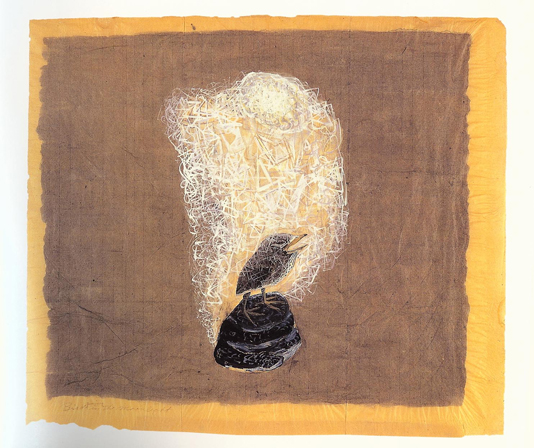
(Bird Singing in Moonlight, 1938, by Morris Graves)The rest of the poem is here:

http://ladynyo.wordpress.com/2012/04/12/mirror-for-the-moon-a-little-poetry-of-saigyo/

Today’s Issue: “The opaque and empty opening on what is when there is no more world, when there is no world yet.” (Blanchot)

01 Wednesday Feb 2012

Posted by summermlee in Art, Uncategorized

≈ Leave a comment

Tags

art, Blanchot, Faulkner, Heidegger, poetry, suffering, susan Sontag, war photography, writing

What a better way to spend a sunny weekend day than to read Susan Sontag’s “Regarding the Pain of Others,” and then to “enjoy” subsequent evenings full of nightmares stemming from her war photography imagery.

What allures me to Sontag is an analysis that concerns all artists — how is art, in this case photography, received amidst the unprecedented onslaught of attention-seeking images and information people are bombarded with.

I followed Sontag eagerly on her beautifully written essay, wholeheartedly compliant to her assumption that it is the consumers, including myself, who are blunted by habituating news of atrocity, and how easy it is for an elitist, educated population in the richest part of the world to become cynical. Yet, she finds, almost fortuitously, there persists images that do not lose their power on the viewer, despite the improbability of such resilience.

Before I could ponder why such images persevere, I happened upon a writing: A speech not directed at the public for its lack of awareness or state of distraction, but rather at one’s contemporaries; other artists, writers and poets — to call them out for being fearful (and therefore meaningless) in a most fearful time:

“Our tragedy today is a general and universal physical fear so long sustained by now that we can even bear it. There are no longer problems of the spirit. There is only the question: When will I be blown up? Because of this, the young man or woman writing today has forgotten the problems of the human heart in conflict with itself which alone can make good writing because only that is worth writing about, worth the agony and the sweat.

“He must learn them again. He must teach himself that the basest of all things is to be afraid; and, teaching himself that, forget it forever, leaving no room in his workshop for anything but the old verities and truths of the heart, the old universal truths lacking which any story is ephemeral and doomed – love and honor and pity and pride and compassion and sacrifice. Until he does so, he labors under a curse. He writes not of love but of lust, of defeats in which nobody loses anything of value, of victories without hope and, worst of all, without pity or compassion. His griefs grieve on no universal bones, leaving no scars. He writes not of the heart but of the glands.

“Until he relearns these things, he will write as though he stood among and watched the end of man. I decline to accept the end of man. It is easy enough to say that man is immortal simply because he will endure: that when the last dingdong of doom has clanged and faded from the last worthless rock hanging tideless in the last red and dying evening, that even then there will still be one more sound: that of his puny inexhaustible voice, still talking. I refuse to accept this. I believe that man will not merely endure: he will prevail. He is immortal, not because he alone among creatures has an inexhaustible voice, but because he has a soul, a spirit capable of compassion and sacrifice and endurance. The poet’s, the writer’s, duty is to write about these things. It is his privilege to help man endure by lifting his heart, by reminding him of the courage and honor and hope and pride and compassion and pity and sacrifice which have been the glory of his past. The poet’s voice need not merely be the record of man, it can be one of the props, the pillars to help him endure and prevail.”

This was William Faulkner’s speech at the Nobel Banquet at the City Hall in Stockholm, December 10, 1950, when the number of lives obliterated in the middle of their daily habits were still being counted — the aftermath of the U.S. atomic bombing on hundreds of thousands unarmed, Japanese civilians.

But somehow we need both impulses: Sontag who calls our attention to the suffering captured by art in order to remind us of the atrocities we are capable, sometimes enthusiastically, of; and Faulkner, to take us out of that paralytic grief, to summons everything forgotten in those acts of inhumanity, and despite the heaviness, to lift our hearts.

Today’s Advice:   “To think, to write a poem, is to give thanks for whatever measure of homecoming to Being is open to mortal man.” Steiner on Heidegger

Enter your email address to subscribe to this blog and receive notifications of new posts by email.

Join 619 other subscribers

Recent Posts

  • “Experimenters in the passages between worlds.” Vinciane Despret, Au Bonheur des Morts
  • “The terrifying groundlessness, the eradication of all violences. To be embraced by that which doesn’t know us and in that unknowing caresses us and truly loves us. We might become anything at all, something wildly other than what we are encountered by. A world that truly loves us by not presuming what we want or what shape we will take before we show up… We will be held when we are not known from the start.” — Dr. Marquis Bey
  • Images dream within us, a reverie is a world of expansion.
  • “For the natural world, the ethical responsibility is that being alive gives existence to others.” Vinciane Despret
  • “We meet in the freedoms of each other.” – Takeyoshi Nishiuchi

Archived Posts

Blog at WordPress.com.

  • Subscribe Subscribed
    • Unwanted Advice: Reflections from a Self-Appointed Life Counselor
    • Join 215 other subscribers
    • Already have a WordPress.com account? Log in now.
    • Unwanted Advice: Reflections from a Self-Appointed Life Counselor
    • Subscribe Subscribed
    • Sign up
    • Log in
    • Report this content
    • View site in Reader
    • Manage subscriptions
    • Collapse this bar
Loading Comments...