• About

Unwanted Advice: Reflections from a Self-Appointed Life Counselor

~ Caminante, no hay camino. Se hace camino al andar. Wayfarer, there is no way. You make a way as you go. (Antonio Machado)

Unwanted Advice: Reflections from a Self-Appointed Life Counselor

Tag Archives: bird watching

“ O Opal / your ear / in my heart / both hear / the glorious void, / preferring the birds.” Jim Harrison

04 Saturday May 2024

Posted by summermlee in Aesthetic philosophy, Art, Birds, Nature, poetry, Uncategorized

≈ 2 Comments

Tags

art, Étienne Souriau, bird watching, birding, birds, birdwatching, George Steiner, Jim Harrison, Martin Shaw, migration, painting, Paul Celan, poetry, Summer Lee, Summer Mei Ling Lee

Life-preserving but not life-giving, he says. Maybe the best critique of art I’ve ever heard. “Nothing is harmed but nothing is thriving either.” The people around here trained their eyes away from the gods, ancestral dead, magic — and sometimes even beauty. Everything is a utility or transaction for something else, and that’s not how the most important things come to exist. And, “The true entrance into us will not occur by an act of will.”
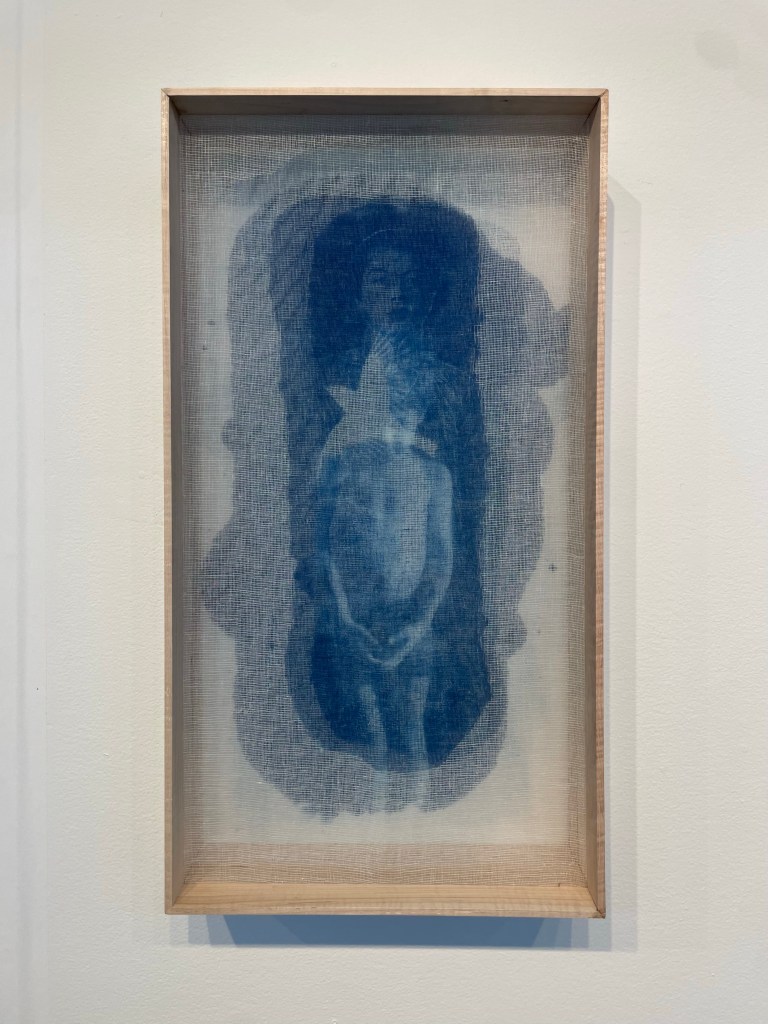
Into the Nearness of Distance, 2024. By Summer Mei Ling Lee. 28 x 15 inches. Cyanotype on three layers of Gauze, wood.

Myself, I want to dance with all that is wild and alive, but am just sometimes scared to. I realize now back on this sky-murdering plane home, full of doubts and in mistake-review mode, I was still greeted that day by gleaming Prairie Warbler, in all his breeding plumage glory. He popped up in front of me when there could have been nothing at all in that sickly, urban forest. Odds are more likely that he would have been a thousand miles further along into Canada, but he was right here. Exactly where I have met so many who I have loved and who have loved me. As he explains, those things we need most in this world are more tangible in the messy, uncertain wild.
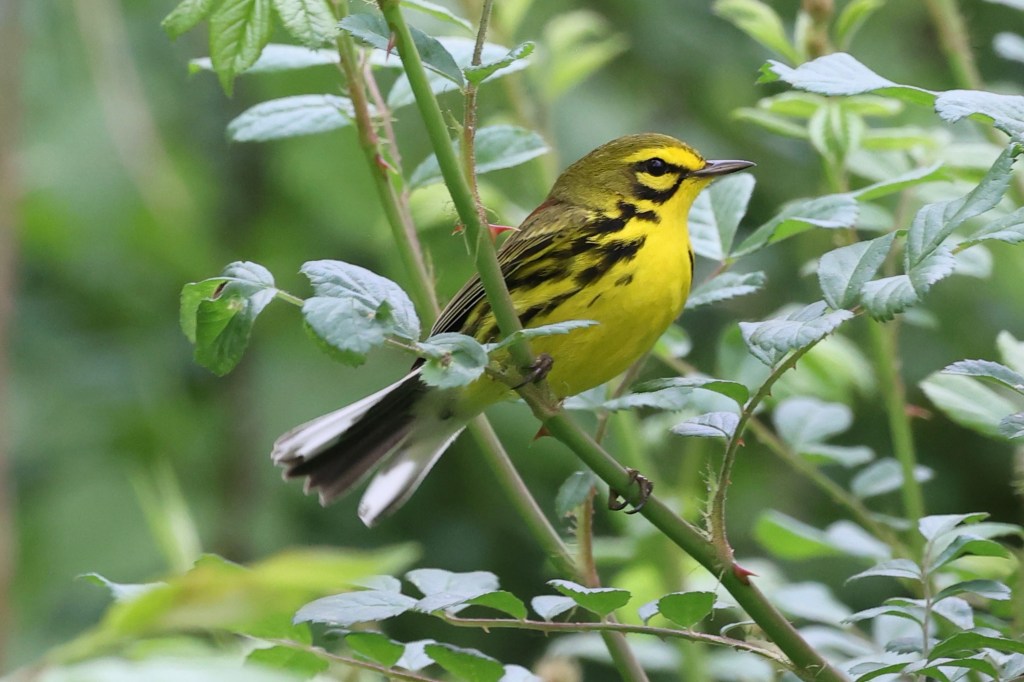
Prairie Warbler, the other day.

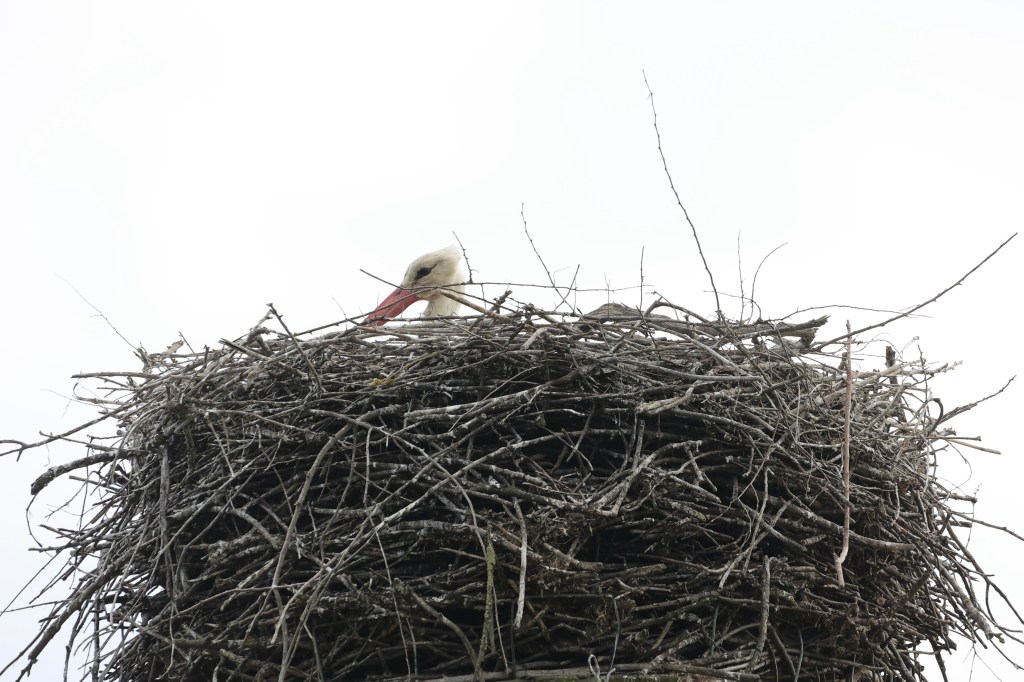
Just two weeks ago, blue-eyed Pietro drove me to a nature preserve that is now tragically a farm, where persists a pole at the side of the field with a platform on top. And up there in a roughly-woven basket structure she stares down at us, telling me something I don’t know how to write, something about fear but also just continuing on despite the hunters. She could live for forty years and knows how to squeeze water from moss into her thirsty chicks’ beaks. For what.

And then he takes me way out where the road barely can be made out anymore, to the last remaining colony of Lesser Kestrels in the eaves of a long-ago collapsed home. He jumps out of his tiny car when he spots them and shrieks like a boy. He delights in telling me when they fly back into view, for a period of time even longer than I still care. He can see them everyday and I will never see them again in my lifetime. And soon no one will. I know why he shrieks, but it’s impossible to write it, even though I feel it in my bones and try every time. I am deeply aware and sorry for that failure.

But after each word, it is impossible not to mention those that understand and keep me company — it’s why she has sent me a bird along her walk. And why he sends that line of poetry. Otherwise it can feel like the people here are dying mostly because they don’t even notice, nonetheless jump out of their car and shriek in delight. I think that’s why Celan threw himself into the Seine river, it becomes overwhelming that the rest of the world swings through the crowd like an ignorantly sharp elbow into a tender bruise.
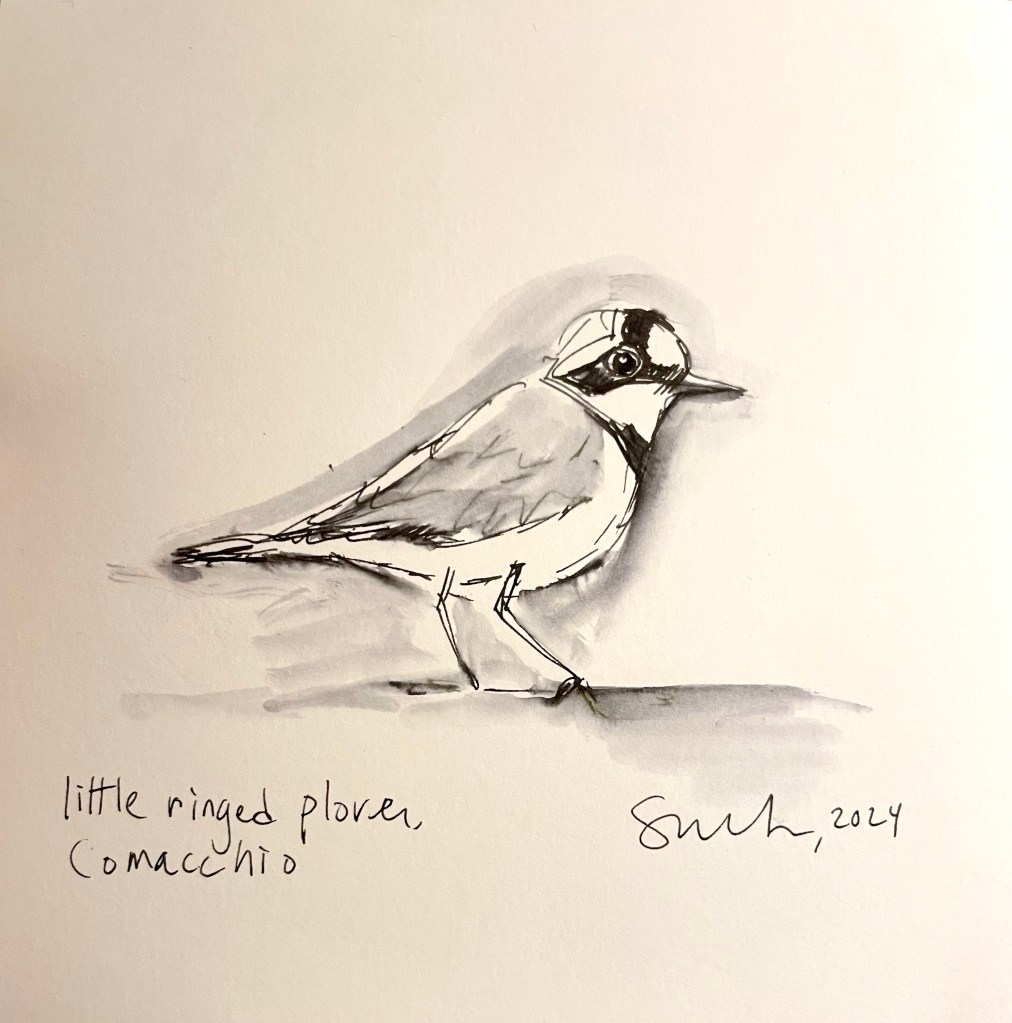
Little Ringed Plover for Fiorenza, by Summer Mei Ling Lee, 2024

She cried openly this time when I left the farm, weeks before the Bee Eaters arrive. This year, I gave her a Little Ringed Plover instead. I am trying to fashion band-aids out of the birds, those little gods and ancestors and bits of magic in the trees. Band-aids for those whose tendernesses in the crowd, including my own, I absurdly want to preserve.

“If we must be careful of any anthropomorphism when studying animals, it is not bad to sometimes do a little zoomorphism when studying man, whose lucidity and power of reasoning are often exaggerated.” (Étienne Souriau, The artistic sense of animals, 1963. My translation).
“The Infinite Cage” — Joron

07 Tuesday Feb 2023

Posted by summermlee in Aesthetic philosophy, Art, Birds, Nature, philosophy, poetry

≈ 5 Comments

Tags

art, bird watching, birds, birdwatching, death, Home, memoir, migration, nature, painting, philosophy, Photography, poetry, Summer Lee, Summer Mei Ling Lee, words, writing

(With a few words in a note to me, she tore open the blank space here, and asked me to write again. Her gesture brought tears, in both senses of the word, and so it starts with tears — because it involves breaking the icy river, the cowardly reluctance to thaw it, to think it isn’t always flowing underneath.)

(Santa Croce ceiling bird.)

Beauty, Nathan reminds me.

What of my small experiences wants words to land them here. What birds would touch down from untouchable sky in order for me to see them, count them, photograph them, devote myself to them.

Because now these birds seem wild and unbelonging like the work that sits months waiting for me in my studio.

Last week we made a strange reunion of local birders on the back porch of a stranger’s house, to peer over a fence into the neighbor’s yard to glimpse a young Summer Tanager eating desperately at the feeder. He was undoubtedly wayward and far from home territory because of the onslaught of coastal storms. We were welcomed into that space and to each other, with only a quick mention of the mass shooting that had happened the day before shattering our small town. Then, the bird arrived, and as Eva describes, we wandered into the center of the circle of wonder. Summer Tanager was the greeting.

How often I delude myself to be disconnected from it all. And as Eva exclaims more loudly, impatiently, because the most obvious is the most difficult — we are always in the circle of wonder, never outside it — and we can indeed find center. Never by our own narrow volition, but by wandering.

(Red Phalarope by Summer Lee, a pelagic bird brought inland by storms, 2023.)

But I want words for those birds, those moments — not the ones where I tenderly helped unclench his fingers from the hospital bed, or the impatient coldness I can turn towards my own children, or how exhilaration smothered grief when driving away from her hopeless apartment for the last time. Not for the woman who rocked her body in prayer before every beautiful dinner she served and told me, this is not the life I expected for myself. And even still, not the gift of my children’s joy that persists despite me, or how I can burrow into the surrendered miracle of my new, unexpected lover.

Somehow there should rather be words for the Virginia Rail that crept out from its perennial hiding place to the spot below the window of my car. And how we caught eyes, one being welcoming another.

The people in that odd backyard meeting, with undoubtedly their own sufferings and joys, would understand. The Virginia Rail is basically all we talk about for hours and hours, even though long ago and long gone — until the next improbable Beauty arrives. And of course, those far away but close to my heart who send me words fluttering down from the sky, out of nowhere perfectly on time — thank god they understand too.

(The Virginia Rail. January 2023.)

In these birds, these words, these friends, I know is the paradox of faith, and how it takes care of us by destroying us.

I will taper down this roughly thawed cascade of words to say that 77 unique species of birds have visited my yard in the 20 or so years I have lived at this home. And I wonder about what I missed in the times I drifted away. Once a group of us chased a vagrant Dusky Warbler across a field of dried fennel, a man’s long camera lens thunking against my head to capture the bird, preventing me from photographing it well. The bird flew off confused, and we stayed to celebrate, for me the 560th species. A bewildered boy next to me scanned over the expanse of chaparral and said, just think how many dusky warblers might be out there and we would never know.

(The Dusky Warbler)

So maybe in my silence, where words haven’t been, is a backwards way to acknowledge some secrets. Not about the “yoke of perishing” we come into being with. More like finally seeing the Prairie Warbler next to the local sewage plant. That time, it took minutes to see his yellow light darting in the scrub, when the year before I spent weeks, thousands of miles away, to no avail. How some things will always escape, even as I am coming closer and closer, and reveal secrets of me that are unknown to myself even. Dufourmantelle cautions, mystery is not an enigma to be solved but prayed to, and truth is only a veil.

“Endure, o mystery of being, so that I might pull threads from your veil.” – Wislawa Szymborska

“Poets became the true accountants, and their ledgers contained the un-profitability of the human soul.” Michael Marsh

31 Monday Dec 2012

Posted by summermlee in Art, Birds, Nature, philosophy, poetry

≈ 2 Comments

Tags

"Anyone can sing", bird watching, birds, birdwatching, Michael March, poetry, Thoreau, Walden, William Ayot, writing

“…the fine print, the small type, of a meadow mouse.” — Thoreau

Behind my eyes is a geometric pattern, the dark blue lines zig zagging and dotting in that 1970’s way around white, repeated ad infinitum on the wall of my grandmother’s breakfast nook I haven’t been in for almost 15 years. It’s there when I rub my eyes in fatigue, who knows why.

On the other side of my eyes, you might see fibers of dark grey, green and ochre around a black circle.

But around the black center of a white-crowned sparrow’s eye is a dark mahogany-red. Inside the abyss of his eye, I can only imagine he is terrified as his heart races in my hand, little short breaths heaving his feathery chest. With the most delicate of touch, I run my finger up and down his body and make promises I can’t keep, still horrified by the thump of his body against the car window. His eyes blink fear and innocence straight into my eyes, but he has no control of his body, which has collapsed belly-up into my palm.

Minutes later, I declare it a minor miracle that he hops out of my makeshift hospital box and is gone. The next day he is returned to the glorious flock of 50 birds working over my now-expensive winter feeder.

Meadowlark by Summer Lee, 2012. watercolor on paper

(A recent watercolor: Yellow happens to be the precise spot where the eye tunes into the sequence of color frequency — it has the same vibration that stimulates the retinal nerve-ends and causes the phenomenon we call light)

Obviously, these birds are my favorite words, my favorite swath of paint — and I am ever envious of those musicians who have such mastery over the wild flocks of notes and melodies, every single beat tamed at the same moment they are also alate.

— and yet, among the most rigorous creators, there is a holy acknowledgment of the not-coincidentally aleatoric. Who knows to where those wings will fly.

After 8 years of minding this winter feeder, I know every resident from migrant as I welcome new offspring and pray for the missing. They are a light, a moment of solitude along my bustling path in and out of my home in this dark time of year. Their hearty feeding is proof of a cold darkness stretching longer than what daylight allows for warmth and food. And maybe my dedication to their feeder is an understanding of these fickle and insufferable days.

Anyone can sing, but there is astonishment that the wonder of words still visits me, like the small group of diminutive, navy-blue and chestnut nuthatches, who for some reason are eagerly taking my sunflower seeds for the first time this winter. They dive into the top of the bare tree, then climb with their powerful claws head-down along the branches like woodpeckers, whom they are always adjacent to in field guides. At the feeder, they grab a singular seed into the tips of their needle-tipped beaks and with a few nasally yank-calls, fly out of sight along a bobbing flight path, into the mysterious.

The next day my son playfully repeats, “dammit” as I scurry out of the car to grieve the little brown body lying below the same car window next door. He also says I am going to eat this bird after watching me consider its life, its body, photograph it, then gently wrap it into the freezer — not an absurd conclusion on his part. I don’t tell him that this bird had not yet developed golden plumage along his crown, being this sparrow’s first winter. He was born last spring in a forever-unknown location on the western coast of Alaska and followed his flock over a thousand miles, maybe two, to our feeder. Probably just like his genetic ancestors have done since time immemorial. But even so, my son asks me if the bird cries. No, but the song says it all.

http://macaulaylibrary.org/audio/49913/play

The loving details of this bird life in my mind’s eye are already fading — I’m no master at this — but I can hear his song and his eyes have gone dark.

“…to face the possibility
that your innermost core may hold nothing at all,
and to sing from that – to fill the void
with every hurt, every harm, every hard-won joy
that staves off death yet honours its coming,
to sing both full and utterly empty,
alone and conjoined, exiled and at home,
to sing what people feel most keenly
yet never acknowledge until you sing it.
Anyone can sing. Yes. Anyone can sing.”

— William Ayot

“Language simply ceases… The poet enters into silence. Here the word borders not on radiance or music, but on night.” George Steiner

17 Monday Sep 2012

Posted by summermlee in Aesthetic philosophy, Art, music, Nature, philosophy, poetry, Uncategorized

≈ 7 Comments

Tags

art, bird watching, birds, George Steiner, music, nature, Rilke

The outskirts of Tahoe National Forest. I followed the early morning mists of little winged bugs along the edge of a forested reservoir, a small cohort of Audubon’s Warblers chasing them also. With a mind galloping through what if’s and what-nots, I sat next to their cathedral, a half-dead tree once under the water line. Its branches stretched arthritically out towards that which feeds it but also puts it asunder. One by one every species of woodland bird worked its way out of the dense pine forest to that diminuitive tree. They would land with a pause, flit a little, perhaps taking a careless bug in this gathering place, then sail down below to the stony water edge. They were singing me stories of wretchedness, of betrayal and harshness from those who didn’t believe they know better. They described predators with only few survival skills who violate their homes, even when their bellies are far from empty. But they also sung of the little joys of sunlight, improbable births, childlike pauses, and cool reservoir water. Fiercely aching nights and warm morning updrafts. And times when every species and variety of plant and bug is available, and times when their children grew silent in the cold. Warblers, nuthatches, wrentits, chickadees, flycatchers, a few I didn’t know, and a rufous sided towhee — the little delicate species, the singers. My favorites. For years this lasted. I have been devoted to them.

Someone once said that birds remind him of an existence before human civilization, of times outside of wars, laws, buildings. Before human suffering and its impulsive response of further suffering. But these birds were not solely of the sweetness of summer, though they had the resilience and the evolutionary wisdom to live as if that was all they knew. Because today it was summer.

(A photo from my studio, by Shae Rocco).

It seemed my birthright to make an offering. Give something, though those little birds of course needed nothing. Steiner reminds that art is free, gratuitous, not for anything, so much so that every artful creation calls forth an awareness that it might not have been. So somehow turning this moment into a drawing or even writing seemed superfluous, like a scarf around Rilke’s torso. And it is.

Because in this moment I also felt like I might not have been, that everything I’ve done and made might have been otherwise. I felt humble, like the chanters of holy songs, whose talents are free and freely given. So, for whatever reason, because I was perfectly alone, I began to sing. My mom would be excited to know I quietly sang songs from her faith, maybe because that foreign language seemed as intimate and yet dispossessed as the birdsong around me — it contains a hint of something inextricable even as it is unknown. And despite my usual anxiety of needing more, I had a moment of needing nothing, a necessary condition for gift-giving, even if it is song-giving. Towards everything surrounding the birds and all the radiating objects and memories and people I know and knew. And as the scene pulsated, the birds neared me one by one as part of their ritual, into otherwise lethal distances. A Townsend Warbler landed a few inches above my head. After that a Kinglet slid down to the frayed end of a branch four inches from my eyes. Another Audubon’s Warbler almost upon my shoulder. They exerted themselves to me. And so I cease to sing.

” — for here there is no place that does not see you. You must change your life.” Rilke

Enter your email address to subscribe to this blog and receive notifications of new posts by email.

Join 618 other subscribers

Recent Posts

  • “The terrifying groundlessness, the eradication of all violences. To be embraced by that which doesn’t know us and in that unknowing caresses us and truly loves us. We might become anything at all, something wildly other than what we are encountered by. A world that truly loves us by not presuming what we want or what shape we will take before we show up… We will be held when we are not known from the start.” — Dr. Marquis Bey
  • Images dream within us, a reverie is a world of expansion.
  • “For the natural world, the ethical responsibility is that being alive gives existence to others.” Vinciane Despret
  • “We meet in the freedoms of each other.” – Takeyoshi Nishiuchi
  • “Those with wings, those without, / the ghosts of the heart / — whose hunger is a dress for my song.” — Brigit Pegan Kelly

Archived Posts

Blog at WordPress.com.

  • Subscribe Subscribed
    • Unwanted Advice: Reflections from a Self-Appointed Life Counselor
    • Join 214 other subscribers
    • Already have a WordPress.com account? Log in now.
    • Unwanted Advice: Reflections from a Self-Appointed Life Counselor
    • Subscribe Subscribed
    • Sign up
    • Log in
    • Report this content
    • View site in Reader
    • Manage subscriptions
    • Collapse this bar

Loading Comments...