• About

Unwanted Advice: Reflections from a Self-Appointed Life Counselor

~ Caminante, no hay camino. Se hace camino al andar. Wayfarer, there is no way. You make a way as you go. (Antonio Machado)

Unwanted Advice: Reflections from a Self-Appointed Life Counselor

Category Archives: music

“I could never have come to the present without you / remember that / from whatever stage we may again / watch it appear…” WS Merwin

03 Friday Jul 2020

Posted by summermlee in Aesthetic philosophy, Art, Birds, music, Nature, philosophy, poetry, Uncategorized

≈ 2 Comments

Tags

Annunciations, art, birds, birdwatching, death, Gadamer, philosophy, poetry, St Cecilia, Summer Lee, WS Merwin

The birds come and go here just as Fox Sparrow does in his homecomings and disappearances back on the West coast. Just as truth and beauty migrate out onto another unreachable continent when trying to reason with them. Why can’t you stay here to remind me, I ask through my binoculars. Just once. Their wondrous plumage and secretive calls draw us out from the smallness of our shelters, out into the rainy forests and sometimes in communion with each other, the alive and lonely. This year all the rarest of ones flickered across my field, even a tiny, crystal-blue Cerulean Warbler that spends most of his time too high for anybody to see. A Hooded Warbler touched down too, in a darkly flooded forest where he normally does not, just for two days. Then they leave and we are alone again. Maybe that’s why I told a beautiful woman birder that I saw the rarest bird, when in fact I hadn’t seen it at all. Something about the mix of her beauty and shyness, and something about me being mistaken and humbled. But maybe that bird is still there in our minds, more glorious and hopeful than if we had even seen it.
IMG_1682

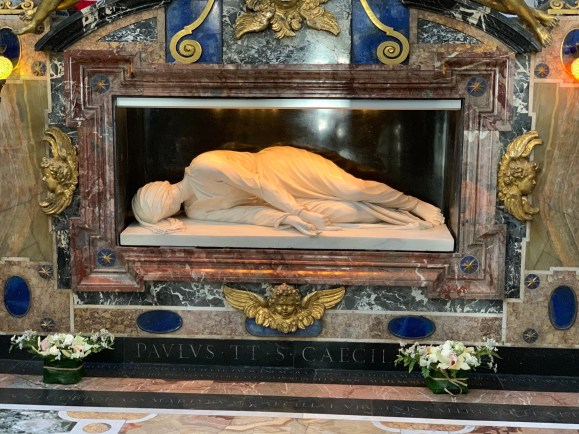
(Martyrdom of Saint Cecilia of Music. Sculpture by Stefano Maderno, 1599.)

What if this wave of unrelenting and invisible death was actually a grace. Except of course for the poor and vulnerable who always die for our sins. All while I suffocate in the safety around me in the anxiety that it’s never enough. Like when I impatiently told her she just needed exercise when in fact she was just about to die, swollen with failed organs, failed also by my insulated stupidity born of fear.

One time out in the twilight of a chaparral migration, stranger birds gathered in a circle. And even more strangely invited me. They had gathered in order to die. But being birds, they had to first learn how to die through song.

I listened. And of course cried too, as one does even at a stranger’s funeral. One sang of her young daughter who died suddenly. And when the mother’s song entered the abyss of dark and permanent grief, her daughter would come sing to her, to the point where I could almost hear it too. I still don’t want to know if it was an apparition of the psyche or from the other side, because it’s the same place where my own grandmother speaks to me.

This mother had brought with her the chaplain she had met in the hospital. Yes, there is always a bird there, even if we don’t believe, and here she was in the body of a middle-aged, white woman wearing a collar. The chaplain sang to me too, as I worried about my own son treading a difficult path through life. As she warbled, we all sat crying for ourselves and for that mother. Her song was about just being there at the right time, reminding us that our bodies know how to die when it is time.

But the timing of the young daughter’s song, as well as this chaplain, was uncanny. Like the little 9th century bell in Rocamadour that rings when there is an incontestable miracle. Not all pilgrims who have climbed on their bloody, tired knees to that church will hear it. But I can hear that birdsong from that circle of death, even if they are on the other side of the earth now.

Through all the hatred to be had of insufferable humanity, its never-ending range of evils, these migratory birds continue to love me well through certain people, strangers even. Just through their words. Through the poetic words they send me, calls to the heart that rain down on me in dark, muddy forests. In poetic words, there lies the impossibility of their birdsong — as impossible as it is to hold truth and beauty too — that living is through learning how to die. One word at a time, one song, risking itself into unreachable silence.


“The greater miracle of language lies not in the fact that the Word becomes flesh and emerges in external being, but that that which emerges and externalizes itself in utterance is always already a word.” Gadamer, Truth and Method.

“Song leads us home to where we have not yet been.” — George Steiner

25 Sunday Jan 2015

Posted by summermlee in Aesthetic philosophy, Art, Birds, music, Nature, philosophy

≈ 9 Comments

Tags

ancestry, art, birds, China, George Steiner birds, music

As the intensity of morning light increases, it signals to different species of birds when to start their morning song. Each bird is prompted to sing by its own special light.

When I visited China, I had in hand my grandmothers INS interrogation which detailed the few belongings they had in hand when they left China, as well as the several dead, young and old, they were leaving behind. In it, she also recounted a gold ring her father had brought to her from America that she lost. I would inherit this reminder of impossible frugality like a mistaken familiar voice in a crowd. As my own trip wore on, I was accumulating breastmilk that I pumped every few hours for relief, but also so that I could return home to nurse my child.

After dumping a heartbreaking amount of milk in China, I persevered the survival of a small frozen stash of milk through five cities (via ferries, taxis, subways, three domestic planes, and a train, all between four separate hotels) and finally across the Pacific ocean home.

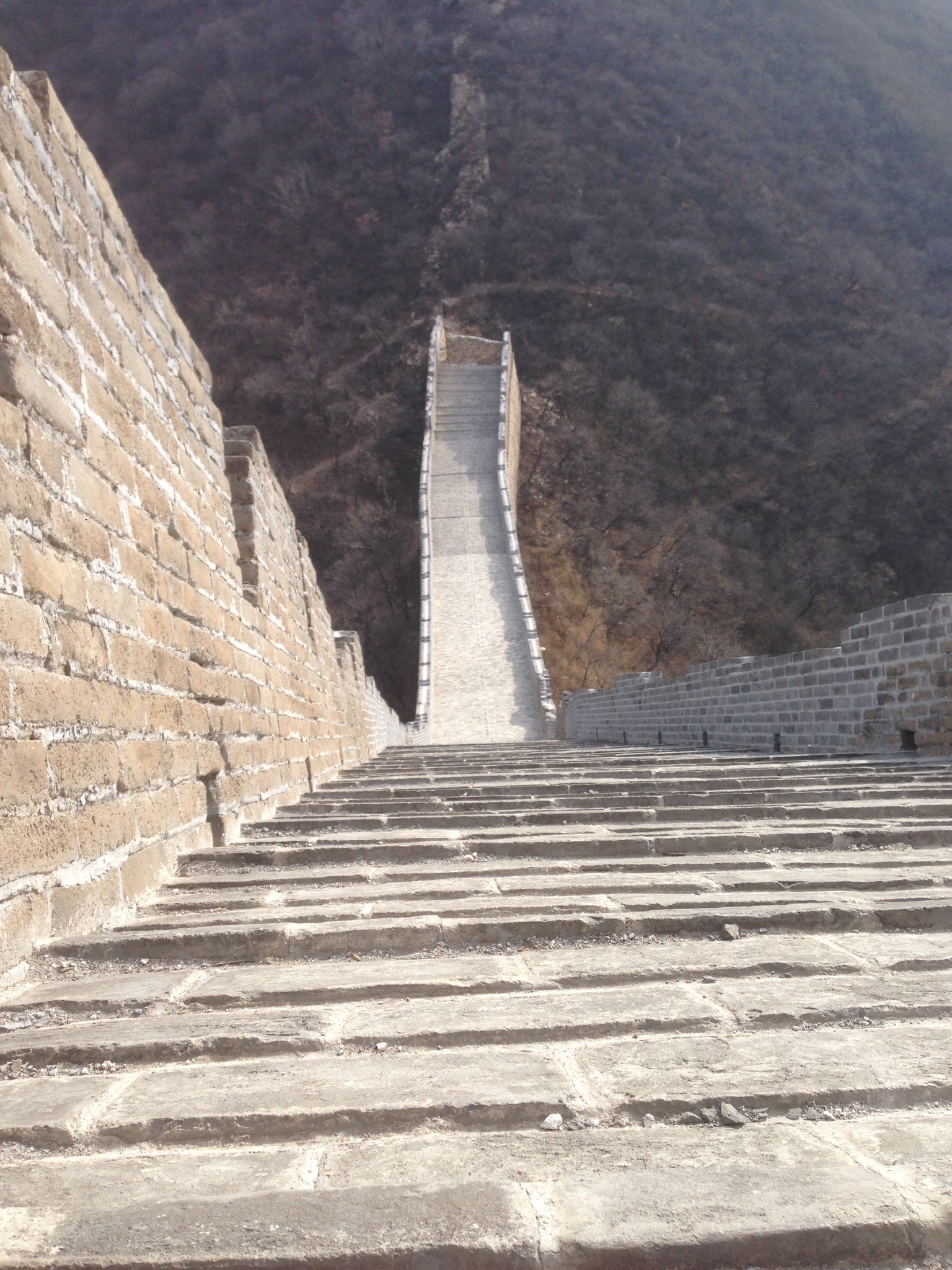
By Summer Lee (Photo of pouring my breastmilk off the Great Wall of China, 2014. Summer Lee)

This trip symbolized the means of how an artwork based on my grandmother would come to be exhibited in the region where she was born. And soon, it will enter the permanent collection of that museum, as if I were the unwitting intermediary to repatriate her bones.

Several years ago, I was contacted for a potential exhibit at a university a few hours from my home, a show which took years to come to fruition. Finally this last week, during the same time my grandmother’s piece is in China, the show opened, and one of the paintings chosen for this exhibit is a watercolor of my grandmother’s husband, my grandfather, who was born in the same unlikely town of Stockton, where the university exhibit is located.

I don’t know if birds have homes, but I imagine they are more at home in the state of homelessness than I am, singing on account of the light, as much location.  In this winter of coincidental homecomings for my grandparents, I have become unhoused at the bird feeder of my yard. After so many years, a grasshopper sparrow, a spritely, smaller-sized, streaked sparrow, who was committed to my feeder winter after winter, has not returned. I will never know why, and I have no bones of his to return, nor an understanding of where his song might be.

This dawn chorus is ever a changing one.

image

(Photo taken by my friend, of where the restored Great Wall meets the ancient wall, 2014)

“We are in the midst of reality, responding with joy.” — Agnes Martin

23 Sunday Jun 2013

Posted by summermlee in Aesthetic philosophy, Art, music, Nature, philosophy

≈ 8 Comments

Tags

Agnes Martin, art, chapel of the chimes, death, Garden of Memory, George Steiner, Heidegger, painting, summer solstice

A year later and I am back visiting the dead, this time questioning the responsibility of putting new life into the world.

Weaving in and out of the crypts and private chapels, the walls are lined with vessels holding ashes, shelves holding caskets, and the letters of names. It takes a strain of my imagination to fill-in the entire arc of a life that now sits in mostly forgotten urns, placeholders. Once behind the names were fleshes of personality, interactions that effected causality, relational change, consequences in the environment, impressions on the psyches of others — and then they were gone. Except for a spot in a tiny little box aside thousands of others, now also mere words.

Painting by Agnes Martin

(Painting, “Tremolo,” by Agnes Martin, 1967.)

This year, it struck me that the cast of musicians performing here and there among the dead were stand-ins, intermediaries. They attracted hordes of the living into this solemn place on the longest day of the year to challenge the human aloofness towards the dead, to weigh the untranslatable meanings behind those words. With mixed success. Even though evidence of death towers on all sides, our finite narratives and rehearsed terminal endings at the end of every sentence — we remain distracted from our own dying.

We committed to one dark grotto of those born in the early 1800’s. A professional cellist sat inside with her laptop and synthesizer. Sometime while she was tuning her cello and tapping on her laptop, it dawned on us that she was in high performance. The ambiguous noises were experiments against the classical instrument’s boundaries: a stutter and screech here, a falling note there, a computer’s response, and the cellist’s retort. When she finished her “tuning” performance and nodded her head to applause, we understood that the provisional and dissonant duet between cellist and computer highlighted the aleatory relationship between existence and not-existence — and was indeed beautiful music. As Steiner says, art reminds us that there is something rather than nothing, only by virtue of grace.

The scene seared into my heart the ruminating words I had read that day of my dear friend’s husband having only days to live. They were going down their road until a few weeks ago, their life was sideswiped by illness and overturned into a tragic twilight. At home in hospice care, they are surrounded by friends and family who improvise themselves into a blanket of love and support for his last moments. There is no score or predictable soundtrack here. Nor, as Pamela says, is this life a dress rehearsal. But at best we merely hear the music at all.

Painting by Agnes Martin

(Painting, “Trumpet,” by Agnes Martin, 1967)

My friend this evening and I jest that it is just as much the beauty of the performer as it is the melodic tunes (amidst many dissonant-sounding experimental musicians) that has drawn a thick crowd into side room of the columbarium. Sitting on the stone floor in vulnerable elegance, she plays odd, unrecognizable instruments in classical improvisations. And we, the living, over a trickling fountain lined with pertly pink and red impatiens, “watch” her fill the space of the eternally invisible with unseen timbres and undulating wavelengths of passionate percussion. When she breathes into a bamboo flute with an electronic lung holding a previous refrain to which she responds in turn, a strange but pleasing chorus emerges into a rhythm of labored breath, a futile and yet beautiful resuscitation.

(In the stairwell from one chapel to another, we overhear a woman remark that this is what people from the rest of the country think Californians do everyday.)

But the true entrance into me does not occur by that willful anticipation of art, just as much as predicted words here do not alight, but sink. Instead it happened when an unexpected noise entered the back of our music-filled worship. It announced the entrance of a young, disabled girl with the cognition of a child ten years younger. She burst into this delicate space, hugging a 3-foot Barney and two teddy bears, and proceeded to march directly to within inches of the musician. The performer was startled but without missing a note, welcomed her softly with her eyes. And the girl of a strange grammar, much to my held breath’s relief, plopped herself front and center with no further histrionics. While the music pulsed along, the girl’s father sat down in the back, occasionally waving a connective hello to his girl. But she is now entranced by the familiarly foreign music, playing seriously with one of the bear’s ears — because afterall, this is about our ears.

And I, the helicopter parent, who constantly restricts my exuberant son in a cloying distrust and tiresome fear of violating the perceived comfort of everyone around me, orchestrating him here and there so as to fit who-knows-what expectations, I succumbed to this scene. Yes, a carnival of existence among the backdrop of non-existence, of Nothingness — but mostly of trusting surrender. There in front of the dead, the distracted living, too — and because of the little bit of life under my domain that is there despite me — my heart busted itself into tears.

“As the shrine of Nothing, death is the shelter of Being.” — Heidegger

Painting by Agnes Martin(Agnes Martin’s last painting, “Untitled,” 2004)

“Things I cannot speak of are not for the ear.” — Monsieur de Sainte Colombe, “Tous Les Matins du Monde.”

20 Wednesday Feb 2013

Posted by summermlee in Aesthetic philosophy, Art, music, philosophy, Uncategorized

≈ 4 Comments

Tags

art, healing, Itzhak Perlman, language, music, Tous Les Matins Du Monde, violin

As children we sometimes rode in his vintage BMW. There was often silence in the presence of my reclusive, stoic father, but his car was always filled with classical music, teeming with the lilt of violins played by ghost-like hands on imaginary stages only alive in the mind’s eye.

But tonight I sit in the intimate presence of an expert and his violin. Without wires and speakers and road noise, nor the dynamics of a vast symphony hall, by luck (privilege is also luck) I am inches away from the source. Unmediated.

The result of animal hair vibrating against metal strings over the opening of a lacquered, wooden box, it is also the most complicated of unspoken languages, the full range of human emotions and unarticulated impulses, all coming through a man who has painstakingly practiced his craft for over 50 years. Neurons, muscles, the electricity of infinitesimal choices of movement, invisible wavelengths and the receptive ear. Music. And like the best art, it is much more than that.

It is the ultimate of hubris that I might try to write about this experience. As Marin Marais utters in the culmination of Tous Les Matins du Monde, this violinist’s playing is “A refreshment for those who have run out of words.”

But among my people are silent musicians who had no such openings during war, invasions, immigration, mundane necessity, to sit where I am tonight.

The performer himself has been crippled by polio, and so easily could not be sitting where he is tonight. In the perfection of interpreting for composers hundreds of years dead, there lies the unmistaken inflection of his own living voice, informed by the circumstances that make their mark onto one’s life. Like the unique gesture made by a painter’s hand. His talents are undoubtedly mending the frays of pain, those tears in the fabric of human survival, passed down to him by his own people.

Because I know this is a healing and that it is in the realm of the miraculous. Music, as well as miracles, come to life on the necessity of the present moment. For over two hours, I am tethered to present tenses by unpredictable sounds and melodies, by the sight of his hands dancing impossibly up and down the strings. I am tied there until the end of his last performance, a composition he knows by heart and displays the utmost limit of his skill, of all human ability.

When he finishes I break inside and experience a pronounced loss because it is over, as are all the circumstances that culminated into this one evening — there with my mother weeping at the greatness of it all, our backs to the thousands of other audience members behind us, their wounds closing even if they don’t know it. I am greeted by an acceptance that this will never happen again. Even more, all of this could so easily, more likely even, not have been at all.

As it turns out, the night of this impossible recital happened to fall on my father’s unrealized birthday. If alive, he would have turned 80 years-old. And in his quiet way, he would’ve been healed most of all.

“Music exists to say things that words cannot say. Which is why it is not entirely human.” — Monsieur de Saint Colombe, Tous Les Matins du Monde

“You’ll see how much your little bird has changed.” — Edith Piaf

03 Sunday Feb 2013

Posted by summermlee in Aesthetic philosophy, Art, Birds, music, philosophy, poetry

≈ 9 Comments

Tags

art, Edith Piaf, French, high school, Jacques Prevert, memoir, philosophy, teachers, Virginia Woolf

Not much taller than the desks, she stood unblinking in front of the students, hopping and gesticulating wildly to convey her lesson to her jaded audience. In this of her many dramatic monologues with occasional spittle, she introduced a new topic, rudiment to understanding French, and maybe even life: existentialism.

We thoroughly read Camus, en français, and over time she espoused to her sheltered and callow high school students that every choice one makes has a consequence, and the absurd man is one who acts out of habit, shirking responsibility and awareness for the events and choices that come to comprise one’s life. We listened to Edith Piaf, learning her lyrics by heart. Having heard no other voice so utterly pained, wretched even, but strong and moving, I was taken. She grabbed me at the end of class after the rest of the students had drained out of the room, and for whatever reason, recounted that during her first teaching job at an elementary school, an air force officer entered her classroom and in front of her 25 students, handed her an envelope. In it was a piece of paper describing in the most coldly succinct language that her husband’s plane had crashed on a training flight nearby and he was deceased. There also in the envelope was his metal wristwatch, the only personal item with him and recovered from the crash, cracked with hands frozen at the exact moment of his death. With a teacher’s salary and two young children, she said Edith Piaf’s tragic life and inextricably-linked music became anthem to the fact she had no other choice to move on.

Her philosophy must have been a double-edged sword for the ESL students also under her care at the high school — the dregs, the few brown and black kids bussed into an otherwise privileged school of white kids dropped off by luxury cars. But there was no less, if not more, passion for these kids as there was for her sniveling French students. When her Edith Piaf admirer became Senior Class President, she arranged a secret meeting, knowing my duties as student organizer of the school prom. She said she had a young couple in her ESL class who wanted to go to the prom but could not pay the price of ticket, exorbitant even for today’s standards. She wanted to broker an arrangement for them, and they must never know. Loyal to her, I offered to comp them in, no one would notice in the shabby accounting. Slightly offended, she interjected to say the boyfriend had agreed to work the coat check before and after the dance to earn his way. I added their names to the paid list and other than her catching my eye at the entryway of the dance hall while she stood next to her couple, there was no word of it after.

She also introduced us to a book of poetry by Jacques Prevert, someone also familiar with war and loss. She had to have known I never returned my copy back to the school repository, and from time to time I still find a guilty joy in reading a poem or two from it — a treasured contraband. It was, of course, easy to tell her I was coming out as gay. She might have even said she had some gay friends or a gay son, I don’t remember. But after that, she took to meeting me at the town’s bookstore cafe, and we sat together as an unlikely duo of a middle-aged, manically energetic, short woman, and a gangly, wide-eyed, attentive girl — my hair getting shorter by the week as my shoes grew more militant. I don’t remember much of what we talked about, but I can smell the bitter coffee-filled air, and see the tome of pages from Antigone she xeroxed in French (another petty crime) and brought me to read over the summer. It was also there that she asked me to be President of the school French Club. I had no duties except to bring a piece of brie to the school club fair, where she also hosted an escargot-eating contest, and in turn it was something to add to my padded Stanford-bound resume. When our senior yearbook came out weeks before the end of school, she curiously asked to hold mine for a day or so. When she returned it to me, there adhered strongly to the inside the front page was an engraved, stately metal plaque. It read my name, the title of French Club President, and underneath, “Honni soit, qui mal y pense.” An ancient motto of chivalry, it means something to the effect of, evil to those who think evil, or shame to those who think shame of it.

The last week of school, she made me promise that I would let her be the last teacher I would say goodbye to. So, after gathering my things and finishing some tearful thank you’s to a few of my other teachers, I found her waiting for me in her classroom. As we walked down the hallway to one of the school’s exits out to the parking lot, she explained to me that there at the doorway was a threshold and it was marked by a strip of metal. She said that it was a milestone, a marker, this line. She would go on the other side and she was going to watch me cross. So I did: I unceremoniously stepped over the line, tears welling in my eyes, and there on the outside of the school she jumped to hug me. As she grasped me in her embrace she whispered in my ear, though it seemed louder and permanent: You have crossed the line and you must go, and I want you to remember, she clenched more tightly, you can’t go back.

Ladder, by Summer Lee
(An image from an art performance I did with Jesse Schmidt, 2008)

“I wish that once & for all I could put down in this wretched handwriting how this country impresses me — how great I feel the stony-hard flatness & monotony of the plain. Every time I write in this book I find myself drifting into the attractive but impossible task of describing the Fens — till I grow heartily sick of so much feeble word painting; & long for one expressive quotation that should signify in its solitary compass all the glories of earth air & Heaven. Nevertheless I own it is a joy to me to be set down with such a vast never ending picture to reproduce — reproduction is out of the question — but to gaze at, nibble at & scratch at.

After all we are a world of imitations; all the Arts that is to say imitate as far as they can the one great truth that all can see. Such is the eternal instinct in the human beast, to try & reproduce something of that majesty in paint marble or ink. Somehow ink tonight seems to me the least effectual method of all — & music the nearest to truth.” –Virginia Woolf

“Language simply ceases… The poet enters into silence. Here the word borders not on radiance or music, but on night.” George Steiner

17 Monday Sep 2012

Posted by summermlee in Aesthetic philosophy, Art, music, Nature, philosophy, poetry, Uncategorized

≈ 7 Comments

Tags

art, bird watching, birds, George Steiner, music, nature, Rilke

The outskirts of Tahoe National Forest. I followed the early morning mists of little winged bugs along the edge of a forested reservoir, a small cohort of Audubon’s Warblers chasing them also. With a mind galloping through what if’s and what-nots, I sat next to their cathedral, a half-dead tree once under the water line. Its branches stretched arthritically out towards that which feeds it but also puts it asunder. One by one every species of woodland bird worked its way out of the dense pine forest to that diminuitive tree. They would land with a pause, flit a little, perhaps taking a careless bug in this gathering place, then sail down below to the stony water edge. They were singing me stories of wretchedness, of betrayal and harshness from those who didn’t believe they know better. They described predators with only few survival skills who violate their homes, even when their bellies are far from empty. But they also sung of the little joys of sunlight, improbable births, childlike pauses, and cool reservoir water. Fiercely aching nights and warm morning updrafts. And times when every species and variety of plant and bug is available, and times when their children grew silent in the cold. Warblers, nuthatches, wrentits, chickadees, flycatchers, a few I didn’t know, and a rufous sided towhee — the little delicate species, the singers. My favorites. For years this lasted. I have been devoted to them.

Someone once said that birds remind him of an existence before human civilization, of times outside of wars, laws, buildings. Before human suffering and its impulsive response of further suffering. But these birds were not solely of the sweetness of summer, though they had the resilience and the evolutionary wisdom to live as if that was all they knew. Because today it was summer.

(A photo from my studio, by Shae Rocco).

It seemed my birthright to make an offering. Give something, though those little birds of course needed nothing. Steiner reminds that art is free, gratuitous, not for anything, so much so that every artful creation calls forth an awareness that it might not have been. So somehow turning this moment into a drawing or even writing seemed superfluous, like a scarf around Rilke’s torso. And it is.

Because in this moment I also felt like I might not have been, that everything I’ve done and made might have been otherwise. I felt humble, like the chanters of holy songs, whose talents are free and freely given. So, for whatever reason, because I was perfectly alone, I began to sing. My mom would be excited to know I quietly sang songs from her faith, maybe because that foreign language seemed as intimate and yet dispossessed as the birdsong around me — it contains a hint of something inextricable even as it is unknown. And despite my usual anxiety of needing more, I had a moment of needing nothing, a necessary condition for gift-giving, even if it is song-giving. Towards everything surrounding the birds and all the radiating objects and memories and people I know and knew. And as the scene pulsated, the birds neared me one by one as part of their ritual, into otherwise lethal distances. A Townsend Warbler landed a few inches above my head. After that a Kinglet slid down to the frayed end of a branch four inches from my eyes. Another Audubon’s Warbler almost upon my shoulder. They exerted themselves to me. And so I cease to sing.

” — for here there is no place that does not see you. You must change your life.” Rilke

And when we imagine wings that come and go / What we see is a house / And a wide open window. – May Sarton

23 Thursday Aug 2012

Posted by summermlee in Aesthetic philosophy, music, Nature, philosophy, poetry, Uncategorized

≈ 8 Comments

Tags

Bachelard, birdsong, childhood home, dead sparrow, Gadamer, Heidegger, Home, May Sarton, memoir, music

If Goethe is right, and architecture is frozen music, home is a song we have learned by heart.

My friend reminds me that learning things by heart insists upon rhythm, the heartbeat, and that the experience of the present moment is rhythmic.

One beat has to end for the next to begin. And like his favorite piano concerto, we don’t know when this note ends, and there is much tension in the space before the next. And life is marked by a gentle sadness when that moment ends and dissolves into the next moment. That, according to Bugbee, life is haunted by a continual parting. Proust says these moments are connected to places that also don’t exist anymore: “The places we have known do not belong only to the world of space on which we map them for our convenience. None of them was ever more than a thin slice, held between the contiguous impressions that composed our life at that time; the memory of a particular image is but regret for a particular moment; and houses, roads, avenues, are as fugitive, alas as the years.”

And that was the fugitive feeling I have had recently. First, I was at a dinner where a friend made a lovingly-prepared pot roast. Tomato and herbs infused a slow-cooked meat I’ve not experienced since I was living in my childhood home. The warm, familiar smell wrapped its arms around me as I sat in this modern-day apartment, just as my mother’s filled our evening home when I was a child. The smell invoked something so palpably nostalgic that one part of my self remained in a distant past even as I carried about in the present-tense conviviality. My friend sitting next to me also was piqued by the memories of childhood dinners; someone who I happened to have first met when I was 6 years old. We have witnessed each other grow and shed several versions of ourselves, though there is something from which we struggle not to stray.

It recalls Gadamer’s notion of festival — that there is an enduring in the perishing. There is continually a moment that we wish could be retained, held onto for just another moment longer, even though it can never be. It is a “consciousness of human frailty,” when we are aware of the rhythms of our life and the fact that they end. “Every festive joy, yes, every joy, is perhaps the other side of an inexpressible, unutterable.” And every beat of the heart is inseparable from its opposite — silence; nothingness.

And then I gave into the urge to drive by my childhood home this week. I was in the area, where a chaparral dustiness meets the crisp coastal breeze and tugs at me. As did the autumnally-filtered light of a sun beginning to arc lower in the sky. And there predictably sat the home on the corner of middle-suburbia covered with mature trees and gridded off by narrow streets. The house, like the area, is shinier and more regal than the more humble and equitable times known before Silicon Valley bubbles and exorbitant housing prices. The home was still incredibly intimate, yet completely estranged from me — the current occupants undoubtedly using it in their own way in a sort of betrayal of the past. Because, like everything else, my home had to give way to their home. Like the tightly woven, straw nest that fell off the side of our house a few months ago. Next to it was a darkly stippled egg, intact, but belonging now to the unknown.

The nest fell from the eaves of my new home of the last 13 years. Soon, as with every year, the winter flock of Golden-crowned Sparrows and their one loyal Fox Sparrow friend returns to our feeder. One year our cat in her boredom slaughtered the Fox Sparrow, and after I grieved its dark, hopeless body in my hand, I decided not to slaughter the cat. A few years later, a new Fox Sparrow somehow rejoined the flock. I’ll never know how.

Fox Sparrow song

This is the home which presses itself into my son whose foundational memories will be part of the architecture, as the architecture is part of his psyche. And eventually, the most eventual fact of all, my life will give way also. So dramatic-sounding, I know, but the remembrance of which always relates to Heidegger’s astonishment that I exist rather than not, that leads to Hamill’s loving a little bit more, because one of us will die. And the moment when the stars begin to burn through Mary Oliver’s sheets of clouds so that I may write about it here, with words that are little houses, as they dissolve away also. That things come and go, it brings about wonder:

“Celebration … is self-restraint, is attentiveness, is questioning, is meditating, is awaiting, is the step over into the more wakeful glimpse of the wonder — the wonder that a world is worlding around us at all, that there are beings rather than nothing, that things are and we ourselves are in their midst, that we ourselves are and yet barely know who we are, and barely know that we do not know this. – Martin Heidegger, Polt

“The narrow bridge of art…” – Virginia Woolf

22 Friday Jun 2012

Posted by summermlee in Aesthetic philosophy, music, philosophy

≈ 4 Comments

Tags

chapel of the chimes, Columbarium, death, Garden of Memory, Laurie Amat, music, Oakland, summer solstice, Virginia Woolf

On the day with the longest daylight of the year, the Northern Solstice, I found myself surrounded by thousands of dead people. Yes, I am probably over-working the mortality theme of late into an insipid pulp, what with all of its depressing seriousness. But at the columbarium in Oakland tonight, the chapels,  cloisters, and crypts filled with the remains of the dead carried the very alive music of more than 30 musicians, as apparently happens every solstice.

In following our ears to the next musician around each corner, we worked our way through the names of bookended lives lining the niches, hallways and courtyards built almost as an ascending and descending gothic maze. Corners and alcoved places exist for the bereaved to experience a meditative solitude away from others, while the constant light through open ceilings and skylights reminds of an other place, and of human smallness. Tonight, the meditators, the remembering, were music-makers.

Among the more recently interred, an accordionist sat on a metal folding chair in a marble alcove and played accomplished polkas and waltzes and even a French classic — the same song I heard on a lively street behind the Notre Dame of Paris. Then, I sat looking at candy colored tulips in the sunny, cathedral garden, while couples cooed at the river, tourists gawked at the sentinel and soaring architecture, and locals ambled on their itinerant paths to bakeries, friendly meetings, work duties. Such aspirating and pumping accordion music is of a buzzing life, even as it was played tonight among the dead. The borderline absurdity of this accordion music in what is usually a solemn and silent, heart-heavy and self-reflective space was almost sublime. Like the last scene of Life is Beautiful, when the parade of humanity, and a boy full of life, marches out of a death camp.

And there was an incredibly serious experimental piano player, in a long hallway of glass-enclosed rows of urns, pounding and trilling her piano in utter dissonant refrains. Our toddler son was fascinating himself in the gurgling, concrete memorial fountain situated a few feet in front of her, and during a particular dark and howling section of her work, he crooned his neck up to the opening in the ceiling, and sang, Bubbles, Bubbles, Buuuuuuubbbbbbles, as if to commune with the alienating musician and her intentionally awful and emotionally grueling composition.

And of course, the moment of Being. I ducked into a light-filled crypt, where written passages of St. Luke adorn the stacks of shelved lives reduced to a plaque of name and date, a date far enough in antiquity that nothing is remembered of them except their grave marker. There, a welcoming, professionally-attired woman, Laurie Amat, gracefully filled the space of the dead with her operatic voice, lilting and trembling and belting and reverberating against the stone architecture. Her melodic voice ushered me in, but as she faced the places that contained the dead, her audience, I knew that I was superfluous. Her talents were refreshment for those who cannot sing or listen anymore. She was an instrument upon which an aliveness came home to acknowledge, to reach even, the realm of the unalive. It was a remembrance for the forgotten. And it was a reminder that I, like the thousands surrounding me who are reduced to ashes, urns, plaques and one or two mementos left by a dwindling number of adoring survivors, last for just a second on this earth — just like one of her perfectly pitched, honeyed notes as it disappears into the ethers, like the note before it. At first it hurt to let go of all that my self thinks is important, those empirical requirements of the everyday. And yet, the more I disappeared into the moment, I didn’t care that I was gone, forgotten. In fact, I relished it.

“If again we should find if we took a walk with our friend that he is alive to everything — to ugliness, sordidity, beauty, amusement. He follows every thought careless where it may lead him. He discusses openly what used never to be mentioned privately. And this very freedom and curiosity are perhaps the cause of what appears to be his most marked characteristic — the strange way in which things that have no apparent connection are associated in his mind. Feelings which used to come single and separate do so no longer. Beauty is part ugliness; amusement part disgust; pleasure part pain. Emotions which used to enter the mind whole are now broken up on the threshold.” Virginia Woolf

Enter your email address to subscribe to this blog and receive notifications of new posts by email.

Join 619 other subscribers

Recent Posts

  • “Experimenters in the passages between worlds.” Vinciane Despret, Au Bonheur des Morts
  • “The terrifying groundlessness, the eradication of all violences. To be embraced by that which doesn’t know us and in that unknowing caresses us and truly loves us. We might become anything at all, something wildly other than what we are encountered by. A world that truly loves us by not presuming what we want or what shape we will take before we show up… We will be held when we are not known from the start.” — Dr. Marquis Bey
  • Images dream within us, a reverie is a world of expansion.
  • “For the natural world, the ethical responsibility is that being alive gives existence to others.” Vinciane Despret
  • “We meet in the freedoms of each other.” – Takeyoshi Nishiuchi

Archived Posts

Blog at WordPress.com.

  • Subscribe Subscribed
    Unwanted Advice: Reflections from a Self-Appointed Life Counselor
    Join 215 other subscribers

    Have a WordPress.com account? Log in now.

  • Unwanted Advice: Reflections from a Self-Appointed Life Counselor
    View site in Reader
    Manage subscriptionsSign upLog in
    Report this content
    Collapse this bar
Loading Comments...