• About

Unwanted Advice: Reflections from a Self-Appointed Life Counselor

~ Caminante, no hay camino. Se hace camino al andar. Wayfarer, there is no way. You make a way as you go. (Antonio Machado)

Unwanted Advice: Reflections from a Self-Appointed Life Counselor

Tag Archives: Rilke

“Philosophy is really homesickness; the urge to be at home everywhere.” Novalis

14 Sunday Aug 2016

Posted by summermlee in Aesthetic philosophy, Art, Birds, Nature, philosophy, Uncategorized

≈ 7 Comments

Tags

art, david Whyte, Heidegger, John Berger, Karsten Harries, Moving, Rilke, Summer Lee, unhousedness
IMG_3454

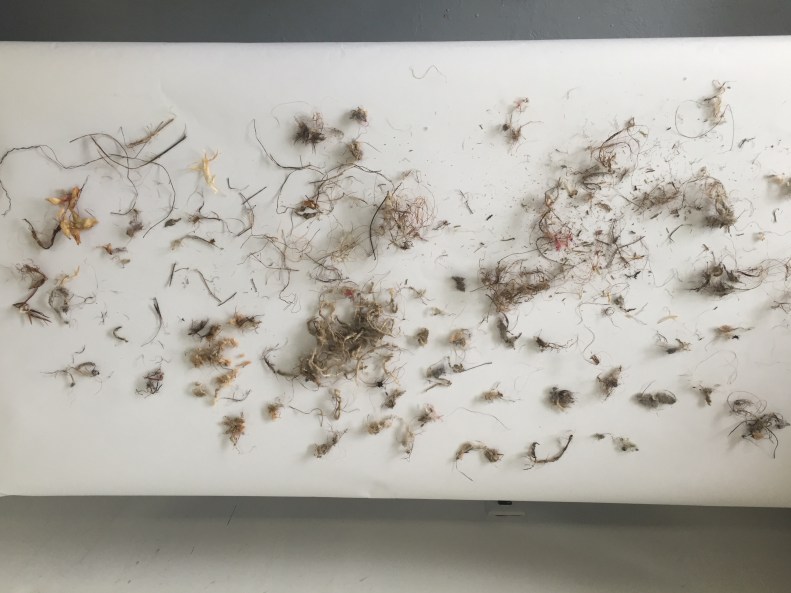
(A deconstructed bird nest for a new art project.)

When we turned the car west, the miles of snowy Sierra pines and stone pushed into greenly-wooded foothills and then into rolling brown scrub of the Pacific. Only a few birds can make a home in all three geographies, as most birds are specialists. As we flew along, something was being pulled from the middle of me, the fragmentation that occurs in the process of becoming not at home.

They would hold him there until I could arrive to say goodbye. Goodbye to who or what I am not sure, but we kept on driving because a monument was in the making.

This is what comes to mind right now as the fog is peeling back over my coastal mountains from which my plane is turning on the runway. East-bound, a one-way route.

John Berger says home is the vertical line between the gods and the buried dead. It’s one that can move along the horizontal of human mobility, but he admits some emigrations disconnect. Nomadic tribes know nothing of this. Home travels with them. Birds neither. They build the most tenuous nests for their most profound task.

I have written here before about needing to be at home in the state of unhousedness. When there is an ambiguous loss with nothing to bury, and no effable one to pray to. This of course means that there is so much glory here: laughter that stung my eyes, the epiphany of childbirth, improbable resonances with strangers, friends who are fixtures at every milestone, family there in an instant, and moments when the art came and made me disappear. Not to mention this light off the ocean. And it all is tied to this home.

I met a homelessness back in China several months before I knew of our move. It was there that I discovered something true that I still have no words for. And in this, I found myself lonely. In consolation, the thick bamboo forest offered me a dark and aching embrace, but there was nothing to hold on to. When will I learn that an attachment to loving moments quickly drains them. This resistance is the artist’s mischief and rebellion — to try to extend the present moment, to give presence, to still a nearing god.

That moment in China, as is happening on this plane, something fell undone into her pond with the splash of a thousand fish about to be dinner. She built a life story inside ten kilometers of that pond, and I was from ten thousand kilometers away. The epiphany of scaffolding, smothering beliefs, and cloying security falling away. And resulted in the terror of a new vulnerability and uncertainty. A deepening of the divine recognition of fragility.

I am making this goodbye a self-indulgent monument, lovingly constructed of the small numbers of my childhood address held by the eucalyptus and coastal sage in the evening breeze yesterday. Also the threshold of every door and every word through which I greeted you and you greeted me, in the company of language-less ghosts who don’t seem to age. It leads one to draft absurd postmortem directions for the body, a future tense when I am no longer present, long after the goodbye. Here also are the wounds of possibility.
IMG_3611.jpg

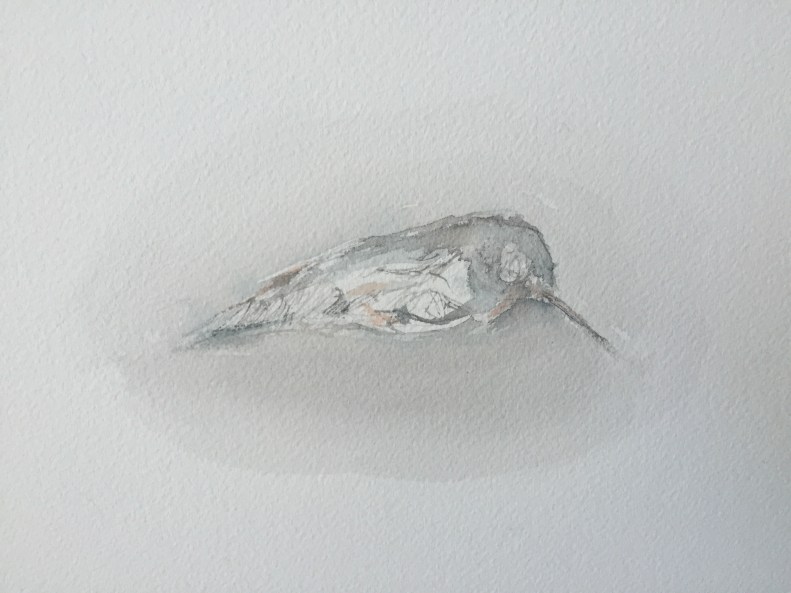
(Detail from my painting of cremated hummingbird, 2009)

“Inhabit vulnerability as a generous citizen of loss.” David Whyte.

“Only when we learn to transcend our earth-bound selves in love, learn to take ourselves not too seriously, do we begin to truly live.” — Karsten Harries
“Already the knowing animals are aware that we are not really at home in our interpreted world.” Rilke

30 Saturday Apr 2016

Posted by summermlee in Aesthetic philosophy, Art, Birds, Nature, Uncategorized

≈ 3 Comments

Tags

art, China, death, immigration, nature, Rilke, Summer Mei Ling Lee

IMG_1118

In the thicket of wild and obscure feelings, I want to have faith in the art of incantation.  Because I can’t but darken and over-organize the more luminous and playful energies in the inward privacy of a mind, I had stopped for so long.

But now there is so much uncertainty to invite me here.

The first impulse is to eulogize the land. To grieve the coastal mountains where I have lived all my life, now overlooking a sea-change, with only hazy constellations to navigate by.

Then the birds of my neighborhood, who will feed them now? Who will notice when Fox Sparrow arrives in the fall and leaves in the spring? Who will extoll how perilous and brave he is?

And then there are all my life-long loved ones…. And the ones who love my sons. The ones like me who don’t migrate and never have.

A few weeks ago, I was deep in the grand-mother land, under the green mountains jutting up like crowded tombstones in the fog of familiarly foreign languages. On one clear day I asked her about the lightening and thunder, and she said no, they are bombing the mountains to make way for roads.

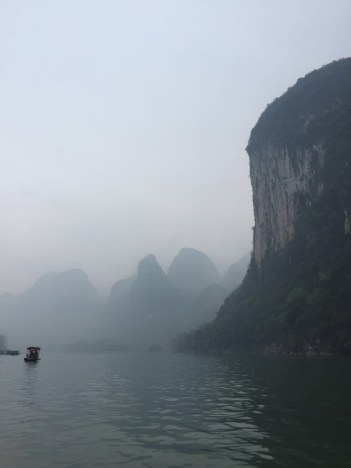
I watched the locals prepare for Ching Ming, as I headed home. How it is that the snap of fireworks can cleanse the space of the afterlife. And yet the ways we keep the never-aging dead here with us. Along a new freeway — more of a battlefield than a road — I passed one ancient mountain where erosion had stripped the earth except for one gravestone. The simple tomb seemingly held up the core of stone and dirt and history. And the other unworldly mountains looked on and agreed. We had floated through those sentinels of ancient ink paintings on bamboo rafts. Our handsome raft-man says his family goes back 1500 years to that village, where now he can no longer survive on our one fare. So we helped him carry the raft upstream, and he let me miserably try to pole us as he so elegantly could. But I kept driving us into the riverbank where a lone woman kneeled among the rows of radishes over several lifetimes.

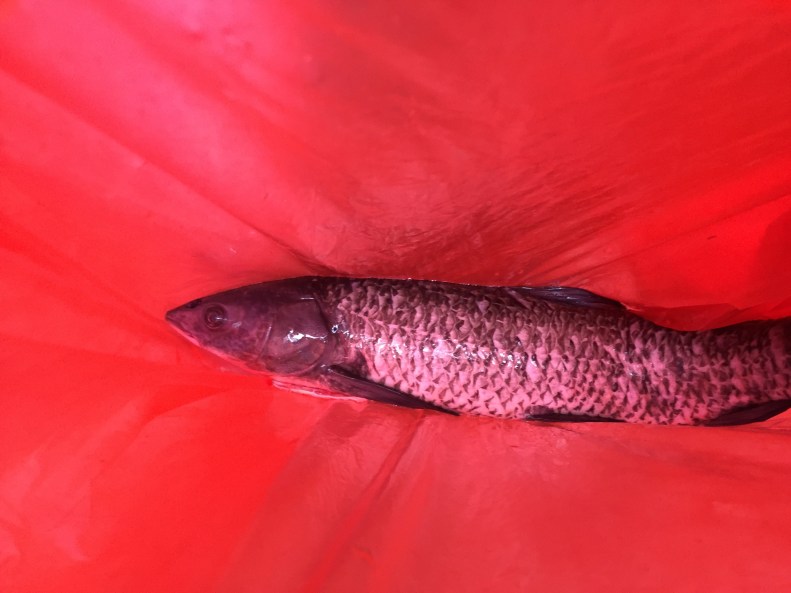
And they would apologize for being simple peasants, their words. And I begged them to know we dream their life. Except I know ours somehow has a deeper horizon — however unchartered, un-ventured and never satisfied. And our pastime of theorizing choices and opportunities when their doors open to another dark courtyard where the chickens scratch. But I sat by her fire and heard the pond language of traveling spring water and ate the fish they just took from there. All while the crickets and stranger frogs hummed oddities. I could place her here in my mind, like how one copes with an untouchable lover on a far-off continent. There I felt a new loneliness that lurked behind me in the bamboo forest, like a luxurious hotel room with no one to share the ache. And it has followed me home.

Because in the same day, I was driving down the street of my childhood home, firmly in an Americana that is iconic and unoriginal and unmoving. The same home that bore an insulated, however splintered child that never moved 30 miles from her birthplace. I arrived on that self-same street not by miracle of imagination but by dint of modernity and privilege and luck and post-human transportation and time changes. There are no words to describe that kind of return.

I cannot also romanticize that grand-mother-land — she is my fleeting sight of the glowing pheasant bird heralded in those ink paintings, digging through garbage behind the hastily-restored Great Wall.

Here is my love of grassy and vegetal air rising off the coastal scrub above the rough surf. The cliffs off which people much braver than I, with only fabric and string faith, jump into those circling updrafts. Here also are the voices of people droning on about sniveling inannities. Trying to escape from their own aching hotel rooms of life, like me.

Her migration was epic like Fox Sparrow’s. Not like ours to a new state. Maybe it is her cells flowing through me, carrying the trauma of torn roots that makes me feel otherwise. She came from so far to be buried here, now part of my mountain over this ocean, not one of those over his river. And I don’t want to go. God please don’t make me go. And I will go. I know and forget that all these minor heartbreaks are good practice for the final one, whichever mountain it will be.

IMG_0954

(That fish.)

“Language simply ceases… The poet enters into silence. Here the word borders not on radiance or music, but on night.” George Steiner

17 Monday Sep 2012

Posted by summermlee in Aesthetic philosophy, Art, music, Nature, philosophy, poetry, Uncategorized

≈ 7 Comments

Tags

art, bird watching, birds, George Steiner, music, nature, Rilke

The outskirts of Tahoe National Forest. I followed the early morning mists of little winged bugs along the edge of a forested reservoir, a small cohort of Audubon’s Warblers chasing them also. With a mind galloping through what if’s and what-nots, I sat next to their cathedral, a half-dead tree once under the water line. Its branches stretched arthritically out towards that which feeds it but also puts it asunder. One by one every species of woodland bird worked its way out of the dense pine forest to that diminuitive tree. They would land with a pause, flit a little, perhaps taking a careless bug in this gathering place, then sail down below to the stony water edge. They were singing me stories of wretchedness, of betrayal and harshness from those who didn’t believe they know better. They described predators with only few survival skills who violate their homes, even when their bellies are far from empty. But they also sung of the little joys of sunlight, improbable births, childlike pauses, and cool reservoir water. Fiercely aching nights and warm morning updrafts. And times when every species and variety of plant and bug is available, and times when their children grew silent in the cold. Warblers, nuthatches, wrentits, chickadees, flycatchers, a few I didn’t know, and a rufous sided towhee — the little delicate species, the singers. My favorites. For years this lasted. I have been devoted to them.

Someone once said that birds remind him of an existence before human civilization, of times outside of wars, laws, buildings. Before human suffering and its impulsive response of further suffering. But these birds were not solely of the sweetness of summer, though they had the resilience and the evolutionary wisdom to live as if that was all they knew. Because today it was summer.

(A photo from my studio, by Shae Rocco).

It seemed my birthright to make an offering. Give something, though those little birds of course needed nothing. Steiner reminds that art is free, gratuitous, not for anything, so much so that every artful creation calls forth an awareness that it might not have been. So somehow turning this moment into a drawing or even writing seemed superfluous, like a scarf around Rilke’s torso. And it is.

Because in this moment I also felt like I might not have been, that everything I’ve done and made might have been otherwise. I felt humble, like the chanters of holy songs, whose talents are free and freely given. So, for whatever reason, because I was perfectly alone, I began to sing. My mom would be excited to know I quietly sang songs from her faith, maybe because that foreign language seemed as intimate and yet dispossessed as the birdsong around me — it contains a hint of something inextricable even as it is unknown. And despite my usual anxiety of needing more, I had a moment of needing nothing, a necessary condition for gift-giving, even if it is song-giving. Towards everything surrounding the birds and all the radiating objects and memories and people I know and knew. And as the scene pulsated, the birds neared me one by one as part of their ritual, into otherwise lethal distances. A Townsend Warbler landed a few inches above my head. After that a Kinglet slid down to the frayed end of a branch four inches from my eyes. Another Audubon’s Warbler almost upon my shoulder. They exerted themselves to me. And so I cease to sing.

” — for here there is no place that does not see you. You must change your life.” Rilke

“When he walks out into the rising dawn or looks out into the event-filled evening and when he feels what is happening there, all situations drop from him as if from a dead man, though he stands in the midst of pure life.” Rilke

17 Sunday Jun 2012

Posted by summermlee in Aesthetic philosophy, Art, philosophy

≈ 3 Comments

Tags

Araya Rasdjarmrearnsook, art, death, Father's Day, Heidegger, phantoms of Asia, Rilke

Rilke says it best that without solitude, the meditative place for the fostering of one’s inner life, there can be no art. No love, either. Love, he writes, is standing guard over another’s solitude.

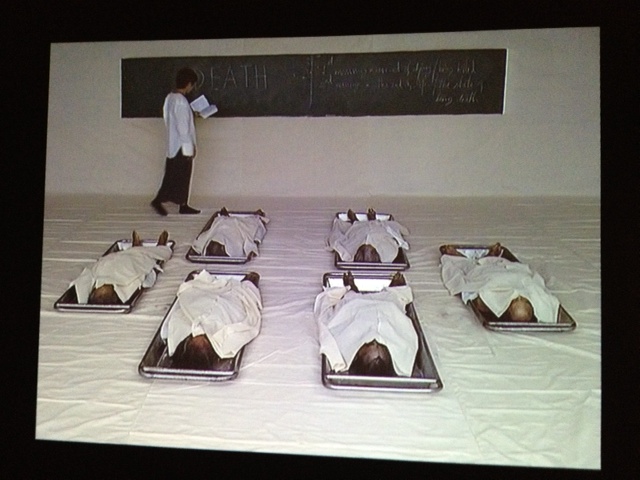
I found a moment to go to the Phantoms of Asia exhibition in the Asian Art Museum, where I encountered this video, entitled, The Class, by Araya Rasdjarmrearnsook. The artist is in essence, lecturing the six dead bodies on death. It is no accident that from where we sit, we are in the same audience as the dead people. At some point, my body will be that corpse lying on a tray. And it is there that I sat uncomfortably energized, feeling that anxiety, or Angst as Heidegger put it, that I am a being-toward-death.

While there is a dark humor pervading this piece, like when the artist asks a cadaver, What was that you said?, it is only a small bit of the profundity that this video reckons with. For me, the fact that the artist, a stand-in for the living, is teaching the dead about death — those who know deeply about it but cannot say —  hits on a facet of human nature that is confounding and all too ubiquitous. The living, in their attempt to colonize and conquer death, deaden and dull life itself.  As Steiner summarizing Heidegger says, those who rob us of the anxiety of death alienate us from life. Because, afterall, “the taking upon oneself, through Angst, of this existential ‘terminality’ is the absolute condition for human freedom.”

My friend, sitting next to me in front of this video, said plainly that she wished she had chosen to see her dead father’s body when she was given the chance, to have closure with his death. I responded carelessly that when she had had the opportunity, her father might have been dead too long and maybe the body was too removed from who he was when alive.

Two weeks later, last night, my undigested subconscious regurgitated before bed, filling my mind with thoughts about my own father. Yes, it’s Father’s Day today, but I haven’t thought of him on the past 3 or 4 such occasions. As some of you know, my ending with my father was not fairytale, but instead riddled with anger, doubt and a feeling of homelessness. But I did have meaningful time with him after he died. Although I was policed and hurried out of my vigil by his new vulturous step-family, I had a moment of loving contemplation over his peaceful body.

I realized last night that this time with him was one in which I could reflect on his life and in those incredibly condensed minutes, to feel the totality of him part from my totality. But last night I also realized that in those moments I worried about him as he faced his abyss. That I heard how he was anxious moments before he died. And I wish something or someone was with him, that he wasn’t totally alone in his leaving. Because it is a leaving that is utterly alone, and utterly into the unknown. And because of all that he was to me, for better or for worse, and because he faced this unspeakable time alone, probably doubting love, like we all might, I wish someone stood guard over him. I wish him love.

And maybe that’s all we can do for the dying — and we are all dying — because to do anything else is to rob one of life: “The inalienability of death — the plain but overwhelming fact that each must die for himself, that death is one existential potentiality which no enslavement, no promise, no power of ‘theyness’ can take away from individual man — is the fundamental truth of the meaning of being.”

In solitude, most critically felt at death, we experience freedom. Rilke’s artists and lovers of the everyday seem to know that freedom is contingent on an acceptance of our mortality and a quotidian comfort with the unknown — and even to let go enough to stand guard over someone else’s solitude. A constant homecoming, if we are brave enough. I’m not sure my father was brave enough until he was forced to be, and god knows I am not either.

“‘The wandering, the peregrination toward that which is worthy of being questioned, is not adventure but homecoming.’ Man, in his dignity, comes home to the unanswerable.” (Steiner on Heidegger)

Today’s Issue: Rilke’s Great Melody

19 Monday Sep 2011

Posted by summermlee in Advice, Aesthetic philosophy, Art, Nature, Uncategorized

≈ Leave a comment

Tags

art, cotton wool, moments of being, nature, Rilke, Virginia Woolf

A crossing guard marches into the gauntlet of the intersection in the Mission – an old woman but the neon sign is her shield. The children are her minion. And the grizzlied fervent of traffic ceases, as they would not dare to do anything but deign to her authority.

A young tomboy, flannel, piercings, tattered black jeans, skips down the street. Thick, outdated rims hold equally thick prescription lenses and belie the secret behind the facade. I hear her skateboard crash to the ground as I drive by.

A man is eager to please over the telephone. I agree to his permutations. He finds joy in his acquired expertise though he gets paid the same as his uninterested colleagues.

My babe holds a ravaged field mouse in her hand, petting it, praying for it. Nobody knows the natural lifespan of a field mouse. Just as this one does after a few more strained breaths, they meet death so early, so often.

During a pause in conversation, my friend puts her chin on her hand and lets the silence flow past the point of discomfort. I feel my heart radiate and look up from the floor — she is looking at me, and she is content.

A struggling, Vietnamese immigrant holds a bag of bread in her hands. She tosses it up in delight to the rain of pigeons cascading down around her.

Today’s Advice: “I feel that I have had a blow; but it is not, as I thought as a child, simply a blow from an enemy hidden behind the cotton wool of daily life; it is or will become a revelation of some order; it is a token of some real thing behind appearances… From this I reach what I might call a philosophy; that behind the cotton wool is hidden a pattern; that we – I mean all human beings – are connected with this; that the whole world is a work of art; that we are parts of the work of art.” Virginia Woolf,  “A Sketch of the Past.”

Enter your email address to subscribe to this blog and receive notifications of new posts by email.

Join 619 other subscribers

Recent Posts

  • “Experimenters in the passages between worlds.” Vinciane Despret, Au Bonheur des Morts
  • “The terrifying groundlessness, the eradication of all violences. To be embraced by that which doesn’t know us and in that unknowing caresses us and truly loves us. We might become anything at all, something wildly other than what we are encountered by. A world that truly loves us by not presuming what we want or what shape we will take before we show up… We will be held when we are not known from the start.” — Dr. Marquis Bey
  • Images dream within us, a reverie is a world of expansion.
  • “For the natural world, the ethical responsibility is that being alive gives existence to others.” Vinciane Despret
  • “We meet in the freedoms of each other.” – Takeyoshi Nishiuchi

Archived Posts

Blog at WordPress.com.

  • Subscribe Subscribed
    Unwanted Advice: Reflections from a Self-Appointed Life Counselor
    Join 215 other subscribers

    Have a WordPress.com account? Log in now.

  • Unwanted Advice: Reflections from a Self-Appointed Life Counselor
    View site in Reader
    Manage subscriptionsSign upLog in
    Report this content
    Collapse this bar
Loading Comments...