• About

Unwanted Advice: Reflections from a Self-Appointed Life Counselor

~ Caminante, no hay camino. Se hace camino al andar. Wayfarer, there is no way. You make a way as you go. (Antonio Machado)

Unwanted Advice: Reflections from a Self-Appointed Life Counselor

Tag Archives: immigration

The Dialogue with the Dead Cannot Stop Until They Hand Over the Future that has been Buried with Them. — Heiner Müller

18 Friday Aug 2017

Posted by summermlee in Aesthetic philosophy, Art, Birds, Nature, philosophy

≈ 4 Comments

Tags

China, Chinese Bone Repatriation, death, Derrida, George Steiner, Home, immigration, migration, philosophy, Summer Mei Ling Lee, Takeyoshi Nishiuchi, Toisan, travel

I am not ready to talk about their immigrant bones, or the difficult stories that each bone box tells. And besides, most are missing, disappeared on the wayward routes returning home, displaced even after death. Or they are in almost-forgotten fields marked by stones that don’t hold names anymore, nonetheless narratives. Sometimes just numbers, sometimes just the memory held by someone’s grandson who saw him bury them over there under there somewhere. And in there could have been my non-existence. As we peered into one unearthed bone urn, the top exposed to the sky cracked open by neglect, he said, there is the way into the underworld.

I need to listen.

I am aware that each word here is an act of listening, opening a new space for the next word. And of my failings of projections and memory and desire and convention, so that some words spill out overwhelmed by chatter and are already dead. Listening, like love, comprises a reverberation between self and other, where words and acts seem to fall out gracefully and illuminated and are received as a welcomed guest.

“It takes two freedoms to make one.”

Even if my grandmother has been gone for twenty years, she speaks to me in a certain way. When she was here she couldn’t explain anything about her childhood or her crossing to the United States, except that she had a favorite brother who died young, she didn’t know how.

By dint of so many unlikely arrangements to explain here, she brought me last week to a 700 year-old village in southern China. A group of villagers greeted me with their own generous hospitality to take what evidence I had and prove it was her home. Easily, she could’ve been from a village destroyed long ago, or one where no one could help. Instead, she knew somehow. What they wanted of her to want of me to know. So I could sit in front of her burned brick house with the gift of her brother in a bone box of a suitcase I brought from his grave in Chicago. So I could witness as nothing and everything took place. I had given nothing. In a long string of no’s, I just had to say yes.

fra angelico prado 3

(detail from Fra Angelico’s Annunciation, Prado)

They asked me if it felt like my homecoming, and it didn’t. I don’t belong there in any way, or really anywhere these days.  For now, I feel I belong to her retreating voice hurled through different time zones. Or when my sons resign their sleepy bodies near mine. It wasn’t my homecoming but it was his, and hers to give him. At the modest home’s ancestral altar, she had returned her sweet, young brother to where he had just left months before he died, at age 21. He knew of no other home. Even if that year was 1924, it was last week.

In that moment of offering inside my grandmother’s childhood home, and earlier on that slave mountain where we hiked for hours with that suitcase to their humble tombs, I asked about home. The calls of the flightless geese from the farms surrounding the village were deafening. Eventually, I understood that he belongs with my grandmother on her mountain overlooking this ocean. Some migrations are irreversible.

There is a lot of fear in listening, of unanswerability, of surrendering to silences too long to bear. In her words, it is the absence that the child can tolerate from the mother and no longer. It wants to choose a withdrawal into a security rather than the uncertainty of new countries, new losses, a new home. Maybe in those spaces created by fear is where unhousedness began, because security is a delusion we need to rest in.  The beginning lines of a tragedy. But a great awakening is at the bottom of a tragic flaw. Tragedy reminds us of our human dignity, opening us up to all possibilities, whereas fear has us only hear what we don’t want.

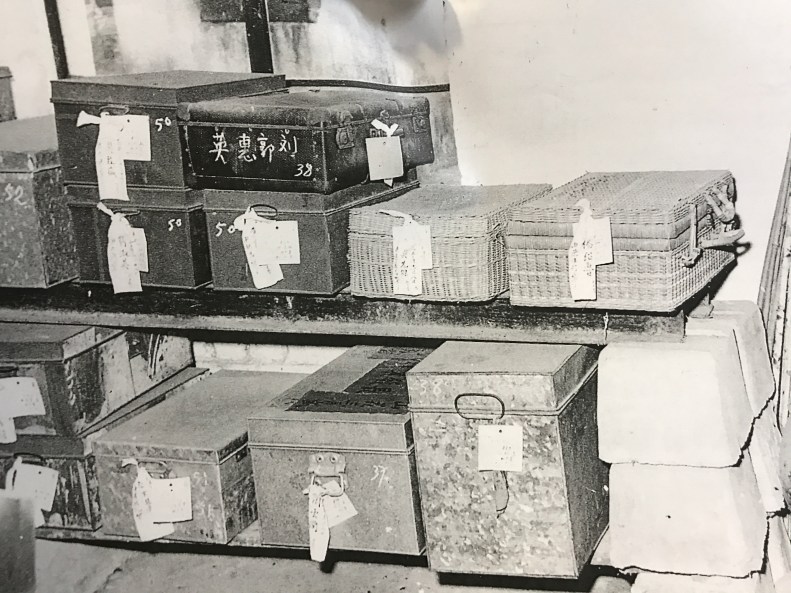
In southern China where my grandmother is from, more people have left than live there today. Thousands of years ago, her earliest Han ancestors brought their family bones when they migrated from the north to the south. Still now they practice a second burial tradition, where years after the first funeral, bones are cleaned and moved to an ancestral tomb. During the first waves of overseas immigration, arduous arrangements were made for those who died abroad to have their bones returned to their ancestral villages, tens of thousands of bone boxes crossing oceans and borders. But then history changed and almost all of the bones don’t come back anymore. Some I visited are stuck in transit and have been for a hundred years. The odds they will go back to their ancestral homes are near-impossible, but they are a living-dead memorial that continues to cry out for all of us, I want to go home.
IMG_9786

(Bone boxes in Tung Wah Coffin Home, Hong Kong, awaiting repatriation.)

So I can forgive those who won’t go, won’t listen, whether they immigrate or not. They don’t go, because maybe the risk is just too much unknown, too much disappointment, the fear that some pain is bigger than us. The greater the connection, the greater the vulnerability when it becomes absent. When I think of moments when I didn’t think I would survive, I remember the scary way my son was brought into the world, when I wanted to be nowhere near what I was experiencing. After losing a lot of blood, I asked my mom to not let me cross over. I discovered then that the over there is so close. Even though I bore it, it was too much to bear.

An angel appeared soon after and spent time with me.

I expected she would say, oh stop, you weren’t even close to going over.

Instead she said, you were close to there, and you could have gone over. But, she added, I know you would have returned. It wasn’t your time. And it shifted something and the nightmares ended, but I understood. We all have our mundane annunciations.

“The wisdom of love is that it isn’t always safe but it is always truthful.”

All of them, alive or in bone boxes, are telling me stories of un-home and home, and underwriting my own restless search for one. Home is certainly not in these small houses of cautionary being, toppled by each new intrusion of life. If so, my sons would not be here. I wouldn’t be here either, along with all the moments when immense gratitude and beauty overwhelmed me. Home seems to transmute from the relentless feeling of loneliness and displacement. Nathan said maybe we hover home, and reminded me that home, if it exists, enters only in the here and now and leaves. And it does seem to be a here of reception and not fear, even if the guest turns despotic or worse. “But without the gamble on welcome, no door can be opened when freedom knocks.”

Who knows what I will hear next.

In leaving China back to my temporary un-home, I followed her original route over an uncertain ocean. And I could imagine their bone boxes passing, going the other way. They pass by me, holding things I realized I had also lost, maybe continually losing as I keep living, and they are returning to the spaces I just left.

The same man who taught me most directly about tragedy, and therefore the beautiful fragility of presence, gave me a life-long address for this route: In welcoming a guest, you have found your home.

“Such a caring for death, an awakening that keeps vigil over death, a conscience that looks death in the face, is another name for freedom.” — Derrida
IMG_9503.jpg

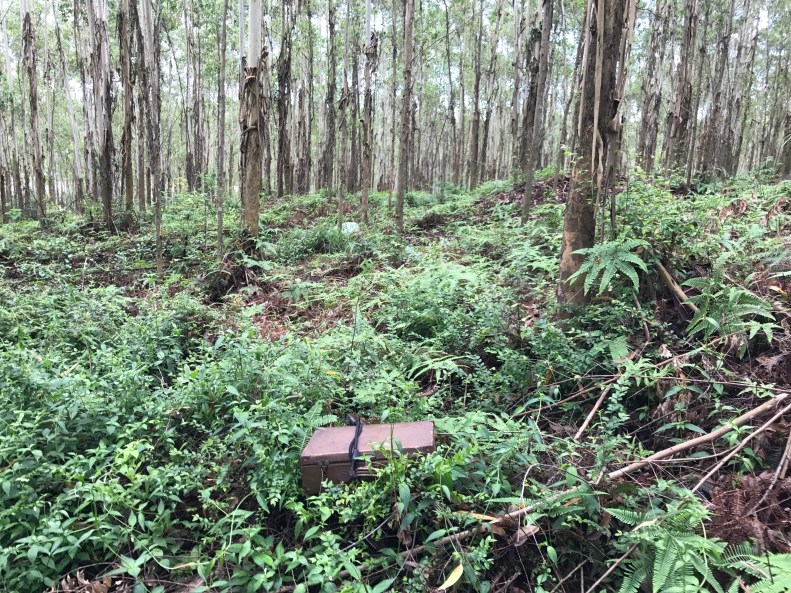
Dai Wan Village cemetery, Toisan.

Welcome home to un-home.

20 Saturday May 2017

Posted by summermlee in Aesthetic philosophy, Art, Birds, Nature, philosophy, poetry

≈ 3 Comments

Tags

art, birds, Chicago, Chinese Bone Repatriation, death, Fra Angelico, Home, immigration, Marie Howe, migration, philosophy, poetry, Summer Lee, Summer Mei Ling Lee, The Annunciation

Non Omnis Moriar

The first bird I met here was half-dead. A Cape May Warbler, my first ever. It had collided with a Chicago building like thousands that do every year. It stood frozen still on the rooftop as I toured the 11-story, urban school for my son, as if warning me of the impending experience there. The Cape May is one of five million migrants and dwindling, but in this season, they still show up as clouds on weather radars every evening as they take into the darkness and as they rest to feed by sunlight.

They must survive the buildings, but also the endless Midwest miles of recently invading soy and corn fields, where there is ironically no food for them. They trace along the lakefront, which is where I found my cathedral among the starving and vulnerable. This church is simple, and the faithful are sensitive souls as they gently but enthusiastically ask me, did I see the black-throated blue warbler over there?

It’s true that in the end love is why. And also, as she crystallized in fragile words, nothing brings so much pain as love.

A third of the first shipment of bone boxes from the United States back to China were empty. Most immigrants back then wanted to be buried in their ancestral homes. They were also not welcomed here. Despite vast impoverishment, the family associations made arrangements to clean the bones and ship them on a 30-day ocean journey via Hong Kong, from where they would be delivered into China. The empty ones were soul-summoning boxes, when their were only names, when bodies could not be located. Something had to migrate home.

Some never made it back. Some are stuck in transit, in boxes in a storage house in Hong Kong, where they opened an empty one for me. When I saw it, I cried uncontrollably. And when I came to, I remembered Faure’s requiem.

Some are still waiting in my hometown, like my great grandmother. And here I had thought the Chinese village name on her tombstone was for biographical purposes only. When in fact, like so many others, it is an unkept promise of a more final return home.  No matter how many children they birthed and raised on this soil, the burial here is temporary. Address labels with no postage, the stone mark of their villages is a question mark of an eternally unanswered request, beseeching unwitting visitors, please take me home. The village name, possibly of a village that doesn’t exist anymore, is a way the dead stay alive. Yes, never dead if your progeny visits and honors you. After all, if someone remembers you, you still exist. But here it is not ancestral worship either, just an endless restlessness for homecoming.

6500294f6f1bc41c81d2bdba49049b3e
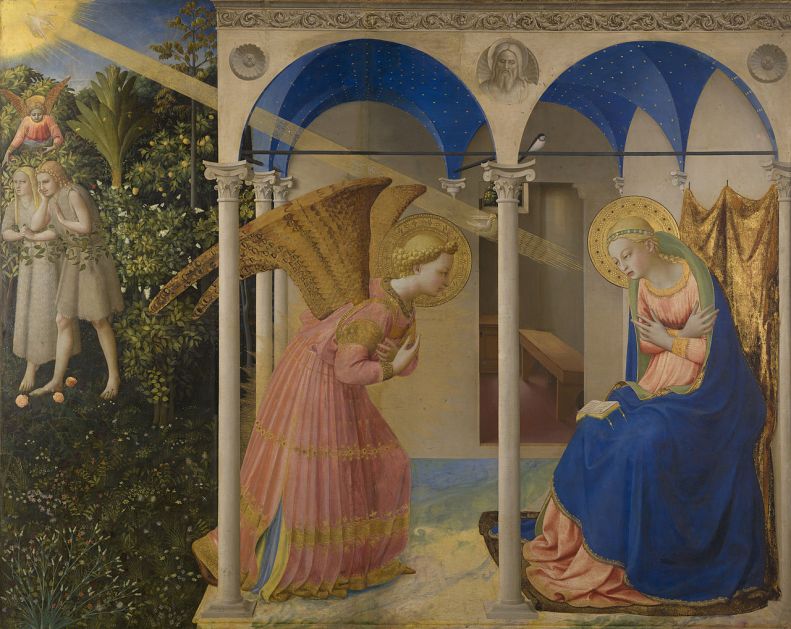
(The Annunciation, Fra Angelico, 1425-6)

The neighbor in Chicago to the right voted for Trump and the grumpy one on the left asked to take down my bird feeder because it was bringing woodpeckers to her yard. I never saw a woodpecker at my feeder in California, who knows why not, but there are four kinds here. You wouldn’t understand what it is to stop feeding the birds of my home. There is no one now to track their yearly changes as well as their disappearances. To no longer hear their version of truths about migrations and the space they know between heaven and earth. So I set out to ask the strange birds of my new home.

It is cold and rainy as I hold my camera up to these birds. We join together in the hopeful uplift of these visitors, knowing also they won’t be here much longer. And I realized maybe this is the reason I was brought here, and why I must now live between two homes.

It was also cold and rainy when I found him at the nearby cemetery in an unmarked grave. The Hong Kong assignment led me to review my grandmother’s INS interrogation from 1925. In it, her father describes burning the documents of her oldest brother at his gravesite. To erase any reminder that he had died in Chicago, the year before in 1924, at the age of 21 of a sudden illness that is of poverty. The confused clerk looked at me strangely, the white lady who presented his romanized Chinese name, but soon enough they found him on a hand-written map. Minutes later, the groundsmen took me to a field and paced off the coordinates — and there in the middle of fucking Chicago, I had found his bones.

She said, it’s as if I had to become displaced to find my family.

(In my imagination my grandmother’s family experienced one Chicago winter because thank you god they quickly moved to San Francisco.)

And if you have ever uttered a word thinking your dead would hear, you understand the birds. And you also know that all real happiness sets you on the edge of loss. As Judith and I ended our two hour phone call, a Cerulean Warbler flitted across my driveway. It was here and gone so quickly, it exists in the realm of doubt. But somehow my grandmother knows I am listening.

____________________________________

ANNUNCIATION

Even if I don’t see it again – Nor ever feel it
I know it is — and that if once it hailed me
it ever does–

and so it is myself I want to turn in that direction
not as toward a place, but it was a tilting within
myself, as one turns a mirror to flash the light to where it isn’t — I was blinded like that — and swam
in what shone at me

only able to endure it by being no one and so specifically myself I thought I’d die
from being loved like that.

— Marie Howe

“Already the knowing animals are aware that we are not really at home in our interpreted world.” Rilke

30 Saturday Apr 2016

Posted by summermlee in Aesthetic philosophy, Art, Birds, Nature, Uncategorized

≈ 3 Comments

Tags

art, China, death, immigration, nature, Rilke, Summer Mei Ling Lee

IMG_1118

In the thicket of wild and obscure feelings, I want to have faith in the art of incantation.  Because I can’t but darken and over-organize the more luminous and playful energies in the inward privacy of a mind, I had stopped for so long.

But now there is so much uncertainty to invite me here.

The first impulse is to eulogize the land. To grieve the coastal mountains where I have lived all my life, now overlooking a sea-change, with only hazy constellations to navigate by.

Then the birds of my neighborhood, who will feed them now? Who will notice when Fox Sparrow arrives in the fall and leaves in the spring? Who will extoll how perilous and brave he is?

And then there are all my life-long loved ones…. And the ones who love my sons. The ones like me who don’t migrate and never have.

A few weeks ago, I was deep in the grand-mother land, under the green mountains jutting up like crowded tombstones in the fog of familiarly foreign languages. On one clear day I asked her about the lightening and thunder, and she said no, they are bombing the mountains to make way for roads.

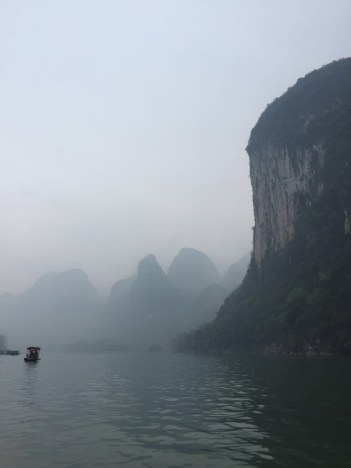
I watched the locals prepare for Ching Ming, as I headed home. How it is that the snap of fireworks can cleanse the space of the afterlife. And yet the ways we keep the never-aging dead here with us. Along a new freeway — more of a battlefield than a road — I passed one ancient mountain where erosion had stripped the earth except for one gravestone. The simple tomb seemingly held up the core of stone and dirt and history. And the other unworldly mountains looked on and agreed. We had floated through those sentinels of ancient ink paintings on bamboo rafts. Our handsome raft-man says his family goes back 1500 years to that village, where now he can no longer survive on our one fare. So we helped him carry the raft upstream, and he let me miserably try to pole us as he so elegantly could. But I kept driving us into the riverbank where a lone woman kneeled among the rows of radishes over several lifetimes.

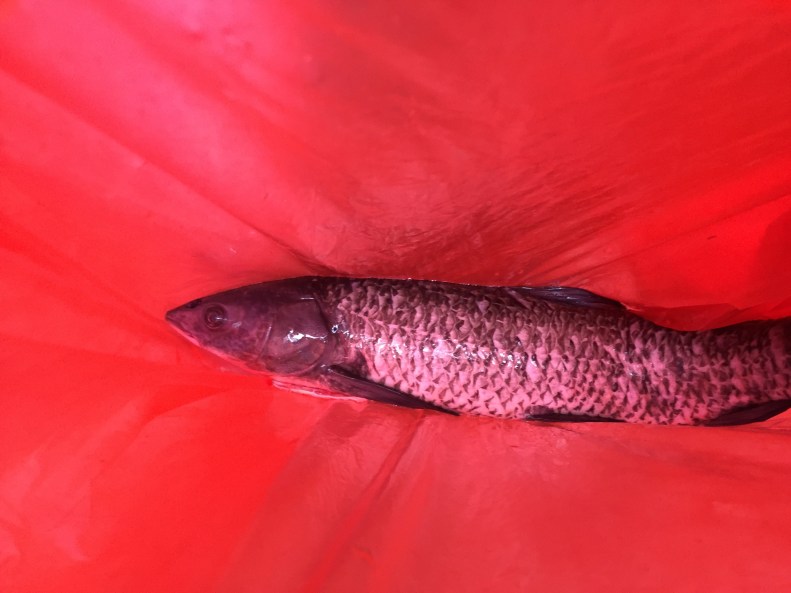
And they would apologize for being simple peasants, their words. And I begged them to know we dream their life. Except I know ours somehow has a deeper horizon — however unchartered, un-ventured and never satisfied. And our pastime of theorizing choices and opportunities when their doors open to another dark courtyard where the chickens scratch. But I sat by her fire and heard the pond language of traveling spring water and ate the fish they just took from there. All while the crickets and stranger frogs hummed oddities. I could place her here in my mind, like how one copes with an untouchable lover on a far-off continent. There I felt a new loneliness that lurked behind me in the bamboo forest, like a luxurious hotel room with no one to share the ache. And it has followed me home.

Because in the same day, I was driving down the street of my childhood home, firmly in an Americana that is iconic and unoriginal and unmoving. The same home that bore an insulated, however splintered child that never moved 30 miles from her birthplace. I arrived on that self-same street not by miracle of imagination but by dint of modernity and privilege and luck and post-human transportation and time changes. There are no words to describe that kind of return.

I cannot also romanticize that grand-mother-land — she is my fleeting sight of the glowing pheasant bird heralded in those ink paintings, digging through garbage behind the hastily-restored Great Wall.

Here is my love of grassy and vegetal air rising off the coastal scrub above the rough surf. The cliffs off which people much braver than I, with only fabric and string faith, jump into those circling updrafts. Here also are the voices of people droning on about sniveling inannities. Trying to escape from their own aching hotel rooms of life, like me.

Her migration was epic like Fox Sparrow’s. Not like ours to a new state. Maybe it is her cells flowing through me, carrying the trauma of torn roots that makes me feel otherwise. She came from so far to be buried here, now part of my mountain over this ocean, not one of those over his river. And I don’t want to go. God please don’t make me go. And I will go. I know and forget that all these minor heartbreaks are good practice for the final one, whichever mountain it will be.

IMG_0954

(That fish.)

Enter your email address to subscribe to this blog and receive notifications of new posts by email.

Join 619 other subscribers

Recent Posts

  • “Experimenters in the passages between worlds.” Vinciane Despret, Au Bonheur des Morts
  • “The terrifying groundlessness, the eradication of all violences. To be embraced by that which doesn’t know us and in that unknowing caresses us and truly loves us. We might become anything at all, something wildly other than what we are encountered by. A world that truly loves us by not presuming what we want or what shape we will take before we show up… We will be held when we are not known from the start.” — Dr. Marquis Bey
  • Images dream within us, a reverie is a world of expansion.
  • “For the natural world, the ethical responsibility is that being alive gives existence to others.” Vinciane Despret
  • “We meet in the freedoms of each other.” – Takeyoshi Nishiuchi

Archived Posts

Blog at WordPress.com.

  • Subscribe Subscribed
    Unwanted Advice: Reflections from a Self-Appointed Life Counselor
    Join 215 other subscribers

    Have a WordPress.com account? Log in now.

  • Unwanted Advice: Reflections from a Self-Appointed Life Counselor
    View site in Reader
    Manage subscriptionsSign upLog in
    Report this content
    Collapse this bar
Loading Comments...