• About

Unwanted Advice: Reflections from a Self-Appointed Life Counselor

~ Caminante, no hay camino. Se hace camino al andar. Wayfarer, there is no way. You make a way as you go. (Antonio Machado)

Unwanted Advice: Reflections from a Self-Appointed Life Counselor

Tag Archives: Virginia Woolf

“The terrifying groundlessness, the eradication of all violences. To be embraced by that which doesn’t know us and in that unknowing caresses us and truly loves us. We might become anything at all, something wildly other than what we are encountered by. A world that truly loves us by not presuming what we want or what shape we will take before we show up… We will be held when we are not known from the start.” — Dr. Marquis Bey

06 Monday Jul 2026

Posted by summermlee in Aesthetic philosophy, Art, Birds, Nature, philosophy, Uncategorized

≈ 1 Comment

Tags

art, Étienne Souriau, Being, birding, birds, birdsong, birdwatching, Crossings, death, Dr. Marquis Bey, homecoming, nature, painting, philosophy, Photography, Summer Lee, Summer Mei Ling Lee, tragedy, travel, Vinciane Despret, Virginia Woolf

Last year, there were vireos, grosbeaks, and warblers raining down on me with their song, from their canopy above a steep climb through the pine and aspen canyon, Ouray of the San Juan Mountains. This year a fire erased it all and was still burning as we flew out above the plumes, our pilot making a rubbernecking route as we departed. As we peered out down onto the devastated mountains, my sons held my hand as we ascended, a tradition they still abide by. And I saw the woman behind me from the corner of my eye, crossing herself.
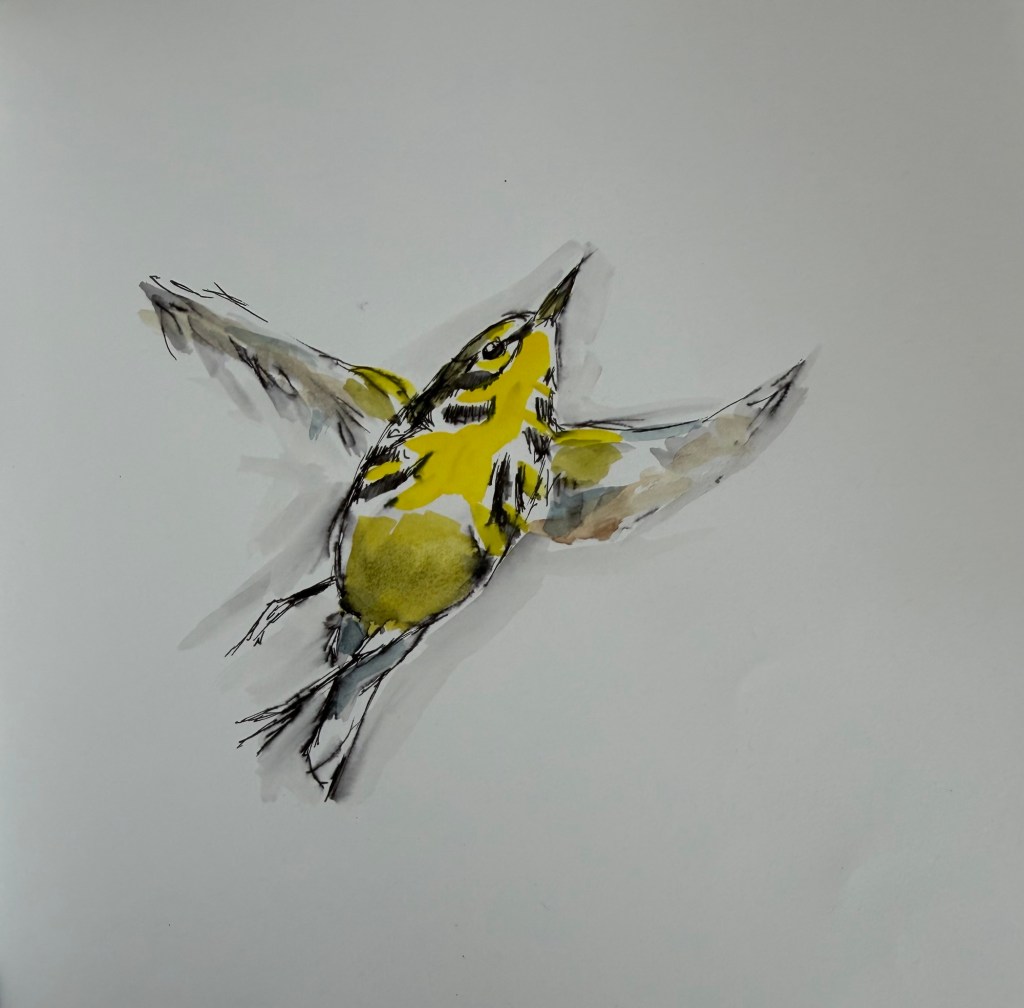
Prairie Warbler, 2025, by Summer Mei Ling Lee

Joseph drove me from that place I freed myself from, where he was a day laborer. He had to change his shirt before he got into the van, where I waited in my impatience to break away. I was reborn like when I collected my kids and my things and my self worth and flew away from her smoldering apartment.

Joseph apologized for keeping me waiting and asked where I was going. Though he meant which hotel, I said I wanted to see his Zambia. Minutes later we were deep in conversation in the local open market. The open aluminum and wood stalls were humming at mid day with babies sleeping in the piles of vegetables and housewares, and women walking in groups with their bags and baskets. I bought vegetables from his aunt, peanuts from a man and his son, and I can’t remember what else, but in a short time his van was full of food. I told Joseph to bring it all home to his wife, what would I do in a hotel with any of that anyway. I was down to my last $20 USD in kwacha, a week’s wages for the better off there, when Joseph said he had understood me now. The last spot he took me was under a tree where women sat on the ground with some vegetables. He told me these women had to take a bus for two hours to arrive to that patch of dirt at the end of the market, to try and sell what little they had. I said for him to pick someone and give her my last bit of money. In a few minutes, he returned to the van with a fistful of onions he threw onto the pile of food. He said the woman was very grateful, told him to tell me thank you, but she had to give me something in return.

I would understand soon that many Zambians were orphaned young, and that famine lingered. They didn’t come out and tell you this directly but a few sentences in and they were missing their mother who was a good church singer, who even while dying asked her son if he had eaten something.

During our drives around the area, Joseph became less a guide and more a confidant. Joseph had some disappointment with his wife, the unfairness at his workplace, the different ways Zambians did things. How his young parents got sick, one after the other, and died. One evening, a story came up that he said he hadn’t told anyone. He had been taken in by an aunt who was mean, making him choose between school and food. He told me more than a few times that he knew what hunger was. He said one night when he was a boy he was dreaming and a voice told him to get up and walk the road. It was 2 am but he did it anyway, along a red dirt road just like the one we were driving along. Pitch darkness except his headlights and our imaginations. He said that he walked about a hundred yards and found coins lying in the dirt. It was enough to let him eat the next day. The next morning no one believed him and he didn’t try to convince them. I said it was an angel, thinking silently to myself about his parents somewhere in a different mode of existence. He said from then on he started to believe in a god, that there was something bigger than all of us that we couldn’t make sense of. His god was loving.

Ten years ago when I had to move thousands of miles away from my native land, I found a nest that fell to the ground in the yard of the home I was about to leave, I separated the fibers and fluff of the nest and sewed them into fifty cards and sent them to everyone across the country and the world who had given me a sense of home. When I told her about the project, she told me, you had to become displaced to find your family.

Soon after my time with Joseph, I found myself on four continents within a few months, and home became that tiny piece of driftwood I once photographed, where a Common Tern perched forty miles out at sea with no hint of land anywhere on the horizon.

Adrienne said this is where the utter vastness of patterning arrives to us in 3D rendering. I said Virginia Woolf called it the hidden pattern behind the cotton wool of daily life. I droned on about miracles, and she said: yes, they occur in the crossing, when the pattern breaks through and reminds us of what we are normally cut off from. And then she sent me a poem where multiple realities are happening all at the same time, the most superficial one being a young girl declining a stranger’s invitation.

Are there unlived lives?

Joseph tells me in the same sentence that he is ready to leave the earth, and that he adopted and is raising two orphans of his own.

And yesterday, emerging from the smoke of the western Colorado fires, the Black Grosbeak and the Yellow Warbler alight upon branches within feet of each other and despite everything, sing each other into being.
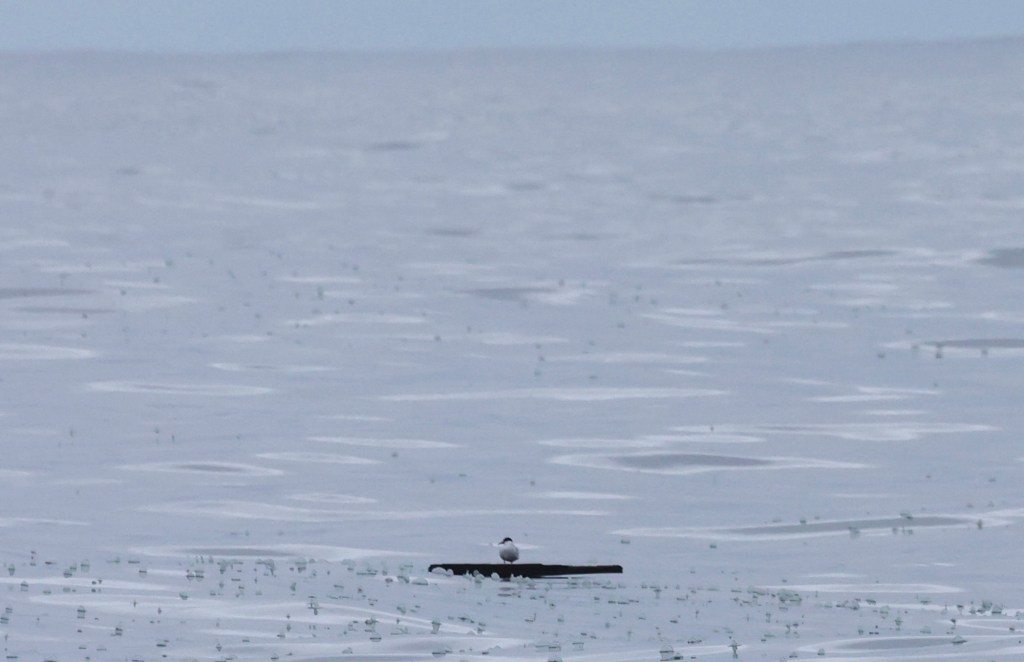
Common Tern, 40 miles west into the Pacific Ocean by Summer Mei Ling Lee, 2026

“Summer’s ardor was confided to silent birds and due indolence to a priceless mourning boat through gulfs of dead loves and fallen perfumes.” Rimbaud

21 Saturday Apr 2018

Posted by summermlee in Aesthetic philosophy, Art, Birds, Nature, philosophy, poetry, Uncategorized

≈ 3 Comments

Tags

art, birds, birdwatching, Chekhov, death, Joan Jonas, Love, merlo, Ouse River, Rimbaud, river, Summer Lee, Summer Mei Ling Lee, travel, Virginia Woolf

Fox Sparrow is still here. But I know it’s soon. Almost now.

I have seen bodies float down that river. And I have let them pass, even though they took parts of me, right from the heart.

We stand at the banks, birdwatchers most of us.  An improbable fellowship of a strange generosity. They will run to tell me they just spotted something beautiful and rare, just over there. They delight in sharing stories of the ones they saw many years ago. And I delight in every one with them as if I had been there. How words awaken that. Sometimes a personal story will spill out like a loose feather, like why he remains unemployed. How after her mom died a slow death,  she and her sister call each other about what miraculous birds they have seen that day. One boyish teenage-girl alone for years under a tree told me which of two almost identical species of obscure birds was way up there, just by hearing its call.

Once I walked silently into a group of men bowing their heads crying, their cameras off as if in mourning also. It seemed one of them had been expecting me, because he plainly said that he had accidentally scared a deer into that river over there and it drowned.

Many years ago, he had asked me about Virginia Woolf’s drowning before he took his own life and so I was determined to walk to that river, to see if somehow my response was at all valid.

After a long hike through pastures outside the village, I walked her to the muddy embankment of the brown river running. She has been in and out of my life, even the last few lives too, and when she felt it she didn’t trust it. But there we were. A long curve of river surrounded by lifeless and flattened swales of fields saddled by fog. After a moment of taking in the dull scene, a white thing in the distance pierced through the grey. A majestic swan aflight squeaked its wing feathers in a steady beat, and glided the course of the river past us, down out of sight. Flight and not stones, even if fear changes her mind. The birders among us will understand.

Because this bird knew where I needed to be. In this word. Sometimes I lose my patience with it all, as if I could turn the direction of an entire sentence. But life just runs over my impertinent hands and through my doubtful fingers. And will eventually take her too. And another bird might drift by, or flit onto a branch right here along the way. On its own time.

Like Fox Sparrow who is still here. He knows it is now. He also knows it is not.

(Joan Jonas, performance entitled “Merlo,” 1970’s Tuscany.)

“The birds were fluttering in and out of the open door; the photographs were tumbling over the tables; and, lying before a large open window, Mrs. Cameron saw the stars shining, breathed the one word “Beautiful,” and so died.” — Virginia Woolf.

______

“With total rapture and delight he talks about the birds which he can see from his prison window, and which he never noticed before, when he was a minister. Now of course, after he’s been released, he doesn’t notice the birds anymore, just as beforehand. In the same way you won’t notice Moscow when you actually live there.” — Vershinin in Chekhov’s The Three Sisters.

“You’ll see how much your little bird has changed.” — Edith Piaf

03 Sunday Feb 2013

Posted by summermlee in Aesthetic philosophy, Art, Birds, music, philosophy, poetry

≈ 9 Comments

Tags

art, Edith Piaf, French, high school, Jacques Prevert, memoir, philosophy, teachers, Virginia Woolf

Not much taller than the desks, she stood unblinking in front of the students, hopping and gesticulating wildly to convey her lesson to her jaded audience. In this of her many dramatic monologues with occasional spittle, she introduced a new topic, rudiment to understanding French, and maybe even life: existentialism.

We thoroughly read Camus, en français, and over time she espoused to her sheltered and callow high school students that every choice one makes has a consequence, and the absurd man is one who acts out of habit, shirking responsibility and awareness for the events and choices that come to comprise one’s life. We listened to Edith Piaf, learning her lyrics by heart. Having heard no other voice so utterly pained, wretched even, but strong and moving, I was taken. She grabbed me at the end of class after the rest of the students had drained out of the room, and for whatever reason, recounted that during her first teaching job at an elementary school, an air force officer entered her classroom and in front of her 25 students, handed her an envelope. In it was a piece of paper describing in the most coldly succinct language that her husband’s plane had crashed on a training flight nearby and he was deceased. There also in the envelope was his metal wristwatch, the only personal item with him and recovered from the crash, cracked with hands frozen at the exact moment of his death. With a teacher’s salary and two young children, she said Edith Piaf’s tragic life and inextricably-linked music became anthem to the fact she had no other choice to move on.

Her philosophy must have been a double-edged sword for the ESL students also under her care at the high school — the dregs, the few brown and black kids bussed into an otherwise privileged school of white kids dropped off by luxury cars. But there was no less, if not more, passion for these kids as there was for her sniveling French students. When her Edith Piaf admirer became Senior Class President, she arranged a secret meeting, knowing my duties as student organizer of the school prom. She said she had a young couple in her ESL class who wanted to go to the prom but could not pay the price of ticket, exorbitant even for today’s standards. She wanted to broker an arrangement for them, and they must never know. Loyal to her, I offered to comp them in, no one would notice in the shabby accounting. Slightly offended, she interjected to say the boyfriend had agreed to work the coat check before and after the dance to earn his way. I added their names to the paid list and other than her catching my eye at the entryway of the dance hall while she stood next to her couple, there was no word of it after.

She also introduced us to a book of poetry by Jacques Prevert, someone also familiar with war and loss. She had to have known I never returned my copy back to the school repository, and from time to time I still find a guilty joy in reading a poem or two from it — a treasured contraband. It was, of course, easy to tell her I was coming out as gay. She might have even said she had some gay friends or a gay son, I don’t remember. But after that, she took to meeting me at the town’s bookstore cafe, and we sat together as an unlikely duo of a middle-aged, manically energetic, short woman, and a gangly, wide-eyed, attentive girl — my hair getting shorter by the week as my shoes grew more militant. I don’t remember much of what we talked about, but I can smell the bitter coffee-filled air, and see the tome of pages from Antigone she xeroxed in French (another petty crime) and brought me to read over the summer. It was also there that she asked me to be President of the school French Club. I had no duties except to bring a piece of brie to the school club fair, where she also hosted an escargot-eating contest, and in turn it was something to add to my padded Stanford-bound resume. When our senior yearbook came out weeks before the end of school, she curiously asked to hold mine for a day or so. When she returned it to me, there adhered strongly to the inside the front page was an engraved, stately metal plaque. It read my name, the title of French Club President, and underneath, “Honni soit, qui mal y pense.” An ancient motto of chivalry, it means something to the effect of, evil to those who think evil, or shame to those who think shame of it.

The last week of school, she made me promise that I would let her be the last teacher I would say goodbye to. So, after gathering my things and finishing some tearful thank you’s to a few of my other teachers, I found her waiting for me in her classroom. As we walked down the hallway to one of the school’s exits out to the parking lot, she explained to me that there at the doorway was a threshold and it was marked by a strip of metal. She said that it was a milestone, a marker, this line. She would go on the other side and she was going to watch me cross. So I did: I unceremoniously stepped over the line, tears welling in my eyes, and there on the outside of the school she jumped to hug me. As she grasped me in her embrace she whispered in my ear, though it seemed louder and permanent: You have crossed the line and you must go, and I want you to remember, she clenched more tightly, you can’t go back.

Ladder, by Summer Lee
(An image from an art performance I did with Jesse Schmidt, 2008)

“I wish that once & for all I could put down in this wretched handwriting how this country impresses me — how great I feel the stony-hard flatness & monotony of the plain. Every time I write in this book I find myself drifting into the attractive but impossible task of describing the Fens — till I grow heartily sick of so much feeble word painting; & long for one expressive quotation that should signify in its solitary compass all the glories of earth air & Heaven. Nevertheless I own it is a joy to me to be set down with such a vast never ending picture to reproduce — reproduction is out of the question — but to gaze at, nibble at & scratch at.

After all we are a world of imitations; all the Arts that is to say imitate as far as they can the one great truth that all can see. Such is the eternal instinct in the human beast, to try & reproduce something of that majesty in paint marble or ink. Somehow ink tonight seems to me the least effectual method of all — & music the nearest to truth.” –Virginia Woolf

“It can be observed that darkness does in fact show itself active in light, determining it to colour and thereby imparting visibility to it, since, as was said above, just as little is seen in pure light as in pure darkness.” — Hegel

22 Tuesday Jan 2013

Posted by summermlee in Aesthetic philosophy, Art, philosophy, poetry

≈ 2 Comments

Tags

Binh Danh, Bruce Wilshire, dark, fragility, Hegel, light, Paul Celan, poetry, suicide, Virginia Woolf

Art by Binh Danh

(Artwork using light and chlorophyll, by Binh Danh, 2004)

The moment before total light, and total darkness has about it a fragiity. The best art and the best writing possess it. As my philosophy mentor once said, fragility is a necessary condition for something in the future to arise. But humans are wired to stockpile, safeguard, and barricade against fragility, especially in a Western culture that promotes an elimination of all that is inconclusive or ambiguous. It appears to be a minor miracle when the next moment manages to squeeze through our futile clamps on the future. On the unknown.

(I can learn much by watching my son change irreparably into his future self — a constant, gentle sadness for his past appearances, abilities, size, mannerisms that no longer exist.)

So we look to art and writing — the theatre where we can enjoy bloody spectacles without having our own lives be sliced and stained. We can even eat snacks while in a vicarious embodiment of an actor or protagonist valiantly facing whatever violently unanticipated plot-turn served up by cunning artist or writer.

But sometimes, the masterful artist or writer pulls the curtain up and reveals the theatre itself. Bruce Wilshire writes in his book on theatre: “It is art which is most obviously art that puts us in closest and most revealing contact with the heart of our reality: our ability to give presence to the absent or to the nonexistent.” Wilshire is speaking of the same mechanism by which paintings illuminate the presence of an object when it reveals it to be painterly. And when words reveal themselves to be word-like. Wilshire feels this is a path towards truly knowing ourselves.

I can think of no other than Paul Celan, whose poetry beautifully crafts language at the same time reveals its fragility. His words teeter between the most profound of meanings and meaninglessness. One inch this way, and his poems would be static and predictable declarations. One inch the other way and it would be jibberish. His skilled balancing act results in a present-moment awareness of words, and maybe if we let it, results also in an awareness that we are at our best when we are the most fragile. We are the freest, most alive, when we dance the high beam knowing the great depths below on each side of us.

The beam was set impossibly high for Paul Celan. During his life, his poetry was not famous, nor lucrative. Although a polyglot, he wrote in the language that denied him the right to exist, the same language belonging to those who killed his mother and father and imprisoned him in a concentration camp. One day, he underlined the words from Holderlin’s biography, “Sometimes this genius goes dark and sinks down into the bitter well of his heart” and then drowned himself (one recalls Virginia Woolf), in the river Seine. He left the rest of the Holderlin sentence unmarked: “but mostly his apocalyptic star glitters wondrously.” Wondrously indeed does Celan’s work glitter.

To reveal language as language-like while it illuminates beyond it — to do so in German — was existential for Paul Celan. In the meanwhile, I merely (and happily, I have not the constitution for more) read the memoirs, poems — the thoughts — of the dead like Celan. Wilshire says we “engage artistically in myths in order to come to grips with the myths we live unthematically every day. To be is to exist in the presence of the absent.” Nowhere is this more acutely felt than when these posthumous thoughts are alive in my mind as I read them, as if I re-animate the corpse who thought them and wrote them down. And yet they are just words. Like the words here that you may have allowed an entrance for. But we put the book down, click off a screen, and move on. One has to. Today, afterall, is Tuesday. Well, just for a few more minutes, anyway.

“Examine for a moment an ordinary mind on an ordinary day. The mind receives a myriad impressions — trivial, fantastic, evanescent, or engraved with the sharpness of steel. From all sides they come, an incessant shower of innumerable atoms; and as they fall, as they shape themselves into the life of Monday or Tuesday.” –Virginia Woolf

“The narrow bridge of art…” – Virginia Woolf

22 Friday Jun 2012

Posted by summermlee in Aesthetic philosophy, music, philosophy

≈ 4 Comments

Tags

chapel of the chimes, Columbarium, death, Garden of Memory, Laurie Amat, music, Oakland, summer solstice, Virginia Woolf

On the day with the longest daylight of the year, the Northern Solstice, I found myself surrounded by thousands of dead people. Yes, I am probably over-working the mortality theme of late into an insipid pulp, what with all of its depressing seriousness. But at the columbarium in Oakland tonight, the chapels,  cloisters, and crypts filled with the remains of the dead carried the very alive music of more than 30 musicians, as apparently happens every solstice.

In following our ears to the next musician around each corner, we worked our way through the names of bookended lives lining the niches, hallways and courtyards built almost as an ascending and descending gothic maze. Corners and alcoved places exist for the bereaved to experience a meditative solitude away from others, while the constant light through open ceilings and skylights reminds of an other place, and of human smallness. Tonight, the meditators, the remembering, were music-makers.

Among the more recently interred, an accordionist sat on a metal folding chair in a marble alcove and played accomplished polkas and waltzes and even a French classic — the same song I heard on a lively street behind the Notre Dame of Paris. Then, I sat looking at candy colored tulips in the sunny, cathedral garden, while couples cooed at the river, tourists gawked at the sentinel and soaring architecture, and locals ambled on their itinerant paths to bakeries, friendly meetings, work duties. Such aspirating and pumping accordion music is of a buzzing life, even as it was played tonight among the dead. The borderline absurdity of this accordion music in what is usually a solemn and silent, heart-heavy and self-reflective space was almost sublime. Like the last scene of Life is Beautiful, when the parade of humanity, and a boy full of life, marches out of a death camp.

And there was an incredibly serious experimental piano player, in a long hallway of glass-enclosed rows of urns, pounding and trilling her piano in utter dissonant refrains. Our toddler son was fascinating himself in the gurgling, concrete memorial fountain situated a few feet in front of her, and during a particular dark and howling section of her work, he crooned his neck up to the opening in the ceiling, and sang, Bubbles, Bubbles, Buuuuuuubbbbbbles, as if to commune with the alienating musician and her intentionally awful and emotionally grueling composition.

And of course, the moment of Being. I ducked into a light-filled crypt, where written passages of St. Luke adorn the stacks of shelved lives reduced to a plaque of name and date, a date far enough in antiquity that nothing is remembered of them except their grave marker. There, a welcoming, professionally-attired woman, Laurie Amat, gracefully filled the space of the dead with her operatic voice, lilting and trembling and belting and reverberating against the stone architecture. Her melodic voice ushered me in, but as she faced the places that contained the dead, her audience, I knew that I was superfluous. Her talents were refreshment for those who cannot sing or listen anymore. She was an instrument upon which an aliveness came home to acknowledge, to reach even, the realm of the unalive. It was a remembrance for the forgotten. And it was a reminder that I, like the thousands surrounding me who are reduced to ashes, urns, plaques and one or two mementos left by a dwindling number of adoring survivors, last for just a second on this earth — just like one of her perfectly pitched, honeyed notes as it disappears into the ethers, like the note before it. At first it hurt to let go of all that my self thinks is important, those empirical requirements of the everyday. And yet, the more I disappeared into the moment, I didn’t care that I was gone, forgotten. In fact, I relished it.

“If again we should find if we took a walk with our friend that he is alive to everything — to ugliness, sordidity, beauty, amusement. He follows every thought careless where it may lead him. He discusses openly what used never to be mentioned privately. And this very freedom and curiosity are perhaps the cause of what appears to be his most marked characteristic — the strange way in which things that have no apparent connection are associated in his mind. Feelings which used to come single and separate do so no longer. Beauty is part ugliness; amusement part disgust; pleasure part pain. Emotions which used to enter the mind whole are now broken up on the threshold.” Virginia Woolf

Today’s Issue: Rilke’s Great Melody

19 Monday Sep 2011

Posted by summermlee in Advice, Aesthetic philosophy, Art, Nature, Uncategorized

≈ Leave a comment

Tags

art, cotton wool, moments of being, nature, Rilke, Virginia Woolf

A crossing guard marches into the gauntlet of the intersection in the Mission – an old woman but the neon sign is her shield. The children are her minion. And the grizzlied fervent of traffic ceases, as they would not dare to do anything but deign to her authority.

A young tomboy, flannel, piercings, tattered black jeans, skips down the street. Thick, outdated rims hold equally thick prescription lenses and belie the secret behind the facade. I hear her skateboard crash to the ground as I drive by.

A man is eager to please over the telephone. I agree to his permutations. He finds joy in his acquired expertise though he gets paid the same as his uninterested colleagues.

My babe holds a ravaged field mouse in her hand, petting it, praying for it. Nobody knows the natural lifespan of a field mouse. Just as this one does after a few more strained breaths, they meet death so early, so often.

During a pause in conversation, my friend puts her chin on her hand and lets the silence flow past the point of discomfort. I feel my heart radiate and look up from the floor — she is looking at me, and she is content.

A struggling, Vietnamese immigrant holds a bag of bread in her hands. She tosses it up in delight to the rain of pigeons cascading down around her.

Today’s Advice: “I feel that I have had a blow; but it is not, as I thought as a child, simply a blow from an enemy hidden behind the cotton wool of daily life; it is or will become a revelation of some order; it is a token of some real thing behind appearances… From this I reach what I might call a philosophy; that behind the cotton wool is hidden a pattern; that we – I mean all human beings – are connected with this; that the whole world is a work of art; that we are parts of the work of art.” Virginia Woolf,  “A Sketch of the Past.”

Enter your email address to subscribe to this blog and receive notifications of new posts by email.

Join 618 other subscribers

Recent Posts

  • “The terrifying groundlessness, the eradication of all violences. To be embraced by that which doesn’t know us and in that unknowing caresses us and truly loves us. We might become anything at all, something wildly other than what we are encountered by. A world that truly loves us by not presuming what we want or what shape we will take before we show up… We will be held when we are not known from the start.” — Dr. Marquis Bey
  • Images dream within us, a reverie is a world of expansion.
  • “For the natural world, the ethical responsibility is that being alive gives existence to others.” Vinciane Despret
  • “We meet in the freedoms of each other.” – Takeyoshi Nishiuchi
  • “Those with wings, those without, / the ghosts of the heart / — whose hunger is a dress for my song.” — Brigit Pegan Kelly

Archived Posts

Blog at WordPress.com.

  • Subscribe Subscribed
    • Unwanted Advice: Reflections from a Self-Appointed Life Counselor
    • Join 214 other subscribers
    • Already have a WordPress.com account? Log in now.
    • Unwanted Advice: Reflections from a Self-Appointed Life Counselor
    • Subscribe Subscribed
    • Sign up
    • Log in
    • Report this content
    • View site in Reader
    • Manage subscriptions
    • Collapse this bar

Loading Comments...