• About

Unwanted Advice: Reflections from a Self-Appointed Life Counselor

~ Caminante, no hay camino. Se hace camino al andar. Wayfarer, there is no way. You make a way as you go. (Antonio Machado)

Unwanted Advice: Reflections from a Self-Appointed Life Counselor

Tag Archives: Love

“Experimenters in the passages between worlds.” Vinciane Despret, Au Bonheur des Morts

14 Tuesday Jul 2026

Posted by summermlee in Aesthetic philosophy, Art, Birds, Nature, philosophy, Uncategorized

≈ 1 Comment

Tags

"Où s'en vont les gens qui meurent?", Annunciation, art, Étienne Souriau, birds, birdwatching, death, Gadamer, Indonesia, Loss, Love, Mourning, nature, philosophy, poetry, Ruby-Throated Bulbul, Summer Lee, Summer Mei Ling Lee, temples, Vinciane Despret, wildlife, writing

1060.

He refuses to call the birds even if it means his customers will see less birds and from farther away, or that his customers could choose another guide who does. 

He knows that these encounters are where truth can reveal itself, not when we try to shape the world around us. 

What all the birds are telling me these days is that it’s never been about the birds, or the lover, or the one who is no longer here. I start with some words, and then I wait. Fiat mihi secundum verbum tuum.

We waited for hours in the sticky heat, scoping out across a ravine where it’s impossible for the villagers to plant rice fields. It’s always when you are about to leave when they enter and that’s why birders never leave — even if my son is pulling my arm or I have missed a zoom call. I have started to live for these Annunciations, the moment like this, when he careens without fanfare into a morass of jungle vines, the flash of gold and blood red grabbing my eye. 

There is a lowly triumph when you are the first to spot a rarity, especially before the native expert does. But this was also about waiting and listening, Tai would say to weaken our ego. And sometimes something happens and sometimes it does not. Birds, like my favorite art, exceed explanation and translation. 

As much as the people of this area leave gratitude for every spirit here—the spirits of the trees and the water and, especially, the winds—they also still catch wild birds and cage them.

I waited for three days for our escaped pet cockatiel to come down from the trees in our neighborhood back to me. Every morning I would wake before sunrise so that I could hear her first calls somewhere outside and re-locate her from the night before. I cancelled every appointment and obligation and tracked her. A few times a car or the oblivious dog-walker would startle her and she would make a wild flight, so I would run after her, under her next impossibly high perch. I blasted cockatiel calls from my phone and called her name incessantly, altogether confirming my title as the crazy bird lady on the block. There were many desperate moments when our eyes locked, and I registered her simultaneous anxiety to return to me with the existential fear of what that entailed. 

On the third night, when daylight was fading I lost sight of her in a patch of thick pines, on the exact hillside property over which our group won a lawsuit to prevent it from being paved over. I made a call out and she answered me from the darkness. And then went forever silent. 

My guide used to take the money from his tours and buy back the freedom of those caged birds. Maybe he still does, but I didn’t ask, because I know the discipline of that practice is to never commit it into words. From one angle, it can feel relentlessly useless. From another, it is where God is located.

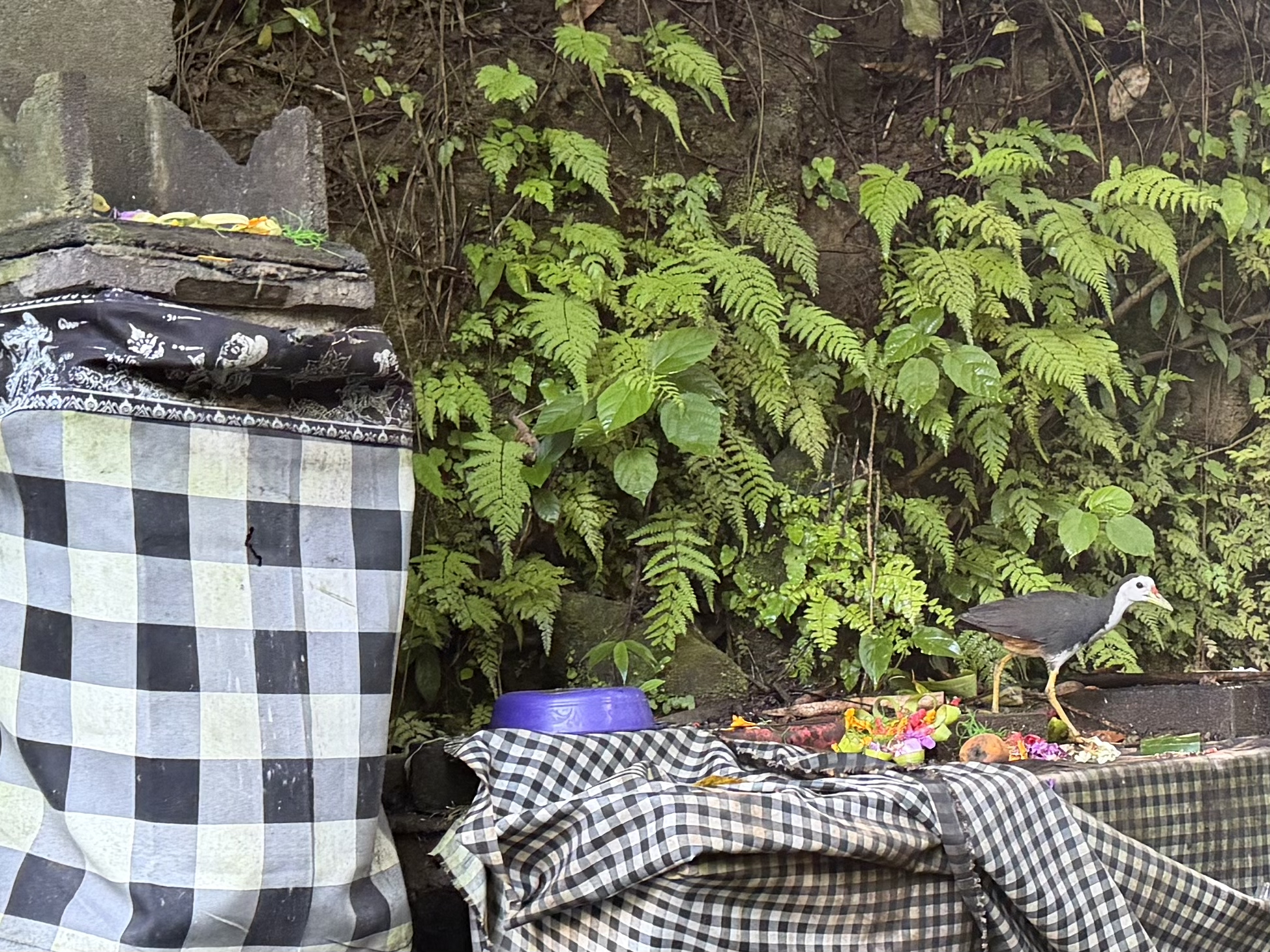
His people apparently think the gods are also located in all of these miniature temples, plopped every hundred yards, it seems. My favorite one was where White-breasted Waterhen was gobbling up their offerings right alongside the scooter-filled jungle road.

We lost sight of the bird somewhere in the ravine, so we finally could take a nature break, which we jokingly dubbed “apologizing to the trees.” Then we finally left with my tiny indexical residue of a photo strained from what seems like a mile away in my giant lens.
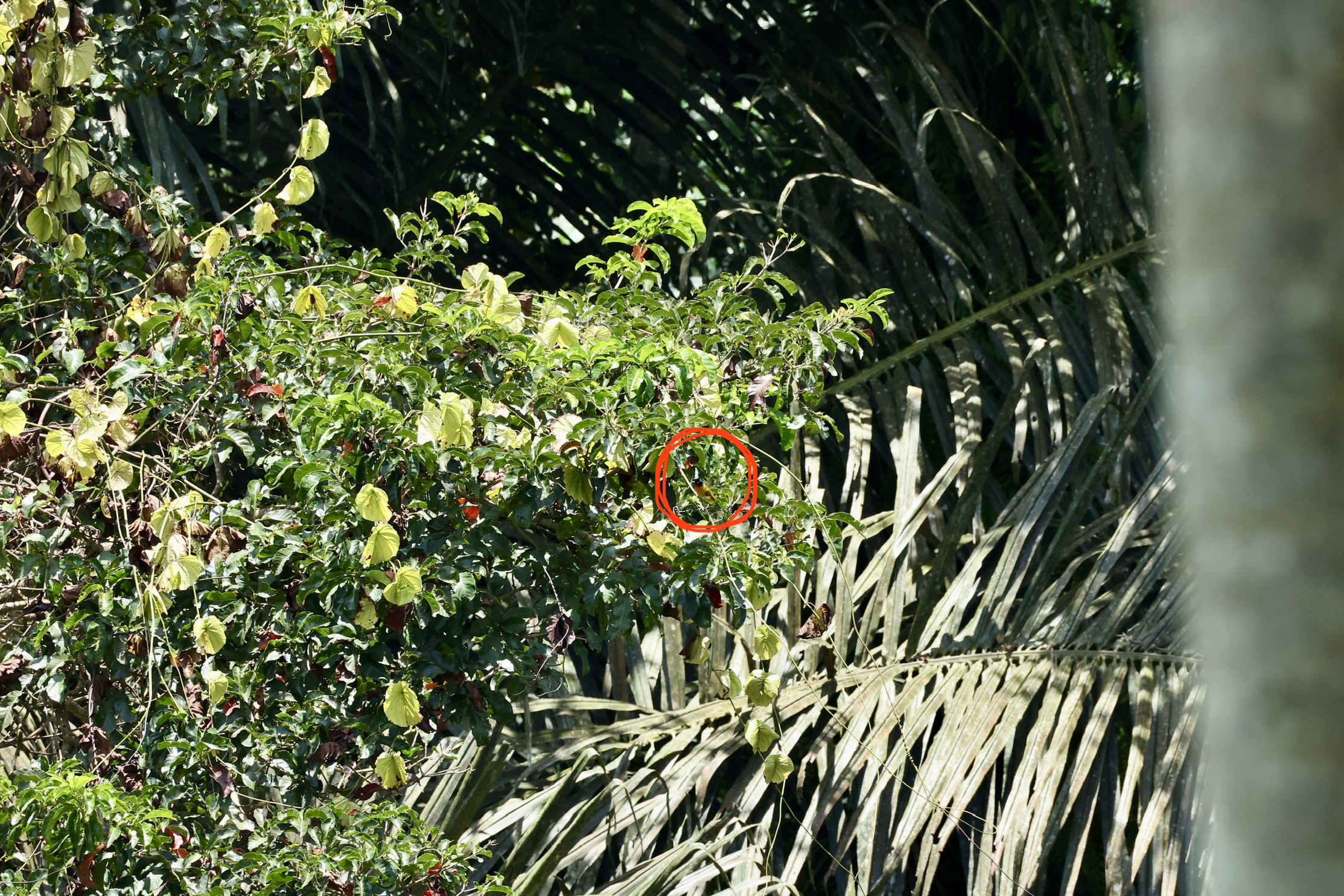
There is an ache that I will never see that bird again, and my photo will never improve. But I also have the wound of possibility of re-animating it all in reverie. Like everyone and everything dear I have ever lost. 

He writes that there is something more primordial than the one who gives and the one who receives — the experience giving itself. 

Vinciane Despret puts it another way: love exists because there are those who love: “Perhaps one has to imagine love a bit in order to love, and in imagining it and by loving, love exists.”

To end her lecture on where do the dead go, curiously fashioned for children, (and we are all children in the face of death), she leaves us with this invocation: “When a pagan meets someone, they never know if they are having business with a god.”

Two weeks after our cockatiel disappeared, I was across the country when a neighbor spotted her less than a half mile away. Lupe went right away and was able to capture her. Everyone who had been in these words with me cried in joy and for a moment my intense mourning lifted. Then I saw her up close, and even if my youngest son still refuses to accept it — our new bird is not our lost one. A lot can change a cockatiel who is in the wild for three weeks, but they can’t get younger. Still I took the wrangled bird in and made a perch so she can sit up high and eat, sleep, and watch birds fly by outside. Another little altar for the temple of words.  
 

“What the river says, that is what I say.” – William Stafford, Ask Me.

01 Tuesday Aug 2023

Posted by summermlee in Aesthetic philosophy, Art, Birds, Nature, philosophy, poetry

≈ 5 Comments

Tags

Ask Me, bird-watching, birds, birdwatching, George Steiner, giotto, grief, grieving, Love, painting, Summer Mei Ling Lee, Szymborska, Takeyoshi Nishiuchi, William Stafford, wonder

591.

A bird took me by the wing once. Pregnant and in pain, afraid for the baby and afraid for me, I was trapped in bed and wanted to sleep away the remaining prison term. One night, a snowy white Egret visited me in my dream. I locked eyes onto how luminous she was even in the sheer darkness. I followed her up and out of my room, up the stairs, through the shuttered window and into the dense fog above my house. As if such wonder could be contained, I took stock of the immensely opaque ocean air, and then my thought of well, now what? immediately ended the ascent. With the heaviest of thuds I arrived back in my body, into the discomfort of being a body again, and incredulously awake from the dream.

I didn’t know that memory was what I was going to write. But maybe it appeared because along my commute here to this place I remembered he told me once: to be human, we must renounce paradise and accept ourselves as fallen.

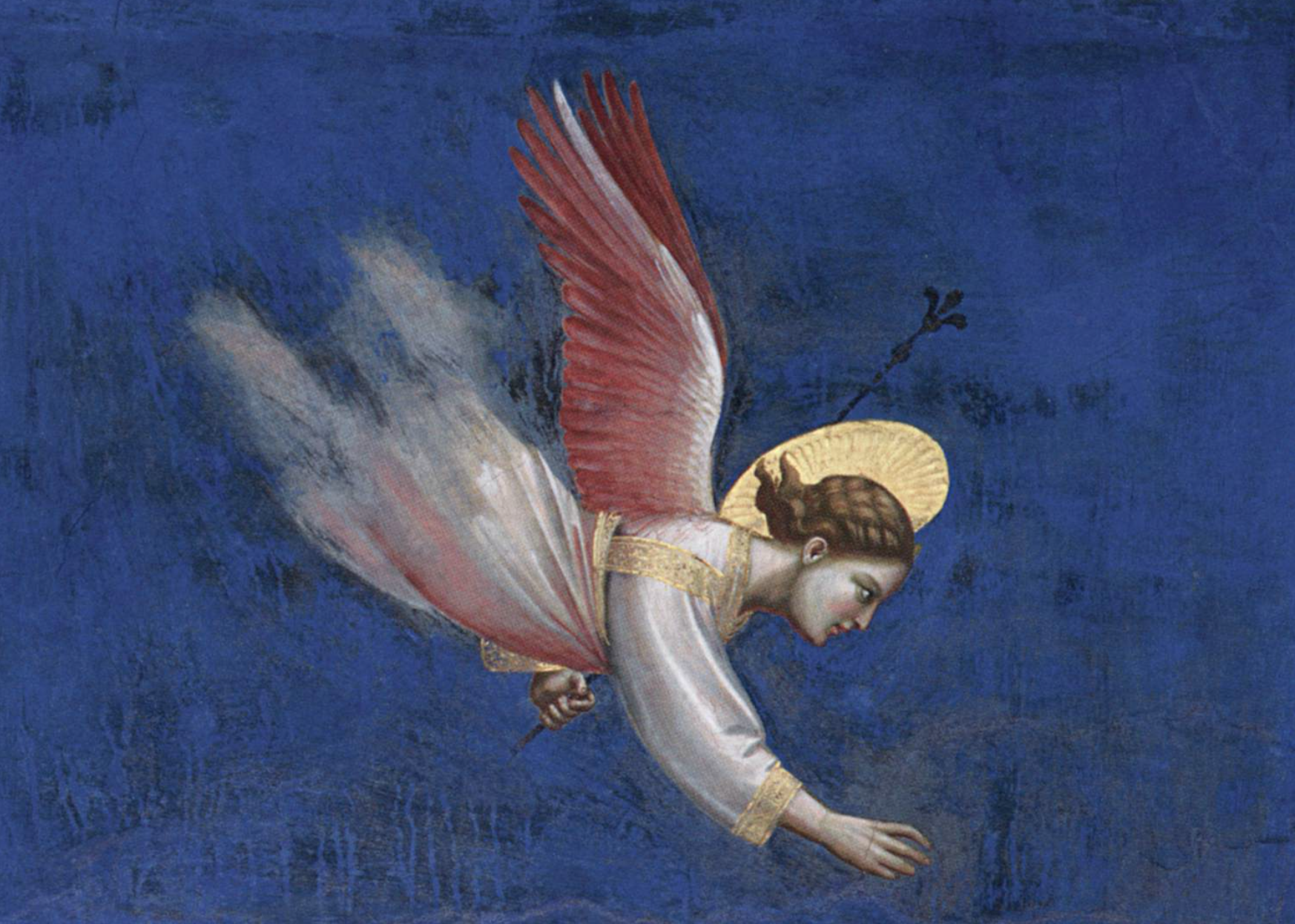
(Giotto, 1302. Scrovegni Chapel, Padova)

I can’t write about what I wish I could write about, but I could write about fallenness:

Her aggression hiding the need to be lovingly reassured. How I wanted to give him more love in the last hours than I had the rest of my life, and how there are no other words for it. How one evening we are laughing and she is a tipsy teenager again with lit-up Elton John glasses, and the next evening she slips below the water line and is gone. One week he asked me to teach his course for him because he knew I understood everything, and the next week I cannot fathom why he could take his last breath from himself. How such love and pleasure could follow in the year of someone else’s disappointment and regret. And just a few days ago, she tells me she witnessed a scene of a bird attacking a raptor who was in turn attacked and fell dead to her feet. We both knew what this meant — and just now, I receive some iridescent feathers she has sent me in the mail, from 2773 miles away.

But maybe most interesting of all, the little winged angel on the wall of the 14th century chapel, an angel whose bottom half is scumbled out with gray paint. As if to show we can try with paint or words to describe that dimension, and then as a result, something bigger than us, something more knowing than we are, arrives.

I don’t know what the 600th bird will be. 500 was the Bee Eaters from Africa who summer up north near the farm of the women who took me in, sick, a little lost, and with two sweet but wild boys. In the evening as we are eating in their garden, the Bee Eaters fly over us as if they are unscrolling stars on the chapel ceiling. Excited, they then yell to me in Italian and I don’t understand what they are saying, but it is to make sure I see them as they do — and something about how when I arrived, Summer arrived too. And then again, a year later, they tell me the Bee Eaters have arrived, and now they know, so will I.

I have no way to count the returning ones. It could be unending, they are events only half-way through.

And for those who followed me this far, and you don’t understand it all — I love you for it. I have hope that the nearer I am to it, the more mysterious it is. The more painful and yet the more beautiful. It just takes you by the wing.

This is why, for now, I am not afraid of the technologists who are coming after us with their machine-learning algorithms. Their logic cannot follow a bird that glows in the dark and flies into a house and through walls. Not just because the death of art is translation, he tells me, himself from behind the veil. But also because you and I still feel the “intolerable burden”, the beautiful burden, of the presence of something Other, and some of us have merely forgotten.

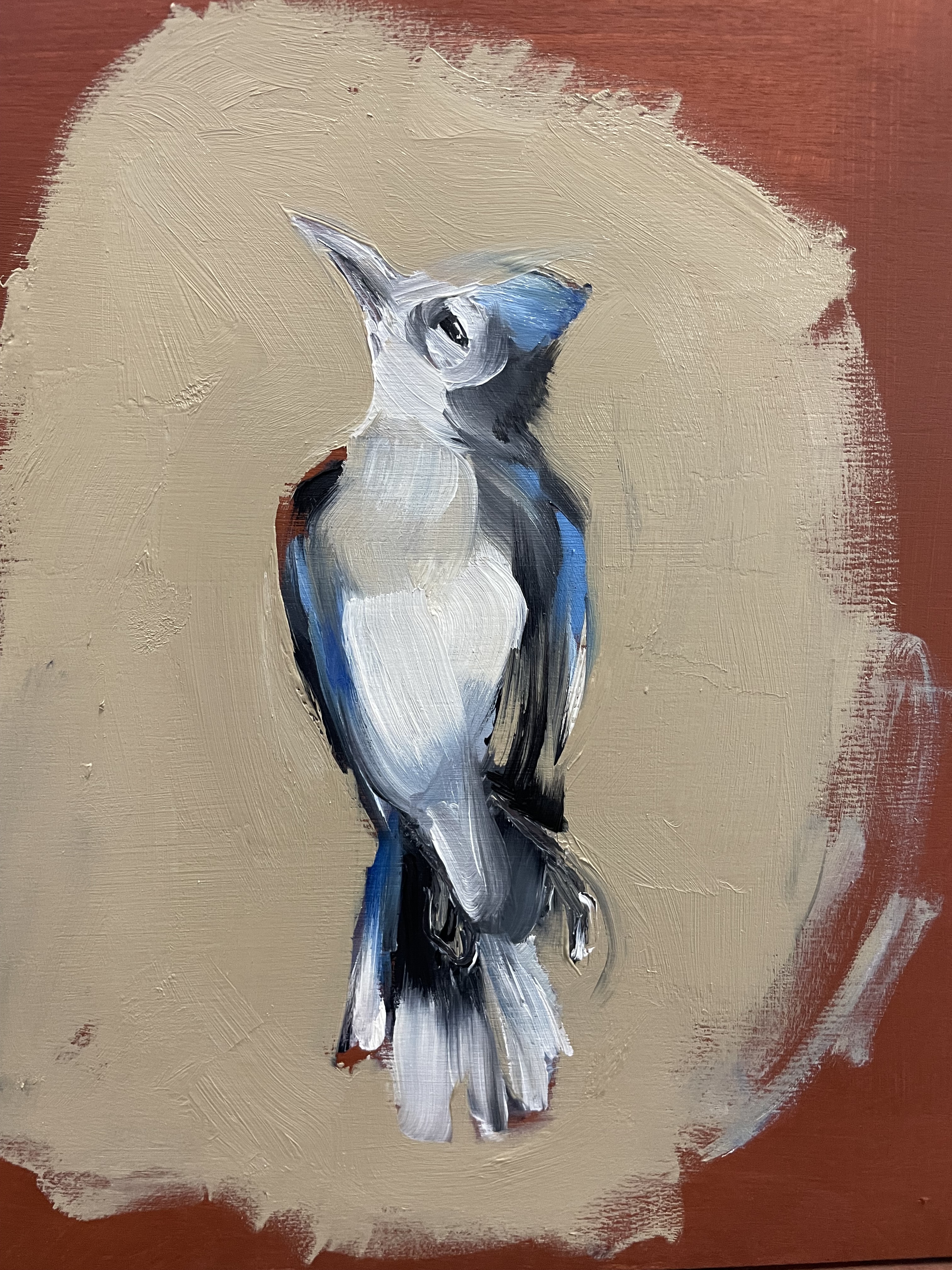
(Oil Painting of Leah’s bird by Summer Lee, 2023)

“Some time when the river is ice ask me

mistakes I have made. Ask me whether

what I have done is my life. Others

have come in their slow way into

my thought, and some have tried to help

or to hurt: ask me what difference

their strongest love or hate has made.

I will listen to what you say.

You and I can turn and look

at the silent river and wait. We know

the current is there, hidden; and there

are comings and goings from miles away

that hold the stillness exactly before us.

What the river says, that is what I say.”

— William Stafford, Ask Me.

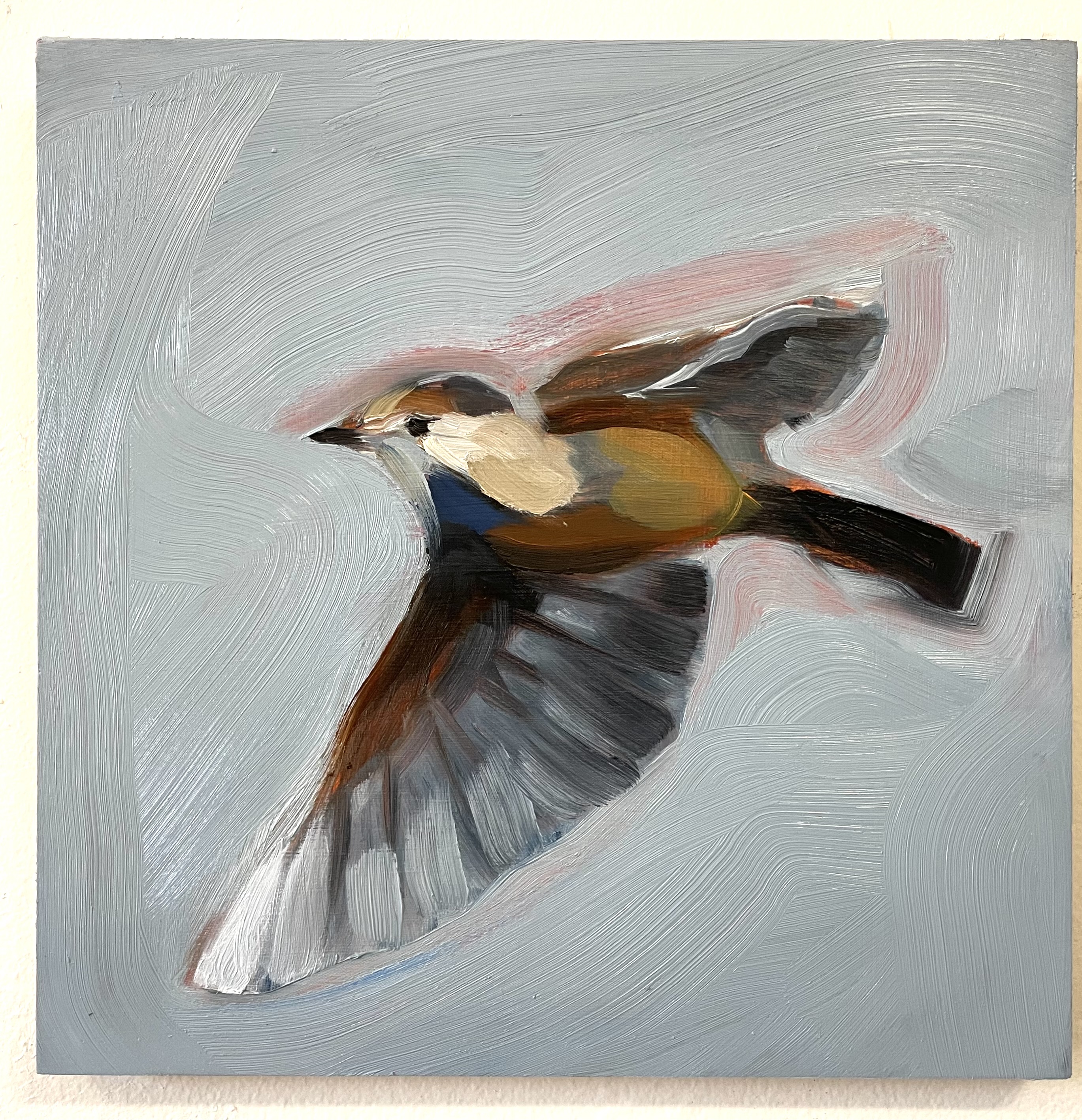
(Oil Painting by Summer Lee, 2023)

“That of a bird floating on the wind without moving its own wings, that of a bird which is flown by the wind.” Zeami, 15th Century

26 Sunday Aug 2018

Posted by summermlee in Aesthetic philosophy, Art, Birds, Nature, Uncategorized

≈ 5 Comments

Tags

art, birds, Czeslaw Milosz, kite, Lorenzo di Credi, Love, poetry, spirituality, St. Francis, Summer Mei Ling Lee, Zeami

It’s a flagrantly irreverent kite, as it dances a silly jig back and forth, fancy-free and a mile high in the gray sky. Shadows of swallows and swifts dart all around, you can’t much see them but can feel them hurling by just inches away.  All this high above a green river, slicing through a narrow forest, carving into the dead center of city. Just a concrete bridge, an updraft, and an insect haven for the evening hunger.

Yes but I’m not happy, he says in broken English, laughing only a little. Because even though it is a plastic-blue-Walmart-superhero kite, this is serious.

You have eagle eyes, he adds, as I point out to him where in the forest the string has hitched itself. Although I side with the runaway kite, mocking his owner, finding communion with the disinterested birds.

His little boy is concerned as his father sternly reels the string in, the father with one eye on his little boy “Vincent!” who might at any moment fall off the unrailed bridge to the rocky riverbed below.

A gray hawk does some stoic surveillance and disappears. Then a noisy plane above it.

He pulls the string harder and the place in the tree where it is stuck is made clear, revealing our finite and diminished existence. Now caught, the kite flails against certain death, surrounding leaves torn away and falling. It occurs to me this $20 kite battle means something to this man, when my kids lose toys daily without notice. And how this battle now means the world to me.

Suddenly one of the yanks frees the kite from the branches and it soars up again into the sky. He releases a shout of victory like a knight who has slayed the dragon. He retreats back into the city with his child, kite following closely like a dog with a tail between the legs. I laugh.

Then just when the whole sky seemed too vast to embrace our little drama, tiny stabs of rain give their acknowledgement and I start to cry. A mote of beauty in this world. Yet under the same sky where children were torn apart in their school bus by our bomb. The same day the sky gathered the river, made a clearing, and uttered our silently grateful birds.

IMG_4190
(Detail from Lorenzo di Credi, The Virgin Adoring the Child, 1490. British National Gallery)
——
Love by Czesław Miłosz


Love means to learn to look at yourself
The way one looks at distant things
For you are only one thing among many.
And whoever sees that way heals his heart,
Without knowing it, from various ills.

A bird and a tree say to him: Friend.

Then he wants to use himself and things
So that they stand in the glow of ripeness.
It doesn’t matter whether he knows what he serves:

Who serves best doesn’t always understand.

IMG_5990
(Detail, Follower of Joos Van Cleve, St. Francis Receiving the Stigmata, 1530. SF Legion of Honor)

“Summer’s ardor was confided to silent birds and due indolence to a priceless mourning boat through gulfs of dead loves and fallen perfumes.” Rimbaud

21 Saturday Apr 2018

Posted by summermlee in Aesthetic philosophy, Art, Birds, Nature, philosophy, poetry, Uncategorized

≈ 3 Comments

Tags

art, birds, birdwatching, Chekhov, death, Joan Jonas, Love, merlo, Ouse River, Rimbaud, river, Summer Lee, Summer Mei Ling Lee, travel, Virginia Woolf

Fox Sparrow is still here. But I know it’s soon. Almost now.

I have seen bodies float down that river. And I have let them pass, even though they took parts of me, right from the heart.

We stand at the banks, birdwatchers most of us.  An improbable fellowship of a strange generosity. They will run to tell me they just spotted something beautiful and rare, just over there. They delight in sharing stories of the ones they saw many years ago. And I delight in every one with them as if I had been there. How words awaken that. Sometimes a personal story will spill out like a loose feather, like why he remains unemployed. How after her mom died a slow death,  she and her sister call each other about what miraculous birds they have seen that day. One boyish teenage-girl alone for years under a tree told me which of two almost identical species of obscure birds was way up there, just by hearing its call.

Once I walked silently into a group of men bowing their heads crying, their cameras off as if in mourning also. It seemed one of them had been expecting me, because he plainly said that he had accidentally scared a deer into that river over there and it drowned.

Many years ago, he had asked me about Virginia Woolf’s drowning before he took his own life and so I was determined to walk to that river, to see if somehow my response was at all valid.

After a long hike through pastures outside the village, I walked her to the muddy embankment of the brown river running. She has been in and out of my life, even the last few lives too, and when she felt it she didn’t trust it. But there we were. A long curve of river surrounded by lifeless and flattened swales of fields saddled by fog. After a moment of taking in the dull scene, a white thing in the distance pierced through the grey. A majestic swan aflight squeaked its wing feathers in a steady beat, and glided the course of the river past us, down out of sight. Flight and not stones, even if fear changes her mind. The birders among us will understand.

Because this bird knew where I needed to be. In this word. Sometimes I lose my patience with it all, as if I could turn the direction of an entire sentence. But life just runs over my impertinent hands and through my doubtful fingers. And will eventually take her too. And another bird might drift by, or flit onto a branch right here along the way. On its own time.

Like Fox Sparrow who is still here. He knows it is now. He also knows it is not.

(Joan Jonas, performance entitled “Merlo,” 1970’s Tuscany.)

“The birds were fluttering in and out of the open door; the photographs were tumbling over the tables; and, lying before a large open window, Mrs. Cameron saw the stars shining, breathed the one word “Beautiful,” and so died.” — Virginia Woolf.

______

“With total rapture and delight he talks about the birds which he can see from his prison window, and which he never noticed before, when he was a minister. Now of course, after he’s been released, he doesn’t notice the birds anymore, just as beforehand. In the same way you won’t notice Moscow when you actually live there.” — Vershinin in Chekhov’s The Three Sisters.

Enter your email address to subscribe to this blog and receive notifications of new posts by email.

Join 619 other subscribers

Recent Posts

  • “Experimenters in the passages between worlds.” Vinciane Despret, Au Bonheur des Morts
  • “The terrifying groundlessness, the eradication of all violences. To be embraced by that which doesn’t know us and in that unknowing caresses us and truly loves us. We might become anything at all, something wildly other than what we are encountered by. A world that truly loves us by not presuming what we want or what shape we will take before we show up… We will be held when we are not known from the start.” — Dr. Marquis Bey
  • Images dream within us, a reverie is a world of expansion.
  • “For the natural world, the ethical responsibility is that being alive gives existence to others.” Vinciane Despret
  • “We meet in the freedoms of each other.” – Takeyoshi Nishiuchi

Archived Posts

Blog at WordPress.com.

  • Subscribe Subscribed
    • Unwanted Advice: Reflections from a Self-Appointed Life Counselor
    • Join 215 other subscribers
    • Already have a WordPress.com account? Log in now.
    • Unwanted Advice: Reflections from a Self-Appointed Life Counselor
    • Subscribe Subscribed
    • Sign up
    • Log in
    • Report this content
    • View site in Reader
    • Manage subscriptions
    • Collapse this bar
Loading Comments...