• About

Unwanted Advice: Reflections from a Self-Appointed Life Counselor

~ Caminante, no hay camino. Se hace camino al andar. Wayfarer, there is no way. You make a way as you go. (Antonio Machado)

Unwanted Advice: Reflections from a Self-Appointed Life Counselor

Tag Archives: Gadamer

“Experimenters in the passages between worlds.” Vinciane Despret, Au Bonheur des Morts

14 Tuesday Jul 2026

Posted by summermlee in Aesthetic philosophy, Art, Birds, Nature, philosophy, Uncategorized

≈ 1 Comment

Tags

"Où s'en vont les gens qui meurent?", Annunciation, art, Étienne Souriau, birds, birdwatching, death, Gadamer, Indonesia, Loss, Love, Mourning, nature, philosophy, poetry, Ruby-Throated Bulbul, Summer Lee, Summer Mei Ling Lee, temples, Vinciane Despret, wildlife, writing

1060.

He refuses to call the birds even if it means his customers will see less birds and from farther away, or that his customers could choose another guide who does. 

He knows that these encounters are where truth can reveal itself, not when we try to shape the world around us. 

What all the birds are telling me these days is that it’s never been about the birds, or the lover, or the one who is no longer here. I start with some words, and then I wait. Fiat mihi secundum verbum tuum.

We waited for hours in the sticky heat, scoping out across a ravine where it’s impossible for the villagers to plant rice fields. It’s always when you are about to leave when they enter and that’s why birders never leave — even if my son is pulling my arm or I have missed a zoom call. I have started to live for these Annunciations, the moment like this, when he careens without fanfare into a morass of jungle vines, the flash of gold and blood red grabbing my eye. 

There is a lowly triumph when you are the first to spot a rarity, especially before the native expert does. But this was also about waiting and listening, Tai would say to weaken our ego. And sometimes something happens and sometimes it does not. Birds, like my favorite art, exceed explanation and translation. 

As much as the people of this area leave gratitude for every spirit here—the spirits of the trees and the water and, especially, the winds—they also still catch wild birds and cage them.

I waited for three days for our escaped pet cockatiel to come down from the trees in our neighborhood back to me. Every morning I would wake before sunrise so that I could hear her first calls somewhere outside and re-locate her from the night before. I cancelled every appointment and obligation and tracked her. A few times a car or the oblivious dog-walker would startle her and she would make a wild flight, so I would run after her, under her next impossibly high perch. I blasted cockatiel calls from my phone and called her name incessantly, altogether confirming my title as the crazy bird lady on the block. There were many desperate moments when our eyes locked, and I registered her simultaneous anxiety to return to me with the existential fear of what that entailed. 

On the third night, when daylight was fading I lost sight of her in a patch of thick pines, on the exact hillside property over which our group won a lawsuit to prevent it from being paved over. I made a call out and she answered me from the darkness. And then went forever silent. 

My guide used to take the money from his tours and buy back the freedom of those caged birds. Maybe he still does, but I didn’t ask, because I know the discipline of that practice is to never commit it into words. From one angle, it can feel relentlessly useless. From another, it is where God is located.

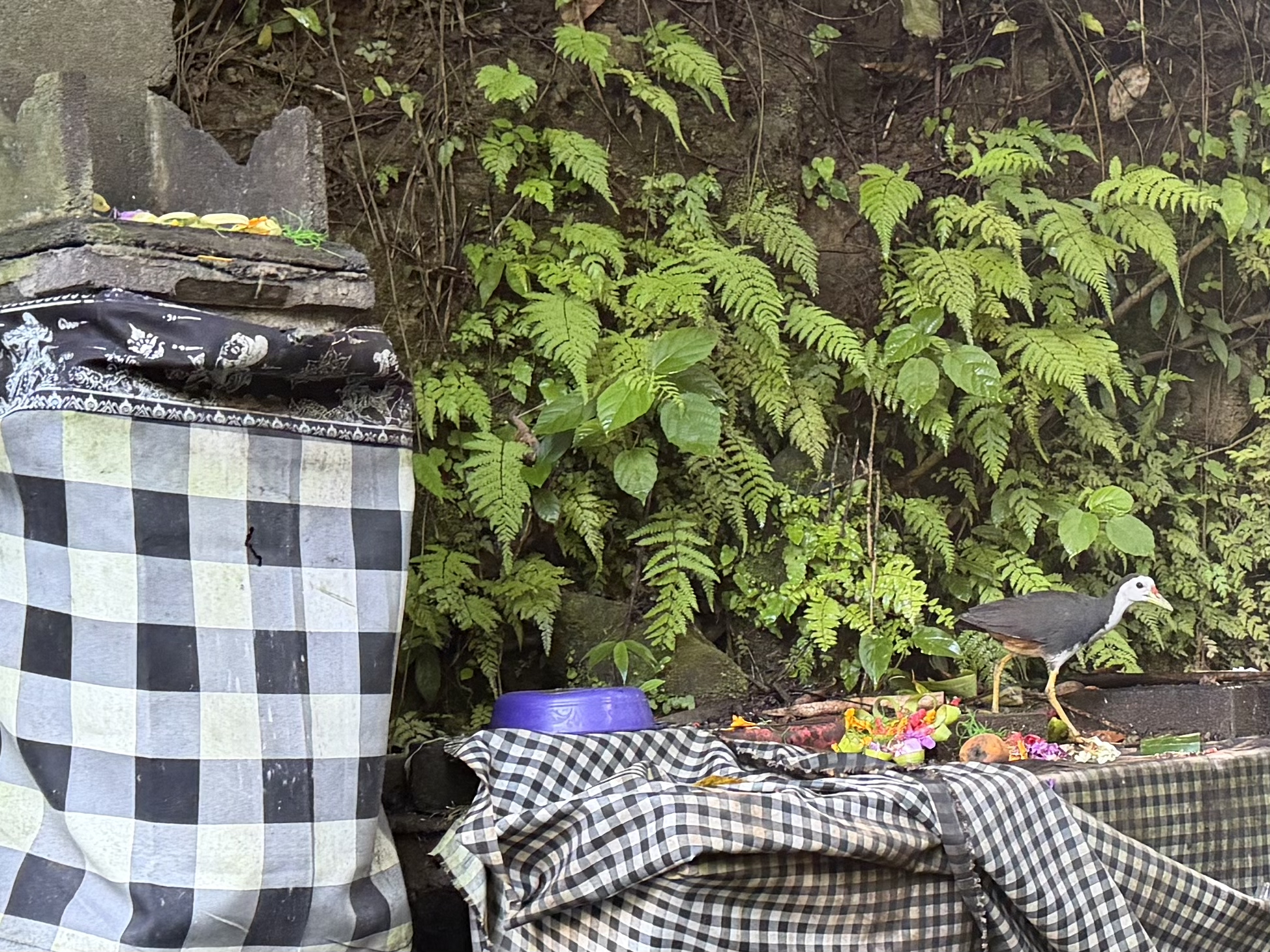
His people apparently think the gods are also located in all of these miniature temples, plopped every hundred yards, it seems. My favorite one was where White-breasted Waterhen was gobbling up their offerings right alongside the scooter-filled jungle road.

We lost sight of the bird somewhere in the ravine, so we finally could take a nature break, which we jokingly dubbed “apologizing to the trees.” Then we finally left with my tiny indexical residue of a photo strained from what seems like a mile away in my giant lens.
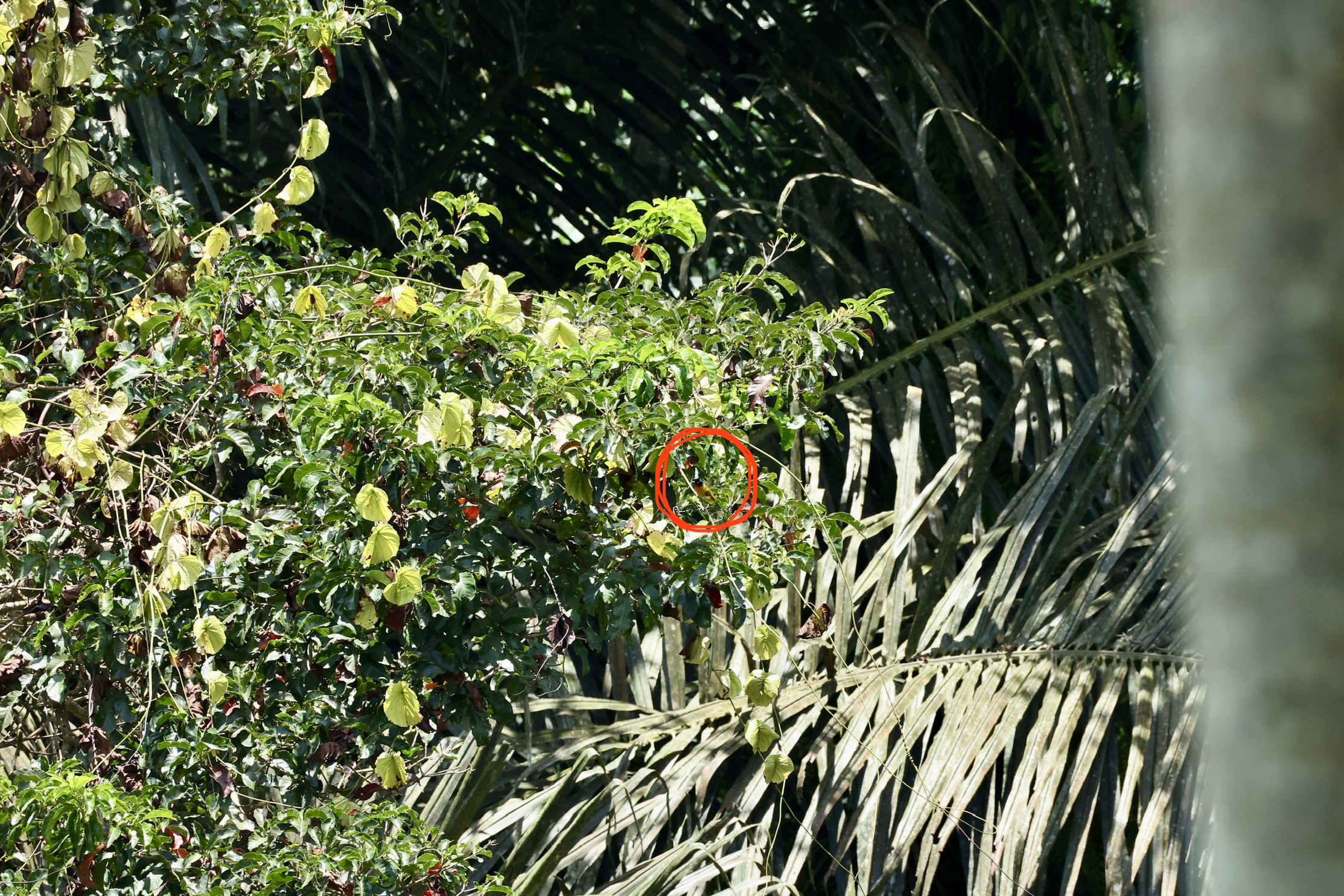
There is an ache that I will never see that bird again, and my photo will never improve. But I also have the wound of possibility of re-animating it all in reverie. Like everyone and everything dear I have ever lost. 

He writes that there is something more primordial than the one who gives and the one who receives — the experience giving itself. 

Vinciane Despret puts it another way: love exists because there are those who love: “Perhaps one has to imagine love a bit in order to love, and in imagining it and by loving, love exists.”

To end her lecture on where do the dead go, curiously fashioned for children, (and we are all children in the face of death), she leaves us with this invocation: “When a pagan meets someone, they never know if they are having business with a god.”

Two weeks after our cockatiel disappeared, I was across the country when a neighbor spotted her less than a half mile away. Lupe went right away and was able to capture her. Everyone who had been in these words with me cried in joy and for a moment my intense mourning lifted. Then I saw her up close, and even if my youngest son still refuses to accept it — our new bird is not our lost one. A lot can change a cockatiel who is in the wild for three weeks, but they can’t get younger. Still I took the wrangled bird in and made a perch so she can sit up high and eat, sleep, and watch birds fly by outside. Another little altar for the temple of words.  
 

“I could never have come to the present without you / remember that / from whatever stage we may again / watch it appear…” WS Merwin

03 Friday Jul 2020

Posted by summermlee in Aesthetic philosophy, Art, Birds, music, Nature, philosophy, poetry, Uncategorized

≈ 2 Comments

Tags

Annunciations, art, birds, birdwatching, death, Gadamer, philosophy, poetry, St Cecilia, Summer Lee, WS Merwin

The birds come and go here just as Fox Sparrow does in his homecomings and disappearances back on the West coast. Just as truth and beauty migrate out onto another unreachable continent when trying to reason with them. Why can’t you stay here to remind me, I ask through my binoculars. Just once. Their wondrous plumage and secretive calls draw us out from the smallness of our shelters, out into the rainy forests and sometimes in communion with each other, the alive and lonely. This year all the rarest of ones flickered across my field, even a tiny, crystal-blue Cerulean Warbler that spends most of his time too high for anybody to see. A Hooded Warbler touched down too, in a darkly flooded forest where he normally does not, just for two days. Then they leave and we are alone again. Maybe that’s why I told a beautiful woman birder that I saw the rarest bird, when in fact I hadn’t seen it at all. Something about the mix of her beauty and shyness, and something about me being mistaken and humbled. But maybe that bird is still there in our minds, more glorious and hopeful than if we had even seen it.

IMG_1682

(Martyrdom of Saint Cecilia of Music. Sculpture by Stefano Maderno, 1599.)

What if this wave of unrelenting and invisible death was actually a grace. Except of course for the poor and vulnerable who always die for our sins. All while I suffocate in the safety around me in the anxiety that it’s never enough. Like when I impatiently told her she just needed exercise when in fact she was just about to die, swollen with failed organs, failed also by my insulated stupidity born of fear.

One time out in the twilight of a chaparral migration, stranger birds gathered in a circle. And even more strangely invited me. They had gathered in order to die. But being birds, they had to first learn how to die through song.

I listened. And of course cried too, as one does even at a stranger’s funeral. One sang of her young daughter who died suddenly. And when the mother’s song entered the abyss of dark and permanent grief, her daughter would come sing to her, to the point where I could almost hear it too. I still don’t want to know if it was an apparition of the psyche or from the other side, because it’s the same place where my own grandmother speaks to me.

This mother had brought with her the chaplain she had met in the hospital. Yes, there is always a bird there, even if we don’t believe, and here she was in the body of a middle-aged, white woman wearing a collar. The chaplain sang to me too, as I worried about my own son treading a difficult path through life. As she warbled, we all sat crying for ourselves and for that mother. Her song was about just being there at the right time, reminding us that our bodies know how to die when it is time.

But the timing of the young daughter’s song, as well as this chaplain, was uncanny. Like the little 9th century bell in Rocamadour that rings when there is an incontestable miracle. Not all pilgrims who have climbed on their bloody, tired knees to that church will hear it. But I can hear that birdsong from that circle of death, even if they are on the other side of the earth now.

Through all the hatred to be had of insufferable humanity, its never-ending range of evils, these migratory birds continue to love me well through certain people, strangers even. Just through their words. Through the poetic words they send me, calls to the heart that rain down on me in dark, muddy forests. In poetic words, there lies the impossibility of their birdsong — as impossible as it is to hold truth and beauty too — that living is through learning how to die. One word at a time, one song, risking itself into unreachable silence.


“The greater miracle of language lies not in the fact that the Word becomes flesh and emerges in external being, but that that which emerges and externalizes itself in utterance is always already a word.” Gadamer, Truth and Method.

The power of Art seems to tear up the one experiencing Art, all at once, from the connection of his life, yet at the same time to move him back to the whole of his existence in this world.” Gadamer

27 Tuesday Feb 2018

Posted by summermlee in Aesthetic philosophy, Art, Birds, Nature, philosophy

≈ 4 Comments

Tags

art, birds, Gadamer, homecoming, Ma Yuan, ocean, Odyssey, Summer Mei Ling Lee

It is almost time for Fox Sparrow to leave.

Yesterday a red cargo ship full of containers from Asia approached our coast. It happened on a glassy, high-blue light day as the Bay Area can be in February, so that even the frothy wakes along the ship could be seen crisply miles away. And how the crew must have seen the land from miles away also, how that green and gray brown alights after a month at sea. The welcome that builds after days of an interminable emptiness on the horizon, in every direction. Maybe a terror of openness, but the warmth of possibility. Lonely yes, but connected to the ocean and the sky, feeding on inward mornings and memory — connected to all things, connected even by our loneliness. To be on an endless sea — yet, as Caroline said, to feel lucky waking in the morning unafraid, to get up with the desire to get up, for another day of open and empty horizons.

After ten epic years at war, and ten more at sea, Odysseus reaches home where no one can recognize him except his dog. He is washed by his childhood nanny, who discovers a scar on his thigh, revealing his identity. His scar is the doorway to homecoming.

How life’s experiences, like words, cut and divide while gathering its skins into a scar.

I hope while at sea, I would delight in the unrepeatable colors, and how ocean water defies all predictable pattern, and what fog can create with light. That I would relish in all the inks and brushes I have, not analyze those I don’t. And maybe there is a bird, the courageously pelagic amongst us. At home without terra firma, the beings of the utmost unhousedness.

Does anyone else wonder where Fox Sparrow is when he is not at my feeder?

a11cc818699bd20487636199e8a1952b

Ma-Yuan3-650x420

(Ma Yuan, Studies of Water, 1190-1224)

“If you are a poet, you will see clearly that there is a cloud floating in the sheet of paper. Without a cloud there will be no rain; without trees, we cannot make paper. The cloud is essential for the paper to exist.” — Thich Nhat Hanh


And when we imagine wings that come and go / What we see is a house / And a wide open window. – May Sarton

23 Thursday Aug 2012

Posted by summermlee in Aesthetic philosophy, music, Nature, philosophy, poetry, Uncategorized

≈ 8 Comments

Tags

Bachelard, birdsong, childhood home, dead sparrow, Gadamer, Heidegger, Home, May Sarton, memoir, music

If Goethe is right, and architecture is frozen music, home is a song we have learned by heart.

My friend reminds me that learning things by heart insists upon rhythm, the heartbeat, and that the experience of the present moment is rhythmic.

One beat has to end for the next to begin. And like his favorite piano concerto, we don’t know when this note ends, and there is much tension in the space before the next. And life is marked by a gentle sadness when that moment ends and dissolves into the next moment. That, according to Bugbee, life is haunted by a continual parting. Proust says these moments are connected to places that also don’t exist anymore: “The places we have known do not belong only to the world of space on which we map them for our convenience. None of them was ever more than a thin slice, held between the contiguous impressions that composed our life at that time; the memory of a particular image is but regret for a particular moment; and houses, roads, avenues, are as fugitive, alas as the years.”

And that was the fugitive feeling I have had recently. First, I was at a dinner where a friend made a lovingly-prepared pot roast. Tomato and herbs infused a slow-cooked meat I’ve not experienced since I was living in my childhood home. The warm, familiar smell wrapped its arms around me as I sat in this modern-day apartment, just as my mother’s filled our evening home when I was a child. The smell invoked something so palpably nostalgic that one part of my self remained in a distant past even as I carried about in the present-tense conviviality. My friend sitting next to me also was piqued by the memories of childhood dinners; someone who I happened to have first met when I was 6 years old. We have witnessed each other grow and shed several versions of ourselves, though there is something from which we struggle not to stray.

It recalls Gadamer’s notion of festival — that there is an enduring in the perishing. There is continually a moment that we wish could be retained, held onto for just another moment longer, even though it can never be. It is a “consciousness of human frailty,” when we are aware of the rhythms of our life and the fact that they end. “Every festive joy, yes, every joy, is perhaps the other side of an inexpressible, unutterable.” And every beat of the heart is inseparable from its opposite — silence; nothingness.

And then I gave into the urge to drive by my childhood home this week. I was in the area, where a chaparral dustiness meets the crisp coastal breeze and tugs at me. As did the autumnally-filtered light of a sun beginning to arc lower in the sky. And there predictably sat the home on the corner of middle-suburbia covered with mature trees and gridded off by narrow streets. The house, like the area, is shinier and more regal than the more humble and equitable times known before Silicon Valley bubbles and exorbitant housing prices. The home was still incredibly intimate, yet completely estranged from me — the current occupants undoubtedly using it in their own way in a sort of betrayal of the past. Because, like everything else, my home had to give way to their home. Like the tightly woven, straw nest that fell off the side of our house a few months ago. Next to it was a darkly stippled egg, intact, but belonging now to the unknown.

The nest fell from the eaves of my new home of the last 13 years. Soon, as with every year, the winter flock of Golden-crowned Sparrows and their one loyal Fox Sparrow friend returns to our feeder. One year our cat in her boredom slaughtered the Fox Sparrow, and after I grieved its dark, hopeless body in my hand, I decided not to slaughter the cat. A few years later, a new Fox Sparrow somehow rejoined the flock. I’ll never know how.

Fox Sparrow song

This is the home which presses itself into my son whose foundational memories will be part of the architecture, as the architecture is part of his psyche. And eventually, the most eventual fact of all, my life will give way also. So dramatic-sounding, I know, but the remembrance of which always relates to Heidegger’s astonishment that I exist rather than not, that leads to Hamill’s loving a little bit more, because one of us will die. And the moment when the stars begin to burn through Mary Oliver’s sheets of clouds so that I may write about it here, with words that are little houses, as they dissolve away also. That things come and go, it brings about wonder:

“Celebration … is self-restraint, is attentiveness, is questioning, is meditating, is awaiting, is the step over into the more wakeful glimpse of the wonder — the wonder that a world is worlding around us at all, that there are beings rather than nothing, that things are and we ourselves are in their midst, that we ourselves are and yet barely know who we are, and barely know that we do not know this. – Martin Heidegger, Polt

Today’s Issue: “You who are not kept anxiously awake for love’s sake, sleep on.” – Rumi

17 Tuesday Jan 2012

Posted by summermlee in Aesthetic philosophy, Art, Uncategorized

≈ 9 Comments

Tags

alice miller, art, becoming a parent, Gadamer, psychotherapy, sensitive person

I’m now at the dreadful realization that I have squeezed in a little time and space to write and make art, but that I am willfully refusing to. I see clearly what is bubbling up to be expressed, and frankly I don’t want to do it. What wants to exist on page or on canvas touches upon things that I fear are too banal, vulnerable, unoriginal — the list could go on and on.

I could blame it on becoming a parent. I’m already a frighteningly sensitive person, and now my son blows open a new portal of acute feelings, including the most intense pangs of doubt, impatience, and heart-bursting ache for his welfare. I exist like an emotional puff pastry — flakes of feelings falling down onto my messy lap at the slightest jostle. Just a snippet of some violence done to a child on the fading ticker of the corner of the news channel I skipped over on my way to Downton Abbey… and I am on the verge of existential crisis.

And so it is this week, if the muse couldn’t corner me any more, I cross paths with the writings of psychotherapist and artist, Alice Miller.

Her premise is simple: Our culture is violent because we learn not to feel. It seems like old news now, but an insight that is all too ubiquitously relevant: Repressed feelings are a reaction to being hurt, often by parents, and that a child, completely dependent on those parents, must repress them or else be killed by the pain. A numb child can grow into an adult who lacks empathy for others, and in turn inflicts pain on their own children, as well as others.

Trust me I hear the groans from those who know me as overly sensitive and analytical. Obviously, this encompasses my own dealings with my childhood and shaping my son’s childhood, but more interestingly involves the resistance to writing this and avoiding the studio.

I’ve never met an artist who didn’t feel things deeply or who didn’t want to question things, even if it’s the story tickering off the corner of the news screen. And this requires an exploration of the “furthest countries of one’s secret soul,” because, as Rilke penned, the most profound and unique art is borne by those “who have faced the danger, gone to the very end of an experience, to the point beyond which no human being can go.” In my silly, little case, I just might have to face the danger of being too banal, vulnerable and unoriginal.

Turns out Alice Miller felt that creative work trumped all the years she practiced psychotherapy. That, as Gadamer agrees, in play, albeit serious play, can we visit places outside of where we were supposed to go, off the paths we were only allowed to go.

Alice Miller doesn’t go as far as I do here; that art opens up a beyond, past the prerequisite and unavoidable acknowledgment of what is true (and often painful) about ourselves and those around us. That if I recall the last time I was moved by music, writing, or art, I was taken to the edge of an experience where I could leap into a moment of not being anything at all.  I could go with art into my very self-most straits, and set myself free.

(And only from that freedom — from my self, my needs, my projections, my ego — can I truly love someone else.)

Today’s Advice: “Only when we learn to transcend our death-bound selves in love, learn to take ourselves not too seriously, do we begin to truly live.” Karsten Harries

Enter your email address to subscribe to this blog and receive notifications of new posts by email.

Join 619 other subscribers

Recent Posts

  • “Experimenters in the passages between worlds.” Vinciane Despret, Au Bonheur des Morts
  • “The terrifying groundlessness, the eradication of all violences. To be embraced by that which doesn’t know us and in that unknowing caresses us and truly loves us. We might become anything at all, something wildly other than what we are encountered by. A world that truly loves us by not presuming what we want or what shape we will take before we show up… We will be held when we are not known from the start.” — Dr. Marquis Bey
  • Images dream within us, a reverie is a world of expansion.
  • “For the natural world, the ethical responsibility is that being alive gives existence to others.” Vinciane Despret
  • “We meet in the freedoms of each other.” – Takeyoshi Nishiuchi

Archived Posts

Blog at WordPress.com.

  • Subscribe Subscribed
    • Unwanted Advice: Reflections from a Self-Appointed Life Counselor
    • Join 215 other subscribers
    • Already have a WordPress.com account? Log in now.
    • Unwanted Advice: Reflections from a Self-Appointed Life Counselor
    • Subscribe Subscribed
    • Sign up
    • Log in
    • Report this content
    • View site in Reader
    • Manage subscriptions
    • Collapse this bar
Loading Comments...