“Everything that can be thought at all can be thought clearly. Everything that can be said at all can be said clearly. But not everything that can be thought can be said.” — Wittgenstein

Tags

, , , , , , , ,

In the yard of my childhood home, a robin drunk from devouring over-ripe cherries on our tree, flew into our bay window that must have held an attractive illusory world, so much so that more than a few birds met that hard, bludgeoning reality. And after struggling for air on the ground below, it became still and lifeless. My mother, sensitive to the meekest of life forms, gathered the corpse and her two fledgling daughters for a funeral. A hole was dug, and as I watched the corpse of the bird descend into the dirt void, my mom said words, words of ritual, wishing that this bird would be in peace.

That robin’s life, unlike the other carcasses of animals on roadsides or worse, was made sacred to me, and the abyss into which some part of this bird, the part besides feathers and flesh, inhabited when it was into the ground became the eternal question mark.

My mentor describes the pre-classical Chinese pictogram of sacred as a person standing on earth, on one’s toes, reaching for the sky, the heavens. The sacred cannot be without the earth, the mundane requirements of being human, but it also has the urge for beyond such knowing.

Eventually and logically, that became the case for those beings lying unceremoniously in rotting ditches who by my eyes were not made sacred. And a moment of heightened attention in a car passing by was, and continues to be, my attempt to sacralize, because it feels necessary that we would all be given the mere gift of attention as we disappear.

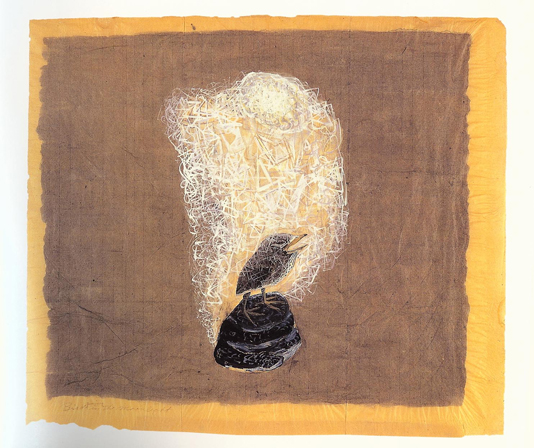
Finally this week, it was this scene that appeared to me in my own ritualized space of art-making in my studio, where I stared upon the flocks of quiet, often dissolving, single, little dead birds I’ve painted over and over for the last 7 years. After enduring the dissonant if not polite questioning and dismissal from others and myself — amidst a cultural popularization of cute birds on every sundry item available (“put a bird on it”) — I was partially decoded.

And luckily, also this week, I read an essay by Susan Sontag, who fully understands the impulse to make art “towards the ever-receding horizon of silence.”:

“One result is a type of art which many people characterize pejoratively as dumb, depressed, acquiescent, cold. But these privative qualities exist in a context of the artist’s objective intention, which is always discernible. To cultivate the metaphoric silence that’s suggested by conventionally lifeless subjects (as in much of Pop Art) and to construct “minimal” forms which seem to lack emotional resonance are in themselves vigorous, often tonic choices.”


(My painting: “Bird Elegy #1″ (detail), 2012.  14″ x 19” Watercolor on Paper)

But my recent writing/searching has drawn my attention to the fact that all things, especially the experience of love, are of a continual parting. Perhaps that impossible constant attention to that coming and going, the making sacred of every moment and every thing that makes a heartbeat, that presences and reaches into us, and then dissolves into silence — Heidegger’s clearing and gathering and clearing — that is a  glimpse into the untranslatable state of Being.

For now, I can only handle my little birds.

“It seems unlikely that the possibilities of continually undermining one’s assumptions can go on unfolding indefinitely into the future, without being eventually checked by despair or by a laugh that leaves one without any breath at all.” Susan Sontag

And when we imagine wings that come and go / What we see is a house / And a wide open window. – May Sarton

Tags

, , , , , , , , ,

If Goethe is right, and architecture is frozen music, home is a song we have learned by heart.

My friend reminds me that learning things by heart insists upon rhythm, the heartbeat, and that the experience of the present moment is rhythmic.

One beat has to end for the next to begin. And like his favorite piano concerto, we don’t know when this note ends, and there is much tension in the space before the next. And life is marked by a gentle sadness when that moment ends and dissolves into the next moment. That, according to Bugbee, life is haunted by a continual parting. Proust says these moments are connected to places that also don’t exist anymore: “The places we have known do not belong only to the world of space on which we map them for our convenience. None of them was ever more than a thin slice, held between the contiguous impressions that composed our life at that time; the memory of a particular image is but regret for a particular moment; and houses, roads, avenues, are as fugitive, alas as the years.”

And that was the fugitive feeling I have had recently. First, I was at a dinner where a friend made a lovingly-prepared pot roast. Tomato and herbs infused a slow-cooked meat I’ve not experienced since I was living in my childhood home. The warm, familiar smell wrapped its arms around me as I sat in this modern-day apartment, just as my mother’s filled our evening home when I was a child. The smell invoked something so palpably nostalgic that one part of my self remained in a distant past even as I carried about in the present-tense conviviality. My friend sitting next to me also was piqued by the memories of childhood dinners; someone who I happened to have first met when I was 6 years old. We have witnessed each other grow and shed several versions of ourselves, though there is something from which we struggle not to stray.

It recalls Gadamer’s notion of festival — that there is an enduring in the perishing. There is continually a moment that we wish could be retained, held onto for just another moment longer, even though it can never be. It is a “consciousness of human frailty,” when we are aware of the rhythms of our life and the fact that they end. “Every festive joy, yes, every joy, is perhaps the other side of an inexpressible, unutterable.” And every beat of the heart is inseparable from its opposite — silence; nothingness.

And then I gave into the urge to drive by my childhood home this week. I was in the area, where a chaparral dustiness meets the crisp coastal breeze and tugs at me. As did the autumnally-filtered light of a sun beginning to arc lower in the sky. And there predictably sat the home on the corner of middle-suburbia covered with mature trees and gridded off by narrow streets. The house, like the area, is shinier and more regal than the more humble and equitable times known before Silicon Valley bubbles and exorbitant housing prices. The home was still incredibly intimate, yet completely estranged from me — the current occupants undoubtedly using it in their own way in a sort of betrayal of the past. Because, like everything else, my home had to give way to their home. Like the tightly woven, straw nest that fell off the side of our house a few months ago. Next to it was a darkly stippled egg, intact, but belonging now to the unknown.

The nest fell from the eaves of my new home of the last 13 years. Soon, as with every year, the winter flock of Golden-crowned Sparrows and their one loyal Fox Sparrow friend returns to our feeder. One year our cat in her boredom slaughtered the Fox Sparrow, and after I grieved its dark, hopeless body in my hand, I decided not to slaughter the cat. A few years later, a new Fox Sparrow somehow rejoined the flock. I’ll never know how.

Fox Sparrow song

This is the home which presses itself into my son whose foundational memories will be part of the architecture, as the architecture is part of his psyche. And eventually, the most eventual fact of all, my life will give way also. So dramatic-sounding, I know, but the remembrance of which always relates to Heidegger’s astonishment that I exist rather than not, that leads to Hamill’s loving a little bit more, because one of us will die. And the moment when the stars begin to burn through Mary Oliver’s sheets of clouds so that I may write about it here, with words that are little houses, as they dissolve away also. That things come and go, it brings about wonder:

“Celebration … is self-restraint, is attentiveness, is questioning, is meditating, is awaiting, is the step over into the more wakeful glimpse of the wonder — the wonder that a world is worlding around us at all, that there are beings rather than nothing, that things are and we ourselves are in their midst, that we ourselves are and yet barely know who we are, and barely know that we do not know this. – Martin Heidegger, Polt

“Words … are little houses.” Bachelard

Tags

, , , , , , , , ,

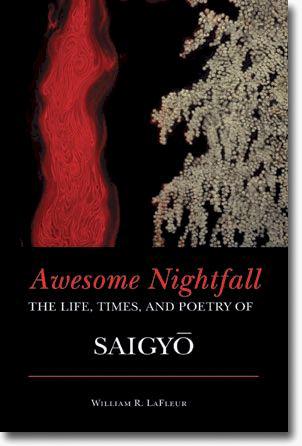
The 12th century Japanese poet, Saigyo, lived in horrific times of war, chaos, and scandal. He descended from a lineage of warriors, and after violent service to the Emperor, he took up the robes of a monk and the pen of a poet to both understand and release the straits of human-ness, his metaphorical and literal bloodstained past, the limits that all humans are born into.

In both life and writing, he became a homeless wanderer. And it was during these unceasing peregrinations between mountainous temple sites and towns that he used the ability of nature’s images to capture all that matters through deceivingly simple words.

An ancient field

and in the sole tree starkly

rising to its side

sits a dove, calling to its mate:

the awesome nightfall.

In his poems, words as single ideographs balloon with layers of meaning, and no one meaning stabilizes over another. What we think is important becomes indistinguishable as night falls. What remains there is the gift of the dove’s birdsong lilting in the dissolution of light — into awesome darkness.  As Sam Hamill writes, thoroughly intimate with Saigyo and profoundly aware that song might be the last thing heard, that words are the springboard into nothingness:  Those that I love are more beautiful because one of us will die.

I recall the moment driving home from the hospital after giving birth to our son, a process that even in good circumstances is seismic to the foundation. And in my case, I exhausted myself to the point of an acuity of my mortality. So there I was, dispossessed, with one foot still in the non-world, while my family packed up the days-old baby asleep into his carseat, also with one foot in the non-world. We were heading home.

Oddly, our destination in my mind’s eye was my childhood home. Driving down the familiar coastal route, I only saw my childhood living room with the wretched, green upholstered chair that I spent so many hours in, there under the expansive pane of glass through which was our neglected garden, littered with robins pecking at unwanted cherries. Even when it became clear that this was not indeed where we were heading, that the last time I stepped foot in this house was decades ago, I could not understand how to get to my current home, the one “known” for the last third of my life. I experienced a moment of homelessness.

Of course my literary hero, George Steiner, drawing on writers ranging from pre-classical Chinese poets to Holocaust survivors, professes this homelessness, that we are always guestworkers, “frontaliers in the boardinghouse of life,” regardless any distraction from this eventuality. It is the same for Dante, in his love for Beatrice, who travels through the three realms of the dead. And that the epic narration of Odysseus is in his journey, the textual death occurs when he reaches home.  Chuang tzu’s free and easy wandering, which is incredibly not free, nor easy.

Because we are human. We need a home. If we are to have a home, according to Bachelard, it would be like the fragile nest. Every precariously woven-together twig and dried straw comprise our human desire to hope for the future, and the precious eggs it cradles — but also the acceptance of its propensity to decay, fall apart, to be destroyed — to be ephemeral. The nest acknowledges the potential for me to be without the soul-killing need to push against Being, distracted from where the beauty of it lies. I have exhausted myself in my will to make things certain — because, as I am reminded in my changeling son, the infinite little losses in my body, my relationships, my art-making, and how in this moment right here is the possibility of perishing — words are anything but certain.

(Sparrow, by Sheila Ghidini. http://sheilaghidiniprojectspace.com/home.html)

“When you are philosophizing, you have to descend into primeval chaos, and feel at home there.” Wittgenstein.

“The grammars of creation are, in the final analysis, those of the erotic, of shaping intellect and psyche in a condition of Eros (the Logos, in the arms of love…).” George Steiner

Tags

, , , , , , , , ,

This entry wrote itself this morning on my jog, in the valley tucked away from the ocean shore. There in the chapparal valley are my kindred birds, families of quail fused together. One adult male is always vigilantly poised atop a signpost or garbage can, alertly standing guard over the small herd of fuzzy fledglings and their preoccupied surrogates pecking in the dry grass. I always regret that I must pass through them, causing them to scatter like field mice into the brambles that line the creek. The brambles where I know lurks a chubby, yet insatiated bobcat.

Despite being worn, I chose to heave myself up from the valley floor, along the switchbacks that ascend the side of a sun-lit mountain. Along the way, as predictable, I become anxious of whether I am able to reach the summit, that it is always longer and farther than I remembered. I try to recall that if I just attend to what is going on around me, go inward into my thoughts, even the burning in my legs, I will be less aware of the draining heaviness of the future tense.

Such is using any medium to create. A self-consciousness of one’s tools can turn them into the bars of a prison. We have developed bars around these lights of vulnerable creativity, sometimes so ornamental that others approve of them so much as to make us invest more and more in them. Yet the bars restrict and the air is stagnant therein, allowing only precarious involvement on the thin breath of things.

They amount to a gilded cage, polished to a mirror surface enclosing the songbird. This is the self-image of Narcissus, the trap of self-congealing. Even if it might provide both protection and adoration from the Crowd, the illusion of a subsistent self does not allow ephemeral song to take wing.

(Scene of the Bellmaker, from the film, Andrei Rublev, by Tarkovsky)

I sensed a predictable relief when I reached the top of the summit this morning, because yet again, I got to where I didn’t think I could go, and even more, I was yet surprised by the expansive view of the valley floor below extending to the sea. It occurred to me that there are summits that are exponentially harder to reach than my little hill of this blog, arriving upon its first birthday. How I curb my vulnerabilities and borrow from convention throughout is damning. And the more arduous and improbable to overcome this, the more solitary it might be to reach it — and the less likely anyone else can confirm it. Even the parasitic and invulnerable art critic Clement Greenberg said, “All profoundly original work looks ugly at first.” I have not the courage for this freedom to be ugly, nor the freedom to not be anything at all.

But it stands that I am grateful for my tribe of friends who stand guard over this endeavor, as it works its way through its awkwardness and conventional shortcomings.

I am profoundly in the arms of love.

(This poem was sent from Alice Bach, the first ever to stand guard over my writing)

Words, by Anne Sexton

Be careful of words, even the miraculous ones.

For the miraculous we do our best,

sometimes they swarm like insects

and leave not a sting but a kiss.

They can be as good as fingers.

They can be as trusty as the rock

you stick your bottom on.

But they can be both daisies and bruises.

Yet I am in love with words.

They are doves falling out of the ceiling.

They are six holy oranges sitting in my lap.

They are the trees, the legs of summer,

and the sun, its passionate face.

Yet often they fail me.

I have so much I want to say,

so many stories, images, proverbs, etc.

But the words aren’t good enough,

the wrong ones kiss me.

Sometimes I fly like an eagle

but with the wings of a wren.

But I try to take care

and be gentle to them.

Words and eggs must be handled with care.

Once broken they are impossible

things to repair.

“All our heart’s courage is the echoing response to the first call of Being which gathers our thinking into the play of the world.” Heidegger

Tags

, , , , , ,

It is funny how the muse works. Even as I am distracted by the art-killing, mundane requirements of life, something persists to whisper to me. Thankfully. Even if those whispers are drowned out by the storm-like babel of Rilke’s crowd, they emerge almost imperceptibly like fragile threads of lace woven by frail hands into the dwindled still moments of my life. Little by little, something clearer and compelling forms itself together. Like a glimpse of Virginia Woolf’s pattern. And then I wonder regretfully what art could compose itself had I been able to listen more.

Tonight there is something about the moon. Except that it is so foggy here I cannot actually see it.

Last week at the shelter support group, we presented education on domestic violence to the women who are living there, escaping it. We try to instill a framework of what they experienced, perhaps so they can avoid it in the future, but also to reassure them that what they experienced was real, and that many, far too many, have experienced it also. As has become routine, we end this session with asking them what is a healthy relationship — a question most have not considered, nonetheless those who have wrangled with an almost lethally unhealthy one. But this evening, some of the women had definite ideas.

It came time to go around the group for their closing thoughts. One woman, the newest to the household, had been stone-silent the entire group. Just when I thought she would pass her turn, she began slowly to speak. She glared into my eyes and said that our discussion had been hard. It made her feel hurt, but also ignited an anger towards the person who had hurt her. She wanted vengeance even. She wondered how could someone begin to consider healthy relationships when they are mired in a bad one. To the point where it is no longer clear what is healthy and what is not. That we begin to become unhealthy too, starting to do abusive things ourselves because of what we experienced, over and over. How can we even hope for a good relationship, she asked, in a way that embarrassed me in the philosophically-flawed notion of future-tensed hope. She pleaded, but not in a way that warranted an answer, other than the tears welling all around the table. All I could do was put my hand on her arm and say that I was so happy she had responded.

That night driving home, the moon was so low and radiant in my horizon so as to be a guiding beacon for my car. And perhaps because I was tired and raw, the moon conjured something romantic, melancholy, poetic. At first I wanted to explore an annoying litany of philosopher ideas to articulate my connection to this strange, glowing disk hovering incredulously over the skyline. But what most came to mind, to the part of me that wants to translate these moments, is that simply, the creme-lit, distant landscape is a place I will never visit. Completely unreachable. Yet it persists in my darkening sky so predictably that civilizations could measure their time by it, more accurately than by the sun.

The next day, a friend wrote me an incredibly poetic email from her artist retreat in the countryside. It was correspondence tending to the heartening and savory details of nature available to only those who know true and enviable solitude. And of course it was full of Birdness. In it, she mentioned that I might like a talk that her Zen Buddhist teacher gave on suffering, as it is my relentless theme of late. As I listened to his illuminating talk, I received a hint sewn into the pattern. Her teacher read the poetry of the medieval poet, Saigyo — a poet almost obsessively concerned with the moon. A symbol of enlightenment, the beauty in the breath-taking and indescribable culmination of accepting the painfully ephemeral and suffering nature of being human. Always there, but practically unreachable.

Winter has withered

Everything in this mountain place:

Dignity is in

Its desolation now, and beauty

In the cold clarity of its moon.

This is what the muse left me this week. I know it’s not my job (nor am I able) to weave it so tightly together with meaning and language that it would suck the air out of the atmosphere and extinguish the moon one might see tonight, the moon throughout one’s entire life. But I am astonished that somehow a poet, from across the divide of 1,000 years and immeasurable distance, reaches to me through the chatter and knows intimately the miraculous moon that guided me home that withered night.

(Bird Singing in Moonlight, 1938, by Morris Graves)The rest of the poem is here:

http://ladynyo.wordpress.com/2012/04/12/mirror-for-the-moon-a-little-poetry-of-saigyo/

“The narrow bridge of art…” – Virginia Woolf

Tags

, , , , , , , ,

On the day with the longest daylight of the year, the Northern Solstice, I found myself surrounded by thousands of dead people. Yes, I am probably over-working the mortality theme of late into an insipid pulp, what with all of its depressing seriousness. But at the columbarium in Oakland tonight, the chapels,  cloisters, and crypts filled with the remains of the dead carried the very alive music of more than 30 musicians, as apparently happens every solstice.

In following our ears to the next musician around each corner, we worked our way through the names of bookended lives lining the niches, hallways and courtyards built almost as an ascending and descending gothic maze. Corners and alcoved places exist for the bereaved to experience a meditative solitude away from others, while the constant light through open ceilings and skylights reminds of an other place, and of human smallness. Tonight, the meditators, the remembering, were music-makers.

Among the more recently interred, an accordionist sat on a metal folding chair in a marble alcove and played accomplished polkas and waltzes and even a French classic — the same song I heard on a lively street behind the Notre Dame of Paris. Then, I sat looking at candy colored tulips in the sunny, cathedral garden, while couples cooed at the river, tourists gawked at the sentinel and soaring architecture, and locals ambled on their itinerant paths to bakeries, friendly meetings, work duties. Such aspirating and pumping accordion music is of a buzzing life, even as it was played tonight among the dead. The borderline absurdity of this accordion music in what is usually a solemn and silent, heart-heavy and self-reflective space was almost sublime. Like the last scene of Life is Beautiful, when the parade of humanity, and a boy full of life, marches out of a death camp.

And there was an incredibly serious experimental piano player, in a long hallway of glass-enclosed rows of urns, pounding and trilling her piano in utter dissonant refrains. Our toddler son was fascinating himself in the gurgling, concrete memorial fountain situated a few feet in front of her, and during a particular dark and howling section of her work, he crooned his neck up to the opening in the ceiling, and sang, Bubbles, Bubbles, Buuuuuuubbbbbbles, as if to commune with the alienating musician and her intentionally awful and emotionally grueling composition.

And of course, the moment of Being. I ducked into a light-filled crypt, where written passages of St. Luke adorn the stacks of shelved lives reduced to a plaque of name and date, a date far enough in antiquity that nothing is remembered of them except their grave marker. There, a welcoming, professionally-attired woman, Laurie Amat, gracefully filled the space of the dead with her operatic voice, lilting and trembling and belting and reverberating against the stone architecture. Her melodic voice ushered me in, but as she faced the places that contained the dead, her audience, I knew that I was superfluous. Her talents were refreshment for those who cannot sing or listen anymore. She was an instrument upon which an aliveness came home to acknowledge, to reach even, the realm of the unalive. It was a remembrance for the forgotten. And it was a reminder that I, like the thousands surrounding me who are reduced to ashes, urns, plaques and one or two mementos left by a dwindling number of adoring survivors, last for just a second on this earth — just like one of her perfectly pitched, honeyed notes as it disappears into the ethers, like the note before it. At first it hurt to let go of all that my self thinks is important, those empirical requirements of the everyday. And yet, the more I disappeared into the moment, I didn’t care that I was gone, forgotten. In fact, I relished it.

“If again we should find if we took a walk with our friend that he is alive to everything — to ugliness, sordidity, beauty, amusement. He follows every thought careless where it may lead him. He discusses openly what used never to be mentioned privately. And this very freedom and curiosity are perhaps the cause of what appears to be his most marked characteristic — the strange way in which things that have no apparent connection are associated in his mind. Feelings which used to come single and separate do so no longer. Beauty is part ugliness; amusement part disgust; pleasure part pain. Emotions which used to enter the mind whole are now broken up on the threshold.” Virginia Woolf

“When he walks out into the rising dawn or looks out into the event-filled evening and when he feels what is happening there, all situations drop from him as if from a dead man, though he stands in the midst of pure life.” Rilke

Tags

, , , , , ,

Rilke says it best that without solitude, the meditative place for the fostering of one’s inner life, there can be no art. No love, either. Love, he writes, is standing guard over another’s solitude.

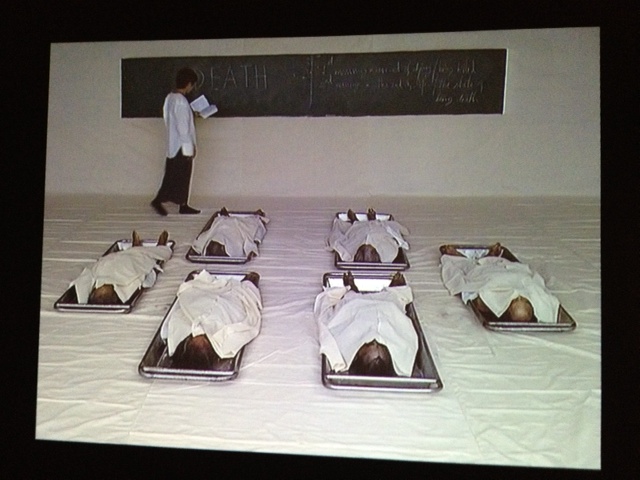
I found a moment to go to the Phantoms of Asia exhibition in the Asian Art Museum, where I encountered this video, entitled, The Class, by Araya Rasdjarmrearnsook. The artist is in essence, lecturing the six dead bodies on death. It is no accident that from where we sit, we are in the same audience as the dead people. At some point, my body will be that corpse lying on a tray. And it is there that I sat uncomfortably energized, feeling that anxiety, or Angst as Heidegger put it, that I am a being-toward-death.

While there is a dark humor pervading this piece, like when the artist asks a cadaver, What was that you said?, it is only a small bit of the profundity that this video reckons with. For me, the fact that the artist, a stand-in for the living, is teaching the dead about death — those who know deeply about it but cannot say —  hits on a facet of human nature that is confounding and all too ubiquitous. The living, in their attempt to colonize and conquer death, deaden and dull life itself.  As Steiner summarizing Heidegger says, those who rob us of the anxiety of death alienate us from life. Because, afterall, “the taking upon oneself, through Angst, of this existential ‘terminality’ is the absolute condition for human freedom.”

My friend, sitting next to me in front of this video, said plainly that she wished she had chosen to see her dead father’s body when she was given the chance, to have closure with his death. I responded carelessly that when she had had the opportunity, her father might have been dead too long and maybe the body was too removed from who he was when alive.

Two weeks later, last night, my undigested subconscious regurgitated before bed, filling my mind with thoughts about my own father. Yes, it’s Father’s Day today, but I haven’t thought of him on the past 3 or 4 such occasions. As some of you know, my ending with my father was not fairytale, but instead riddled with anger, doubt and a feeling of homelessness. But I did have meaningful time with him after he died. Although I was policed and hurried out of my vigil by his new vulturous step-family, I had a moment of loving contemplation over his peaceful body.

I realized last night that this time with him was one in which I could reflect on his life and in those incredibly condensed minutes, to feel the totality of him part from my totality. But last night I also realized that in those moments I worried about him as he faced his abyss. That I heard how he was anxious moments before he died. And I wish something or someone was with him, that he wasn’t totally alone in his leaving. Because it is a leaving that is utterly alone, and utterly into the unknown. And because of all that he was to me, for better or for worse, and because he faced this unspeakable time alone, probably doubting love, like we all might, I wish someone stood guard over him. I wish him love.

And maybe that’s all we can do for the dying — and we are all dying — because to do anything else is to rob one of life: “The inalienability of death — the plain but overwhelming fact that each must die for himself, that death is one existential potentiality which no enslavement, no promise, no power of ‘theyness’ can take away from individual man — is the fundamental truth of the meaning of being.”

In solitude, most critically felt at death, we experience freedom. Rilke’s artists and lovers of the everyday seem to know that freedom is contingent on an acceptance of our mortality and a quotidian comfort with the unknown — and even to let go enough to stand guard over someone else’s solitude. A constant homecoming, if we are brave enough. I’m not sure my father was brave enough until he was forced to be, and god knows I am not either.

“‘The wandering, the peregrination toward that which is worthy of being questioned, is not adventure but homecoming.’ Man, in his dignity, comes home to the unanswerable.” (Steiner on Heidegger)

“To all and to none.” Heidegger

Tags

, , , , , , ,

Yesterday, I found myself singing Twinkle Twinkle Little Star with my family just as we have done many times over, but this time our tone was gentle and elegiac because our intended audience was a dying rabbit in a cardboard box, wrapped in my jacket. I know, for those who know me, that yes, it seems like injured and dying animals flock to me, but it might just be that this is the condition we all are in: living in the borderlands where a dominating human presence presses up against nature’s tenuous domain.

The bunny, who happened to be lying in the dirt path on our routine evening walk, seemed to have a leg injury and a scratch on the nose, perhaps a result of predation by a cat, a coyote, a raptor, a bicyclist, who knows.

As occurred to me when a bloodied raven worked his way out of my green Whole Foods bag onto the front seat of my car, I again had a fear of driving off the road if the bunny might leap from the box into my lap. But I reasoned that it was more likely this bunny, lying awkwardly in such bad shape and with an inherent fragile heart, was dead.

A few miles into the drive, wondering if indeed Bunny was still alive and finding my NPR show jarring, I decided to peel back the fabric to see what Bunny was doing. And there suddenly was a fur-lined, big, black, round eye staring straight up at me — and a look of fright and curiosity and concern exchanged between us. I quickly covered Bunny back up.

I immediately recalled the image of another big, round, animal eye that had also poignantly looked up at me. An adult pelican, with an injured wing wrapped in a towel, sat on my lap as my friend drove us to the same shelter. En route, feeling the bird’s heart rate progressively calm, I peeled back the warm, wet towel to glimpse Pelican. Pelican’s eye was questioning and fearful, and I decided the darkness of the towel was more comforting than my own questioning, strange, and incredulous face.

So it seems fitting that I have been thinking about an amazingly beautiful film recently screened at the Experimental Film Festival in Portland, by a friend and colleague, Catherine Fairbanks. You can watch it for yourself here.

http://catherinefairbanks.com/artwork/2397516_Transference_is_a_Tough_Row_to_Hoe.html

"Transference is a tough row to how."

Catherine wonders whether attempts at empathy reach an impasse or dead end; the failure to completely reach another.  And yet her beautiful imagery and wistful narrative embodies a transcendent poetics of the human condition. As Heidegger writes about this impasse, there is something about a thing that cannot be appropriated by us. Like walking out towards a horizon. We occupy that horizon, yet there is an out there that remains away from us. Likewise, a horizon, or object or thing, has a thereness that precedes our cognition of it. But he also describes those moments where we glimpse something otherwise, when a thing things itself. For example when the presence of his Van Gogh painting, beyond its pigment and canvas and brushstrokes, reaches into our being. Or when the culmination of instruments, rhythm, and tones arrives in an untranslatable and indescribable music that stirs something within. Steiner says we experience this presence “‘[i]n moments of great despair when things lose all their weight and all meaning becomes obscured,’ or in flashes of vital brilliance.”

“We feel, we know, urges Heidegger, that there is something else there, something utterly decisive. But when we seek to articulate it, ‘it is always as though we were reaching into the void.'” It is the possibility that the horizon, the impasse between two beings, is only the something we know — the consciousness of objects. Because also therein we are offered (and it almost always feels like a gift) “an opening to what is beyond the horizon of such knowing.”

The felt love between the two mythological entities in the lake surrounded by a loving voice; the moment of knowingness between the birds and animals and myself; and a lighting that occurs between a passage of painting and the viewer. Indeed, says Heidegger, without these moments, we forget to be astonished.

“The world’s darkening never reaches to the light of Being.” Heidegger

“Art is not for.” Sam Hamill about Morris Graves

Tags

, , , , , , ,

Tonight, the poor bloke handsomely dressed in traditional Hawaiian cloth and lei, as it is every night, blows a conch to the delight of the hotel guests and their cameras and then runs with his burning torch from tiki lamp to tiki lamp across the expansive plantation style grounds. My incredulous son and other children giddily in tow. Every night it has been a new person, always Hawaiian though, and some are more obliging in this cultural fetish performance than others. But each one has warmly facilitated my son in lighting at least two tikis (because he demands more than one), bless their hearts.

Stunning is the island landscape, illuminated by torchlight flickering in the tradewinds.

Such are the moments of artistry in Hawaii, never untangled from its colonial past and its current economic conundrum as tourist industry.

In any given hotel and restaurant catering to this particular area, there is almost certainly to be incredibly talented live musicians, plucking away at a slack key guitar, soulfully singing the Hawaiian traditional opus, mostly written to keep names of places, plants, fishes, birds and cultural knowledge — a dying language — alive.

20120512-211359.jpg

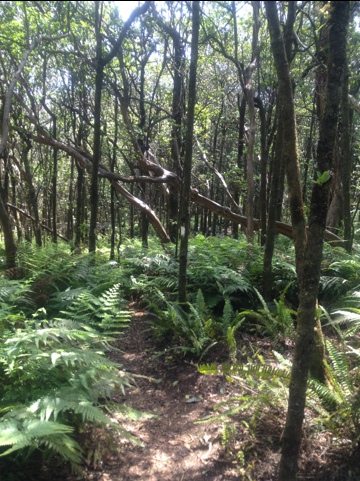
(Kalopa State Park, nature preserve)

I was already bruised after just hearing the wistful “Me ke aloha ku’u home o Kahalu’u,” (with love for my home Kahalu’u). Kahalu’u is a gorgeous beach almost smothered by concrete hotels and hordes of sunscreened waders, food trucks, and signs saying please do not step on the coral, please do not feed the fish. Even as I am counted among the island’s outsiders, I stopped to listen to these two men sing delicately and lovingly their version of ku’u home. Who isn’t bereaved of changes to the land?  They sang this elegy in an empty restaurant, empty besides a handful of waiters chatting amongst themselves, one sunburned couple watching basketball on the bar TV, and sentimental me in my bathing suit waiting for my to-go order.

Later when I entered the lobby of our hotel, where I’ve been annoyed by the constant presence of people since we arrived, a pang of a familiar melody filled me as it filled the architecture. The lobby lanai, full of well-dressed, shiny guests enjoying a cocktail and chatting amongst themselves, frames a view across the ocean where a faint silhouette of Maui dissolves into cloud. But what made me stop was yet again, another vulnerably sincere, Hawaiian slack key performer there in the skyline. He was playing not for the sake of the distracted guests unaware that this particular song, Hi’ilawe, extolls a site they probably snapped a photo of today; not for what is probably a paltry salary; and not for me mouthing what words I knew in appreciation for his performance, for the artful moment.

I hid in the adjacent stairwell hearing the last bits of the song until he transitioned to his next (I imagine to avoid the awkward silence between songs), and then I exited underneath the patio out to the courtyard. As I walked away, the musician ignored his audience as they ignored him and turned out over the balcony, looking for me below. I looked up at him and put my hand on my heart. As he strummed out the beginning of his next song, he smiled knowingly and nodded his head — a private, unseen gesture in a place of all places to be seen. Our eyes were on Hi’ilawe — an artful moment because it was completely gratuitous.

Hi’ilawe

George Kahumoku Jr.’s version of the song on YouTube, and its hula:

http://www.youtube.com/watch?v=u8kpNAIBRIw

Translation:

All eyes are on Hi’ilawe
In the sparkling lowlands of Maukele.

I escape all the birds
Chattering everywhere in Waipiʻo.

I am not caught
For I am the mist of the mountains.

I am the darling (a toy) of the parents
And a lei for the necks of grandparents.

The fragrance is wafted from Puna
And lives at Hi’ilawe waterfall.

Tell the refrain
All eyes are on Hi’ilawe.

“We are creatures of a great thirst. Bent on coming home to a place we have never known.” George Steiner

Tags

, , , , , , , ,

A kitchen oven structure, a plastic outlet plate, and other remnants of a home are a haunting sight on the bottom of the ocean floor of Kealakekua Bay. Ke ala ke kua, the pathway to God. The wreckage lies off the shore of Manini Kapahukapu beach, a sacred gathering place for ancient Hawaiians. They deemed the site a place of healing, and it seems since time immemorial this place has been in need of healing.

Hard to find, the beach’s grassy flat is surrounded by lush foliage, and its ocean shore is crusted over with almost black, unforgivingly sharp lava rock. Across the calm bay, an odd white, stone beacon of a monument commemorates Captain Cook, who landed at this Hawaiian village amicably at first. But after the entanglements of disease and colonial politics and cultural misunderstandings, he was murdered at that spot, in plain sight across from Manini.

Of course it is odd that there is no monument there to honor the dead Hawaiians that once occupied the present day ghost village and Heiau, now overgrown by bird-filled plants and trees, the true natives of the area. Besides the monument and a plaque now in the tide waters of a rising ocean stating, “Near this spot Captain Cook met his death,” there are only loads of snorkelers by boat and kayak swimming among luminescent coral forests. The reef is growing less and less pristine, inversely to its popularity. On an unmarked spot there in the turbidity of ocean water lurks one of our wedding rings, a frightful loss at first, but now a fitting, romantic homage.

Behind Manini lies a lava field, now filled with a rural grouping of homes, the impoverished ones belonging to native Hawaiians, the gentrified ones belonging to outsiders who either own them as rentals to outsiders, or who visit there just as transiently as would-be renters. I can’t help but want one myself. But that area feels heavy, and when figuring out why, I learned that before there were homes there, the lava field was the site of historical bloodshed. A faction of Hawaiians hoping to gain control over all the islands overpowered a group supporting the disinherited. The Battle of Mokuahai, in 1781, was savage as even women took up arms for their territory and were among the losers, killed by bludgeoning instruments, or forced over cliffs into the lava strewn ocean.

In the center of the bay, a large pod of spinner dolphins rest, swimming easy circuits with their calves. One year we swam out to them. They, being the more fit for sea, and either cautious or curious, found us first. I dove into the depths of the bay as a group passed me, and for the length of a held breath I swam with them, tears filling my swim mask, my hand holding my heart hurting for the beauty still left in pockets of this contested earth. But after a little research, my heart hurt more to know that my presence was detrimental to their rest, to their impending survival outside the bay where they are forced to return earlier than necessary because of swimmers like me, wanting to experience their glory.

Today, I stayed at Manini, and resisted the coral reef at the monument, and the pod of dolphins splashing and spinning on the other side of the Bay. And there is where I found the modern day ruins of a shipwrecked home, dragged into the sea by the reach of a tsunami that just over a year ago, swept tens of thousands of people in Japan out to sea. The same grandmother working there three years ago with her infant grandson, already adept at the ocean, my son then only a shrimp in my belly, was also there today as she is everyday under her umbrella. Folks stop by regularly to hear of what news, I’m not sure. While our sprouted kids played in Manini’s one sandy opening to the surf, she explained to me the recovery taking place in the area. In the eddy where pristine waters meet the machinations of savage American imperialism and colonialism, I hope Manini prevails for all of us.

20120510-070741.jpg

Glad sight wherever new with old
Is joined through some dear homeborn tie;
The life of all that we behold
Depends upon that mystery.
Vain is the glory of the sky,
The beauty vain of field and grove
Unless, while with admiring eye
We gaze, we also learn to love.
— Williams Wordsworth