• About

Unwanted Advice: Reflections from a Self-Appointed Life Counselor

~ Caminante, no hay camino. Se hace camino al andar. Wayfarer, there is no way. You make a way as you go. (Antonio Machado)

Unwanted Advice: Reflections from a Self-Appointed Life Counselor

Category Archives: poetry

“It can be observed that darkness does in fact show itself active in light, determining it to colour and thereby imparting visibility to it, since, as was said above, just as little is seen in pure light as in pure darkness.” — Hegel

22 Tuesday Jan 2013

Posted by summermlee in Aesthetic philosophy, Art, philosophy, poetry

≈ 2 Comments

Tags

Binh Danh, Bruce Wilshire, dark, fragility, Hegel, light, Paul Celan, poetry, suicide, Virginia Woolf

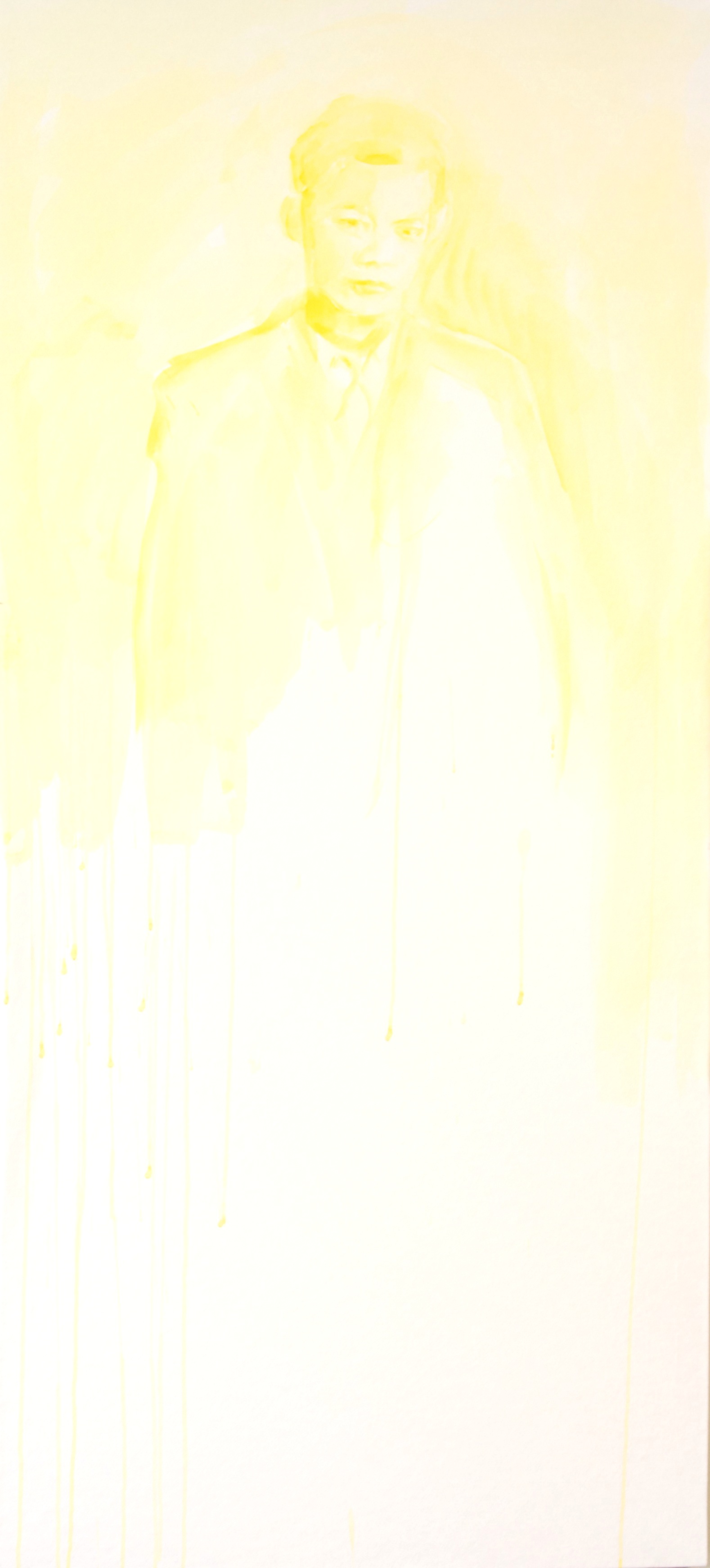
Art by Binh Danh

(Artwork using light and chlorophyll, by Binh Danh, 2004)

The moment before total light, and total darkness has about it a fragiity. The best art and the best writing possess it. As my philosophy mentor once said, fragility is a necessary condition for something in the future to arise. But humans are wired to stockpile, safeguard, and barricade against fragility, especially in a Western culture that promotes an elimination of all that is inconclusive or ambiguous. It appears to be a minor miracle when the next moment manages to squeeze through our futile clamps on the future. On the unknown.

(I can learn much by watching my son change irreparably into his future self — a constant, gentle sadness for his past appearances, abilities, size, mannerisms that no longer exist.)

So we look to art and writing — the theatre where we can enjoy bloody spectacles without having our own lives be sliced and stained. We can even eat snacks while in a vicarious embodiment of an actor or protagonist valiantly facing whatever violently unanticipated plot-turn served up by cunning artist or writer.

But sometimes, the masterful artist or writer pulls the curtain up and reveals the theatre itself. Bruce Wilshire writes in his book on theatre: “It is art which is most obviously art that puts us in closest and most revealing contact with the heart of our reality: our ability to give presence to the absent or to the nonexistent.” Wilshire is speaking of the same mechanism by which paintings illuminate the presence of an object when it reveals it to be painterly. And when words reveal themselves to be word-like. Wilshire feels this is a path towards truly knowing ourselves.

I can think of no other than Paul Celan, whose poetry beautifully crafts language at the same time reveals its fragility. His words teeter between the most profound of meanings and meaninglessness. One inch this way, and his poems would be static and predictable declarations. One inch the other way and it would be jibberish. His skilled balancing act results in a present-moment awareness of words, and maybe if we let it, results also in an awareness that we are at our best when we are the most fragile. We are the freest, most alive, when we dance the high beam knowing the great depths below on each side of us.

The beam was set impossibly high for Paul Celan. During his life, his poetry was not famous, nor lucrative. Although a polyglot, he wrote in the language that denied him the right to exist, the same language belonging to those who killed his mother and father and imprisoned him in a concentration camp. One day, he underlined the words from Holderlin’s biography, “Sometimes this genius goes dark and sinks down into the bitter well of his heart” and then drowned himself (one recalls Virginia Woolf), in the river Seine. He left the rest of the Holderlin sentence unmarked: “but mostly his apocalyptic star glitters wondrously.” Wondrously indeed does Celan’s work glitter.

To reveal language as language-like while it illuminates beyond it — to do so in German — was existential for Paul Celan. In the meanwhile, I merely (and happily, I have not the constitution for more) read the memoirs, poems — the thoughts — of the dead like Celan. Wilshire says we “engage artistically in myths in order to come to grips with the myths we live unthematically every day. To be is to exist in the presence of the absent.” Nowhere is this more acutely felt than when these posthumous thoughts are alive in my mind as I read them, as if I re-animate the corpse who thought them and wrote them down. And yet they are just words. Like the words here that you may have allowed an entrance for. But we put the book down, click off a screen, and move on. One has to. Today, afterall, is Tuesday. Well, just for a few more minutes, anyway.

“Examine for a moment an ordinary mind on an ordinary day. The mind receives a myriad impressions — trivial, fantastic, evanescent, or engraved with the sharpness of steel. From all sides they come, an incessant shower of innumerable atoms; and as they fall, as they shape themselves into the life of Monday or Tuesday.” –Virginia Woolf
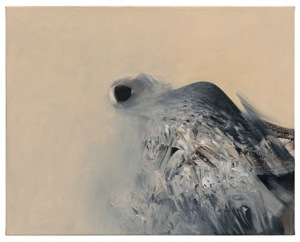
“Poets became the true accountants, and their ledgers contained the un-profitability of the human soul.” Michael Marsh

31 Monday Dec 2012

Posted by summermlee in Art, Birds, Nature, philosophy, poetry

≈ 2 Comments

Tags

"Anyone can sing", bird watching, birds, birdwatching, Michael March, poetry, Thoreau, Walden, William Ayot, writing

“…the fine print, the small type, of a meadow mouse.” — Thoreau

Behind my eyes is a geometric pattern, the dark blue lines zig zagging and dotting in that 1970’s way around white, repeated ad infinitum on the wall of my grandmother’s breakfast nook I haven’t been in for almost 15 years. It’s there when I rub my eyes in fatigue, who knows why.

On the other side of my eyes, you might see fibers of dark grey, green and ochre around a black circle.

But around the black center of a white-crowned sparrow’s eye is a dark mahogany-red. Inside the abyss of his eye, I can only imagine he is terrified as his heart races in my hand, little short breaths heaving his feathery chest. With the most delicate of touch, I run my finger up and down his body and make promises I can’t keep, still horrified by the thump of his body against the car window. His eyes blink fear and innocence straight into my eyes, but he has no control of his body, which has collapsed belly-up into my palm.

Minutes later, I declare it a minor miracle that he hops out of my makeshift hospital box and is gone. The next day he is returned to the glorious flock of 50 birds working over my now-expensive winter feeder.

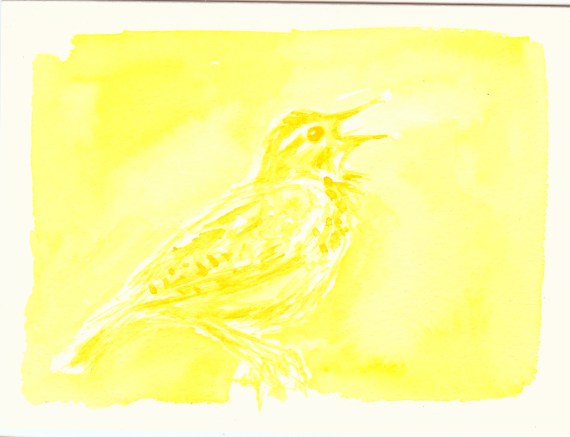
Meadowlark by Summer Lee, 2012. watercolor on paper

(A recent watercolor: Yellow happens to be the precise spot where the eye tunes into the sequence of color frequency — it has the same vibration that stimulates the retinal nerve-ends and causes the phenomenon we call light)

Obviously, these birds are my favorite words, my favorite swath of paint — and I am ever envious of those musicians who have such mastery over the wild flocks of notes and melodies, every single beat tamed at the same moment they are also alate.

— and yet, among the most rigorous creators, there is a holy acknowledgment of the not-coincidentally aleatoric. Who knows to where those wings will fly.

After 8 years of minding this winter feeder, I know every resident from migrant as I welcome new offspring and pray for the missing. They are a light, a moment of solitude along my bustling path in and out of my home in this dark time of year. Their hearty feeding is proof of a cold darkness stretching longer than what daylight allows for warmth and food. And maybe my dedication to their feeder is an understanding of these fickle and insufferable days.

Anyone can sing, but there is astonishment that the wonder of words still visits me, like the small group of diminutive, navy-blue and chestnut nuthatches, who for some reason are eagerly taking my sunflower seeds for the first time this winter. They dive into the top of the bare tree, then climb with their powerful claws head-down along the branches like woodpeckers, whom they are always adjacent to in field guides. At the feeder, they grab a singular seed into the tips of their needle-tipped beaks and with a few nasally yank-calls, fly out of sight along a bobbing flight path, into the mysterious.

The next day my son playfully repeats, “dammit” as I scurry out of the car to grieve the little brown body lying below the same car window next door. He also says I am going to eat this bird after watching me consider its life, its body, photograph it, then gently wrap it into the freezer — not an absurd conclusion on his part. I don’t tell him that this bird had not yet developed golden plumage along his crown, being this sparrow’s first winter. He was born last spring in a forever-unknown location on the western coast of Alaska and followed his flock over a thousand miles, maybe two, to our feeder. Probably just like his genetic ancestors have done since time immemorial. But even so, my son asks me if the bird cries. No, but the song says it all.

http://macaulaylibrary.org/audio/49913/play

The loving details of this bird life in my mind’s eye are already fading — I’m no master at this — but I can hear his song and his eyes have gone dark.

“…to face the possibility
that your innermost core may hold nothing at all,
and to sing from that – to fill the void
with every hurt, every harm, every hard-won joy
that staves off death yet honours its coming,
to sing both full and utterly empty,
alone and conjoined, exiled and at home,
to sing what people feel most keenly
yet never acknowledge until you sing it.
Anyone can sing. Yes. Anyone can sing.”

— William Ayot

“Why then do we not despair?” — Anna Akhmatova

17 Monday Dec 2012

Posted by summermlee in Aesthetic philosophy, Art, philosophy, poetry

≈ 2 Comments

Tags

anna Akhmatova, art, funeral, Jay DeFeo, painting, poetry, The Rose, Women

The incense burns itself into the sinuses and forms a memory of her passing and these funerary rituals, so that for at least a few days, the smoky smell is a remembrance of a being who is no longer with us. The fading smell is the inevitable process of honoring a person we eventually can’t remember often enough. Indeed, memory is one way to ease the constant anxiety we future-oriented, unsatiated beings live with. We just can’t hold on.

So instead another image wants to write itself here in the space opened up by writing, by memory.

20121217-155808.jpg

(Painting, “Dove One,” by Jay DeFeo, in the SFMOMA retrospective)

In an orange jumpsuit, he sits across from me in a dingy jail interview cell. He is young, tall, strong, and mentally quite unstable. So in my callow role as his caseworker I make sure to stay arms length from the emergency call button, and closest to the door. It doesn’t help that his movements are abrupt, his voice loud, and he can only speak of fighting others, sometimes even aliens. Ju-Jitsu moves, karate techniques, kicking and punching and more threats of violence. Not towards me, though. He just wants me to hear him, I begin to understand, but attempts towards conversation provide only bizarre digressions that stubbornly return to more Ju-Jitsu talk.

It’s our third such meeting, and I bring my colleague, for safety, yes, but also because I want a witness to his instability and any insight as to why I was making no real progress with him. This time, I decide to just listen, leave my intentions and fears with my colleague sitting in quiet interest next to me.

As usual, he begins his intense litany of karate stories, of people he once punched and kicked. But suddenly, in a moment I’ve only since experienced as artistic inspiration, in a moment of self-forgetting, I have joined him. His language appears to me as a simple story-telling code. And just as I am about to weep at his stories of years in foster care and institutions, at his outpouring of traumatic recall, my colleague breaks her silence to remind him that violence is not ok. It is then I realize I had slipped into his world without her and she does not understand the code. Her words transport me back to where he is that man so strange, intimidating and inaccessible to me. To everyone.

Like the moment I stopped planting seeds in the shelter garden because a Korean resident wants to show me using gestures how she and her family had crouched under tents on their farmland in the rain, when they lost their home to war. And how our gardening together healed something, I will never know.

And how it is that a vast canvas holding 1500 pounds of gobs of oil paint and the aura of 8 years of creative toil, can also yet contain in a breath-turn the most fragile, most unearthly of passages. The same fragility that recalls the image of a woman finding refuge from military invasion inside a temple. She is mortally injured, parts of her body are missing, and it is there she nurses her baby.

In my mind she will stay there like the sentinel that is Jay DeFeo’s Rose standing guard over us. Because if you have followed me this far, you also understand she must, no matter how painful it is.

In the metaphor of gift-giving, there exists no stronger, no more difficult example.

Fortunately, there are easier exchanges, like the smiles of my friends, my fellow colleagues, as we chant together in the incense cloud hovering over Tu-Minh’s mother’s funeral. These are the same faces that appear to me in memories of my own family funerals. That some people are so indelibly present, heart-burstingly present, in the reel turning out life events.

Such is the mark of women drawn to a certain kind of work, how to describe it, I’m not sure. Yes here I’ve made some words for it, but they don’t hold, like the leaves of paper money falling behind our funeral procession into the winter wind.

And the miraculous comes so close
to the ruined, dirty houses —
something not known to anyone at all,
but wild in our breast for centuries.
— Anna Akhmatova

20121217-155835.jpgP

“I am moved by fancies that are curled / Around these images, and cling: / The notion of some infinitely gentle / Infinitely suffering thing.” T.S. Eliot

01 Saturday Dec 2012

Posted by summermlee in Aesthetic philosophy, Art, philosophy, poetry

≈ 4 Comments

Tags

A3, art, Georg Trakl, Heidegger, installation art, pain, Pamela Belknap, poetry, T.S. Eliot, threshold


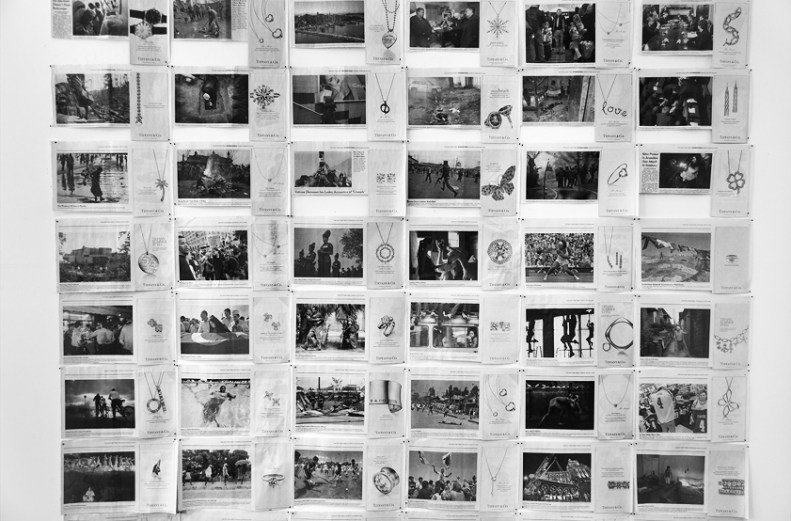
A3 by Pamela Belknap(A3 Installation, by Pamela Belknap. More can be found here)

A Winter Evening, by Georg Trakl

Window with falling snow is arrayed,
Long tolls the vesper bell,
The house is provided well,
The table is for many laid.

Wandering ones, more than a few,
Come to the door on darksome courses.
Golden blooms the tree of graces
Drawing up the earth’s cool dew.

Wanderer quietly steps within;
Pain has turned the threshold to stone.
There lie, in limpid brightness shown,
Upon the table bread and wine.

—

This is going to be a difficult one, not just because it is about pain, but also because it involves Heidegger philosophizing about pain and this “Winter Evening” poem. And Heidegger’s thinking is very abstract, even if, and almost necessarily because, it hits on something so true about being.

Heidegger holds that pain is not just the experience of Trakl’s wanderer (and we are all wanderers). Instead, pain itself has turned the threshold to stone.

A3 by Pamela Belknap

Last night, I was standing in front of these images that comprise my friend’s brilliant installation at her open studio event, and I could not help think about, and feel, this threshold.

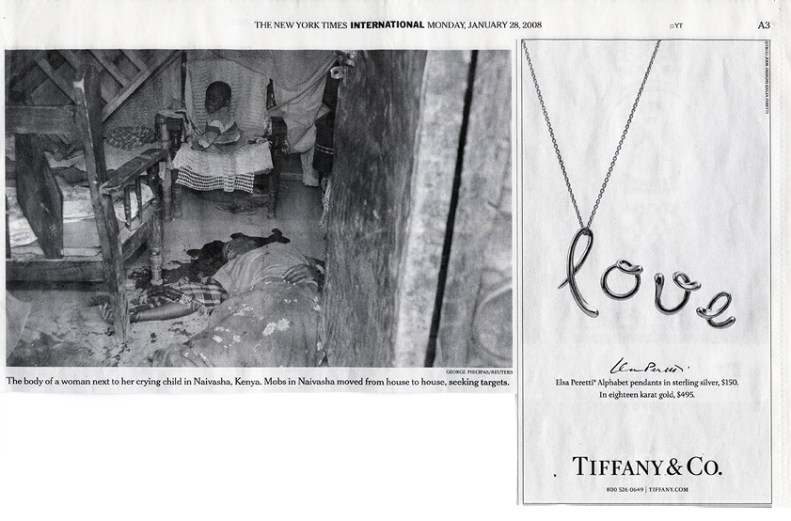
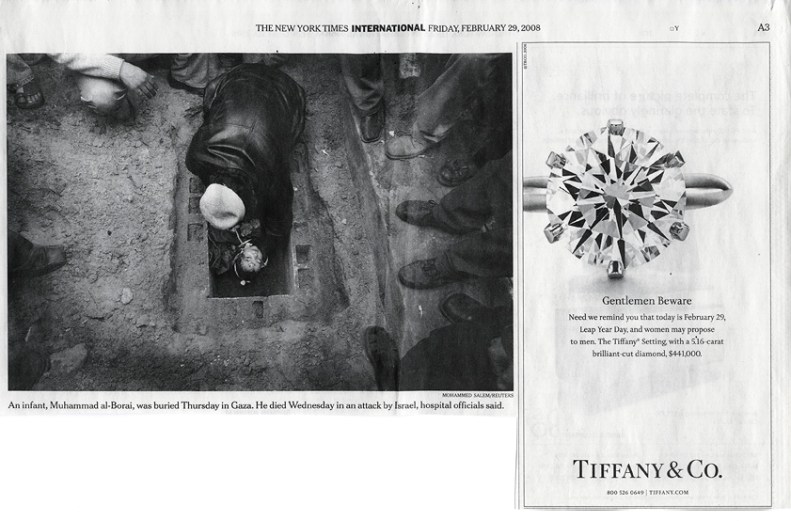
Yes, there is a threshold between the two images from the A3 section of the New York Times, almost always of an “infinitely suffering thing” captured by some journalist, and that of the Tiffany jewelry advertisement, almost always of an ostentatious, absurdly valuable and useless piece of metal, plastic or stone. These images together (and the over 800 others Pamela has collected), bear evidence of our interminable extremes of human subsistence and materialist glut, and the endlessly and unjustly paradoxical nature of being human. They are painful.

A3 by Pamela Belknap

Which side of Pamela’s image do we participate in? As I stood in front of this image, I heard the whisper of Heidegger telling me it was one and both at the same time.

Heidegger writes that pain can tear us asunder, separate us, in a way that can also join and draw together. It is pain found in the winter of Trakl’s scene, dividing “outside from inside, darkness from light, cold from warmth, hunger from nourishment, wandering from rest” – and in the case of Pamela’s artwork our participation in suffering and our painful attempt to elude it. It is pain that institutes the whole of it. The world grants these things as things, according to Heideggerian John Caputo, and “the joining of their intertwining is pain.”

Leonard Lawlor summarizes it more clearly: The fates we all are subject to cannot be simply planned and calculated; the harvest of wheat and grapes that make up Trakl’s table, of diamonds and precious metals even, are dependent on grace. “They are the fruits of the heaven and earth, gifts from the divinities to the mortals.” BUT, “grace can be withheld, and that is painful, even deadly.” Pain is the “grace of essential being in everything that comes to presence.” Without the threshold made stone by pain, it would all disappear  — “like a line drawn in the dirt.”

Somehow, though, we catch these glimpses of the threshold disappearing altogether. It is the same unspeakable mechanism that allows for one to feel most alive at the moment of instability and despair, like Blanchot’s happiness at nearly being shot to death, and the freedom at the instant of Orpheus’ loss. It is also the astonishing wonder found in the moment of receiving or giving a gift — or of love. Of a genuine act to reach and give to a fellow human.  It’s the tragedy inherent in Pamela’s A3.

Unexpected and not for anything – undivided and alive to everything.

(And it is not lost on me that even language, these words right here, cuts and divides, but at the same time gathers its skins towards itself into a scar.)

“Out of the meaningless practical shapes of all that is living or lifeless
Joined with the artist’s eye, new life, new form, new colour.
Out of the sea of sound the life of music,
Out of the slimy mud of words, out of the sleet and hail of verbal imprecisions,
Approximate thoughts and feelings, words that have taken the place of thoughts and feelings,
There spring the perfect order of speech, and the beauty of incantation.”

— T.S. Eliot, The Rock, 1934

“We cannot live only for ourselves. A thousand fibers connect us with our fellow men; and among those fibers, as sympathetic threads, our actions run as causes, and they come back to us as effects.” Henry Melvill

25 Sunday Nov 2012

Posted by summermlee in Aesthetic philosophy, Art, Nature, philosophy, poetry

≈ 3 Comments

Tags

dungeness crab, Fishing, George Steiner, Moby Dick, poetry, sculpture

I stood into the whipping onshore winds, 30 feet above the Pacific, where waves portended increasingly wicked weather patterns. My sister and I have entered into the strange world of fishing for dungeness crab on our local pier. No we are not entirely the only women there, there are sometimes one or two more — but yes, our demi-Chinese background is a flimsy but important connection to that mostly immigrant lot, working these waters for food just as much as recreation. We are not ancestrally that far-removed from those sea hunters holding down their territory with buckets and panoply of poles, bedraggled with odd bits and junkets that is the providence of fishing.

The men are abrupt and unshy in asking me to make sense of my weird fishing pole belonging to my deceased father. The more worldly fishermen are merely dumbfounded as to why I am using a fly fishing rig off a pier — but I stand my ground in my non-CostCo jeans and retort that it is indeed an ocean fly-fishing rod that can coincidentally handle the weight of a snare and imagined crab. And if this man appears gentle enough for any human disclosure, I admit that I am not fly casting, but rather repurposing the same rod and reel that has also graced the rolling rivers of Oregon, the open waterways of the Sierras, and icy brooks of western Colorado  — not because I have some innovative approach to crabbing (I have no approach whatsoever), but because the purchase of more apt equipment (and oh how these men love their equipment) drives up the cost of anything I might catch. The price is already dear, as each hour on the pier is an hour someone is watching my impatient son on wage, and the snare and disgustingly oily bait and the gloves to deal with them each have their own accounting.

An elderly Vietnamese man immediately likes us. After his curiosity with my fly rod, he admits he owns 50 different poles and unlike the disdain of the other men, he admires my unusual rod and reel because he doesn’t yet own one. He particularly likes my sister, asking her if she has a husband and when she answers no (for reasons outside his purview and worldview), he says she should find one who likes to fish. He doesn’t have any sons to marry her to, since they are all already married, adding with disappointment and a tinge of dry humour (and certainly not elation) that he has too many grandchildren. Too many who must not appreciate his hobby like his beloved wife. A wife, he boasts, who catches more fish than he does.

The surf is rough today, and only the rare reel-in results in a cringing crab, mostly too wiry to keep. Most of the men seem to know each other and share in an unspoken etiquette while taking a fatherly pleasure in helping my sister navigate her unruly crab net. And though it is not quite ten in the morning, some of them partake in flasks of undiscernable alcohol or musty marijuana I assume to relax the very stressful experience of holding one’s fishing pole while endlessly waiting — or of course needed on a medication-basis.

A somewhat-preppy, white man stops to ask how it is going. I say it would be hard for a crab to hold on to the ocean floor in such torrid surf, nonetheless for it to stop and eat something attached to a fishing pole. Cued by his warm weather outfit, I ask if he is visiting and he says no but he has brought family from Kansas here to see the ocean for the first time. He then asks who I’m there with and where do I live and other questions too numerous and probing, and it dawns on me that not just my sister has found an admirer on the pier today. In turn, I have discovered on this pier yet another god-awful trolling idea for my single lady friends, or at the very least another social event for my artist friends to ironically wear formal attire to.

We catch nothing which is always a bittersweet relief for me. No slaughtering, no prayers and apologies for cutting short the life of my unsuspecting victim, no snuffing of vitalities that even a hard-shelled, bottom-feeding, spider-creature relishes in. And no guts, thankfully no guts to wrench from cavities; no fingers dirtied by innards primatively exposed and decimated and discarded — those uncomfortable vulnerabilities and unknown consequences put off for my life’s other contingencies. Put off instead, I imagine, for the lines of dead people’s poetry, my failed paintings and the thoughts and writings I wrangle with here.

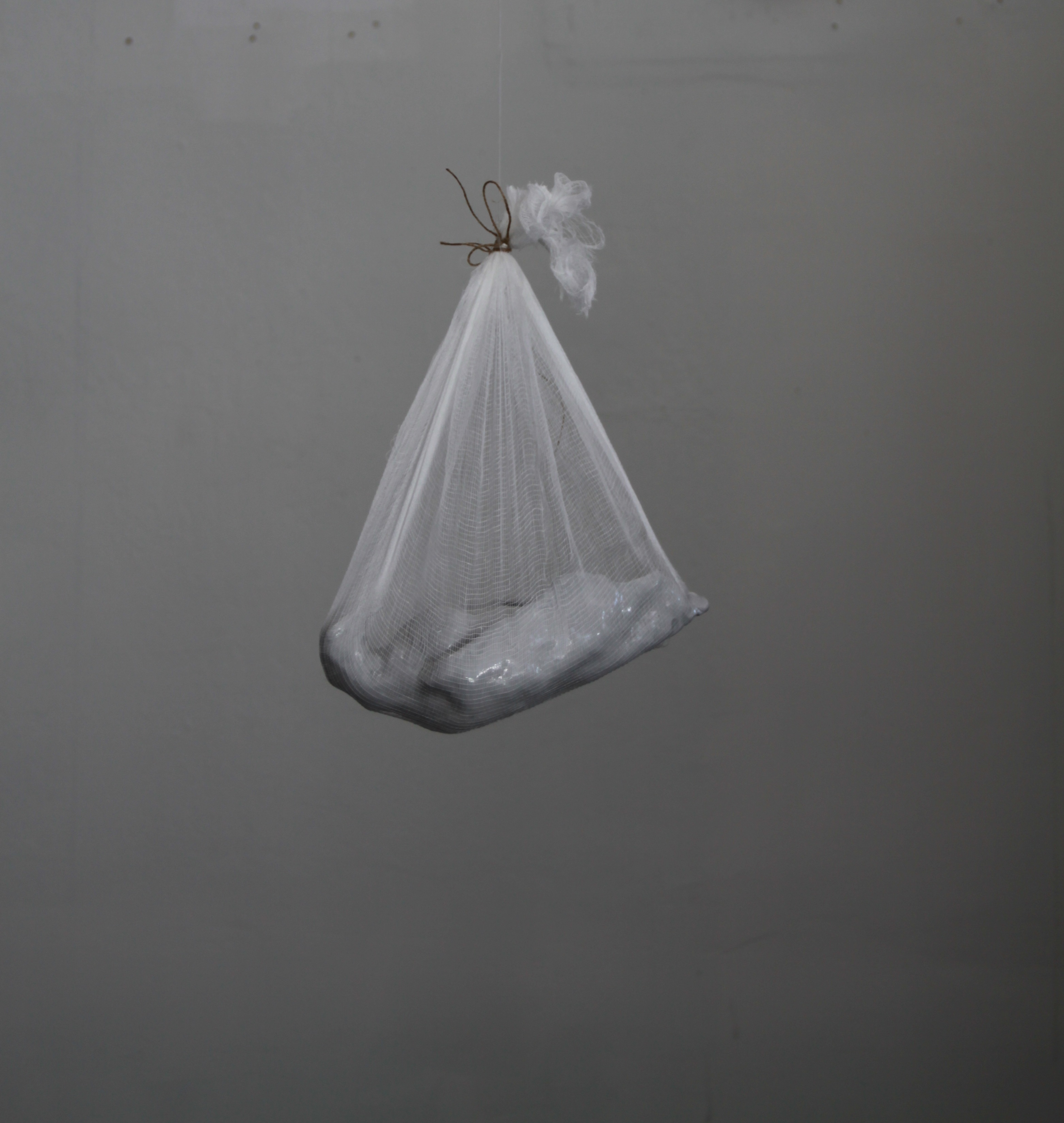
(My recent sculpture, 2012. Porcelain dead bird suspended by fabric and string)

“Man is ennobled by the vengeful spite or injustice of the gods. It does not make him innocent, but it hollows him as if he had passed through a flame. Hence there is in the final moments of great tragedy… a fusion of grief and joy, of lament over his spirit.” George Steiner, Death of Tragedy

“…a collector of silences and solitudes.” George Steiner on Ludwig Hohl

17 Saturday Nov 2012

Posted by summermlee in Aesthetic philosophy, Art, Nature, philosophy, poetry

≈ 2 Comments

Tags

Andre Chénier, art, death, George Steiner, Orpheus, poetry, rainy day poetry, solitude

As the sun’s last flashing ray,
As the last cool breeze from the shore,
Cheer the close of a dying day,
Thus I strike my lyre once more.
As now by the scaffold I wait,
Each moment of time seems the last,
For the clock, like a finger of fate,
Points onward and onward fast.

— Andre Chénier, 1794


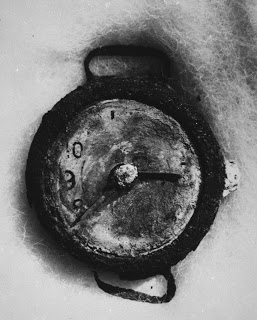
(Hiroshima watch, 8:15 a.m. August 6th, 1945)

A rainy day in the Bay Area is perfect for poetry that celebrates the precious solitude lacking from my life these days. I don’t need to blame the mundane circumstances of my life, or the lasting hangover from “art” school. Or the fact that I am trying to write this in a car whose turns are twisting my stomach into nausea all while from the backseat my son repeatedly sings a preciously off-tune version of the Abc’s. Because even so, anything less than what Steiner describes as a writing at “the edge of itself,” anything that falls short of being itself but also “speaking on behalf of the other,” is not a moment of true solitude. Art and writing necessitate a “self-summons” but also a “state of nothingness,” of which I am not capable of right now.

And what analogy is more apt than of a man awaiting guillotine in the last days of Revolutionary France, relying on his art to guide him to the imminent underworld. Again, I hear Orpheus calling on music to forge a path into the unknown. But somehow, thankfully, the situation need not be so dramatic, so dire, nor as politically charged, as to understand that what Chenier describes in his last moments is the human condition we all find ourselves in.

“The Young Captive”
The budding shoot ripens unharmed by the scythe,
Without fear of the press, on vine branches lithe,
Through spring-tide the green clusters bloom.
Is’t strange, then, that I in my life’s morning hour,
Though troubles like clouds on the dark present lower,
Half-frighted shrink back from my doom ?
Let the stern-hearted stoic run boldly on death!
I — I weep and I hope; to the north wind’s chill breath
I bend, — then erect is my form!
If days there are bitter, there are days also sweet,
Enjoyment unmixed where on earth may we meet?
What ocean has never a storm?
Illusions the fairest assuage half my pain,
The walls of a prison enclose me in vain,
The strong wings of hope bear me far;
So escapes from the net of the fowler the bird,
So darts he through ether, while his music is heard
Like showers of sweet sound from a star.
Comes Death unto me? I sleep tranquil and calm.
And Peace when I waken stands by with her balm.
Remorse is the offspring of crimes;
My welcome each morning smiles forth in all eyes,
My presence is here, to sad brows, a surprise
Which kindles to pleasure at times.
The end of my journey seemed so far to my view;
Of the elm-trees which border the long avenue,
The nearest are only past by;
At the banquet of life I have barely sat down.
My lips have but pressed the bright foaming crown
Of the wine in my cup bubbling high.
I am only in spring, — the harvest I’d see,
From season to season like the sun I would be
Intent on completing my round;
Shining bright in the garden, — its honour and queen;
As yet but the beams of the morning I’ve seen,
I wait for eve’s stillness profound.
O Death, thou canst wait; leave, leave me to dream,
And strike at the hearts where Despair is supreme,
And Shame hails thy dart as a boon!
For me, Pales has arbours unknown to the throngs,
The world has delights, the Muses have songs,
I wish not to perish too soon.
A prisoner myself, broken-hearted and crushed,
From my heart to my lips all my sympathies rushed,
And my lyre from its slumbers awoke;
At these sorrows, these wishes, of a captive, I heard,
And to rhyme and to measure I married each word
As softly and simply she spoke.
Should this song of my prison hereafter inspire
Some student with leisure her name to inquire,
This answer at least may be given, —
That grace marked her figure, her action, her speech,
And such as lived near her, blameless might teach

That life is the best gift of heaven.

(A recent watercolor of an unknown relative, 72 x 33 inches)

“You were my death / you all I could hold / when all fell away from me.” Paul Celan

27 Saturday Oct 2012

Posted by summermlee in Aesthetic philosophy, Art, philosophy, poetry

≈ 5 Comments

Tags

"The Gaze of Orpheus", "The Instant of My Death", art, death, Derrida, George Steiner, language, Maurice Blanchot, Paul Celan, poetry, Summer Mei Ling Lee, World War II

It is hard to know what this thread is, as it weaves through my recent travels. The only way to understand it more is to start about here.

Because, Blanchot says, in order to write, one must be already writing. “One can only write if one arrives at the instant towards which one can only move through space opened up by the movement of writing.” He writes this in reference to Orpheus, and that Orpheus needed music to descend to the underworld to rescue his love, a precise metaphorical homage to artistic creation. As it happens in tragedy, the moment he gazes at his beloved, he loses her, but experiences perhaps a moment of freedom: “[He] frees the work of his concern, frees the sacred contained in the work, gives the sacred to itself, to the freedom of its essence, to its essence which is freedom (for this reason, inspiration is the greatest gift).”

That is why a particularly masterful work of art recalls the fact that it could not have been — if we are vulnerable enough to let our art be art, let our hearts be touched, and to sense the present moment. Steiner is particularly fascinated with art’s ability to give presence to that which is absent and profoundly otherwise: “The arts, and music above all, give to man the freedom from his otherwise mortal city.” It is where humans can “surpass their condition.”

Blanchot, as with Paul Celan, knew Orpheus’ gaze in his own life, and both had stood within the “breath-turn” between absence and presence. Towards the end of his life, Blanchot wrote this letter to Derrida, who deeply understood occupied France:

“July 20. Fifty years ago, I knew the happiness of nearly being shot to death.”

As Blanchot was removed from his home by soldiers and placed in front of a firing squad, he experienced a “feeling of extraordinary lightness.”

Blanchot writes of the man who experienced this moment, “He was perhaps suddenly invincible. Dead — immortal. Perhaps ecstasy. Rather the feeling of compassion for suffering humanity, the happiness of not being immortal or eternal. Henceforth, he was bound to death by a surreptitious friendship.”

Blanchot, a stand-in for Orpheus, penned this “Instant of My Death” from the stance of a young man’s testimony, a fiction that is the leap of literature, one step removed from his own life. Perhaps he did so because it had been posited since classical Greece that the image of the thing is more beautiful than the thing it represents. But likely more so because he used his art to go to the depths of this underworld experience, the shadow-side of being human.  So at the moment of writing his death — as if Orpheus might describe it in 3rd person narration — at the moment he gazes back at Eurydice, he is free.

Tonight, I sit in my midnight bed, reading-lamp dim, and I hear the the approach of husky breathing that is my son, who turns his inhalations to exhalations without self-consciousness yet, who has ambled out of his bed and his room, guided by slivered lines drawn through sleep-puffed eyes, one hand viced to his blanket. He is just awake enough to know the path to my bed, and he is asleep before I have finished picking his warm, softly surrendered body up into the bed next to me. His breathing returns to the quieter rhythms of sleep and I wonder what impulse wakes him and directs him to my company. Years ago, during a particular grueling time (though there would be worse yet), I woke myself yelling for my mom. Calling for her as if she was down the hallway, like a child needing rescue from a bad dream. The impulse for words that call out for salvation is deep, even as I know that my faith in words, in salvation also, is constantly asunder.

“(At every turn, language traps us within the labyrinth which we are calling on language to elucidate).” George Steiner, Grammars of Creation.

(My recent installation, “Saigyo’s Moon.” Projection of flying birds on eggshells.)

“Endure, O mystery of being that I might pull threads from your veil.” Wislawa Szymborska

12 Friday Oct 2012

Posted by summermlee in philosophy, poetry

≈ 1 Comment

Tags

Being, Pierre Jean Jouve, poetry, Wislawa Szymborska, writing

Under A Certain Little Star

My apologies to chance for calling it necessity.
My apologies to necessity in case I’m mistaken.
May happiness not be angry if I take it for my own.
May the dead forgive me that their memory’s but a flicker.
My apologies to time for the multiplicity of the world overlooked
each second.
My apologies to an old love for treating the new one as the first.
Forgive me far-off wars for taking my flowers home.
Forgive me open wounds for pricking my finger.
My apologies for the minuet record, to those calling out from the
abyss.
My apologies to those in railway stations for sleeping comfortably
at five in the morning.
Pardon me hounded hope for laughing sometimes.
Pardon me deserts for not rushing in with a spoonful of water.
And you O hawk, the same bird for years in the same cage,
forever still and staring at the same spot,
absolve me even if you happened to be stuffed.
My apologies to the tree felled for four table legs.
My apologies to large questions for small answers.
Truth, do not pay me too much attention.
Solemnity, be magnanimous to me.
Endure, O mystery of being that I might pull threads from your
veil.
Soul, don’t blame me that I’ve got you so seldom.
My apologies to everything that I can’t be everywhere.
My apologies to all for not knowing how to be every man and
woman.
I know that as long as I live nothing can excuse me,
because I myself am my own obstacle.
Do not hold it against me, O speech, that I borrow weighty words,
and then labor to make them light.

— Wislawa Szymborska

20121012-163732.jpg
(My recent installation, ink and video on fabric.)

“Write now for the sky/ Write for the arc of the sky/ And may no black lead letter/ Veil your literature”
— Pierre-Jean Jouve, “À soi-même”

“Believe in the holy contour of life.” Jack Kerouac

05 Friday Oct 2012

Posted by summermlee in Aesthetic philosophy, Art, Nature, philosophy, poetry, Uncategorized

≈ 5 Comments

Tags

art, Heidegger, Jacques Prevert, painting, poetry, To Paint a Portrait of a Bird

Pour faire le portrait d’un oiseau

— Jacques Prévert

Peindre d’abord une cage
avec une porte ouverte
peindre ensuite
quelque chose de joli
quelque chose de simple
quelque chose de beau
quelque chose d’utile
pour l’oiseau
placer ensuite la toile contre un arbre
dans un jardin
dans un bois
ou dans une forêt
se cacher derrière l’arbre
sans rien dire
sans bouger…
Parfois l’oiseau arrive vite
mais il peut aussi bien mettre de longues années
avant de se décider
Ne pas se décourager
attendre
attendre s’il faut pendant des années
la vitesse ou la lenteur de l’arrivée de l’oiseau
n’ayant aucun rapport
avec la réussite du tableau
Quand l’oiseau arrive
s’il arrive
observer le plus profond silence
attendre que l’oiseau entre dans la cage
et quand il est entré
fermer doucement la porte avec le pinceau
puis
effacer un à un tous les barreaux
en ayant soin de ne toucher aucune des plumes de l’oiseau
Faire ensuite le portrait de l’arbre
en choisissant la plus belle de ses branches
pour l’oiseau
peindre aussi le vert feuillage et la fraîcheur du vent
la poussière du soleil
et le bruit des bêtes de l’herbe dans la chaleur de l’été
et puis attendre que l’oiseau se décide à chanter
Si l’oiseau ne chante pas
c’est mauvais signe
signe que le tableau est mauvais
mais s’il chante c’est bon signe
signe que vous pouvez signer
Alors vous arrachez tout doucement
une des plumes de l’oiseau
et vous écrivez votre nom dans un coin du tableau.

——–

To Paint a Picture of a Bird

First you paint a cage
With its door open
Then paint
Something nice
Something simple
Something lovely
Something useful
For the bird
Then set the canvas against a tree
In a garden
In a grove
Or in a forest
Hide behind the tree
Without speaking
Or moving…
Sometimes a bird arrives quickly
But equally it may take many years
Before it chooses to
Don’t be discouraged
Wait
Wait many years if needed
The speed or tardiness of its arrival
Has nothing to do
With the success of the picture
When the bird arrives
If it arrives
Observe the most profound silence
Wait till the bird enters the cage
And when it has
Gently close the door with your brush
Then
Erase all the bars one by one
Taking care not to touch a feather of the bird
Then paint a picture of the tree
Choosing the loveliest branches
For the bird
Paint the green leaves too and the wind’s coolness
The dust in the sunlight
The sound of insects, in the grass, in the summer heat
Then wait for the bird to choose to sing
If the bird won’t sing
That’s an adverse sign
A sign that the painting is bad
But if it sings it’s a good sign
A sign you can sign your name
Then very gently you’ll detach
A feather from the bird
And write your name in a corner of the painting.

“We never come to thoughts. They come to us.” Heidegger

“Language simply ceases… The poet enters into silence. Here the word borders not on radiance or music, but on night.” George Steiner

17 Monday Sep 2012

Posted by summermlee in Aesthetic philosophy, Art, music, Nature, philosophy, poetry, Uncategorized

≈ 7 Comments

Tags

art, bird watching, birds, George Steiner, music, nature, Rilke

The outskirts of Tahoe National Forest. I followed the early morning mists of little winged bugs along the edge of a forested reservoir, a small cohort of Audubon’s Warblers chasing them also. With a mind galloping through what if’s and what-nots, I sat next to their cathedral, a half-dead tree once under the water line. Its branches stretched arthritically out towards that which feeds it but also puts it asunder. One by one every species of woodland bird worked its way out of the dense pine forest to that diminuitive tree. They would land with a pause, flit a little, perhaps taking a careless bug in this gathering place, then sail down below to the stony water edge. They were singing me stories of wretchedness, of betrayal and harshness from those who didn’t believe they know better. They described predators with only few survival skills who violate their homes, even when their bellies are far from empty. But they also sung of the little joys of sunlight, improbable births, childlike pauses, and cool reservoir water. Fiercely aching nights and warm morning updrafts. And times when every species and variety of plant and bug is available, and times when their children grew silent in the cold. Warblers, nuthatches, wrentits, chickadees, flycatchers, a few I didn’t know, and a rufous sided towhee — the little delicate species, the singers. My favorites. For years this lasted. I have been devoted to them.

Someone once said that birds remind him of an existence before human civilization, of times outside of wars, laws, buildings. Before human suffering and its impulsive response of further suffering. But these birds were not solely of the sweetness of summer, though they had the resilience and the evolutionary wisdom to live as if that was all they knew. Because today it was summer.

(A photo from my studio, by Shae Rocco).

It seemed my birthright to make an offering. Give something, though those little birds of course needed nothing. Steiner reminds that art is free, gratuitous, not for anything, so much so that every artful creation calls forth an awareness that it might not have been. So somehow turning this moment into a drawing or even writing seemed superfluous, like a scarf around Rilke’s torso. And it is.

Because in this moment I also felt like I might not have been, that everything I’ve done and made might have been otherwise. I felt humble, like the chanters of holy songs, whose talents are free and freely given. So, for whatever reason, because I was perfectly alone, I began to sing. My mom would be excited to know I quietly sang songs from her faith, maybe because that foreign language seemed as intimate and yet dispossessed as the birdsong around me — it contains a hint of something inextricable even as it is unknown. And despite my usual anxiety of needing more, I had a moment of needing nothing, a necessary condition for gift-giving, even if it is song-giving. Towards everything surrounding the birds and all the radiating objects and memories and people I know and knew. And as the scene pulsated, the birds neared me one by one as part of their ritual, into otherwise lethal distances. A Townsend Warbler landed a few inches above my head. After that a Kinglet slid down to the frayed end of a branch four inches from my eyes. Another Audubon’s Warbler almost upon my shoulder. They exerted themselves to me. And so I cease to sing.

” — for here there is no place that does not see you. You must change your life.” Rilke

← Older posts
Newer posts →

Enter your email address to subscribe to this blog and receive notifications of new posts by email.

Join 619 other subscribers

Recent Posts

  • “Experimenters in the passages between worlds.” Vinciane Despret, Au Bonheur des Morts
  • “The terrifying groundlessness, the eradication of all violences. To be embraced by that which doesn’t know us and in that unknowing caresses us and truly loves us. We might become anything at all, something wildly other than what we are encountered by. A world that truly loves us by not presuming what we want or what shape we will take before we show up… We will be held when we are not known from the start.” — Dr. Marquis Bey
  • Images dream within us, a reverie is a world of expansion.
  • “For the natural world, the ethical responsibility is that being alive gives existence to others.” Vinciane Despret
  • “We meet in the freedoms of each other.” – Takeyoshi Nishiuchi

Archived Posts

Blog at WordPress.com.

  • Subscribe Subscribed
    Unwanted Advice: Reflections from a Self-Appointed Life Counselor
    Join 215 other subscribers

    Have a WordPress.com account? Log in now.

  • Unwanted Advice: Reflections from a Self-Appointed Life Counselor
    View site in Reader
    Manage subscriptionsSign upLog in
    Report this content
    Collapse this bar
Loading Comments...