• About

Unwanted Advice: Reflections from a Self-Appointed Life Counselor

~ Caminante, no hay camino. Se hace camino al andar. Wayfarer, there is no way. You make a way as you go. (Antonio Machado)

Unwanted Advice: Reflections from a Self-Appointed Life Counselor

Category Archives: Nature

“We are in the midst of reality, responding with joy.” — Agnes Martin

23 Sunday Jun 2013

Posted by summermlee in Aesthetic philosophy, Art, music, Nature, philosophy

≈ 8 Comments

Tags

Agnes Martin, art, chapel of the chimes, death, Garden of Memory, George Steiner, Heidegger, painting, summer solstice

A year later and I am back visiting the dead, this time questioning the responsibility of putting new life into the world.

Weaving in and out of the crypts and private chapels, the walls are lined with vessels holding ashes, shelves holding caskets, and the letters of names. It takes a strain of my imagination to fill-in the entire arc of a life that now sits in mostly forgotten urns, placeholders. Once behind the names were fleshes of personality, interactions that effected causality, relational change, consequences in the environment, impressions on the psyches of others — and then they were gone. Except for a spot in a tiny little box aside thousands of others, now also mere words.

Painting by Agnes Martin

(Painting, “Tremolo,” by Agnes Martin, 1967.)

This year, it struck me that the cast of musicians performing here and there among the dead were stand-ins, intermediaries. They attracted hordes of the living into this solemn place on the longest day of the year to challenge the human aloofness towards the dead, to weigh the untranslatable meanings behind those words. With mixed success. Even though evidence of death towers on all sides, our finite narratives and rehearsed terminal endings at the end of every sentence — we remain distracted from our own dying.

We committed to one dark grotto of those born in the early 1800’s. A professional cellist sat inside with her laptop and synthesizer. Sometime while she was tuning her cello and tapping on her laptop, it dawned on us that she was in high performance. The ambiguous noises were experiments against the classical instrument’s boundaries: a stutter and screech here, a falling note there, a computer’s response, and the cellist’s retort. When she finished her “tuning” performance and nodded her head to applause, we understood that the provisional and dissonant duet between cellist and computer highlighted the aleatory relationship between existence and not-existence — and was indeed beautiful music. As Steiner says, art reminds us that there is something rather than nothing, only by virtue of grace.

The scene seared into my heart the ruminating words I had read that day of my dear friend’s husband having only days to live. They were going down their road until a few weeks ago, their life was sideswiped by illness and overturned into a tragic twilight. At home in hospice care, they are surrounded by friends and family who improvise themselves into a blanket of love and support for his last moments. There is no score or predictable soundtrack here. Nor, as Pamela says, is this life a dress rehearsal. But at best we merely hear the music at all.

Painting by Agnes Martin

(Painting, “Trumpet,” by Agnes Martin, 1967)

My friend this evening and I jest that it is just as much the beauty of the performer as it is the melodic tunes (amidst many dissonant-sounding experimental musicians) that has drawn a thick crowd into side room of the columbarium. Sitting on the stone floor in vulnerable elegance, she plays odd, unrecognizable instruments in classical improvisations. And we, the living, over a trickling fountain lined with pertly pink and red impatiens, “watch” her fill the space of the eternally invisible with unseen timbres and undulating wavelengths of passionate percussion. When she breathes into a bamboo flute with an electronic lung holding a previous refrain to which she responds in turn, a strange but pleasing chorus emerges into a rhythm of labored breath, a futile and yet beautiful resuscitation.

(In the stairwell from one chapel to another, we overhear a woman remark that this is what people from the rest of the country think Californians do everyday.)

But the true entrance into me does not occur by that willful anticipation of art, just as much as predicted words here do not alight, but sink. Instead it happened when an unexpected noise entered the back of our music-filled worship. It announced the entrance of a young, disabled girl with the cognition of a child ten years younger. She burst into this delicate space, hugging a 3-foot Barney and two teddy bears, and proceeded to march directly to within inches of the musician. The performer was startled but without missing a note, welcomed her softly with her eyes. And the girl of a strange grammar, much to my held breath’s relief, plopped herself front and center with no further histrionics. While the music pulsed along, the girl’s father sat down in the back, occasionally waving a connective hello to his girl. But she is now entranced by the familiarly foreign music, playing seriously with one of the bear’s ears — because afterall, this is about our ears.

And I, the helicopter parent, who constantly restricts my exuberant son in a cloying distrust and tiresome fear of violating the perceived comfort of everyone around me, orchestrating him here and there so as to fit who-knows-what expectations, I succumbed to this scene. Yes, a carnival of existence among the backdrop of non-existence, of Nothingness — but mostly of trusting surrender. There in front of the dead, the distracted living, too — and because of the little bit of life under my domain that is there despite me — my heart busted itself into tears.

“As the shrine of Nothing, death is the shelter of Being.” — Heidegger

Painting by Agnes Martin(Agnes Martin’s last painting, “Untitled,” 2004)

“When a fox is fifty, it can take the form of a woman. When it is one hundred, it can take the form of a beautiful girl. When it is a thousand, it can speak to Heaven and will never die.” — Larissa Lai

08 Wednesday May 2013

Posted by summermlee in Art, Birds, Nature, philosophy, poetry

≈ 8 Comments

Tags

Adrienne Rich, art, artist's block, birds, Heidegger, Larissa Lai, May Sarton, poetry, The Fact of a Doorframe, When Fox is A Thousand

They left me last week, as was bound to happen.

But back in time, societies marked the first day of spring by the arrival of swallows, the same birds you might see outside your window right now. They cut through the air with imperceptible wing beats, more like the bugs they chase than bird-like. They sweep faster than my camera can focus, weaving invisible flight paths like loose braids in the ways my own memories criss-cross and become farther from truth, but in a way closer to me. And similar to memory, it’s as if one random clear day, they appear out of no where, just as likely as emergent from the ground underneath our feet than arriving from distant lands.

 IMG_1761 II

The same people believed that a fox could also be an immortal woman who prowls the night.

“When a fox is fifty, it can take the form of a woman. When it is one hundred, it can take the form of a beautiful girl. When it is a thousand, it can speak to Heaven and will never die.”

Our dear neighbor, Chuck (there is no better neighbor for warm mailbox conversation and handyman referrals and trinket-gifts to our scavenger son) has just spotted a fox traipsing along our backyards. Back there, the ceanothus is putting out snowballs of periwinkle blue, its branches forming undulating waves under which birds and snakes alike find refuge. And now this fox. I wonder what she wants to tell me.

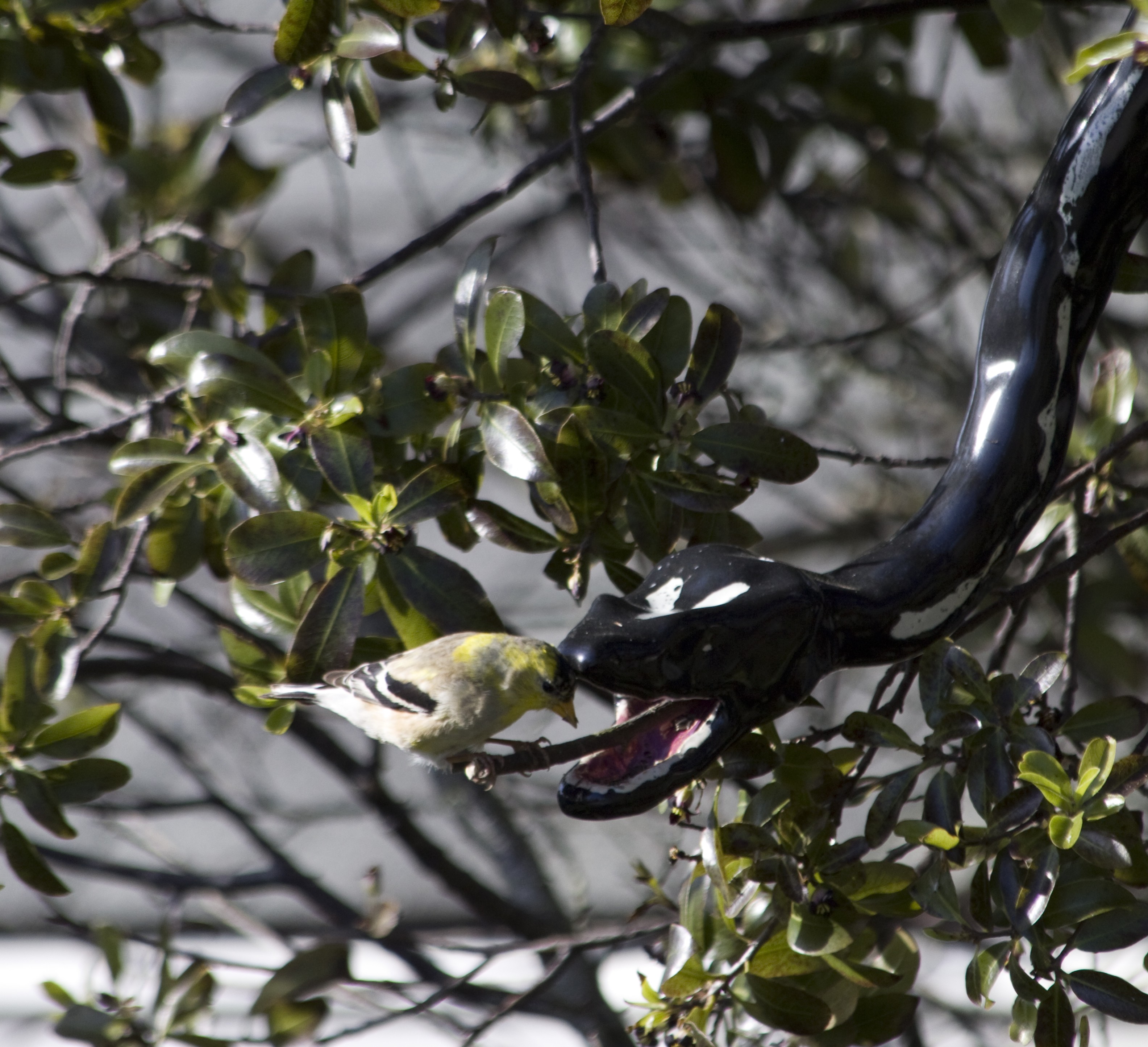
Ceramic birdfeeder and goldfinch from my frontyard, 2008

(Ceramic snake birdfeeder, by Summer Lee, 2008)

May Sarton has been speaking to me through her journals. She tells me to make an art of solitude, of which I have a lethal deprivation these days. Solitude is not for everyone, she seems to say through her doldrums and delights. You can get stuck with yourself there and self-berate endlessly. But beyond that, there is an expanse that wants to be explored with ink, words, light. Silence.

Heidegger says getting to that place begins with willing not to will. By intending not to intend — which for us humans, hungry for connection and to be special, anxious for security and accomplishment, is pretty fucking hard. And only after that little unlikely step, can an awakening to an inner releasement occur. A lettingness. Gelassenheit, he called it, borrowing from ancient, mystical German text. In turn, through Gelassenheit, we are let in. The most mundane glint of light through a swath of paint on a centuries-old, unknown painting brings me to my knees. Or the tiny yellow feathers of a pine siskin is a sign of god. Or, on the other hand, nothing happens. Like Adrienne Rich’s fact of a doorframe: we may go through, but it makes no promises.

And for good reason, since that mystery is the foundation of being. But I forget. Or as Heidegger says, I fall asleep thinking I am most awake. And during my restless slumber these clear spring nights, the fox wanders through the moon-glazed fields of my backyard, hoping I glimpse her and remember before she changes form again.

So, despite my circulation-squashing chokehold on all trivial things right now — whether to have another child, how to produce an acceptable art piece, how to be a good parent and partner, how to protect wildlife and destroy the gun lobby, how even to slow down bastard time as it mocks my appearance, my memory, my ability to get anything done — I accept that those tiny pine siskins have left my feeder and have gone north for several years, if they return at all. They are faithful to a rhythm older than time immemorial. Not to me. And I’m so grateful.

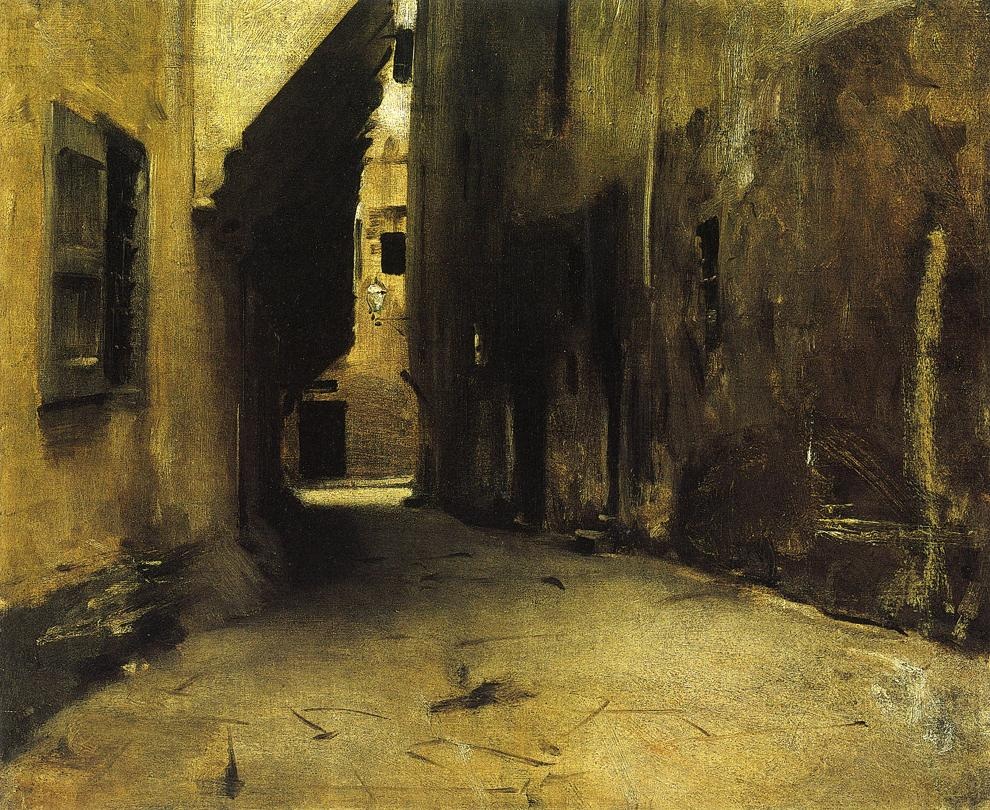
By John Singer Sargent

(Painting by John Singer Sargent)

“The shadow is a tight passage, a narrow door, whose painful constriction no one is spared who goes down to the deep well… For what comes after the door is surprisingly enough, a boundless expanse full of unprecedented uncertainty, with apparently no inside and no outside, no above and no below, no here and no there, no mine and no thine, no good and no bad… Where I am indivisible this and that; where I experience the other in myself and the other-than-myself experiences me.” — Mary Sarton, quoting Carl Jung.

“One can never pretend to comprehend completely –: that would disrespect in the face of the Unknown that inhabits — or comes to inhabit — the poet; that would be to forget that poetry is something that breathes; that poetry breathes you in.” Paul Celan to René Char

21 Sunday Apr 2013

Posted by summermlee in Aesthetic philosophy, Art, Birds, Nature, philosophy, poetry, Uncategorized

≈ 7 Comments

Tags

art, death, Leigh Hyams, painting, Paul Celan, poetry, San Miguel de Allende, Stephane Mallarme, teachers

Since I was the youngest by 3 or 4 decades, my traveling companions were relieved it was me who, drained from travel and the stifling heat (and a sip of the local margarita), interrupted pleasantries to declare that I might pass out. Our host for the week escorted me to the warm cement sidewalk of a dirt street outside the humble restaurant and waited until the cool breeze of the desert night revived me. She asked me polite questions, mostly trying to ease my embarrassment, but also to indirectly resolve how it is that at not even 30 years old, I had become close friends and travel companions with a cadre of women in their 60’s.

The babel of barking dogs woke me the next morning, which was after the night of dreaming she came to hold me. Somehow, the dark sensuality of this woman a half-century older did not alarm me.

In the morning painting session, I start with images and colors I have known before, but they don’t cooperate. As I paint canvases full of utterly conventional crap, I find myself at the edge of tears. There in the shade of her turquoise and pink adobe courtyard, tendrils of bougainvillea cling to the walls closing in on me, mocking my vulnerability and failure — like the stuffing has fallen out of my bra and the world sees me trying to put it back.

She sees the paintings and since I cannot dare the gracelessness needed to throw them over the fence,  I wish for once they could tell a lie. She moves like a dancer around them and critiques them with the fists of a boxer. I am politely mute, in turn, hating my own politeness. I want to hate her but she is just the conduit.

Painting. By Leigh Hyams(Painting by Leigh Hyams)

Plus, San Miguel de Allende overwhelms my sensitivity. I know why the dogs bark. All of them trying to simplify and drown out the brightly jarring colors, the incessant music from blocks away, the dead heat, the spirit voices, the craving for something other. The unreachable ocean.

The next night I dream that my neighbor’s contractor tears out my yard. All my cherished plants are missing, upturned soil exposes eviscerated roots. I experience an abyss where there once had been logic and rationality. Before hitting bottom, I wake to the pre-dawn storm of bird songs.

My dream is clear to her. She tells me in deep tones and direct terms that this unknown is the place where I want to be. Because of this and the buzz in her words, I start crying as she speaks, releasing all the tears that started bubbling in the courtyard. Tears that were neatly packaged screams against my mediocrity, my mundane banality, my safety. Tears that were cages holding a fearful but overgrown child wanting out into the wilderness. My painter friends look on tenderly, thinking it is because I’m sad. But I am beyond sad or happy, I am approaching otherness.

They think she is only speaking to me.

She says, this crying business, as if to be disdainful and compassionate at the same time, is something that only artists can understand.

I would return years later for an extended time considering the small city, my being in the midst of fertility treatment, and the lack of communication to my home from this gritty, foreign country. I was prisoner again to my own painting in her light-drenched studio, but she was a gentle and stern warden. We had many conversations here and there, aside a parade of indigenous costume-wearing tribes, over breakfasts in teeming gardens, after a dip in the local mineral springs, and hopping along the cobblestones incongruently filling the roads.

Sensing her increased frailty and watching her meticulous devotion to a series of sparsely charcoaled paintings of local ruins — to me obvious elegies to past magnanimous accomplishment — I asked if she was questioning her mortality. She, sitting in the improbably verdant backdrop of a sumptuous, water-filled courtyard garden gleaming in desert light and singing heat, answered with a smile, and maybe a slight disingenuousness: not anymore than I always have.

Painting by Leigh Hyams
(Painting by Leigh Hyams)

Some mornings new art books would appear at my breakfast table, always with unspoken pertinence. I loaned her my copy of Mary Oliver’s recent Evidence — a book of searching poems comprised of terse words around what cannot be buried, even spoken, after a loss, or death.

So I can imagine exactly how it was when she died a few weeks ago. Her bed is overlooking her wildly tended garden. She is arms-distance to her favorite art pieces ranging from profoundly poetic to those with playful certainty, and those, maybe her favorite, continually in serious questioning. I can see the washed out colors of early Mexican spring, feel the light-headed air of the high altitude aggressively dancing with the dust lifted and levitating in her richly alive, medieval Latin city. And I hear a liturgy from the birds of her neighborhood, of course, taking over the tinny brass horns droning from distant radios. The birds alone can accept that someone who loved life so much should have to leave it.  As a consolation, when dawn breaks leaving an emptiness for the rest of us, they send jewels of ephemeral birdsong down to earth to adorn her.

“Toute chose sacrée et qui veut demeurer sacrée s’enveloppe de mystère.” Stephane Mallarmé

Painting, by Leigh Hyams

(Painting by Leigh Hyams)

“Poets became the true accountants, and their ledgers contained the un-profitability of the human soul.” Michael Marsh

31 Monday Dec 2012

Posted by summermlee in Art, Birds, Nature, philosophy, poetry

≈ 2 Comments

Tags

"Anyone can sing", bird watching, birds, birdwatching, Michael March, poetry, Thoreau, Walden, William Ayot, writing

“…the fine print, the small type, of a meadow mouse.” — Thoreau

Behind my eyes is a geometric pattern, the dark blue lines zig zagging and dotting in that 1970’s way around white, repeated ad infinitum on the wall of my grandmother’s breakfast nook I haven’t been in for almost 15 years. It’s there when I rub my eyes in fatigue, who knows why.

On the other side of my eyes, you might see fibers of dark grey, green and ochre around a black circle.

But around the black center of a white-crowned sparrow’s eye is a dark mahogany-red. Inside the abyss of his eye, I can only imagine he is terrified as his heart races in my hand, little short breaths heaving his feathery chest. With the most delicate of touch, I run my finger up and down his body and make promises I can’t keep, still horrified by the thump of his body against the car window. His eyes blink fear and innocence straight into my eyes, but he has no control of his body, which has collapsed belly-up into my palm.

Minutes later, I declare it a minor miracle that he hops out of my makeshift hospital box and is gone. The next day he is returned to the glorious flock of 50 birds working over my now-expensive winter feeder.

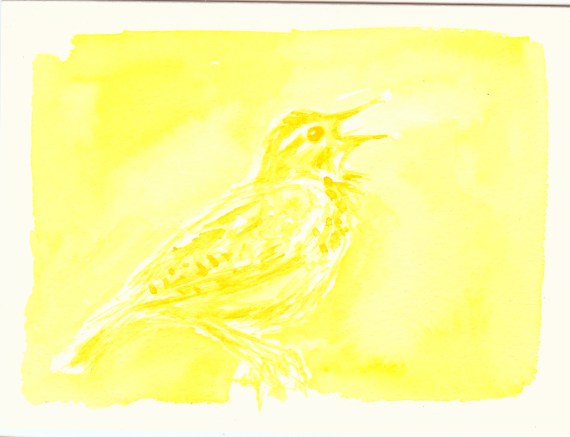
Meadowlark by Summer Lee, 2012. watercolor on paper

(A recent watercolor: Yellow happens to be the precise spot where the eye tunes into the sequence of color frequency — it has the same vibration that stimulates the retinal nerve-ends and causes the phenomenon we call light)

Obviously, these birds are my favorite words, my favorite swath of paint — and I am ever envious of those musicians who have such mastery over the wild flocks of notes and melodies, every single beat tamed at the same moment they are also alate.

— and yet, among the most rigorous creators, there is a holy acknowledgment of the not-coincidentally aleatoric. Who knows to where those wings will fly.

After 8 years of minding this winter feeder, I know every resident from migrant as I welcome new offspring and pray for the missing. They are a light, a moment of solitude along my bustling path in and out of my home in this dark time of year. Their hearty feeding is proof of a cold darkness stretching longer than what daylight allows for warmth and food. And maybe my dedication to their feeder is an understanding of these fickle and insufferable days.

Anyone can sing, but there is astonishment that the wonder of words still visits me, like the small group of diminutive, navy-blue and chestnut nuthatches, who for some reason are eagerly taking my sunflower seeds for the first time this winter. They dive into the top of the bare tree, then climb with their powerful claws head-down along the branches like woodpeckers, whom they are always adjacent to in field guides. At the feeder, they grab a singular seed into the tips of their needle-tipped beaks and with a few nasally yank-calls, fly out of sight along a bobbing flight path, into the mysterious.

The next day my son playfully repeats, “dammit” as I scurry out of the car to grieve the little brown body lying below the same car window next door. He also says I am going to eat this bird after watching me consider its life, its body, photograph it, then gently wrap it into the freezer — not an absurd conclusion on his part. I don’t tell him that this bird had not yet developed golden plumage along his crown, being this sparrow’s first winter. He was born last spring in a forever-unknown location on the western coast of Alaska and followed his flock over a thousand miles, maybe two, to our feeder. Probably just like his genetic ancestors have done since time immemorial. But even so, my son asks me if the bird cries. No, but the song says it all.

http://macaulaylibrary.org/audio/49913/play

The loving details of this bird life in my mind’s eye are already fading — I’m no master at this — but I can hear his song and his eyes have gone dark.

“…to face the possibility
that your innermost core may hold nothing at all,
and to sing from that – to fill the void
with every hurt, every harm, every hard-won joy
that staves off death yet honours its coming,
to sing both full and utterly empty,
alone and conjoined, exiled and at home,
to sing what people feel most keenly
yet never acknowledge until you sing it.
Anyone can sing. Yes. Anyone can sing.”

— William Ayot

“We cannot live only for ourselves. A thousand fibers connect us with our fellow men; and among those fibers, as sympathetic threads, our actions run as causes, and they come back to us as effects.” Henry Melvill

25 Sunday Nov 2012

Posted by summermlee in Aesthetic philosophy, Art, Nature, philosophy, poetry

≈ 3 Comments

Tags

dungeness crab, Fishing, George Steiner, Moby Dick, poetry, sculpture

I stood into the whipping onshore winds, 30 feet above the Pacific, where waves portended increasingly wicked weather patterns. My sister and I have entered into the strange world of fishing for dungeness crab on our local pier. No we are not entirely the only women there, there are sometimes one or two more — but yes, our demi-Chinese background is a flimsy but important connection to that mostly immigrant lot, working these waters for food just as much as recreation. We are not ancestrally that far-removed from those sea hunters holding down their territory with buckets and panoply of poles, bedraggled with odd bits and junkets that is the providence of fishing.

The men are abrupt and unshy in asking me to make sense of my weird fishing pole belonging to my deceased father. The more worldly fishermen are merely dumbfounded as to why I am using a fly fishing rig off a pier — but I stand my ground in my non-CostCo jeans and retort that it is indeed an ocean fly-fishing rod that can coincidentally handle the weight of a snare and imagined crab. And if this man appears gentle enough for any human disclosure, I admit that I am not fly casting, but rather repurposing the same rod and reel that has also graced the rolling rivers of Oregon, the open waterways of the Sierras, and icy brooks of western Colorado  — not because I have some innovative approach to crabbing (I have no approach whatsoever), but because the purchase of more apt equipment (and oh how these men love their equipment) drives up the cost of anything I might catch. The price is already dear, as each hour on the pier is an hour someone is watching my impatient son on wage, and the snare and disgustingly oily bait and the gloves to deal with them each have their own accounting.

An elderly Vietnamese man immediately likes us. After his curiosity with my fly rod, he admits he owns 50 different poles and unlike the disdain of the other men, he admires my unusual rod and reel because he doesn’t yet own one. He particularly likes my sister, asking her if she has a husband and when she answers no (for reasons outside his purview and worldview), he says she should find one who likes to fish. He doesn’t have any sons to marry her to, since they are all already married, adding with disappointment and a tinge of dry humour (and certainly not elation) that he has too many grandchildren. Too many who must not appreciate his hobby like his beloved wife. A wife, he boasts, who catches more fish than he does.

The surf is rough today, and only the rare reel-in results in a cringing crab, mostly too wiry to keep. Most of the men seem to know each other and share in an unspoken etiquette while taking a fatherly pleasure in helping my sister navigate her unruly crab net. And though it is not quite ten in the morning, some of them partake in flasks of undiscernable alcohol or musty marijuana I assume to relax the very stressful experience of holding one’s fishing pole while endlessly waiting — or of course needed on a medication-basis.

A somewhat-preppy, white man stops to ask how it is going. I say it would be hard for a crab to hold on to the ocean floor in such torrid surf, nonetheless for it to stop and eat something attached to a fishing pole. Cued by his warm weather outfit, I ask if he is visiting and he says no but he has brought family from Kansas here to see the ocean for the first time. He then asks who I’m there with and where do I live and other questions too numerous and probing, and it dawns on me that not just my sister has found an admirer on the pier today. In turn, I have discovered on this pier yet another god-awful trolling idea for my single lady friends, or at the very least another social event for my artist friends to ironically wear formal attire to.

We catch nothing which is always a bittersweet relief for me. No slaughtering, no prayers and apologies for cutting short the life of my unsuspecting victim, no snuffing of vitalities that even a hard-shelled, bottom-feeding, spider-creature relishes in. And no guts, thankfully no guts to wrench from cavities; no fingers dirtied by innards primatively exposed and decimated and discarded — those uncomfortable vulnerabilities and unknown consequences put off for my life’s other contingencies. Put off instead, I imagine, for the lines of dead people’s poetry, my failed paintings and the thoughts and writings I wrangle with here.

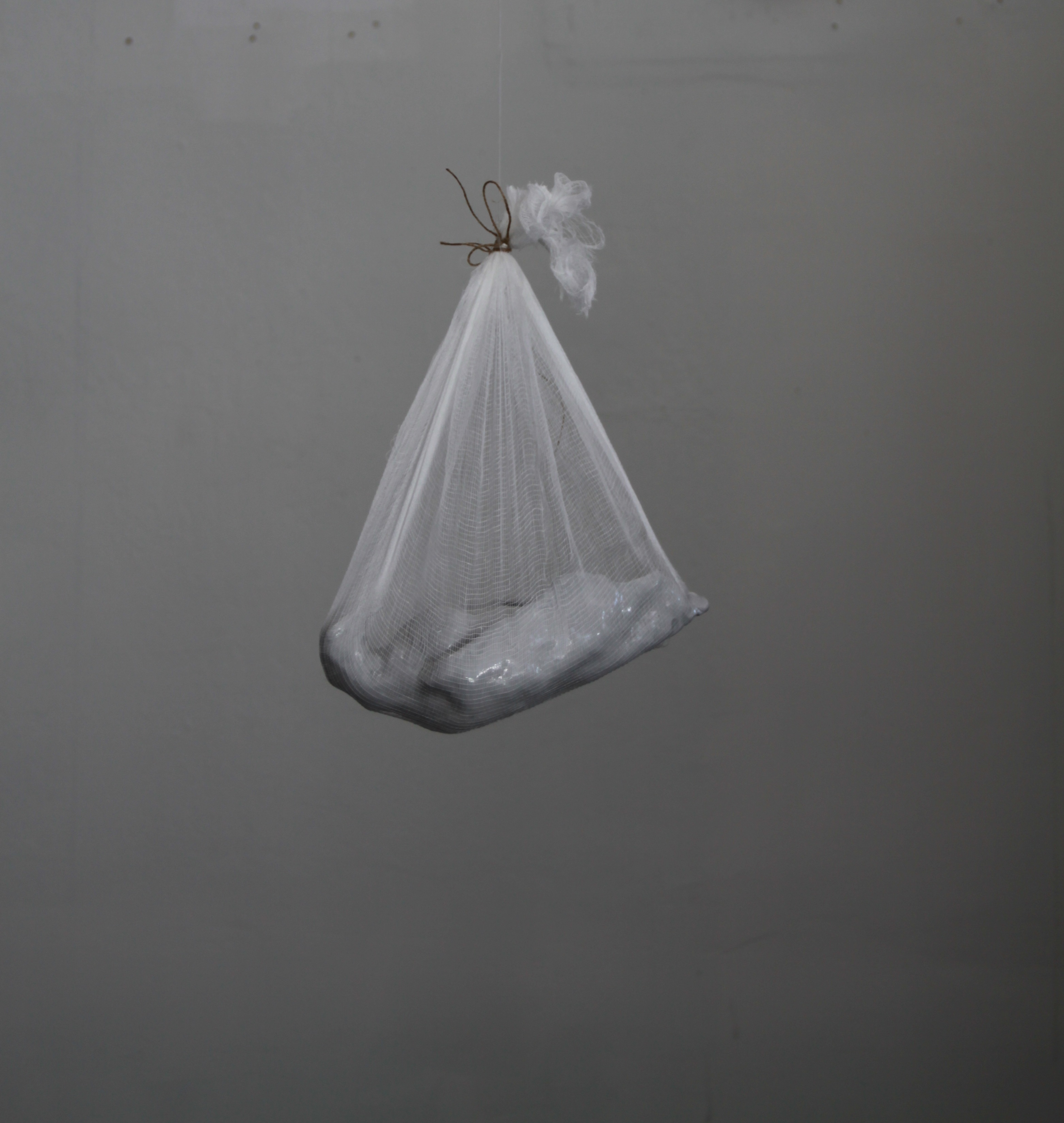
(My recent sculpture, 2012. Porcelain dead bird suspended by fabric and string)

“Man is ennobled by the vengeful spite or injustice of the gods. It does not make him innocent, but it hollows him as if he had passed through a flame. Hence there is in the final moments of great tragedy… a fusion of grief and joy, of lament over his spirit.” George Steiner, Death of Tragedy

“…a collector of silences and solitudes.” George Steiner on Ludwig Hohl

17 Saturday Nov 2012

Posted by summermlee in Aesthetic philosophy, Art, Nature, philosophy, poetry

≈ 2 Comments

Tags

Andre Chénier, art, death, George Steiner, Orpheus, poetry, rainy day poetry, solitude

As the sun’s last flashing ray,
As the last cool breeze from the shore,
Cheer the close of a dying day,
Thus I strike my lyre once more.
As now by the scaffold I wait,
Each moment of time seems the last,
For the clock, like a finger of fate,
Points onward and onward fast.

— Andre Chénier, 1794


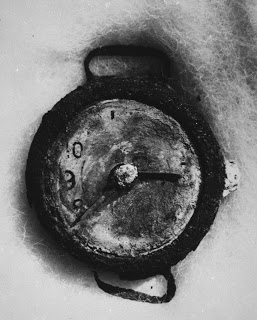
(Hiroshima watch, 8:15 a.m. August 6th, 1945)

A rainy day in the Bay Area is perfect for poetry that celebrates the precious solitude lacking from my life these days. I don’t need to blame the mundane circumstances of my life, or the lasting hangover from “art” school. Or the fact that I am trying to write this in a car whose turns are twisting my stomach into nausea all while from the backseat my son repeatedly sings a preciously off-tune version of the Abc’s. Because even so, anything less than what Steiner describes as a writing at “the edge of itself,” anything that falls short of being itself but also “speaking on behalf of the other,” is not a moment of true solitude. Art and writing necessitate a “self-summons” but also a “state of nothingness,” of which I am not capable of right now.

And what analogy is more apt than of a man awaiting guillotine in the last days of Revolutionary France, relying on his art to guide him to the imminent underworld. Again, I hear Orpheus calling on music to forge a path into the unknown. But somehow, thankfully, the situation need not be so dramatic, so dire, nor as politically charged, as to understand that what Chenier describes in his last moments is the human condition we all find ourselves in.

“The Young Captive”
The budding shoot ripens unharmed by the scythe,
Without fear of the press, on vine branches lithe,
Through spring-tide the green clusters bloom.
Is’t strange, then, that I in my life’s morning hour,
Though troubles like clouds on the dark present lower,
Half-frighted shrink back from my doom ?
Let the stern-hearted stoic run boldly on death!
I — I weep and I hope; to the north wind’s chill breath
I bend, — then erect is my form!
If days there are bitter, there are days also sweet,
Enjoyment unmixed where on earth may we meet?
What ocean has never a storm?
Illusions the fairest assuage half my pain,
The walls of a prison enclose me in vain,
The strong wings of hope bear me far;
So escapes from the net of the fowler the bird,
So darts he through ether, while his music is heard
Like showers of sweet sound from a star.
Comes Death unto me? I sleep tranquil and calm.
And Peace when I waken stands by with her balm.
Remorse is the offspring of crimes;
My welcome each morning smiles forth in all eyes,
My presence is here, to sad brows, a surprise
Which kindles to pleasure at times.
The end of my journey seemed so far to my view;
Of the elm-trees which border the long avenue,
The nearest are only past by;
At the banquet of life I have barely sat down.
My lips have but pressed the bright foaming crown
Of the wine in my cup bubbling high.
I am only in spring, — the harvest I’d see,
From season to season like the sun I would be
Intent on completing my round;
Shining bright in the garden, — its honour and queen;
As yet but the beams of the morning I’ve seen,
I wait for eve’s stillness profound.
O Death, thou canst wait; leave, leave me to dream,
And strike at the hearts where Despair is supreme,
And Shame hails thy dart as a boon!
For me, Pales has arbours unknown to the throngs,
The world has delights, the Muses have songs,
I wish not to perish too soon.
A prisoner myself, broken-hearted and crushed,
From my heart to my lips all my sympathies rushed,
And my lyre from its slumbers awoke;
At these sorrows, these wishes, of a captive, I heard,
And to rhyme and to measure I married each word
As softly and simply she spoke.
Should this song of my prison hereafter inspire
Some student with leisure her name to inquire,
This answer at least may be given, —
That grace marked her figure, her action, her speech,
And such as lived near her, blameless might teach

That life is the best gift of heaven.

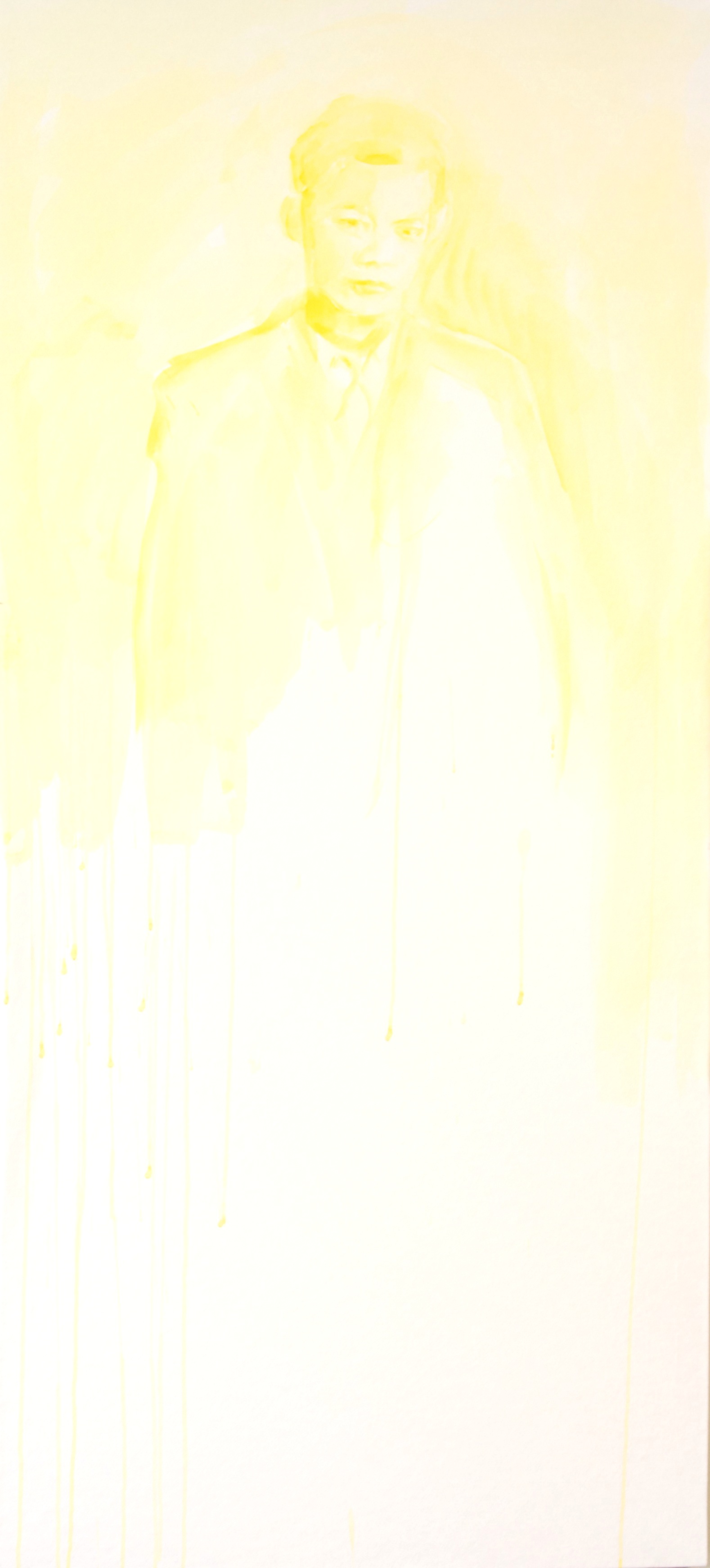
(A recent watercolor of an unknown relative, 72 x 33 inches)

“Believe in the holy contour of life.” Jack Kerouac

05 Friday Oct 2012

Posted by summermlee in Aesthetic philosophy, Art, Nature, philosophy, poetry, Uncategorized

≈ 5 Comments

Tags

art, Heidegger, Jacques Prevert, painting, poetry, To Paint a Portrait of a Bird

Pour faire le portrait d’un oiseau

— Jacques Prévert

Peindre d’abord une cage
avec une porte ouverte
peindre ensuite
quelque chose de joli
quelque chose de simple
quelque chose de beau
quelque chose d’utile
pour l’oiseau
placer ensuite la toile contre un arbre
dans un jardin
dans un bois
ou dans une forêt
se cacher derrière l’arbre
sans rien dire
sans bouger…
Parfois l’oiseau arrive vite
mais il peut aussi bien mettre de longues années
avant de se décider
Ne pas se décourager
attendre
attendre s’il faut pendant des années
la vitesse ou la lenteur de l’arrivée de l’oiseau
n’ayant aucun rapport
avec la réussite du tableau
Quand l’oiseau arrive
s’il arrive
observer le plus profond silence
attendre que l’oiseau entre dans la cage
et quand il est entré
fermer doucement la porte avec le pinceau
puis
effacer un à un tous les barreaux
en ayant soin de ne toucher aucune des plumes de l’oiseau
Faire ensuite le portrait de l’arbre
en choisissant la plus belle de ses branches
pour l’oiseau
peindre aussi le vert feuillage et la fraîcheur du vent
la poussière du soleil
et le bruit des bêtes de l’herbe dans la chaleur de l’été
et puis attendre que l’oiseau se décide à chanter
Si l’oiseau ne chante pas
c’est mauvais signe
signe que le tableau est mauvais
mais s’il chante c’est bon signe
signe que vous pouvez signer
Alors vous arrachez tout doucement
une des plumes de l’oiseau
et vous écrivez votre nom dans un coin du tableau.

——–

To Paint a Picture of a Bird

First you paint a cage
With its door open
Then paint
Something nice
Something simple
Something lovely
Something useful
For the bird
Then set the canvas against a tree
In a garden
In a grove
Or in a forest
Hide behind the tree
Without speaking
Or moving…
Sometimes a bird arrives quickly
But equally it may take many years
Before it chooses to
Don’t be discouraged
Wait
Wait many years if needed
The speed or tardiness of its arrival
Has nothing to do
With the success of the picture
When the bird arrives
If it arrives
Observe the most profound silence
Wait till the bird enters the cage
And when it has
Gently close the door with your brush
Then
Erase all the bars one by one
Taking care not to touch a feather of the bird
Then paint a picture of the tree
Choosing the loveliest branches
For the bird
Paint the green leaves too and the wind’s coolness
The dust in the sunlight
The sound of insects, in the grass, in the summer heat
Then wait for the bird to choose to sing
If the bird won’t sing
That’s an adverse sign
A sign that the painting is bad
But if it sings it’s a good sign
A sign you can sign your name
Then very gently you’ll detach
A feather from the bird
And write your name in a corner of the painting.

“We never come to thoughts. They come to us.” Heidegger

“Language simply ceases… The poet enters into silence. Here the word borders not on radiance or music, but on night.” George Steiner

17 Monday Sep 2012

Posted by summermlee in Aesthetic philosophy, Art, music, Nature, philosophy, poetry, Uncategorized

≈ 7 Comments

Tags

art, bird watching, birds, George Steiner, music, nature, Rilke

The outskirts of Tahoe National Forest. I followed the early morning mists of little winged bugs along the edge of a forested reservoir, a small cohort of Audubon’s Warblers chasing them also. With a mind galloping through what if’s and what-nots, I sat next to their cathedral, a half-dead tree once under the water line. Its branches stretched arthritically out towards that which feeds it but also puts it asunder. One by one every species of woodland bird worked its way out of the dense pine forest to that diminuitive tree. They would land with a pause, flit a little, perhaps taking a careless bug in this gathering place, then sail down below to the stony water edge. They were singing me stories of wretchedness, of betrayal and harshness from those who didn’t believe they know better. They described predators with only few survival skills who violate their homes, even when their bellies are far from empty. But they also sung of the little joys of sunlight, improbable births, childlike pauses, and cool reservoir water. Fiercely aching nights and warm morning updrafts. And times when every species and variety of plant and bug is available, and times when their children grew silent in the cold. Warblers, nuthatches, wrentits, chickadees, flycatchers, a few I didn’t know, and a rufous sided towhee — the little delicate species, the singers. My favorites. For years this lasted. I have been devoted to them.

Someone once said that birds remind him of an existence before human civilization, of times outside of wars, laws, buildings. Before human suffering and its impulsive response of further suffering. But these birds were not solely of the sweetness of summer, though they had the resilience and the evolutionary wisdom to live as if that was all they knew. Because today it was summer.

(A photo from my studio, by Shae Rocco).

It seemed my birthright to make an offering. Give something, though those little birds of course needed nothing. Steiner reminds that art is free, gratuitous, not for anything, so much so that every artful creation calls forth an awareness that it might not have been. So somehow turning this moment into a drawing or even writing seemed superfluous, like a scarf around Rilke’s torso. And it is.

Because in this moment I also felt like I might not have been, that everything I’ve done and made might have been otherwise. I felt humble, like the chanters of holy songs, whose talents are free and freely given. So, for whatever reason, because I was perfectly alone, I began to sing. My mom would be excited to know I quietly sang songs from her faith, maybe because that foreign language seemed as intimate and yet dispossessed as the birdsong around me — it contains a hint of something inextricable even as it is unknown. And despite my usual anxiety of needing more, I had a moment of needing nothing, a necessary condition for gift-giving, even if it is song-giving. Towards everything surrounding the birds and all the radiating objects and memories and people I know and knew. And as the scene pulsated, the birds neared me one by one as part of their ritual, into otherwise lethal distances. A Townsend Warbler landed a few inches above my head. After that a Kinglet slid down to the frayed end of a branch four inches from my eyes. Another Audubon’s Warbler almost upon my shoulder. They exerted themselves to me. And so I cease to sing.

” — for here there is no place that does not see you. You must change your life.” Rilke

“Everything that can be thought at all can be thought clearly. Everything that can be said at all can be said clearly. But not everything that can be thought can be said.” — Wittgenstein

01 Saturday Sep 2012

Posted by summermlee in Aesthetic philosophy, Art, Nature, philosophy

≈ 3 Comments

Tags

art, Being, dead birds, memoir, painting, philosophy, silence, susan Sontag, Wittgenstein

In the yard of my childhood home, a robin drunk from devouring over-ripe cherries on our tree, flew into our bay window that must have held an attractive illusory world, so much so that more than a few birds met that hard, bludgeoning reality. And after struggling for air on the ground below, it became still and lifeless. My mother, sensitive to the meekest of life forms, gathered the corpse and her two fledgling daughters for a funeral. A hole was dug, and as I watched the corpse of the bird descend into the dirt void, my mom said words, words of ritual, wishing that this bird would be in peace.

That robin’s life, unlike the other carcasses of animals on roadsides or worse, was made sacred to me, and the abyss into which some part of this bird, the part besides feathers and flesh, inhabited when it was into the ground became the eternal question mark.

My mentor describes the pre-classical Chinese pictogram of sacred as a person standing on earth, on one’s toes, reaching for the sky, the heavens. The sacred cannot be without the earth, the mundane requirements of being human, but it also has the urge for beyond such knowing.

Eventually and logically, that became the case for those beings lying unceremoniously in rotting ditches who by my eyes were not made sacred. And a moment of heightened attention in a car passing by was, and continues to be, my attempt to sacralize, because it feels necessary that we would all be given the mere gift of attention as we disappear.

Finally this week, it was this scene that appeared to me in my own ritualized space of art-making in my studio, where I stared upon the flocks of quiet, often dissolving, single, little dead birds I’ve painted over and over for the last 7 years. After enduring the dissonant if not polite questioning and dismissal from others and myself — amidst a cultural popularization of cute birds on every sundry item available (“put a bird on it”) — I was partially decoded.

And luckily, also this week, I read an essay by Susan Sontag, who fully understands the impulse to make art “towards the ever-receding horizon of silence.”:

“One result is a type of art which many people characterize pejoratively as dumb, depressed, acquiescent, cold. But these privative qualities exist in a context of the artist’s objective intention, which is always discernible. To cultivate the metaphoric silence that’s suggested by conventionally lifeless subjects (as in much of Pop Art) and to construct “minimal” forms which seem to lack emotional resonance are in themselves vigorous, often tonic choices.”


(My painting: “Bird Elegy #1″ (detail), 2012.  14″ x 19” Watercolor on Paper)

But my recent writing/searching has drawn my attention to the fact that all things, especially the experience of love, are of a continual parting. Perhaps that impossible constant attention to that coming and going, the making sacred of every moment and every thing that makes a heartbeat, that presences and reaches into us, and then dissolves into silence — Heidegger’s clearing and gathering and clearing — that is a  glimpse into the untranslatable state of Being.

For now, I can only handle my little birds.

“It seems unlikely that the possibilities of continually undermining one’s assumptions can go on unfolding indefinitely into the future, without being eventually checked by despair or by a laugh that leaves one without any breath at all.” Susan Sontag

And when we imagine wings that come and go / What we see is a house / And a wide open window. – May Sarton

23 Thursday Aug 2012

Posted by summermlee in Aesthetic philosophy, music, Nature, philosophy, poetry, Uncategorized

≈ 8 Comments

Tags

Bachelard, birdsong, childhood home, dead sparrow, Gadamer, Heidegger, Home, May Sarton, memoir, music

If Goethe is right, and architecture is frozen music, home is a song we have learned by heart.

My friend reminds me that learning things by heart insists upon rhythm, the heartbeat, and that the experience of the present moment is rhythmic.

One beat has to end for the next to begin. And like his favorite piano concerto, we don’t know when this note ends, and there is much tension in the space before the next. And life is marked by a gentle sadness when that moment ends and dissolves into the next moment. That, according to Bugbee, life is haunted by a continual parting. Proust says these moments are connected to places that also don’t exist anymore: “The places we have known do not belong only to the world of space on which we map them for our convenience. None of them was ever more than a thin slice, held between the contiguous impressions that composed our life at that time; the memory of a particular image is but regret for a particular moment; and houses, roads, avenues, are as fugitive, alas as the years.”

And that was the fugitive feeling I have had recently. First, I was at a dinner where a friend made a lovingly-prepared pot roast. Tomato and herbs infused a slow-cooked meat I’ve not experienced since I was living in my childhood home. The warm, familiar smell wrapped its arms around me as I sat in this modern-day apartment, just as my mother’s filled our evening home when I was a child. The smell invoked something so palpably nostalgic that one part of my self remained in a distant past even as I carried about in the present-tense conviviality. My friend sitting next to me also was piqued by the memories of childhood dinners; someone who I happened to have first met when I was 6 years old. We have witnessed each other grow and shed several versions of ourselves, though there is something from which we struggle not to stray.

It recalls Gadamer’s notion of festival — that there is an enduring in the perishing. There is continually a moment that we wish could be retained, held onto for just another moment longer, even though it can never be. It is a “consciousness of human frailty,” when we are aware of the rhythms of our life and the fact that they end. “Every festive joy, yes, every joy, is perhaps the other side of an inexpressible, unutterable.” And every beat of the heart is inseparable from its opposite — silence; nothingness.

And then I gave into the urge to drive by my childhood home this week. I was in the area, where a chaparral dustiness meets the crisp coastal breeze and tugs at me. As did the autumnally-filtered light of a sun beginning to arc lower in the sky. And there predictably sat the home on the corner of middle-suburbia covered with mature trees and gridded off by narrow streets. The house, like the area, is shinier and more regal than the more humble and equitable times known before Silicon Valley bubbles and exorbitant housing prices. The home was still incredibly intimate, yet completely estranged from me — the current occupants undoubtedly using it in their own way in a sort of betrayal of the past. Because, like everything else, my home had to give way to their home. Like the tightly woven, straw nest that fell off the side of our house a few months ago. Next to it was a darkly stippled egg, intact, but belonging now to the unknown.

The nest fell from the eaves of my new home of the last 13 years. Soon, as with every year, the winter flock of Golden-crowned Sparrows and their one loyal Fox Sparrow friend returns to our feeder. One year our cat in her boredom slaughtered the Fox Sparrow, and after I grieved its dark, hopeless body in my hand, I decided not to slaughter the cat. A few years later, a new Fox Sparrow somehow rejoined the flock. I’ll never know how.

Fox Sparrow song

This is the home which presses itself into my son whose foundational memories will be part of the architecture, as the architecture is part of his psyche. And eventually, the most eventual fact of all, my life will give way also. So dramatic-sounding, I know, but the remembrance of which always relates to Heidegger’s astonishment that I exist rather than not, that leads to Hamill’s loving a little bit more, because one of us will die. And the moment when the stars begin to burn through Mary Oliver’s sheets of clouds so that I may write about it here, with words that are little houses, as they dissolve away also. That things come and go, it brings about wonder:

“Celebration … is self-restraint, is attentiveness, is questioning, is meditating, is awaiting, is the step over into the more wakeful glimpse of the wonder — the wonder that a world is worlding around us at all, that there are beings rather than nothing, that things are and we ourselves are in their midst, that we ourselves are and yet barely know who we are, and barely know that we do not know this. – Martin Heidegger, Polt

← Older posts
Newer posts →

Enter your email address to subscribe to this blog and receive notifications of new posts by email.

Join 619 other subscribers

Recent Posts

  • “Experimenters in the passages between worlds.” Vinciane Despret, Au Bonheur des Morts
  • “The terrifying groundlessness, the eradication of all violences. To be embraced by that which doesn’t know us and in that unknowing caresses us and truly loves us. We might become anything at all, something wildly other than what we are encountered by. A world that truly loves us by not presuming what we want or what shape we will take before we show up… We will be held when we are not known from the start.” — Dr. Marquis Bey
  • Images dream within us, a reverie is a world of expansion.
  • “For the natural world, the ethical responsibility is that being alive gives existence to others.” Vinciane Despret
  • “We meet in the freedoms of each other.” – Takeyoshi Nishiuchi

Archived Posts

Blog at WordPress.com.

  • Subscribe Subscribed
    Unwanted Advice: Reflections from a Self-Appointed Life Counselor
    Join 215 other subscribers

    Have a WordPress.com account? Log in now.

  • Unwanted Advice: Reflections from a Self-Appointed Life Counselor
    View site in Reader
    Manage subscriptionsSign upLog in
    Report this content
    Collapse this bar
Loading Comments...