Tags
Adrienne Rich, art, artist's block, birds, Heidegger, Larissa Lai, May Sarton, poetry, The Fact of a Doorframe, When Fox is A Thousand
They left me last week, as was bound to happen.
But back in time, societies marked the first day of spring by the arrival of swallows, the same birds you might see outside your window right now. They cut through the air with imperceptible wing beats, more like the bugs they chase than bird-like. They sweep faster than my camera can focus, weaving invisible flight paths like loose braids in the ways my own memories criss-cross and become farther from truth, but in a way closer to me. And similar to memory, it’s as if one random clear day, they appear out of no where, just as likely as emergent from the ground underneath our feet than arriving from distant lands.

The same people believed that a fox could also be an immortal woman who prowls the night.
“When a fox is fifty, it can take the form of a woman. When it is one hundred, it can take the form of a beautiful girl. When it is a thousand, it can speak to Heaven and will never die.”
Our dear neighbor, Chuck (there is no better neighbor for warm mailbox conversation and handyman referrals and trinket-gifts to our scavenger son) has just spotted a fox traipsing along our backyards. Back there, the ceanothus is putting out snowballs of periwinkle blue, its branches forming undulating waves under which birds and snakes alike find refuge. And now this fox. I wonder what she wants to tell me.
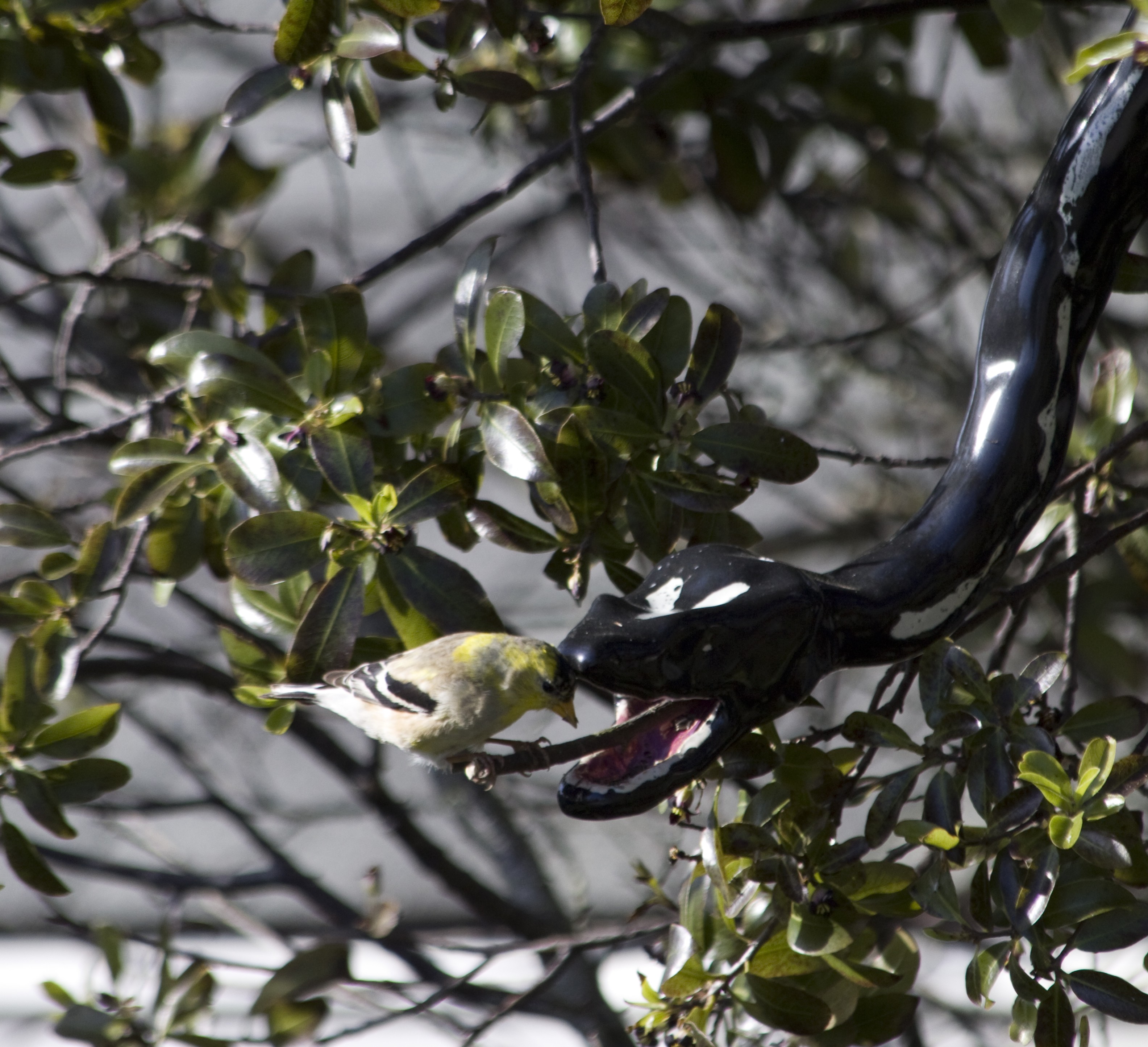
(Ceramic snake birdfeeder, by Summer Lee, 2008)
May Sarton has been speaking to me through her journals. She tells me to make an art of solitude, of which I have a lethal deprivation these days. Solitude is not for everyone, she seems to say through her doldrums and delights. You can get stuck with yourself there and self-berate endlessly. But beyond that, there is an expanse that wants to be explored with ink, words, light. Silence.
Heidegger says getting to that place begins with willing not to will. By intending not to intend — which for us humans, hungry for connection and to be special, anxious for security and accomplishment, is pretty fucking hard. And only after that little unlikely step, can an awakening to an inner releasement occur. A lettingness. Gelassenheit, he called it, borrowing from ancient, mystical German text. In turn, through Gelassenheit, we are let in. The most mundane glint of light through a swath of paint on a centuries-old, unknown painting brings me to my knees. Or the tiny yellow feathers of a pine siskin is a sign of god. Or, on the other hand, nothing happens. Like Adrienne Rich’s fact of a doorframe: we may go through, but it makes no promises.
And for good reason, since that mystery is the foundation of being. But I forget. Or as Heidegger says, I fall asleep thinking I am most awake. And during my restless slumber these clear spring nights, the fox wanders through the moon-glazed fields of my backyard, hoping I glimpse her and remember before she changes form again.
So, despite my circulation-squashing chokehold on all trivial things right now — whether to have another child, how to produce an acceptable art piece, how to be a good parent and partner, how to protect wildlife and destroy the gun lobby, how even to slow down bastard time as it mocks my appearance, my memory, my ability to get anything done — I accept that those tiny pine siskins have left my feeder and have gone north for several years, if they return at all. They are faithful to a rhythm older than time immemorial. Not to me. And I’m so grateful.
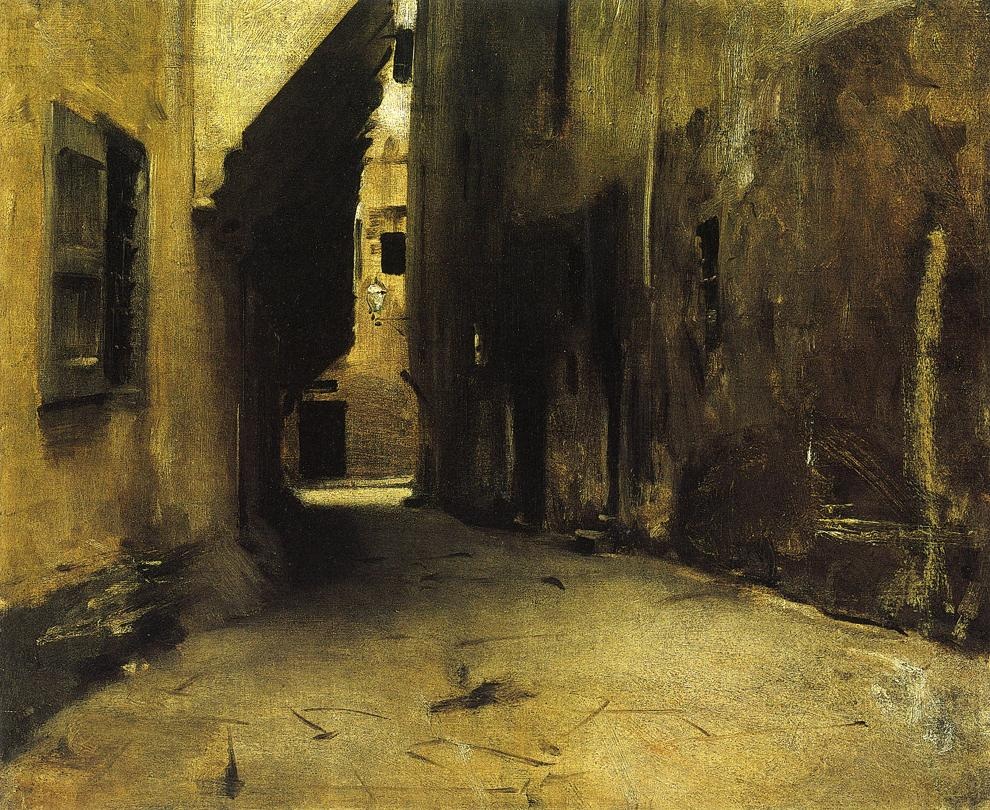
(Painting by John Singer Sargent)
“The shadow is a tight passage, a narrow door, whose painful constriction no one is spared who goes down to the deep well… For what comes after the door is surprisingly enough, a boundless expanse full of unprecedented uncertainty, with apparently no inside and no outside, no above and no below, no here and no there, no mine and no thine, no good and no bad… Where I am indivisible this and that; where I experience the other in myself and the other-than-myself experiences me.” — Mary Sarton, quoting Carl Jung.


Very thought provoking.
Check out my article which, strangely, has a similar ideology to yours!
http://monolovecycle.wordpress.com/2013/05/09/philosophy-of-the-development-gap/
This requires a third cup of coffee, a second read.
Thanks for reading it and your openness in doing so.
terrific entry, thanks
exquisite! I love the poetic way you frame your ideas. Your notes on Heidegger and solitude put me in mind of something I had read in Rilke from “Letters to a young poet”, so I thought I would dig it out!
“Therefore, dear Sir, love your solitude and try to sing out with the pain it causes you. For those who are near you are far away… and this shows that the space around you is beginning to grow vast…. be happy about your growth, in which of course you can’t take anyone with you, and be gentle with those who stay behind; be confident and calm in front of them and don’t torment them with your doubts and don’t frighten them with your faith or joy, which they wouldn’t be able to comprehend. Seek out some simple and true feeling of what you have in common with them, which doesn’t necessarily have to alter when you yourself change again and again; when you see them, love life in a form that is not your own and be indulgent toward those who are growing old, who are afraid of the aloneness that you trust…. and don’t expect any understanding; but believe in a love that is being stored up for you like an inheritance, and have faith that in this love there is a strength and a blessing so large that you can travel as far as you wish without having to step outside it.”
Gorgeous! Thanks for that deeply insightful response. Spot on. I love it. Rilke is truly a poetic expert on solitude and I appreciate you for bringing this passage to me. So hard to not expect understanding in this rational-based world, but all my favorite things — love, art, mystery — are without much logical understanding. Untranslatable even. Thanks again, and thanks for the artistic, poetic and philosophical connection!
First time I have read this blog, and yet I hunger for more. I will be back.
Am reading Proust’s “Literature and Art” and so much of that lyricism reminds me of your writing.
Lady Nyo
Thank you for your kind words and interesting reference. I have actually stumbled on your writings, months ago when researching Saigyo’s moon. One of my favorite artists, Morris Graves had his poet friend, Sam Hamill, stayed with him and they made work based on Saigyo’s work. I appreciated your help exploring such beauty. Looking forward to revisiting your blog.