• About

Unwanted Advice: Reflections from a Self-Appointed Life Counselor

~ Caminante, no hay camino. Se hace camino al andar. Wayfarer, there is no way. You make a way as you go. (Antonio Machado)

Unwanted Advice: Reflections from a Self-Appointed Life Counselor

Tag Archives: George Steiner

“We cannot live only for ourselves. A thousand fibers connect us with our fellow men; and among those fibers, as sympathetic threads, our actions run as causes, and they come back to us as effects.” Henry Melvill

25 Sunday Nov 2012

Posted by summermlee in Aesthetic philosophy, Art, Nature, philosophy, poetry

≈ 3 Comments

Tags

dungeness crab, Fishing, George Steiner, Moby Dick, poetry, sculpture

I stood into the whipping onshore winds, 30 feet above the Pacific, where waves portended increasingly wicked weather patterns. My sister and I have entered into the strange world of fishing for dungeness crab on our local pier. No we are not entirely the only women there, there are sometimes one or two more — but yes, our demi-Chinese background is a flimsy but important connection to that mostly immigrant lot, working these waters for food just as much as recreation. We are not ancestrally that far-removed from those sea hunters holding down their territory with buckets and panoply of poles, bedraggled with odd bits and junkets that is the providence of fishing.

The men are abrupt and unshy in asking me to make sense of my weird fishing pole belonging to my deceased father. The more worldly fishermen are merely dumbfounded as to why I am using a fly fishing rig off a pier — but I stand my ground in my non-CostCo jeans and retort that it is indeed an ocean fly-fishing rod that can coincidentally handle the weight of a snare and imagined crab. And if this man appears gentle enough for any human disclosure, I admit that I am not fly casting, but rather repurposing the same rod and reel that has also graced the rolling rivers of Oregon, the open waterways of the Sierras, and icy brooks of western Colorado  — not because I have some innovative approach to crabbing (I have no approach whatsoever), but because the purchase of more apt equipment (and oh how these men love their equipment) drives up the cost of anything I might catch. The price is already dear, as each hour on the pier is an hour someone is watching my impatient son on wage, and the snare and disgustingly oily bait and the gloves to deal with them each have their own accounting.

An elderly Vietnamese man immediately likes us. After his curiosity with my fly rod, he admits he owns 50 different poles and unlike the disdain of the other men, he admires my unusual rod and reel because he doesn’t yet own one. He particularly likes my sister, asking her if she has a husband and when she answers no (for reasons outside his purview and worldview), he says she should find one who likes to fish. He doesn’t have any sons to marry her to, since they are all already married, adding with disappointment and a tinge of dry humour (and certainly not elation) that he has too many grandchildren. Too many who must not appreciate his hobby like his beloved wife. A wife, he boasts, who catches more fish than he does.

The surf is rough today, and only the rare reel-in results in a cringing crab, mostly too wiry to keep. Most of the men seem to know each other and share in an unspoken etiquette while taking a fatherly pleasure in helping my sister navigate her unruly crab net. And though it is not quite ten in the morning, some of them partake in flasks of undiscernable alcohol or musty marijuana I assume to relax the very stressful experience of holding one’s fishing pole while endlessly waiting — or of course needed on a medication-basis.

A somewhat-preppy, white man stops to ask how it is going. I say it would be hard for a crab to hold on to the ocean floor in such torrid surf, nonetheless for it to stop and eat something attached to a fishing pole. Cued by his warm weather outfit, I ask if he is visiting and he says no but he has brought family from Kansas here to see the ocean for the first time. He then asks who I’m there with and where do I live and other questions too numerous and probing, and it dawns on me that not just my sister has found an admirer on the pier today. In turn, I have discovered on this pier yet another god-awful trolling idea for my single lady friends, or at the very least another social event for my artist friends to ironically wear formal attire to.

We catch nothing which is always a bittersweet relief for me. No slaughtering, no prayers and apologies for cutting short the life of my unsuspecting victim, no snuffing of vitalities that even a hard-shelled, bottom-feeding, spider-creature relishes in. And no guts, thankfully no guts to wrench from cavities; no fingers dirtied by innards primatively exposed and decimated and discarded — those uncomfortable vulnerabilities and unknown consequences put off for my life’s other contingencies. Put off instead, I imagine, for the lines of dead people’s poetry, my failed paintings and the thoughts and writings I wrangle with here.
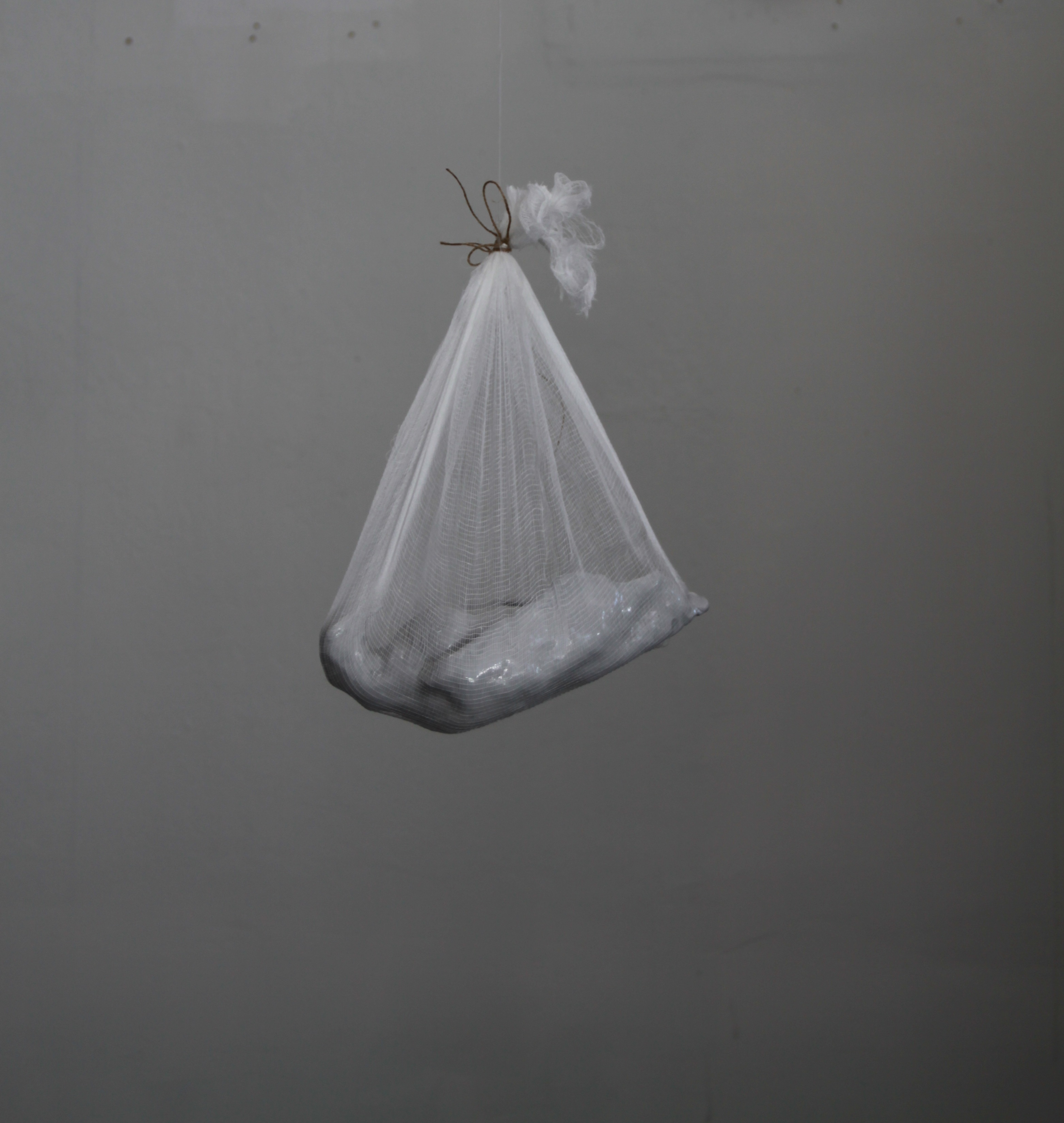
(My recent sculpture, 2012. Porcelain dead bird suspended by fabric and string)

“Man is ennobled by the vengeful spite or injustice of the gods. It does not make him innocent, but it hollows him as if he had passed through a flame. Hence there is in the final moments of great tragedy… a fusion of grief and joy, of lament over his spirit.” George Steiner, Death of Tragedy
“…a collector of silences and solitudes.” George Steiner on Ludwig Hohl

17 Saturday Nov 2012

Posted by summermlee in Aesthetic philosophy, Art, Nature, philosophy, poetry

≈ 2 Comments

Tags

Andre Chénier, art, death, George Steiner, Orpheus, poetry, rainy day poetry, solitude

As the sun’s last flashing ray,
As the last cool breeze from the shore,
Cheer the close of a dying day,
Thus I strike my lyre once more.
As now by the scaffold I wait,
Each moment of time seems the last,
For the clock, like a finger of fate,
Points onward and onward fast.

— Andre Chénier, 1794


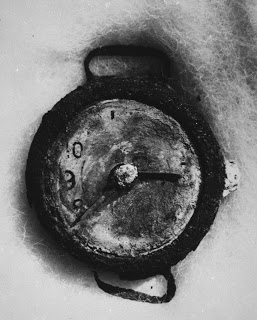
(Hiroshima watch, 8:15 a.m. August 6th, 1945)

A rainy day in the Bay Area is perfect for poetry that celebrates the precious solitude lacking from my life these days. I don’t need to blame the mundane circumstances of my life, or the lasting hangover from “art” school. Or the fact that I am trying to write this in a car whose turns are twisting my stomach into nausea all while from the backseat my son repeatedly sings a preciously off-tune version of the Abc’s. Because even so, anything less than what Steiner describes as a writing at “the edge of itself,” anything that falls short of being itself but also “speaking on behalf of the other,” is not a moment of true solitude. Art and writing necessitate a “self-summons” but also a “state of nothingness,” of which I am not capable of right now.

And what analogy is more apt than of a man awaiting guillotine in the last days of Revolutionary France, relying on his art to guide him to the imminent underworld. Again, I hear Orpheus calling on music to forge a path into the unknown. But somehow, thankfully, the situation need not be so dramatic, so dire, nor as politically charged, as to understand that what Chenier describes in his last moments is the human condition we all find ourselves in.

“The Young Captive”
The budding shoot ripens unharmed by the scythe,
Without fear of the press, on vine branches lithe,
Through spring-tide the green clusters bloom.
Is’t strange, then, that I in my life’s morning hour,
Though troubles like clouds on the dark present lower,
Half-frighted shrink back from my doom ?
Let the stern-hearted stoic run boldly on death!
I — I weep and I hope; to the north wind’s chill breath
I bend, — then erect is my form!
If days there are bitter, there are days also sweet,
Enjoyment unmixed where on earth may we meet?
What ocean has never a storm?
Illusions the fairest assuage half my pain,
The walls of a prison enclose me in vain,
The strong wings of hope bear me far;
So escapes from the net of the fowler the bird,
So darts he through ether, while his music is heard
Like showers of sweet sound from a star.
Comes Death unto me? I sleep tranquil and calm.
And Peace when I waken stands by with her balm.
Remorse is the offspring of crimes;
My welcome each morning smiles forth in all eyes,
My presence is here, to sad brows, a surprise
Which kindles to pleasure at times.
The end of my journey seemed so far to my view;
Of the elm-trees which border the long avenue,
The nearest are only past by;
At the banquet of life I have barely sat down.
My lips have but pressed the bright foaming crown
Of the wine in my cup bubbling high.
I am only in spring, — the harvest I’d see,
From season to season like the sun I would be
Intent on completing my round;
Shining bright in the garden, — its honour and queen;
As yet but the beams of the morning I’ve seen,
I wait for eve’s stillness profound.
O Death, thou canst wait; leave, leave me to dream,
And strike at the hearts where Despair is supreme,
And Shame hails thy dart as a boon!
For me, Pales has arbours unknown to the throngs,
The world has delights, the Muses have songs,
I wish not to perish too soon.
A prisoner myself, broken-hearted and crushed,
From my heart to my lips all my sympathies rushed,
And my lyre from its slumbers awoke;
At these sorrows, these wishes, of a captive, I heard,
And to rhyme and to measure I married each word
As softly and simply she spoke.
Should this song of my prison hereafter inspire
Some student with leisure her name to inquire,
This answer at least may be given, —
That grace marked her figure, her action, her speech,
And such as lived near her, blameless might teach

That life is the best gift of heaven.

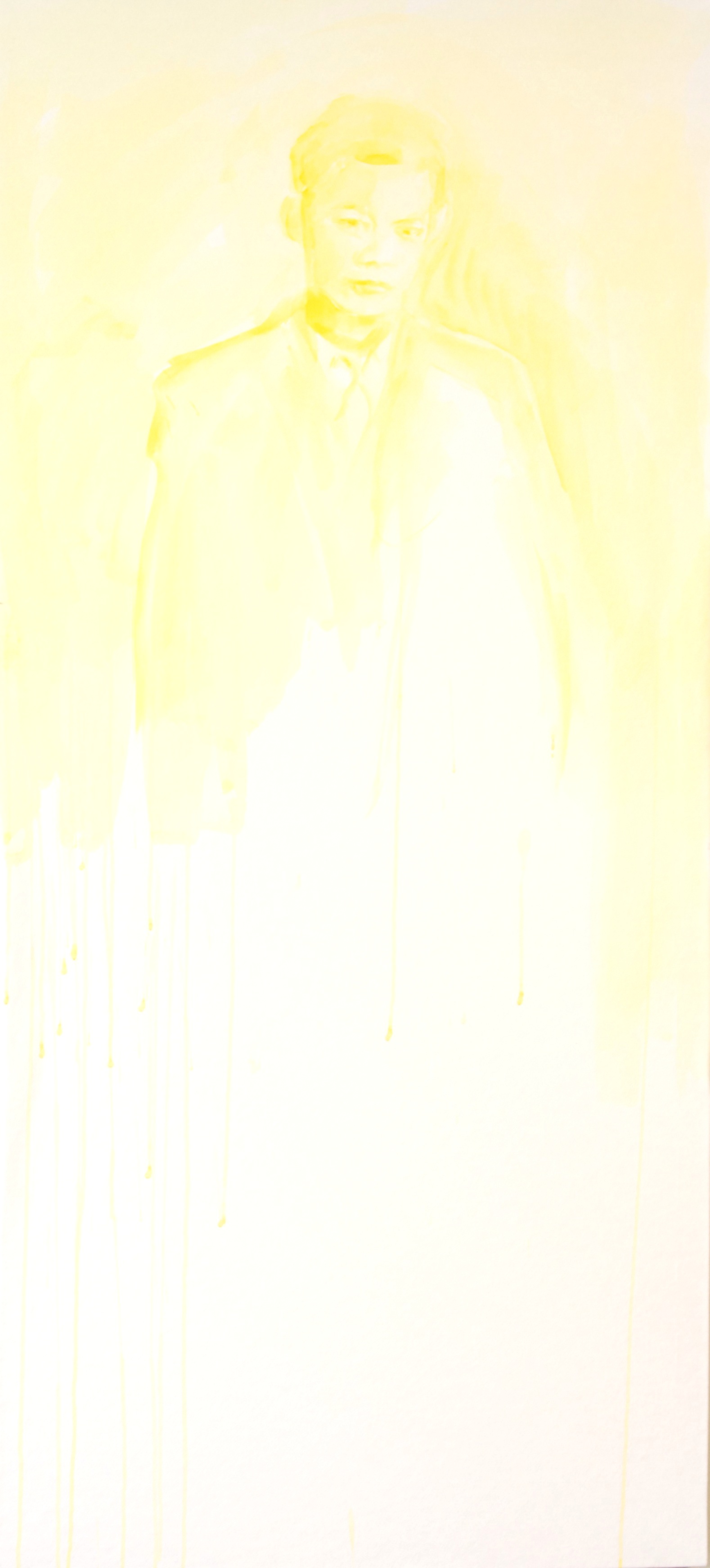
(A recent watercolor of an unknown relative, 72 x 33 inches)

“You were my death / you all I could hold / when all fell away from me.” Paul Celan

27 Saturday Oct 2012

Posted by summermlee in Aesthetic philosophy, Art, philosophy, poetry

≈ 5 Comments

Tags

"The Gaze of Orpheus", "The Instant of My Death", art, death, Derrida, George Steiner, language, Maurice Blanchot, Paul Celan, poetry, Summer Mei Ling Lee, World War II

It is hard to know what this thread is, as it weaves through my recent travels. The only way to understand it more is to start about here.

Because, Blanchot says, in order to write, one must be already writing. “One can only write if one arrives at the instant towards which one can only move through space opened up by the movement of writing.” He writes this in reference to Orpheus, and that Orpheus needed music to descend to the underworld to rescue his love, a precise metaphorical homage to artistic creation. As it happens in tragedy, the moment he gazes at his beloved, he loses her, but experiences perhaps a moment of freedom: “[He] frees the work of his concern, frees the sacred contained in the work, gives the sacred to itself, to the freedom of its essence, to its essence which is freedom (for this reason, inspiration is the greatest gift).”

That is why a particularly masterful work of art recalls the fact that it could not have been — if we are vulnerable enough to let our art be art, let our hearts be touched, and to sense the present moment. Steiner is particularly fascinated with art’s ability to give presence to that which is absent and profoundly otherwise: “The arts, and music above all, give to man the freedom from his otherwise mortal city.” It is where humans can “surpass their condition.”

Blanchot, as with Paul Celan, knew Orpheus’ gaze in his own life, and both had stood within the “breath-turn” between absence and presence. Towards the end of his life, Blanchot wrote this letter to Derrida, who deeply understood occupied France:

“July 20. Fifty years ago, I knew the happiness of nearly being shot to death.”

As Blanchot was removed from his home by soldiers and placed in front of a firing squad, he experienced a “feeling of extraordinary lightness.”

Blanchot writes of the man who experienced this moment, “He was perhaps suddenly invincible. Dead — immortal. Perhaps ecstasy. Rather the feeling of compassion for suffering humanity, the happiness of not being immortal or eternal. Henceforth, he was bound to death by a surreptitious friendship.”

Blanchot, a stand-in for Orpheus, penned this “Instant of My Death” from the stance of a young man’s testimony, a fiction that is the leap of literature, one step removed from his own life. Perhaps he did so because it had been posited since classical Greece that the image of the thing is more beautiful than the thing it represents. But likely more so because he used his art to go to the depths of this underworld experience, the shadow-side of being human.  So at the moment of writing his death — as if Orpheus might describe it in 3rd person narration — at the moment he gazes back at Eurydice, he is free.

Tonight, I sit in my midnight bed, reading-lamp dim, and I hear the the approach of husky breathing that is my son, who turns his inhalations to exhalations without self-consciousness yet, who has ambled out of his bed and his room, guided by slivered lines drawn through sleep-puffed eyes, one hand viced to his blanket. He is just awake enough to know the path to my bed, and he is asleep before I have finished picking his warm, softly surrendered body up into the bed next to me. His breathing returns to the quieter rhythms of sleep and I wonder what impulse wakes him and directs him to my company. Years ago, during a particular grueling time (though there would be worse yet), I woke myself yelling for my mom. Calling for her as if she was down the hallway, like a child needing rescue from a bad dream. The impulse for words that call out for salvation is deep, even as I know that my faith in words, in salvation also, is constantly asunder.

“(At every turn, language traps us within the labyrinth which we are calling on language to elucidate).” George Steiner, Grammars of Creation.

(My recent installation, “Saigyo’s Moon.” Projection of flying birds on eggshells.)

“Language simply ceases… The poet enters into silence. Here the word borders not on radiance or music, but on night.” George Steiner

17 Monday Sep 2012

Posted by summermlee in Aesthetic philosophy, Art, music, Nature, philosophy, poetry, Uncategorized

≈ 7 Comments

Tags

art, bird watching, birds, George Steiner, music, nature, Rilke

The outskirts of Tahoe National Forest. I followed the early morning mists of little winged bugs along the edge of a forested reservoir, a small cohort of Audubon’s Warblers chasing them also. With a mind galloping through what if’s and what-nots, I sat next to their cathedral, a half-dead tree once under the water line. Its branches stretched arthritically out towards that which feeds it but also puts it asunder. One by one every species of woodland bird worked its way out of the dense pine forest to that diminuitive tree. They would land with a pause, flit a little, perhaps taking a careless bug in this gathering place, then sail down below to the stony water edge. They were singing me stories of wretchedness, of betrayal and harshness from those who didn’t believe they know better. They described predators with only few survival skills who violate their homes, even when their bellies are far from empty. But they also sung of the little joys of sunlight, improbable births, childlike pauses, and cool reservoir water. Fiercely aching nights and warm morning updrafts. And times when every species and variety of plant and bug is available, and times when their children grew silent in the cold. Warblers, nuthatches, wrentits, chickadees, flycatchers, a few I didn’t know, and a rufous sided towhee — the little delicate species, the singers. My favorites. For years this lasted. I have been devoted to them.

Someone once said that birds remind him of an existence before human civilization, of times outside of wars, laws, buildings. Before human suffering and its impulsive response of further suffering. But these birds were not solely of the sweetness of summer, though they had the resilience and the evolutionary wisdom to live as if that was all they knew. Because today it was summer.

(A photo from my studio, by Shae Rocco).

It seemed my birthright to make an offering. Give something, though those little birds of course needed nothing. Steiner reminds that art is free, gratuitous, not for anything, so much so that every artful creation calls forth an awareness that it might not have been. So somehow turning this moment into a drawing or even writing seemed superfluous, like a scarf around Rilke’s torso. And it is.

Because in this moment I also felt like I might not have been, that everything I’ve done and made might have been otherwise. I felt humble, like the chanters of holy songs, whose talents are free and freely given. So, for whatever reason, because I was perfectly alone, I began to sing. My mom would be excited to know I quietly sang songs from her faith, maybe because that foreign language seemed as intimate and yet dispossessed as the birdsong around me — it contains a hint of something inextricable even as it is unknown. And despite my usual anxiety of needing more, I had a moment of needing nothing, a necessary condition for gift-giving, even if it is song-giving. Towards everything surrounding the birds and all the radiating objects and memories and people I know and knew. And as the scene pulsated, the birds neared me one by one as part of their ritual, into otherwise lethal distances. A Townsend Warbler landed a few inches above my head. After that a Kinglet slid down to the frayed end of a branch four inches from my eyes. Another Audubon’s Warbler almost upon my shoulder. They exerted themselves to me. And so I cease to sing.

” — for here there is no place that does not see you. You must change your life.” Rilke

“Words … are little houses.” Bachelard

04 Saturday Aug 2012

Posted by summermlee in Aesthetic philosophy, Art, Nature, philosophy, poetry, Uncategorized

≈ 8 Comments

Tags

Bachelard, birdsong, ephemerality, George Steiner, monrtality, nature philosophy, nests, poetry, Saigyo, Sheila Ghidini

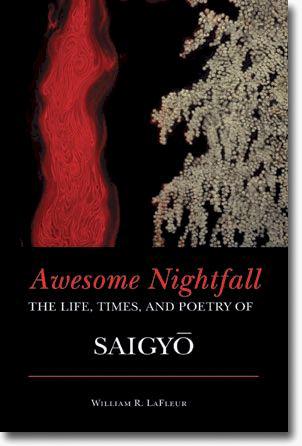
The 12th century Japanese poet, Saigyo, lived in horrific times of war, chaos, and scandal. He descended from a lineage of warriors, and after violent service to the Emperor, he took up the robes of a monk and the pen of a poet to both understand and release the straits of human-ness, his metaphorical and literal bloodstained past, the limits that all humans are born into.

In both life and writing, he became a homeless wanderer. And it was during these unceasing peregrinations between mountainous temple sites and towns that he used the ability of nature’s images to capture all that matters through deceivingly simple words.

An ancient field

and in the sole tree starkly

rising to its side

sits a dove, calling to its mate:

the awesome nightfall.

In his poems, words as single ideographs balloon with layers of meaning, and no one meaning stabilizes over another. What we think is important becomes indistinguishable as night falls. What remains there is the gift of the dove’s birdsong lilting in the dissolution of light — into awesome darkness.  As Sam Hamill writes, thoroughly intimate with Saigyo and profoundly aware that song might be the last thing heard, that words are the springboard into nothingness:  Those that I love are more beautiful because one of us will die.

I recall the moment driving home from the hospital after giving birth to our son, a process that even in good circumstances is seismic to the foundation. And in my case, I exhausted myself to the point of an acuity of my mortality. So there I was, dispossessed, with one foot still in the non-world, while my family packed up the days-old baby asleep into his carseat, also with one foot in the non-world. We were heading home.

Oddly, our destination in my mind’s eye was my childhood home. Driving down the familiar coastal route, I only saw my childhood living room with the wretched, green upholstered chair that I spent so many hours in, there under the expansive pane of glass through which was our neglected garden, littered with robins pecking at unwanted cherries. Even when it became clear that this was not indeed where we were heading, that the last time I stepped foot in this house was decades ago, I could not understand how to get to my current home, the one “known” for the last third of my life. I experienced a moment of homelessness.

Of course my literary hero, George Steiner, drawing on writers ranging from pre-classical Chinese poets to Holocaust survivors, professes this homelessness, that we are always guestworkers, “frontaliers in the boardinghouse of life,” regardless any distraction from this eventuality. It is the same for Dante, in his love for Beatrice, who travels through the three realms of the dead. And that the epic narration of Odysseus is in his journey, the textual death occurs when he reaches home.  Chuang tzu’s free and easy wandering, which is incredibly not free, nor easy.

Because we are human. We need a home. If we are to have a home, according to Bachelard, it would be like the fragile nest. Every precariously woven-together twig and dried straw comprise our human desire to hope for the future, and the precious eggs it cradles — but also the acceptance of its propensity to decay, fall apart, to be destroyed — to be ephemeral. The nest acknowledges the potential for me to be without the soul-killing need to push against Being, distracted from where the beauty of it lies. I have exhausted myself in my will to make things certain — because, as I am reminded in my changeling son, the infinite little losses in my body, my relationships, my art-making, and how in this moment right here is the possibility of perishing — words are anything but certain.

(Sparrow, by Sheila Ghidini. http://sheilaghidiniprojectspace.com/home.html)

“When you are philosophizing, you have to descend into primeval chaos, and feel at home there.” Wittgenstein.

“The grammars of creation are, in the final analysis, those of the erotic, of shaping intellect and psyche in a condition of Eros (the Logos, in the arms of love…).” George Steiner

15 Sunday Jul 2012

Posted by summermlee in Aesthetic philosophy, Art, Nature, philosophy, poetry

≈ 2 Comments

Tags

Anne Sexton, art, Clement Greenberg, creation, creativity, George Steiner, poetry, Professor Alice Bach, Tarkovsky, words

This entry wrote itself this morning on my jog, in the valley tucked away from the ocean shore. There in the chapparal valley are my kindred birds, families of quail fused together. One adult male is always vigilantly poised atop a signpost or garbage can, alertly standing guard over the small herd of fuzzy fledglings and their preoccupied surrogates pecking in the dry grass. I always regret that I must pass through them, causing them to scatter like field mice into the brambles that line the creek. The brambles where I know lurks a chubby, yet insatiated bobcat.

Despite being worn, I chose to heave myself up from the valley floor, along the switchbacks that ascend the side of a sun-lit mountain. Along the way, as predictable, I become anxious of whether I am able to reach the summit, that it is always longer and farther than I remembered. I try to recall that if I just attend to what is going on around me, go inward into my thoughts, even the burning in my legs, I will be less aware of the draining heaviness of the future tense.

Such is using any medium to create. A self-consciousness of one’s tools can turn them into the bars of a prison. We have developed bars around these lights of vulnerable creativity, sometimes so ornamental that others approve of them so much as to make us invest more and more in them. Yet the bars restrict and the air is stagnant therein, allowing only precarious involvement on the thin breath of things.

They amount to a gilded cage, polished to a mirror surface enclosing the songbird. This is the self-image of Narcissus, the trap of self-congealing. Even if it might provide both protection and adoration from the Crowd, the illusion of a subsistent self does not allow ephemeral song to take wing.

(Scene of the Bellmaker, from the film, Andrei Rublev, by Tarkovsky)

I sensed a predictable relief when I reached the top of the summit this morning, because yet again, I got to where I didn’t think I could go, and even more, I was yet surprised by the expansive view of the valley floor below extending to the sea. It occurred to me that there are summits that are exponentially harder to reach than my little hill of this blog, arriving upon its first birthday. How I curb my vulnerabilities and borrow from convention throughout is damning. And the more arduous and improbable to overcome this, the more solitary it might be to reach it — and the less likely anyone else can confirm it. Even the parasitic and invulnerable art critic Clement Greenberg said, “All profoundly original work looks ugly at first.” I have not the courage for this freedom to be ugly, nor the freedom to not be anything at all.

But it stands that I am grateful for my tribe of friends who stand guard over this endeavor, as it works its way through its awkwardness and conventional shortcomings.

I am profoundly in the arms of love.

(This poem was sent from Alice Bach, the first ever to stand guard over my writing)

Words, by Anne Sexton

Be careful of words, even the miraculous ones.

For the miraculous we do our best,

sometimes they swarm like insects

and leave not a sting but a kiss.

They can be as good as fingers.

They can be as trusty as the rock

you stick your bottom on.

But they can be both daisies and bruises.

Yet I am in love with words.

They are doves falling out of the ceiling.

They are six holy oranges sitting in my lap.

They are the trees, the legs of summer,

and the sun, its passionate face.

Yet often they fail me.

I have so much I want to say,

so many stories, images, proverbs, etc.

But the words aren’t good enough,

the wrong ones kiss me.

Sometimes I fly like an eagle

but with the wings of a wren.

But I try to take care

and be gentle to them.

Words and eggs must be handled with care.

Once broken they are impossible

things to repair.

“To all and to none.” Heidegger

31 Thursday May 2012

Posted by summermlee in Aesthetic philosophy, Art, Nature

≈ 4 Comments

Tags

Being, Catherine Fairbanks, empathy, Film, George Steiner, Hiedegger, injured animals, nature

Yesterday, I found myself singing Twinkle Twinkle Little Star with my family just as we have done many times over, but this time our tone was gentle and elegiac because our intended audience was a dying rabbit in a cardboard box, wrapped in my jacket. I know, for those who know me, that yes, it seems like injured and dying animals flock to me, but it might just be that this is the condition we all are in: living in the borderlands where a dominating human presence presses up against nature’s tenuous domain.

The bunny, who happened to be lying in the dirt path on our routine evening walk, seemed to have a leg injury and a scratch on the nose, perhaps a result of predation by a cat, a coyote, a raptor, a bicyclist, who knows.

As occurred to me when a bloodied raven worked his way out of my green Whole Foods bag onto the front seat of my car, I again had a fear of driving off the road if the bunny might leap from the box into my lap. But I reasoned that it was more likely this bunny, lying awkwardly in such bad shape and with an inherent fragile heart, was dead.

A few miles into the drive, wondering if indeed Bunny was still alive and finding my NPR show jarring, I decided to peel back the fabric to see what Bunny was doing. And there suddenly was a fur-lined, big, black, round eye staring straight up at me — and a look of fright and curiosity and concern exchanged between us. I quickly covered Bunny back up.

I immediately recalled the image of another big, round, animal eye that had also poignantly looked up at me. An adult pelican, with an injured wing wrapped in a towel, sat on my lap as my friend drove us to the same shelter. En route, feeling the bird’s heart rate progressively calm, I peeled back the warm, wet towel to glimpse Pelican. Pelican’s eye was questioning and fearful, and I decided the darkness of the towel was more comforting than my own questioning, strange, and incredulous face.

So it seems fitting that I have been thinking about an amazingly beautiful film recently screened at the Experimental Film Festival in Portland, by a friend and colleague, Catherine Fairbanks. You can watch it for yourself here.

http://catherinefairbanks.com/artwork/2397516_Transference_is_a_Tough_Row_to_Hoe.html

"Transference is a tough row to how."

Catherine wonders whether attempts at empathy reach an impasse or dead end; the failure to completely reach another.  And yet her beautiful imagery and wistful narrative embodies a transcendent poetics of the human condition. As Heidegger writes about this impasse, there is something about a thing that cannot be appropriated by us. Like walking out towards a horizon. We occupy that horizon, yet there is an out there that remains away from us. Likewise, a horizon, or object or thing, has a thereness that precedes our cognition of it. But he also describes those moments where we glimpse something otherwise, when a thing things itself. For example when the presence of his Van Gogh painting, beyond its pigment and canvas and brushstrokes, reaches into our being. Or when the culmination of instruments, rhythm, and tones arrives in an untranslatable and indescribable music that stirs something within. Steiner says we experience this presence “‘[i]n moments of great despair when things lose all their weight and all meaning becomes obscured,’ or in flashes of vital brilliance.”

“We feel, we know, urges Heidegger, that there is something else there, something utterly decisive. But when we seek to articulate it, ‘it is always as though we were reaching into the void.'” It is the possibility that the horizon, the impasse between two beings, is only the something we know — the consciousness of objects. Because also therein we are offered (and it almost always feels like a gift) “an opening to what is beyond the horizon of such knowing.”

The felt love between the two mythological entities in the lake surrounded by a loving voice; the moment of knowingness between the birds and animals and myself; and a lighting that occurs between a passage of painting and the viewer. Indeed, says Heidegger, without these moments, we forget to be astonished.

“The world’s darkening never reaches to the light of Being.” Heidegger

“We are creatures of a great thirst. Bent on coming home to a place we have never known.” George Steiner

10 Thursday May 2012

Posted by summermlee in Art, Nature, poetry, Uncategorized

≈ Leave a comment

Tags

George Steiner, Hawaii, history, Kealekekua Bay, Manini Beach, memoir, nature, post-colonialism, Wordworth

A kitchen oven structure, a plastic outlet plate, and other remnants of a home are a haunting sight on the bottom of the ocean floor of Kealakekua Bay. Ke ala ke kua, the pathway to God. The wreckage lies off the shore of Manini Kapahukapu beach, a sacred gathering place for ancient Hawaiians. They deemed the site a place of healing, and it seems since time immemorial this place has been in need of healing.

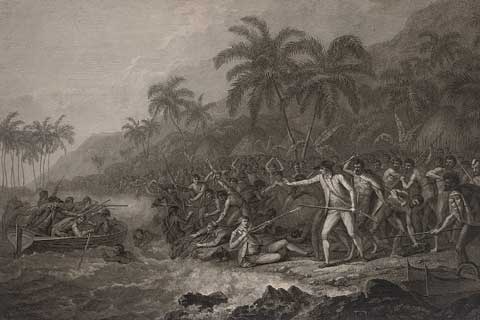
Hard to find, the beach’s grassy flat is surrounded by lush foliage, and its ocean shore is crusted over with almost black, unforgivingly sharp lava rock. Across the calm bay, an odd white, stone beacon of a monument commemorates Captain Cook, who landed at this Hawaiian village amicably at first. But after the entanglements of disease and colonial politics and cultural misunderstandings, he was murdered at that spot, in plain sight across from Manini.

Of course it is odd that there is no monument there to honor the dead Hawaiians that once occupied the present day ghost village and Heiau, now overgrown by bird-filled plants and trees, the true natives of the area. Besides the monument and a plaque now in the tide waters of a rising ocean stating, “Near this spot Captain Cook met his death,” there are only loads of snorkelers by boat and kayak swimming among luminescent coral forests. The reef is growing less and less pristine, inversely to its popularity. On an unmarked spot there in the turbidity of ocean water lurks one of our wedding rings, a frightful loss at first, but now a fitting, romantic homage.

Behind Manini lies a lava field, now filled with a rural grouping of homes, the impoverished ones belonging to native Hawaiians, the gentrified ones belonging to outsiders who either own them as rentals to outsiders, or who visit there just as transiently as would-be renters. I can’t help but want one myself. But that area feels heavy, and when figuring out why, I learned that before there were homes there, the lava field was the site of historical bloodshed. A faction of Hawaiians hoping to gain control over all the islands overpowered a group supporting the disinherited. The Battle of Mokuahai, in 1781, was savage as even women took up arms for their territory and were among the losers, killed by bludgeoning instruments, or forced over cliffs into the lava strewn ocean.

In the center of the bay, a large pod of spinner dolphins rest, swimming easy circuits with their calves. One year we swam out to them. They, being the more fit for sea, and either cautious or curious, found us first. I dove into the depths of the bay as a group passed me, and for the length of a held breath I swam with them, tears filling my swim mask, my hand holding my heart hurting for the beauty still left in pockets of this contested earth. But after a little research, my heart hurt more to know that my presence was detrimental to their rest, to their impending survival outside the bay where they are forced to return earlier than necessary because of swimmers like me, wanting to experience their glory.

Today, I stayed at Manini, and resisted the coral reef at the monument, and the pod of dolphins splashing and spinning on the other side of the Bay. And there is where I found the modern day ruins of a shipwrecked home, dragged into the sea by the reach of a tsunami that just over a year ago, swept tens of thousands of people in Japan out to sea. The same grandmother working there three years ago with her infant grandson, already adept at the ocean, my son then only a shrimp in my belly, was also there today as she is everyday under her umbrella. Folks stop by regularly to hear of what news, I’m not sure. While our sprouted kids played in Manini’s one sandy opening to the surf, she explained to me the recovery taking place in the area. In the eddy where pristine waters meet the machinations of savage American imperialism and colonialism, I hope Manini prevails for all of us.

20120510-070741.jpg

Glad sight wherever new with old
Is joined through some dear homeborn tie;
The life of all that we behold
Depends upon that mystery.
Vain is the glory of the sky,
The beauty vain of field and grove
Unless, while with admiring eye
We gaze, we also learn to love.
— Williams Wordsworth

“What is ultimately required of us with respect to our love of beings?” Henry Bugbee

30 Monday Apr 2012

Posted by summermlee in Aesthetic philosophy, Art, Nature

≈ 4 Comments

Tags

birdwatching, George Steiner, Henry Bugbee, lazuli bunting, meaning, Mortality, nature, Pacific Slope Flycatcher, writing

This weekend, I sympathized with my dear friend who writes an amazingly tender and delicious food blog, www.themooninmykitchen.blogspot.com, that like art, meditation, and any endeavor necessitating commitment, writing these entries can be a mundane practice. There are days when the flow is not there to deliver rivers of insightful revelation, clever words flipping off the tongue, or sparks of delightful references and analogies.  But one starts about anyway, hoping the force of pushing through it doesn’t also run right over the grace of creativity, leaving a corpse of tired, ever-embarrassing, revealing remnants of a self that cannot transcend self.

The same weekend, for a friend’s 70th birthday, a group of us went birdwatching in some of the most beautiful land in the Bay Area. There on the same, short jaunt, one can easily traverse through lemon-green meadows, water-logged swales, arid oak chaparral, and fern-laden woodlands with sentinel sequoias.

Our stout and serious group leader, a veritable General of birdwatchers, started the walk with what amounts to a Holy proclamation of a birder’s Grail: In the same territory she had just spotted Lazuli Buntings on their migratory way through the area. I knew by the reaction of oohs and ahs that none of us seasoned birders had that bird on our life list.

So it was with this exotic expectation burning lazuli blue in my mind that a frustration began to foment as the General took us around every inch of perimeter of a concrete parking lot, bordered by cyclone fence.  She would call out, “Junco at one-o-clock!” as if we should align our bayonets. “Straight ahead is a Robin.” I pretended to take a picture so as to not appear bird-snobby about these usual, tedious suspects. But at one point I couldn’t cork a chuckle as she declared militantly the presence of a dawdling mourning dove ducking into the weeds.

The walk finally ventured away from cars and concrete and chain-link barriers, though we never left a paved trail and the evidence of man’s obtuse intrusions on nature. It was clear that our General was carrying out a warfare not concerned with an immersion in wilderness, but the sniper-like calculation of species of birds sighted — however mundane the species, however bleak the context. My friend even whispered to me (so as to not get chastised again by the General for distracting her from bird calls) that she sees more birds in her frontyard.

With only a few minutes left on the hike, I resigned to an unremarkable, albeit lovely day robbed of solitude (as we were in a bustling group), void of an escape into nature (cite the parking lot above), deplete of silence (hear the General’s commands?) and amiss of a rare and exotic bird sighting (the buntings are undoubtedly in Canada by now).

I was returning to the car when a Pacific Slope Flycatcher overcame its usual shyness to flit from a tree, snatch a meal of unsuspecting moth, and bravely perch a few feet in front of me. We both took pause in the time that Celan calls a breath-turn. A beady black eye gazed unabashedly into mine – and we greeted each other knowingly.

This tiny Flycatcher has made perilous trips from Mexico to its breeding grounds somewhere in Canada, while I am sheltered in my disdain of the predictable. Perhaps the Flycather has crossed paths with the Lazuli Buntings I might never meet, who knows.

And so it seems fitting that along this trip I learned the pair of eagles who began a nest along my hometown reservoir has abandoned their purpose. They disappeared on Earth Day, which leaves a note of irony hanging in the air, along with the humility I imagine their watchers leave behind as they fold up their scopes and head home. I hear George Steiner describe this unfolding of events:

“As if the music played… could turn on its composer and ask: Why did you make me?”

Surely, something beyond us is needed when we question the meaning of coming to be and passing away. At the end of such vigils, whether of writing or birding, one can only surrender a respectful adieu. À dieu.

Today’s Advice: And so put, we must acknowledge an answer to it with which life is inescapably haunted, namely, some kind of parting.” Henry Bugbee

Newer posts →

Enter your email address to subscribe to this blog and receive notifications of new posts by email.

Join 619 other subscribers

Recent Posts

  • “Experimenters in the passages between worlds.” Vinciane Despret, Au Bonheur des Morts
  • “The terrifying groundlessness, the eradication of all violences. To be embraced by that which doesn’t know us and in that unknowing caresses us and truly loves us. We might become anything at all, something wildly other than what we are encountered by. A world that truly loves us by not presuming what we want or what shape we will take before we show up… We will be held when we are not known from the start.” — Dr. Marquis Bey
  • Images dream within us, a reverie is a world of expansion.
  • “For the natural world, the ethical responsibility is that being alive gives existence to others.” Vinciane Despret
  • “We meet in the freedoms of each other.” – Takeyoshi Nishiuchi

Archived Posts

Blog at WordPress.com.

  • Subscribe Subscribed
    Unwanted Advice: Reflections from a Self-Appointed Life Counselor
    Join 215 other subscribers

    Have a WordPress.com account? Log in now.

  • Unwanted Advice: Reflections from a Self-Appointed Life Counselor
    View site in Reader
    Manage subscriptionsSign upLog in
    Report this content
    Collapse this bar
Loading Comments...