• About

Unwanted Advice: Reflections from a Self-Appointed Life Counselor

~ Caminante, no hay camino. Se hace camino al andar. Wayfarer, there is no way. You make a way as you go. (Antonio Machado)

Unwanted Advice: Reflections from a Self-Appointed Life Counselor

Category Archives: Uncategorized

“Art does not reproduce the visible, it makes the visible.” — Paul Klee

16 Monday Sep 2013

Posted by summermlee in Aesthetic philosophy, Art, Birds, Nature, philosophy, Uncategorized

≈ 8 Comments

Tags

art, Chandra Cerritos Gallery, Conversations, drawing, installation, Robert Walser, Sheila Ghidini, Summer Lee

The most profound artwork questions what exists, but at the same time what is not there. Sheila Ghidini’s exhibition at Chandra Cerritos Contemporary Art Gallery, “Conversations,” addresses the seen and unseen through a series of drawings and installations involving intricate choreographies of chairs and birds — and negative space. Her careful drawing and skillful choices remind us: See in order to draw, draw in order to see — but most importantly, draw in order to illuminate the unseen.

Sheila composes her chairs with an infinite number of graphite marks with the facility of a deftly focused draftsperson, creating a tension between the object’s stillness and the energy of mark-making. This intense focus brings equal attention to the swaths of energized negative space surrounding the drawn object. For example, in the piece entitled, “One Chair,” the solitude of a single object in white space precipitates a question, a longing. And what exactly is longed for is the inviolate mystery that makes Sheila’s drawings philosophical, bringing an untranslatable insight into the human condition.
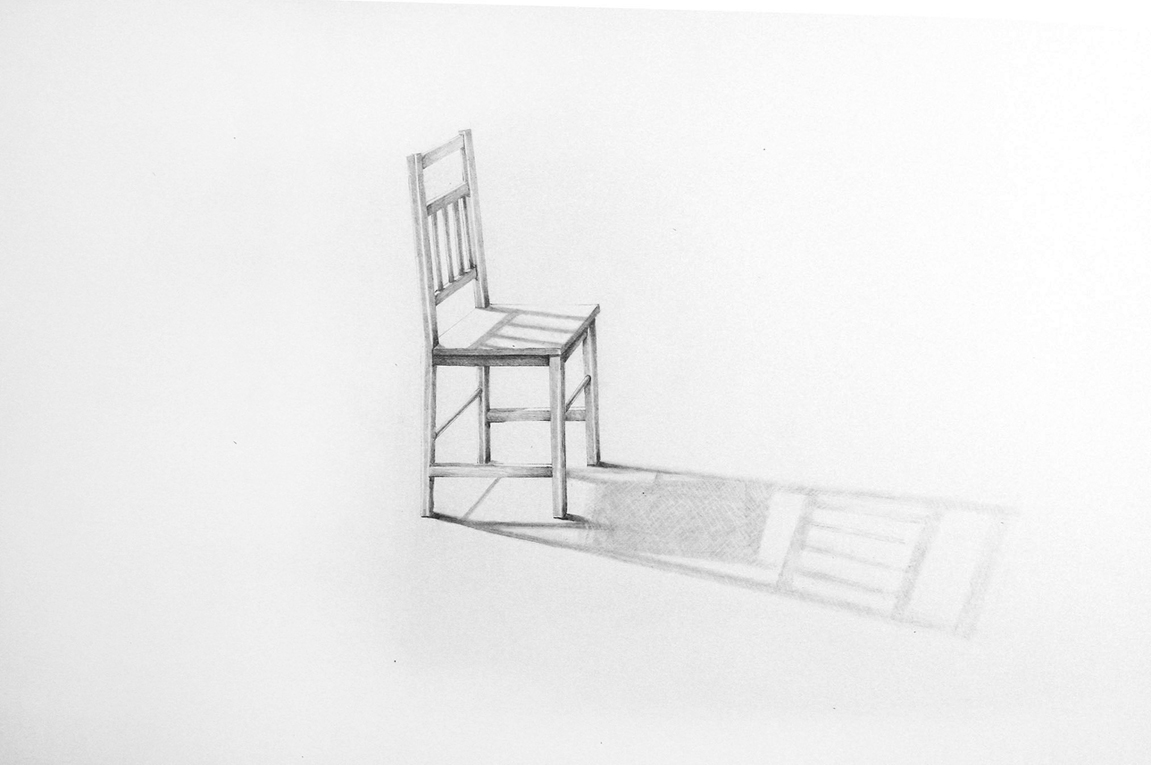
"One Chair," Drawing by Sheila Ghidini

“One Chair,” by Sheila Ghidini, 2013. www.sheilaghidiniprojectspace.com 

The earliest artists, traditional Chinese brush painters, heralded negative space as much as modern, Western artists delighted in filling the entire picture plane. For them the space untouched by brush was the nothing that is something, a space for contemplating what is beyond that something. That space is deeply connected to the philosophical concept of nothingness running through Taoism and Buddhism. In that vein, the Mustard Seed Garden Manual contains an admonishment from the 13th century painter, Jao Tzu-Jan, to always paint a scene with places made inaccessible to humans by nature. Because, as it is here surrounding Sheila’s lovingly rendered chairs, the dense, white nothingness obscures the contexts of their existence — and incandesces what is most beautiful in the mind. And true to the Buddhist aesthetic concept, yugen, we are most entranced by mystery.

Even in a composition of a group of chairs, as in the piece, “Conversation 10,” where different vanishing points for each object are used within the same composition, the same longing persists. The chairs, whether metaphorical or iconic of ourselves, are alone together. They inhabit the same context, but in different perspective realities. Recalling the ubiquitous dark matter that makes up our universe and is only detectable by instrument and not by light, these drawings are of presences, interactions, and possibilities that are around us always, but unseen. But here, lights and shadows figure centrally in Sheila’s rigorous drawing. The areas of highest value on the chairs are the same as the space engulfing the chairs. One could conclude that the negative space is the same entity as that which reflects light — and perhaps is light itself.
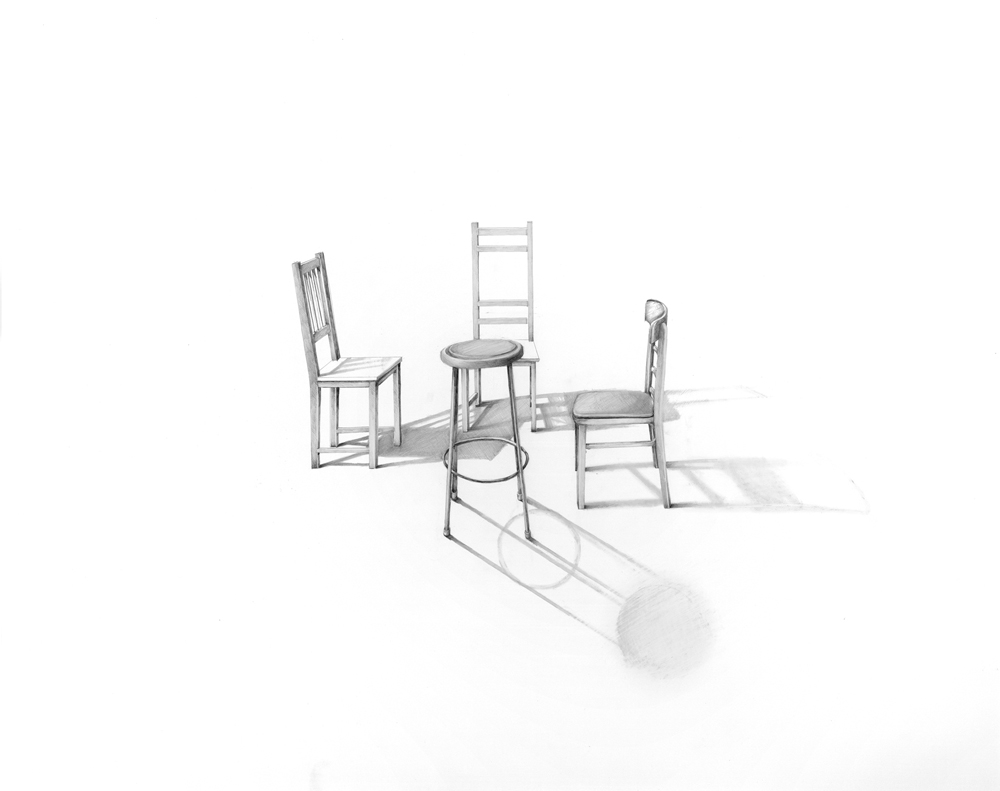
"Conversation 10," drawing by Sheila Ghidini

“Conversation 10,” by Sheila Ghidini, 2013. www.sheilaghidiniprojectspace.com

Therefore, when her installation of a sculpted, white chair enters pictorial space by dint of a graphite murmuration of birds drawn around and through the architecture of the chair and wall, the chair and wall similarly dissolve. The firmament, the reality, that you and I rely on itself becomes negative space, becomes light. And true to thousands of years of mystical understanding of the mediatory role of birds, as with the Asian affinity for negative space, Sheila’s work returns us to what is easily forgotten outside of moments of poetic and artistic attention: There is a horizon beyond our knowing. And let it be full of light.
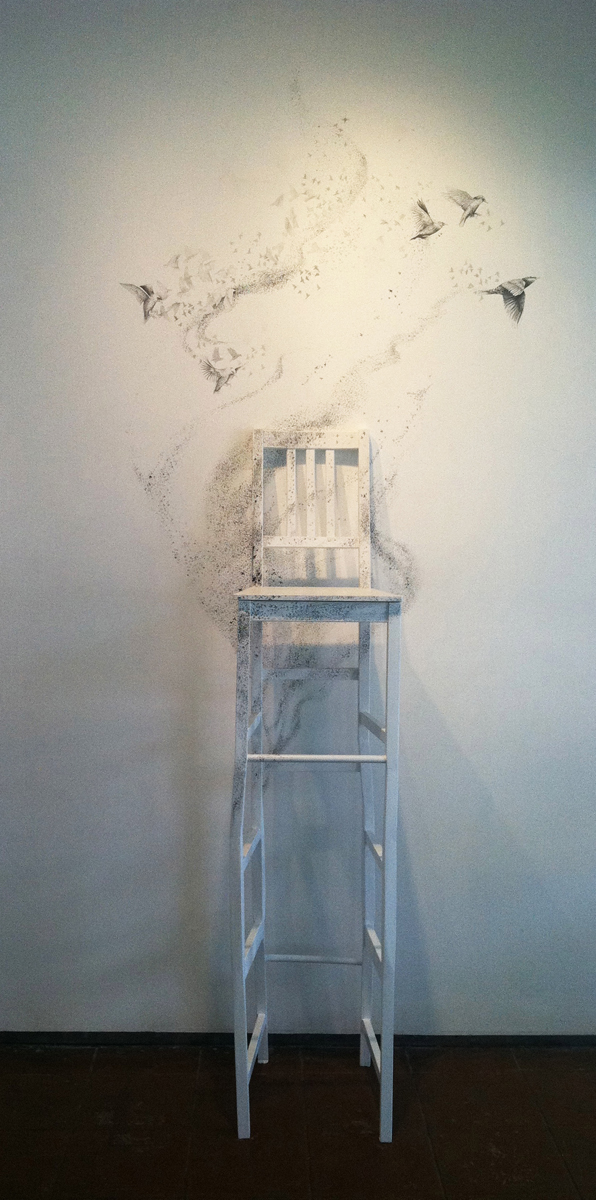
"Murmuration," Installation by Sheila Ghidini

“Murmuration,” Installation by Sheila Ghidini, 2013. www.sheilaghidiniprojectspace.com

“We don’t need to see anything out of the ordinary, we already see so much.” Robert Walser, A Little Ramble.

Be faithful Go

17 Saturday Aug 2013

Posted by summermlee in Art, philosophy, poetry, Uncategorized

≈ Leave a comment

Tags

Adam Hathaway, art, Emily Hughes, faith, George Steiner, journey of a photograph, Karen Hathaway, Photography, Summer Lee, Zbigniew Herbert

Art, even with its inward mystery, and maybe because of it, has a way of illuminating. Here is my contribution to this wonderful collaborative project.

Journey of a photograph, by Summer Lee, 2013.

Read about it here:

http://journeyofaphotograph.com/2013/08/17/be-faithful-go/

Aside

To discover one’s own absence is to discover one’s immortality…

20 Saturday Jul 2013

Posted by summermlee in Aesthetic philosophy, Art, Birds, Nature, philosophy, poetry, Uncategorized

≈ Leave a comment

Tags

Agnes Martin, art, birds, George Steiner, mystery, nature, poetry, San Pedro Valley

Another entry for my new project: Here is Where We Meet. http://thebirdsofsanpedrovalley.wordpress.com/2013/07/20/to-discover-ones-own-absence-is-to-discover-ones-immortality/ Photo, by Summer Lee

“Here is Where We Meet.” — John Berger

11 Thursday Jul 2013

Posted by summermlee in Art, Birds, Nature, philosophy, Uncategorized

≈ 1 Comment

Tags

art, birds, John Berger, nature, philosophy

I’ve started a new project, an off-shoot of this one. I thought it deserved its own place — since it is about my relationship to a meaningful place.

http://thebirdsofsanpedrovalley.wordpress.com/

Photo, by Summer Lee

“One can never pretend to comprehend completely –: that would disrespect in the face of the Unknown that inhabits — or comes to inhabit — the poet; that would be to forget that poetry is something that breathes; that poetry breathes you in.” Paul Celan to René Char

21 Sunday Apr 2013

Posted by summermlee in Aesthetic philosophy, Art, Birds, Nature, philosophy, poetry, Uncategorized

≈ 7 Comments

Tags

art, death, Leigh Hyams, painting, Paul Celan, poetry, San Miguel de Allende, Stephane Mallarme, teachers

Since I was the youngest by 3 or 4 decades, my traveling companions were relieved it was me who, drained from travel and the stifling heat (and a sip of the local margarita), interrupted pleasantries to declare that I might pass out. Our host for the week escorted me to the warm cement sidewalk of a dirt street outside the humble restaurant and waited until the cool breeze of the desert night revived me. She asked me polite questions, mostly trying to ease my embarrassment, but also to indirectly resolve how it is that at not even 30 years old, I had become close friends and travel companions with a cadre of women in their 60’s.

The babel of barking dogs woke me the next morning, which was after the night of dreaming she came to hold me. Somehow, the dark sensuality of this woman a half-century older did not alarm me.

In the morning painting session, I start with images and colors I have known before, but they don’t cooperate. As I paint canvases full of utterly conventional crap, I find myself at the edge of tears. There in the shade of her turquoise and pink adobe courtyard, tendrils of bougainvillea cling to the walls closing in on me, mocking my vulnerability and failure — like the stuffing has fallen out of my bra and the world sees me trying to put it back.

She sees the paintings and since I cannot dare the gracelessness needed to throw them over the fence,  I wish for once they could tell a lie. She moves like a dancer around them and critiques them with the fists of a boxer. I am politely mute, in turn, hating my own politeness. I want to hate her but she is just the conduit.

Painting. By Leigh Hyams(Painting by Leigh Hyams)

Plus, San Miguel de Allende overwhelms my sensitivity. I know why the dogs bark. All of them trying to simplify and drown out the brightly jarring colors, the incessant music from blocks away, the dead heat, the spirit voices, the craving for something other. The unreachable ocean.

The next night I dream that my neighbor’s contractor tears out my yard. All my cherished plants are missing, upturned soil exposes eviscerated roots. I experience an abyss where there once had been logic and rationality. Before hitting bottom, I wake to the pre-dawn storm of bird songs.

My dream is clear to her. She tells me in deep tones and direct terms that this unknown is the place where I want to be. Because of this and the buzz in her words, I start crying as she speaks, releasing all the tears that started bubbling in the courtyard. Tears that were neatly packaged screams against my mediocrity, my mundane banality, my safety. Tears that were cages holding a fearful but overgrown child wanting out into the wilderness. My painter friends look on tenderly, thinking it is because I’m sad. But I am beyond sad or happy, I am approaching otherness.

They think she is only speaking to me.

She says, this crying business, as if to be disdainful and compassionate at the same time, is something that only artists can understand.

I would return years later for an extended time considering the small city, my being in the midst of fertility treatment, and the lack of communication to my home from this gritty, foreign country. I was prisoner again to my own painting in her light-drenched studio, but she was a gentle and stern warden. We had many conversations here and there, aside a parade of indigenous costume-wearing tribes, over breakfasts in teeming gardens, after a dip in the local mineral springs, and hopping along the cobblestones incongruently filling the roads.

Sensing her increased frailty and watching her meticulous devotion to a series of sparsely charcoaled paintings of local ruins — to me obvious elegies to past magnanimous accomplishment — I asked if she was questioning her mortality. She, sitting in the improbably verdant backdrop of a sumptuous, water-filled courtyard garden gleaming in desert light and singing heat, answered with a smile, and maybe a slight disingenuousness: not anymore than I always have.

Painting by Leigh Hyams
(Painting by Leigh Hyams)

Some mornings new art books would appear at my breakfast table, always with unspoken pertinence. I loaned her my copy of Mary Oliver’s recent Evidence — a book of searching poems comprised of terse words around what cannot be buried, even spoken, after a loss, or death.

So I can imagine exactly how it was when she died a few weeks ago. Her bed is overlooking her wildly tended garden. She is arms-distance to her favorite art pieces ranging from profoundly poetic to those with playful certainty, and those, maybe her favorite, continually in serious questioning. I can see the washed out colors of early Mexican spring, feel the light-headed air of the high altitude aggressively dancing with the dust lifted and levitating in her richly alive, medieval Latin city. And I hear a liturgy from the birds of her neighborhood, of course, taking over the tinny brass horns droning from distant radios. The birds alone can accept that someone who loved life so much should have to leave it.  As a consolation, when dawn breaks leaving an emptiness for the rest of us, they send jewels of ephemeral birdsong down to earth to adorn her.

“Toute chose sacrée et qui veut demeurer sacrée s’enveloppe de mystère.” Stephane Mallarmé

Painting, by Leigh Hyams

(Painting by Leigh Hyams)

“Things I cannot speak of are not for the ear.” — Monsieur de Sainte Colombe, “Tous Les Matins du Monde.”

20 Wednesday Feb 2013

Posted by summermlee in Aesthetic philosophy, Art, music, philosophy, Uncategorized

≈ 4 Comments

Tags

art, healing, Itzhak Perlman, language, music, Tous Les Matins Du Monde, violin

As children we sometimes rode in his vintage BMW. There was often silence in the presence of my reclusive, stoic father, but his car was always filled with classical music, teeming with the lilt of violins played by ghost-like hands on imaginary stages only alive in the mind’s eye.

But tonight I sit in the intimate presence of an expert and his violin. Without wires and speakers and road noise, nor the dynamics of a vast symphony hall, by luck (privilege is also luck) I am inches away from the source. Unmediated.

The result of animal hair vibrating against metal strings over the opening of a lacquered, wooden box, it is also the most complicated of unspoken languages, the full range of human emotions and unarticulated impulses, all coming through a man who has painstakingly practiced his craft for over 50 years. Neurons, muscles, the electricity of infinitesimal choices of movement, invisible wavelengths and the receptive ear. Music. And like the best art, it is much more than that.

It is the ultimate of hubris that I might try to write about this experience. As Marin Marais utters in the culmination of Tous Les Matins du Monde, this violinist’s playing is “A refreshment for those who have run out of words.”

But among my people are silent musicians who had no such openings during war, invasions, immigration, mundane necessity, to sit where I am tonight.

The performer himself has been crippled by polio, and so easily could not be sitting where he is tonight. In the perfection of interpreting for composers hundreds of years dead, there lies the unmistaken inflection of his own living voice, informed by the circumstances that make their mark onto one’s life. Like the unique gesture made by a painter’s hand. His talents are undoubtedly mending the frays of pain, those tears in the fabric of human survival, passed down to him by his own people.

Because I know this is a healing and that it is in the realm of the miraculous. Music, as well as miracles, come to life on the necessity of the present moment. For over two hours, I am tethered to present tenses by unpredictable sounds and melodies, by the sight of his hands dancing impossibly up and down the strings. I am tied there until the end of his last performance, a composition he knows by heart and displays the utmost limit of his skill, of all human ability.

When he finishes I break inside and experience a pronounced loss because it is over, as are all the circumstances that culminated into this one evening — there with my mother weeping at the greatness of it all, our backs to the thousands of other audience members behind us, their wounds closing even if they don’t know it. I am greeted by an acceptance that this will never happen again. Even more, all of this could so easily, more likely even, not have been at all.

As it turns out, the night of this impossible recital happened to fall on my father’s unrealized birthday. If alive, he would have turned 80 years-old. And in his quiet way, he would’ve been healed most of all.

“Music exists to say things that words cannot say. Which is why it is not entirely human.” — Monsieur de Saint Colombe, Tous Les Matins du Monde

“Believe in the holy contour of life.” Jack Kerouac

05 Friday Oct 2012

Posted by summermlee in Aesthetic philosophy, Art, Nature, philosophy, poetry, Uncategorized

≈ 5 Comments

Tags

art, Heidegger, Jacques Prevert, painting, poetry, To Paint a Portrait of a Bird

Pour faire le portrait d’un oiseau

— Jacques Prévert

Peindre d’abord une cage
avec une porte ouverte
peindre ensuite
quelque chose de joli
quelque chose de simple
quelque chose de beau
quelque chose d’utile
pour l’oiseau
placer ensuite la toile contre un arbre
dans un jardin
dans un bois
ou dans une forêt
se cacher derrière l’arbre
sans rien dire
sans bouger…
Parfois l’oiseau arrive vite
mais il peut aussi bien mettre de longues années
avant de se décider
Ne pas se décourager
attendre
attendre s’il faut pendant des années
la vitesse ou la lenteur de l’arrivée de l’oiseau
n’ayant aucun rapport
avec la réussite du tableau
Quand l’oiseau arrive
s’il arrive
observer le plus profond silence
attendre que l’oiseau entre dans la cage
et quand il est entré
fermer doucement la porte avec le pinceau
puis
effacer un à un tous les barreaux
en ayant soin de ne toucher aucune des plumes de l’oiseau
Faire ensuite le portrait de l’arbre
en choisissant la plus belle de ses branches
pour l’oiseau
peindre aussi le vert feuillage et la fraîcheur du vent
la poussière du soleil
et le bruit des bêtes de l’herbe dans la chaleur de l’été
et puis attendre que l’oiseau se décide à chanter
Si l’oiseau ne chante pas
c’est mauvais signe
signe que le tableau est mauvais
mais s’il chante c’est bon signe
signe que vous pouvez signer
Alors vous arrachez tout doucement
une des plumes de l’oiseau
et vous écrivez votre nom dans un coin du tableau.

——–

To Paint a Picture of a Bird

First you paint a cage
With its door open
Then paint
Something nice
Something simple
Something lovely
Something useful
For the bird
Then set the canvas against a tree
In a garden
In a grove
Or in a forest
Hide behind the tree
Without speaking
Or moving…
Sometimes a bird arrives quickly
But equally it may take many years
Before it chooses to
Don’t be discouraged
Wait
Wait many years if needed
The speed or tardiness of its arrival
Has nothing to do
With the success of the picture
When the bird arrives
If it arrives
Observe the most profound silence
Wait till the bird enters the cage
And when it has
Gently close the door with your brush
Then
Erase all the bars one by one
Taking care not to touch a feather of the bird
Then paint a picture of the tree
Choosing the loveliest branches
For the bird
Paint the green leaves too and the wind’s coolness
The dust in the sunlight
The sound of insects, in the grass, in the summer heat
Then wait for the bird to choose to sing
If the bird won’t sing
That’s an adverse sign
A sign that the painting is bad
But if it sings it’s a good sign
A sign you can sign your name
Then very gently you’ll detach
A feather from the bird
And write your name in a corner of the painting.

“We never come to thoughts. They come to us.” Heidegger

“Language simply ceases… The poet enters into silence. Here the word borders not on radiance or music, but on night.” George Steiner

17 Monday Sep 2012

Posted by summermlee in Aesthetic philosophy, Art, music, Nature, philosophy, poetry, Uncategorized

≈ 7 Comments

Tags

art, bird watching, birds, George Steiner, music, nature, Rilke

The outskirts of Tahoe National Forest. I followed the early morning mists of little winged bugs along the edge of a forested reservoir, a small cohort of Audubon’s Warblers chasing them also. With a mind galloping through what if’s and what-nots, I sat next to their cathedral, a half-dead tree once under the water line. Its branches stretched arthritically out towards that which feeds it but also puts it asunder. One by one every species of woodland bird worked its way out of the dense pine forest to that diminuitive tree. They would land with a pause, flit a little, perhaps taking a careless bug in this gathering place, then sail down below to the stony water edge. They were singing me stories of wretchedness, of betrayal and harshness from those who didn’t believe they know better. They described predators with only few survival skills who violate their homes, even when their bellies are far from empty. But they also sung of the little joys of sunlight, improbable births, childlike pauses, and cool reservoir water. Fiercely aching nights and warm morning updrafts. And times when every species and variety of plant and bug is available, and times when their children grew silent in the cold. Warblers, nuthatches, wrentits, chickadees, flycatchers, a few I didn’t know, and a rufous sided towhee — the little delicate species, the singers. My favorites. For years this lasted. I have been devoted to them.

Someone once said that birds remind him of an existence before human civilization, of times outside of wars, laws, buildings. Before human suffering and its impulsive response of further suffering. But these birds were not solely of the sweetness of summer, though they had the resilience and the evolutionary wisdom to live as if that was all they knew. Because today it was summer.

(A photo from my studio, by Shae Rocco).

It seemed my birthright to make an offering. Give something, though those little birds of course needed nothing. Steiner reminds that art is free, gratuitous, not for anything, so much so that every artful creation calls forth an awareness that it might not have been. So somehow turning this moment into a drawing or even writing seemed superfluous, like a scarf around Rilke’s torso. And it is.

Because in this moment I also felt like I might not have been, that everything I’ve done and made might have been otherwise. I felt humble, like the chanters of holy songs, whose talents are free and freely given. So, for whatever reason, because I was perfectly alone, I began to sing. My mom would be excited to know I quietly sang songs from her faith, maybe because that foreign language seemed as intimate and yet dispossessed as the birdsong around me — it contains a hint of something inextricable even as it is unknown. And despite my usual anxiety of needing more, I had a moment of needing nothing, a necessary condition for gift-giving, even if it is song-giving. Towards everything surrounding the birds and all the radiating objects and memories and people I know and knew. And as the scene pulsated, the birds neared me one by one as part of their ritual, into otherwise lethal distances. A Townsend Warbler landed a few inches above my head. After that a Kinglet slid down to the frayed end of a branch four inches from my eyes. Another Audubon’s Warbler almost upon my shoulder. They exerted themselves to me. And so I cease to sing.

” — for here there is no place that does not see you. You must change your life.” Rilke

And when we imagine wings that come and go / What we see is a house / And a wide open window. – May Sarton

23 Thursday Aug 2012

Posted by summermlee in Aesthetic philosophy, music, Nature, philosophy, poetry, Uncategorized

≈ 8 Comments

Tags

Bachelard, birdsong, childhood home, dead sparrow, Gadamer, Heidegger, Home, May Sarton, memoir, music

If Goethe is right, and architecture is frozen music, home is a song we have learned by heart.

My friend reminds me that learning things by heart insists upon rhythm, the heartbeat, and that the experience of the present moment is rhythmic.

One beat has to end for the next to begin. And like his favorite piano concerto, we don’t know when this note ends, and there is much tension in the space before the next. And life is marked by a gentle sadness when that moment ends and dissolves into the next moment. That, according to Bugbee, life is haunted by a continual parting. Proust says these moments are connected to places that also don’t exist anymore: “The places we have known do not belong only to the world of space on which we map them for our convenience. None of them was ever more than a thin slice, held between the contiguous impressions that composed our life at that time; the memory of a particular image is but regret for a particular moment; and houses, roads, avenues, are as fugitive, alas as the years.”

And that was the fugitive feeling I have had recently. First, I was at a dinner where a friend made a lovingly-prepared pot roast. Tomato and herbs infused a slow-cooked meat I’ve not experienced since I was living in my childhood home. The warm, familiar smell wrapped its arms around me as I sat in this modern-day apartment, just as my mother’s filled our evening home when I was a child. The smell invoked something so palpably nostalgic that one part of my self remained in a distant past even as I carried about in the present-tense conviviality. My friend sitting next to me also was piqued by the memories of childhood dinners; someone who I happened to have first met when I was 6 years old. We have witnessed each other grow and shed several versions of ourselves, though there is something from which we struggle not to stray.

It recalls Gadamer’s notion of festival — that there is an enduring in the perishing. There is continually a moment that we wish could be retained, held onto for just another moment longer, even though it can never be. It is a “consciousness of human frailty,” when we are aware of the rhythms of our life and the fact that they end. “Every festive joy, yes, every joy, is perhaps the other side of an inexpressible, unutterable.” And every beat of the heart is inseparable from its opposite — silence; nothingness.

And then I gave into the urge to drive by my childhood home this week. I was in the area, where a chaparral dustiness meets the crisp coastal breeze and tugs at me. As did the autumnally-filtered light of a sun beginning to arc lower in the sky. And there predictably sat the home on the corner of middle-suburbia covered with mature trees and gridded off by narrow streets. The house, like the area, is shinier and more regal than the more humble and equitable times known before Silicon Valley bubbles and exorbitant housing prices. The home was still incredibly intimate, yet completely estranged from me — the current occupants undoubtedly using it in their own way in a sort of betrayal of the past. Because, like everything else, my home had to give way to their home. Like the tightly woven, straw nest that fell off the side of our house a few months ago. Next to it was a darkly stippled egg, intact, but belonging now to the unknown.

The nest fell from the eaves of my new home of the last 13 years. Soon, as with every year, the winter flock of Golden-crowned Sparrows and their one loyal Fox Sparrow friend returns to our feeder. One year our cat in her boredom slaughtered the Fox Sparrow, and after I grieved its dark, hopeless body in my hand, I decided not to slaughter the cat. A few years later, a new Fox Sparrow somehow rejoined the flock. I’ll never know how.

Fox Sparrow song

This is the home which presses itself into my son whose foundational memories will be part of the architecture, as the architecture is part of his psyche. And eventually, the most eventual fact of all, my life will give way also. So dramatic-sounding, I know, but the remembrance of which always relates to Heidegger’s astonishment that I exist rather than not, that leads to Hamill’s loving a little bit more, because one of us will die. And the moment when the stars begin to burn through Mary Oliver’s sheets of clouds so that I may write about it here, with words that are little houses, as they dissolve away also. That things come and go, it brings about wonder:

“Celebration … is self-restraint, is attentiveness, is questioning, is meditating, is awaiting, is the step over into the more wakeful glimpse of the wonder — the wonder that a world is worlding around us at all, that there are beings rather than nothing, that things are and we ourselves are in their midst, that we ourselves are and yet barely know who we are, and barely know that we do not know this. – Martin Heidegger, Polt

“Words … are little houses.” Bachelard

04 Saturday Aug 2012

Posted by summermlee in Aesthetic philosophy, Art, Nature, philosophy, poetry, Uncategorized

≈ 8 Comments

Tags

Bachelard, birdsong, ephemerality, George Steiner, monrtality, nature philosophy, nests, poetry, Saigyo, Sheila Ghidini

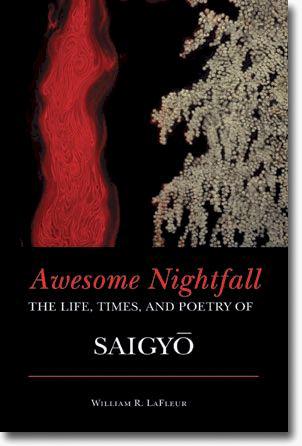
The 12th century Japanese poet, Saigyo, lived in horrific times of war, chaos, and scandal. He descended from a lineage of warriors, and after violent service to the Emperor, he took up the robes of a monk and the pen of a poet to both understand and release the straits of human-ness, his metaphorical and literal bloodstained past, the limits that all humans are born into.

In both life and writing, he became a homeless wanderer. And it was during these unceasing peregrinations between mountainous temple sites and towns that he used the ability of nature’s images to capture all that matters through deceivingly simple words.

An ancient field

and in the sole tree starkly

rising to its side

sits a dove, calling to its mate:

the awesome nightfall.

In his poems, words as single ideographs balloon with layers of meaning, and no one meaning stabilizes over another. What we think is important becomes indistinguishable as night falls. What remains there is the gift of the dove’s birdsong lilting in the dissolution of light — into awesome darkness.  As Sam Hamill writes, thoroughly intimate with Saigyo and profoundly aware that song might be the last thing heard, that words are the springboard into nothingness:  Those that I love are more beautiful because one of us will die.

I recall the moment driving home from the hospital after giving birth to our son, a process that even in good circumstances is seismic to the foundation. And in my case, I exhausted myself to the point of an acuity of my mortality. So there I was, dispossessed, with one foot still in the non-world, while my family packed up the days-old baby asleep into his carseat, also with one foot in the non-world. We were heading home.

Oddly, our destination in my mind’s eye was my childhood home. Driving down the familiar coastal route, I only saw my childhood living room with the wretched, green upholstered chair that I spent so many hours in, there under the expansive pane of glass through which was our neglected garden, littered with robins pecking at unwanted cherries. Even when it became clear that this was not indeed where we were heading, that the last time I stepped foot in this house was decades ago, I could not understand how to get to my current home, the one “known” for the last third of my life. I experienced a moment of homelessness.

Of course my literary hero, George Steiner, drawing on writers ranging from pre-classical Chinese poets to Holocaust survivors, professes this homelessness, that we are always guestworkers, “frontaliers in the boardinghouse of life,” regardless any distraction from this eventuality. It is the same for Dante, in his love for Beatrice, who travels through the three realms of the dead. And that the epic narration of Odysseus is in his journey, the textual death occurs when he reaches home.  Chuang tzu’s free and easy wandering, which is incredibly not free, nor easy.

Because we are human. We need a home. If we are to have a home, according to Bachelard, it would be like the fragile nest. Every precariously woven-together twig and dried straw comprise our human desire to hope for the future, and the precious eggs it cradles — but also the acceptance of its propensity to decay, fall apart, to be destroyed — to be ephemeral. The nest acknowledges the potential for me to be without the soul-killing need to push against Being, distracted from where the beauty of it lies. I have exhausted myself in my will to make things certain — because, as I am reminded in my changeling son, the infinite little losses in my body, my relationships, my art-making, and how in this moment right here is the possibility of perishing — words are anything but certain.

(Sparrow, by Sheila Ghidini. http://sheilaghidiniprojectspace.com/home.html)

“When you are philosophizing, you have to descend into primeval chaos, and feel at home there.” Wittgenstein.

← Older posts
Newer posts →

Enter your email address to subscribe to this blog and receive notifications of new posts by email.

Join 619 other subscribers

Recent Posts

  • “Experimenters in the passages between worlds.” Vinciane Despret, Au Bonheur des Morts
  • “The terrifying groundlessness, the eradication of all violences. To be embraced by that which doesn’t know us and in that unknowing caresses us and truly loves us. We might become anything at all, something wildly other than what we are encountered by. A world that truly loves us by not presuming what we want or what shape we will take before we show up… We will be held when we are not known from the start.” — Dr. Marquis Bey
  • Images dream within us, a reverie is a world of expansion.
  • “For the natural world, the ethical responsibility is that being alive gives existence to others.” Vinciane Despret
  • “We meet in the freedoms of each other.” – Takeyoshi Nishiuchi

Archived Posts

Blog at WordPress.com.

  • Subscribe Subscribed
    • Unwanted Advice: Reflections from a Self-Appointed Life Counselor
    • Join 215 other subscribers
    • Already have a WordPress.com account? Log in now.
    • Unwanted Advice: Reflections from a Self-Appointed Life Counselor
    • Subscribe Subscribed
    • Sign up
    • Log in
    • Report this content
    • View site in Reader
    • Manage subscriptions
    • Collapse this bar
Loading Comments...