• About

Unwanted Advice: Reflections from a Self-Appointed Life Counselor

~ Caminante, no hay camino. Se hace camino al andar. Wayfarer, there is no way. You make a way as you go. (Antonio Machado)

Unwanted Advice: Reflections from a Self-Appointed Life Counselor

Category Archives: Uncategorized

O birds, I’ll sing to myself, you’ve carried/me along this bloody voyage,/ carry me now into that cloud/into the marvel of this final night. — Jim Harrison

04 Friday Dec 2020

Posted by summermlee in Aesthetic philosophy, Art, Birds, Nature, philosophy, poetry, Uncategorized

≈ 8 Comments

Tags

art, birds, birdwatching, death, Jim Harrison, nature, poetry, Pontormo, Summer Lee, Summer Mei Ling Lee, tragedy

I own a caged bird made up of thousands of serious marks by several colored pencils on paper, framed. None of it is particularly bird-like except the woman I know who applied each one. I met her in a room in an institution in my grandmother’s country. She was one of a group who spent their days in an art room. When one of them began hitting his head and shrieking, I asked my colleagues to leave and I sat down and started drawing birds, too. The silent making in that space brought us all back home. Eventually their caregiver tapped me on the shoulder and said, we knew you were coming from far away. We have a song for you. They handed out instruments to each other and stood in a circle around their art desks and starting singing, loud enough to carry into the clinically sterile halls outside. I clapped my wings and let their foreign calls delight me, until an older man who could sing but not speak wrote on his dry erase board: Ask our visitor to sing a song for us.

If I sing these words about you, you stay alive with me. If I craft these scenes from our past here you still are in them. Humans, by dint of language, are the only beings capable of a future conditional tense. It enables the birds to sing in the daybreak after the night of our death, and we hear them. And the more sensitive, by the size of the eyes of the bird, the earlier the song begins. And the more comfortable and active they are in the dark, from where you also emerge.

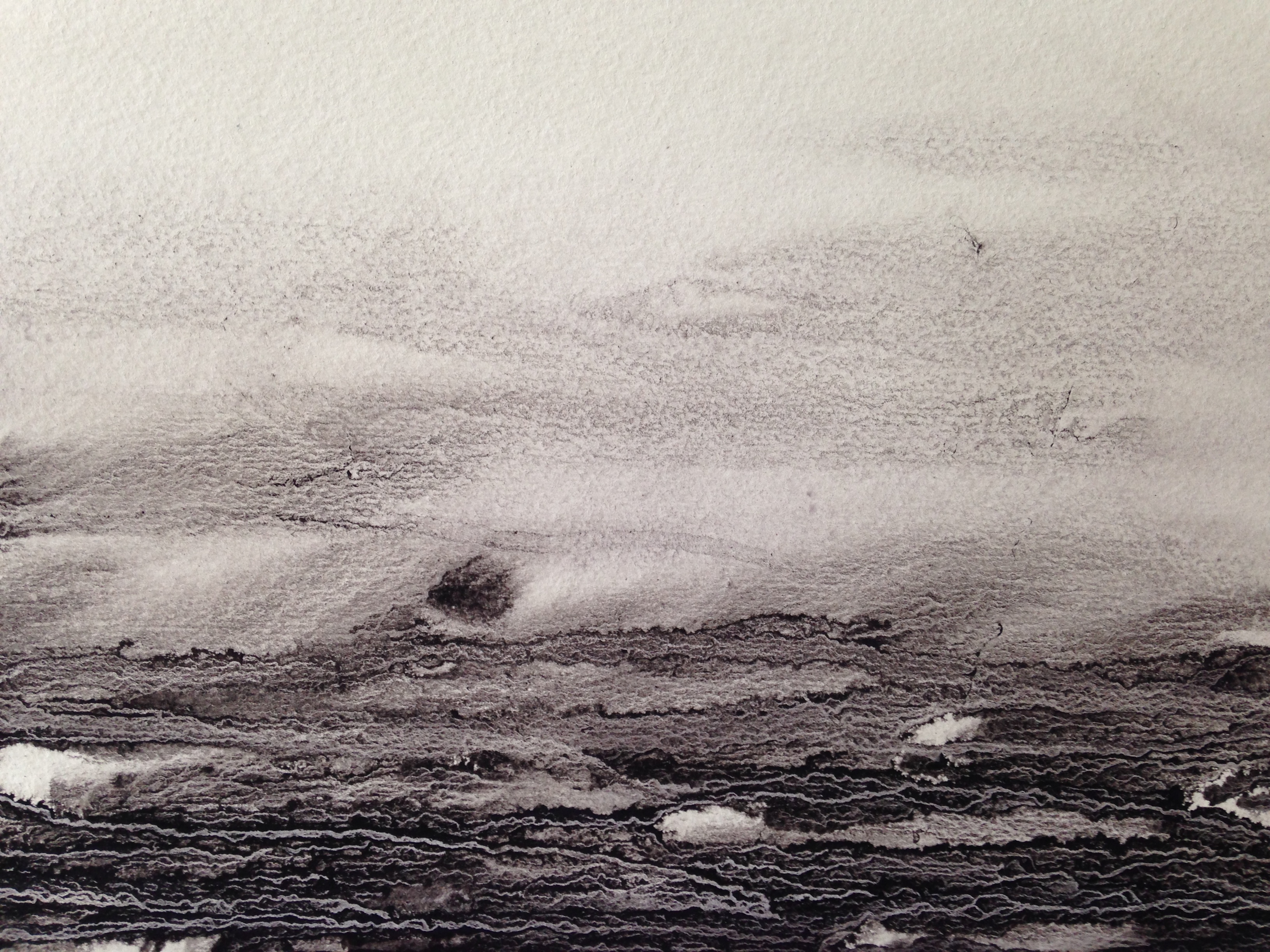
Little ink bird, by Summer Lee, 2020

At some point in their circle of death the birds turned towards me and they told me matter-of-factly you had been taken. Gone. Right from the middle of me. The swaths of memory that made you part of me flew out of an absence and circled themselves over and over as clear as today. Some sort of compensation for the violence that I will never see or talk to you again. I would also learn that someone took something from you when we were young that wasn’t theirs to take. It stole parts of your life increasingly, until you were gone. We were born right across the street from each other. Now I am living and you are not. This song is my deepest apology.

Some of the most beautiful birds in the circle know me through intimate, timely words over incredible distances. At the moment when I thought you were most gone, it was as if you were sitting across from me. In her knowing, the beautiful poet bird just then wrote: somehow when they leave the body, they become closer to our hearts.

And yes, these songs fall out like feathers, like when at the end of one morning, the birder opened her car door to leave and told me the lump was cancer. That same day I held Magnolia Warbler who had been found struggling on the ground, and in my hand he shrieked a distress which was the call that there is unfathomable suffering without the consolation of reason.

One morning of those 43 mornings in a row, before the other birders arrived, there at the edge of the puddle was a bird I knew well and would make me famous to other birders for the week. How funny since he was a common bird to me, Varied Thrush, from a dark path along the reservoir near my west coast home. But here, he was a long way out of range. The place I often find myself. Who knows how these specialists drift thousands of miles from their homes, how this tiny bird managed to cross over the Rocky Mountains. Surely alone. We are birds along a life-long commute of thousands of miles. These words are the apology when one goes off course.

Thank you to our parents who let us little kids out to play together hours on end, often into the darkness. Thank you to my mom who visited him a few weeks before in the hospital, to remind him he was not his diagnosis. Though the tattoos of darkness were adding up on his body, there is always the light of possibility for all our self-inked narratives to be not true.

After the 4 hours a day every morning I spent with these birders, the migration season was over. It reminds me of the moment I left that institution where the caged birds sang and made art for their entire lives. A part of me stayed behind to keep drawing birds. But along a corridor on the way out, a mother was visiting her son. He sat alone from the group flatly staring out a window, and she was petting his head, preening him with all her loving attention.

The birders leave because the birds move on. The last bird spotted was an emerald blur of a tiny hummingbird that was late for the cold air. It hovered over our heads just long enough for even the slowest of us to register and then it zipped away into the invisible. 

“Birds are holes in heaven through which a man may pass.” Jim Harrison

Detail of Deposition by Pontormo, 1528

“I could never have come to the present without you / remember that / from whatever stage we may again / watch it appear…” WS Merwin

03 Friday Jul 2020

Posted by summermlee in Aesthetic philosophy, Art, Birds, music, Nature, philosophy, poetry, Uncategorized

≈ 2 Comments

Tags

Annunciations, art, birds, birdwatching, death, Gadamer, philosophy, poetry, St Cecilia, Summer Lee, WS Merwin

The birds come and go here just as Fox Sparrow does in his homecomings and disappearances back on the West coast. Just as truth and beauty migrate out onto another unreachable continent when trying to reason with them. Why can’t you stay here to remind me, I ask through my binoculars. Just once. Their wondrous plumage and secretive calls draw us out from the smallness of our shelters, out into the rainy forests and sometimes in communion with each other, the alive and lonely. This year all the rarest of ones flickered across my field, even a tiny, crystal-blue Cerulean Warbler that spends most of his time too high for anybody to see. A Hooded Warbler touched down too, in a darkly flooded forest where he normally does not, just for two days. Then they leave and we are alone again. Maybe that’s why I told a beautiful woman birder that I saw the rarest bird, when in fact I hadn’t seen it at all. Something about the mix of her beauty and shyness, and something about me being mistaken and humbled. But maybe that bird is still there in our minds, more glorious and hopeful than if we had even seen it.

IMG_1682

(Martyrdom of Saint Cecilia of Music. Sculpture by Stefano Maderno, 1599.)

What if this wave of unrelenting and invisible death was actually a grace. Except of course for the poor and vulnerable who always die for our sins. All while I suffocate in the safety around me in the anxiety that it’s never enough. Like when I impatiently told her she just needed exercise when in fact she was just about to die, swollen with failed organs, failed also by my insulated stupidity born of fear.

One time out in the twilight of a chaparral migration, stranger birds gathered in a circle. And even more strangely invited me. They had gathered in order to die. But being birds, they had to first learn how to die through song.

I listened. And of course cried too, as one does even at a stranger’s funeral. One sang of her young daughter who died suddenly. And when the mother’s song entered the abyss of dark and permanent grief, her daughter would come sing to her, to the point where I could almost hear it too. I still don’t want to know if it was an apparition of the psyche or from the other side, because it’s the same place where my own grandmother speaks to me.

This mother had brought with her the chaplain she had met in the hospital. Yes, there is always a bird there, even if we don’t believe, and here she was in the body of a middle-aged, white woman wearing a collar. The chaplain sang to me too, as I worried about my own son treading a difficult path through life. As she warbled, we all sat crying for ourselves and for that mother. Her song was about just being there at the right time, reminding us that our bodies know how to die when it is time.

But the timing of the young daughter’s song, as well as this chaplain, was uncanny. Like the little 9th century bell in Rocamadour that rings when there is an incontestable miracle. Not all pilgrims who have climbed on their bloody, tired knees to that church will hear it. But I can hear that birdsong from that circle of death, even if they are on the other side of the earth now.

Through all the hatred to be had of insufferable humanity, its never-ending range of evils, these migratory birds continue to love me well through certain people, strangers even. Just through their words. Through the poetic words they send me, calls to the heart that rain down on me in dark, muddy forests. In poetic words, there lies the impossibility of their birdsong — as impossible as it is to hold truth and beauty too — that living is through learning how to die. One word at a time, one song, risking itself into unreachable silence.


“The greater miracle of language lies not in the fact that the Word becomes flesh and emerges in external being, but that that which emerges and externalizes itself in utterance is always already a word.” Gadamer, Truth and Method.

“Art brings the finite and the infinite, the visible and the invisible, into coincidence.” Takeyoshi Nishiuchi

19 Sunday Jan 2020

Posted by summermlee in Aesthetic philosophy, Art, Birds, Nature, philosophy, poetry, Uncategorized

≈ 5 Comments

Tags

Annunciation, birds, Fra Angelico, language, Summer Lee, Susan McMane, Takeyoshi Nishiuchi, Young Women's Choral Projects

The greatest injury to Fox Sparrow might be that scientists are trying to build a mechanical bird to replicate all he can do. But what a consolation it is that they can’t yet fathom his genius — that when he moves just the toe of his wing, he can change the direction of all his feathers, just so. How he can make his feathers stick together with a force greater than Velcro and then separate them at will. Not to mention his song.

And their song. The mystery that all those technical elements can create a moment completely liberated from them.

Hands

(Here is Where We Meet, by Summer Lee, 2017. Cyanotypes, fabric, wood.)

There was a time when the mystery itself was worshipped. And that painters knew the impossibility of capturing it, but their religion was to try, for hundreds of years. But in these days, even though no one now can say exactly how a word becomes flesh, we are fed so much technical explanation about this material and that, the biography of that painter and historical event. Circular tales plunging us into neurosis. What else is neurosis but the inability to cope with uncertainty. And the delusion we can ward off any risk. They knew then, as it goes, the angel arrives even if Mary turns her head.

If ever you have held dead Fox Sparrow in your hands you also know that nothing else could suffocate life more than the self-congealing words we wrap around it. Even if it is, and it always is, to try and comfort.

Fra Angelico made a point to put the fallen Adam and Eve leaving the garden in the same scene as the Annunciation. He knew the word can separate, but also in the same scene obliterate all back into the messianic. Caroline’s poems do this many times a week. And maybe that’s why I tire you, to set out so selfishly about here with words from time to time. To remind myself, the truth and untruth of language.

To remind myself that no one can explain how the paint in my watercolor pan can bring Fox Sparrow to me. And how Fox Sparrow can leave just like that, just because I wrote it here.

Mary, in an economy of words we can’t fathom today, said,

Fiat mihi secundum verbum tuum.

Let me greet all such incursions on my cautionary house of being with such grace. To find repose in the pain of resignation. Not a lazy resignation, but at the end of intense searching, like that for Fox Sparrow. I have read volumes on his kindred, and created innumerable treatises on all the possible places he could be when he isn’t here. Some dark and treacherous, like facing decisions I must make for my child, the lightning-lit rain pelting Fox Sparrow as he embarks in his night flight home. Some of his places are as light-filled as the clouds of Veronese, overlooking restless humanity. And sometimes as majestic as the vanishing valleys into the boreal forest I will never visit. Most of all, it’s the perch on the thin wire weirdly placed in that painting. Where he peers down on a woman who has been greeted by an angel, telling her that her life is about to be changed by no fault of her own. And of course Fox Sparrow knowing what we don’t know: that we are all fallen. And that a word could turn into flesh, spirit into form, and save us.

fra angelico prado 3

Right now Fox Sparrow is under my feeder scratching the dirt in this humble coastal yard in front of my house. The more hungry he is, the closer he lets me. To see his black eyes see me, see this place, that somehow guided him here to me. Back to the emptiness.

The YWCP chorus, directed by Susan McMane.

“And the emptiness turns its face and whispers ‘I am not empty; I am open.’” —Thomas Tranströmer on Vermeer

09 Saturday Mar 2019

Posted by summermlee in Art, Birds, Nature, Uncategorized

≈ 5 Comments

Tags

art, birds, Chauvet, darkness, emptiness, Josephine Baker, Lascaux, Rocamadour, Summer Lee, Summer Mei Ling Lee, travel

It’s hard to believe but Fox Sparrow says it’s best to fly in the darkness of night. Thousands of miles in just a few weeks. He might already be gone by the time I return.

The birds are named differently here, and are very wary. I follow their calls but cannot see them.

Before the war, some boys went into the forest nearby and climbed down a tunnel in search of a rumored treasure, in the days when one could dream of backyard buried treasure. When they reached the floor of the cavern and raised their lamps they saw a spectacular herd of bison and rhinos and horses running overhead from a time before history, as if it were yesterday. How most treasures are indeed accidental.

There are differences of 2000 years between one painting and another on the same stone wall. And no other change in style of line or pigment. One can compare in contrast how much the same Annunciation scene changes over 300 years. In those paintings, the perspective shifts immensely, as do the colors, and how the bird overhead goes from contour to volumetric realism. But in these caves, the paintings are almost exact, as if done by the same painter, even in caves 400 miles by foot and 20,000 years apart.

Chauvet painting, 37,000 years ago. (Photo by Jean Clotte)

What is more dystopic: life on the freezing tundra on the brink of starvation, living to kill by rudiment tool; or our tired, cynical eyes fixed trance-like to LED screens, where an unmanned drone can drop a bomb on a coordinate, our own child’s life. 20,000 years in between us and us. It is an impossible stretch to imagine a bison or wooly mammoth in this over-farmed field in front of me, but the painters were us, after all. We share some deep part of humanity, maybe if only just the underground place where we go momentarily to dream. And what is there for both of us is those paintings.

Nearby, I saw her there, in her medieval castle home of 30 years, because she found a way to never leave. Even if she had been a starlet and philanthropist, her money had been drained and they dragged her away from her castle at the end of her life. There is a photo of her in that moment, sitting on the ground of the porch like a beggar, with a few belongings and some bottles of water. It was her fall, but also her protest. Because even to the end we made her perform, the exotic caged bird, singing and dancing, sometimes to our low tastes. The castle feels spent now, as if folded up after an epic performance, breathing only memories of the high days of celebrity-filled theatres, greying sequin gowns, and used toys from a line of adopted children (where did they go?). Eventually, the princess offered her a new home, and Jackie O funded her final farewell/revival show (those women understood), then she died a few days later. In Paris. But for now she prevails in that castle. Not unlike an outline of a gorgeous creature fading on an exposed cave wall.

It didn’t ring while I was here, a small 9th-century bell on the ceiling of a chapel carved into the rock of a cliff. The chapel could seat maybe 30, but receives innumerable pilgrims, for a thousand years now. Some climbed the long stairs on their knees, as if life itself weren’t cut and bruised enough. In the dark space, a black virgin carved by a hermit tenderly watches us. And we watch that little bell that is only rung when there is an incontestable miracle. A list on the wall begins in 1385, mostly for miracles at sea. The sea is a fantasy to most who lived here then, 200 miles from this little chapel. And who decided what was deemed a miracle, she asks me. I don’t know but it always involves suffering. And how miracles are also under the auspices of the accidental.

Fox Sparrow

(Fox Sparrow, when I first met him.)

It becomes obvious here that along these little roads and stone villages there are little sauvage patches of forest left, under which are other undiscovered caves full of prehistoric paintings, so beautiful because they will never be seen. Never to be paraded in front of lustful eyes. Like the birds here who continue to call and flit around, always outside the reach of my eyes.

Darkness, Fox Sparrow says. And I believe him, because all of this unfolds when words fail to contain it. How far these little words go though, sore and tired pilgrims of the darkness, in search of the miraculous.

“The true entrance into us will not occur by an act of will.” George Steiner


“That of a bird floating on the wind without moving its own wings, that of a bird which is flown by the wind.” Zeami, 15th Century

26 Sunday Aug 2018

Posted by summermlee in Aesthetic philosophy, Art, Birds, Nature, Uncategorized

≈ 5 Comments

Tags

art, birds, Czeslaw Milosz, kite, Lorenzo di Credi, Love, poetry, spirituality, St. Francis, Summer Mei Ling Lee, Zeami

It’s a flagrantly irreverent kite, as it dances a silly jig back and forth, fancy-free and a mile high in the gray sky. Shadows of swallows and swifts dart all around, you can’t much see them but can feel them hurling by just inches away.  All this high above a green river, slicing through a narrow forest, carving into the dead center of city. Just a concrete bridge, an updraft, and an insect haven for the evening hunger.

Yes but I’m not happy, he says in broken English, laughing only a little. Because even though it is a plastic-blue-Walmart-superhero kite, this is serious.

You have eagle eyes, he adds, as I point out to him where in the forest the string has hitched itself. Although I side with the runaway kite, mocking his owner, finding communion with the disinterested birds.

His little boy is concerned as his father sternly reels the string in, the father with one eye on his little boy “Vincent!” who might at any moment fall off the unrailed bridge to the rocky riverbed below.

A gray hawk does some stoic surveillance and disappears. Then a noisy plane above it.

He pulls the string harder and the place in the tree where it is stuck is made clear, revealing our finite and diminished existence. Now caught, the kite flails against certain death, surrounding leaves torn away and falling. It occurs to me this $20 kite battle means something to this man, when my kids lose toys daily without notice. And how this battle now means the world to me.

Suddenly one of the yanks frees the kite from the branches and it soars up again into the sky. He releases a shout of victory like a knight who has slayed the dragon. He retreats back into the city with his child, kite following closely like a dog with a tail between the legs. I laugh.

Then just when the whole sky seemed too vast to embrace our little drama, tiny stabs of rain give their acknowledgement and I start to cry. A mote of beauty in this world. Yet under the same sky where children were torn apart in their school bus by our bomb. The same day the sky gathered the river, made a clearing, and uttered our silently grateful birds.

IMG_4190
(Detail from Lorenzo di Credi, The Virgin Adoring the Child, 1490. British National Gallery)
——
Love by Czesław Miłosz


Love means to learn to look at yourself
The way one looks at distant things
For you are only one thing among many.
And whoever sees that way heals his heart,
Without knowing it, from various ills.

A bird and a tree say to him: Friend.

Then he wants to use himself and things
So that they stand in the glow of ripeness.
It doesn’t matter whether he knows what he serves:

Who serves best doesn’t always understand.

IMG_5990
(Detail, Follower of Joos Van Cleve, St. Francis Receiving the Stigmata, 1530. SF Legion of Honor)

“Summer’s ardor was confided to silent birds and due indolence to a priceless mourning boat through gulfs of dead loves and fallen perfumes.” Rimbaud

21 Saturday Apr 2018

Posted by summermlee in Aesthetic philosophy, Art, Birds, Nature, philosophy, poetry, Uncategorized

≈ 3 Comments

Tags

art, birds, birdwatching, Chekhov, death, Joan Jonas, Love, merlo, Ouse River, Rimbaud, river, Summer Lee, Summer Mei Ling Lee, travel, Virginia Woolf

Fox Sparrow is still here. But I know it’s soon. Almost now.

I have seen bodies float down that river. And I have let them pass, even though they took parts of me, right from the heart.

We stand at the banks, birdwatchers most of us.  An improbable fellowship of a strange generosity. They will run to tell me they just spotted something beautiful and rare, just over there. They delight in sharing stories of the ones they saw many years ago. And I delight in every one with them as if I had been there. How words awaken that. Sometimes a personal story will spill out like a loose feather, like why he remains unemployed. How after her mom died a slow death,  she and her sister call each other about what miraculous birds they have seen that day. One boyish teenage-girl alone for years under a tree told me which of two almost identical species of obscure birds was way up there, just by hearing its call.

Once I walked silently into a group of men bowing their heads crying, their cameras off as if in mourning also. It seemed one of them had been expecting me, because he plainly said that he had accidentally scared a deer into that river over there and it drowned.

Many years ago, he had asked me about Virginia Woolf’s drowning before he took his own life and so I was determined to walk to that river, to see if somehow my response was at all valid.

After a long hike through pastures outside the village, I walked her to the muddy embankment of the brown river running. She has been in and out of my life, even the last few lives too, and when she felt it she didn’t trust it. But there we were. A long curve of river surrounded by lifeless and flattened swales of fields saddled by fog. After a moment of taking in the dull scene, a white thing in the distance pierced through the grey. A majestic swan aflight squeaked its wing feathers in a steady beat, and glided the course of the river past us, down out of sight. Flight and not stones, even if fear changes her mind. The birders among us will understand.

Because this bird knew where I needed to be. In this word. Sometimes I lose my patience with it all, as if I could turn the direction of an entire sentence. But life just runs over my impertinent hands and through my doubtful fingers. And will eventually take her too. And another bird might drift by, or flit onto a branch right here along the way. On its own time.

Like Fox Sparrow who is still here. He knows it is now. He also knows it is not.

(Joan Jonas, performance entitled “Merlo,” 1970’s Tuscany.)

“The birds were fluttering in and out of the open door; the photographs were tumbling over the tables; and, lying before a large open window, Mrs. Cameron saw the stars shining, breathed the one word “Beautiful,” and so died.” — Virginia Woolf.

______

“With total rapture and delight he talks about the birds which he can see from his prison window, and which he never noticed before, when he was a minister. Now of course, after he’s been released, he doesn’t notice the birds anymore, just as beforehand. In the same way you won’t notice Moscow when you actually live there.” — Vershinin in Chekhov’s The Three Sisters.

No one knows the secret of its beginning or its end. Its forms are phantoms. The thread alone is real; the thread is life. — Loren Eiseley

09 Saturday Dec 2017

Posted by summermlee in Aesthetic philosophy, Art, Birds, philosophy, Uncategorized

≈ 3 Comments

Tags

art, Fox Sparrow, Loren Eiseley, Summer Lee

I’m sorry to Fox Sparrow. Because the dark became darker, and for primordial reasons no one knows, he returned. How did he reckon with the absence after so many years. His ancestors knew of my frontyard and told him somehow, so that he trusted it as a place for sustenance, to fly thousands of miles for this one square foot of shrub. And one year there was nothing.

Now I return to Fox Sparrow.

The figures on top of the architecture here look down, disdaining on our frenzy. They have stood there so long that no one identifies them, relegated minor celebrities now ignored except by erosion and pollution. Sacred space, he said. What do they say from up there about down here. Fox Sparrow flies over them, and I bustle under them, from one cathedral to another, one painting to another.

83EFFB55-0C4B-4F83-A640-35CC22B39603

(Rimini 1300’s, Padova)

And how thanks can be welcomed now, now long enough on this cobbled plaza to understand most of life is forgettable tasks and losses and then precious bursts of presence.  The self-flight of wanting the outside world to adapt to my needs. When really life is all that I needed, even if I only realize it now, hundreds of years later, says this old dusty part of the world. The other drivers madly suicidal, pressing against an imagined self-important destination. So many masterpieces, they blur.

The sum of history, the robber barons and politicians and corrupters careless in their selfish deals, so that an Angelico or a Bellini could escape. Luckier still that someone noticed something there after the floods and the rot. There is art in there, after all.

That is no way to say goodbye, to be stilled in the instant of loss and mourning. In a back room they discovered his final and unfinished Pieta. Who is holding up who, and whose arm is lifting what. And how it looks as if it could topple at any second.

A flight of memories all of them loving even the cruel ones, thank you. Grief is here, too. He tells me, yes the continual parting from which all thought emerges, but it’s the same place same thing that greets what I hold close to me. Sometimes too long. What breaks the heart is mostly heart. And laughter and flesh and thanks. And sometimes catching the ecstatic edge to all this openness, the immense out there, the terror of all possibility. And then having to pack yet another school lunch.

Our performance, this bird and this life, the reverberation is aliveness. Where the play is the only thing to watch and engage — not the players. If only we let ourselves be forgotten. Then we can return to ourselves, however no longer ourselves, but Fox Sparrow. The unfolding self and an empty tomb, completely miraculous. Empty without obligation.

I’m not a believer in anything except Fox Sparrow.


(Performance, “Annunciation.” From Requiem: Welcome Home to Un-Home, 2017. By Summer Lee)


B8BCEB65-E361-4F86-BBBC-419145C87726

“Philosophy is really homesickness; the urge to be at home everywhere.” Novalis

14 Sunday Aug 2016

Posted by summermlee in Aesthetic philosophy, Art, Birds, Nature, philosophy, Uncategorized

≈ 7 Comments

Tags

art, david Whyte, Heidegger, John Berger, Karsten Harries, Moving, Rilke, Summer Lee, unhousedness

IMG_3454

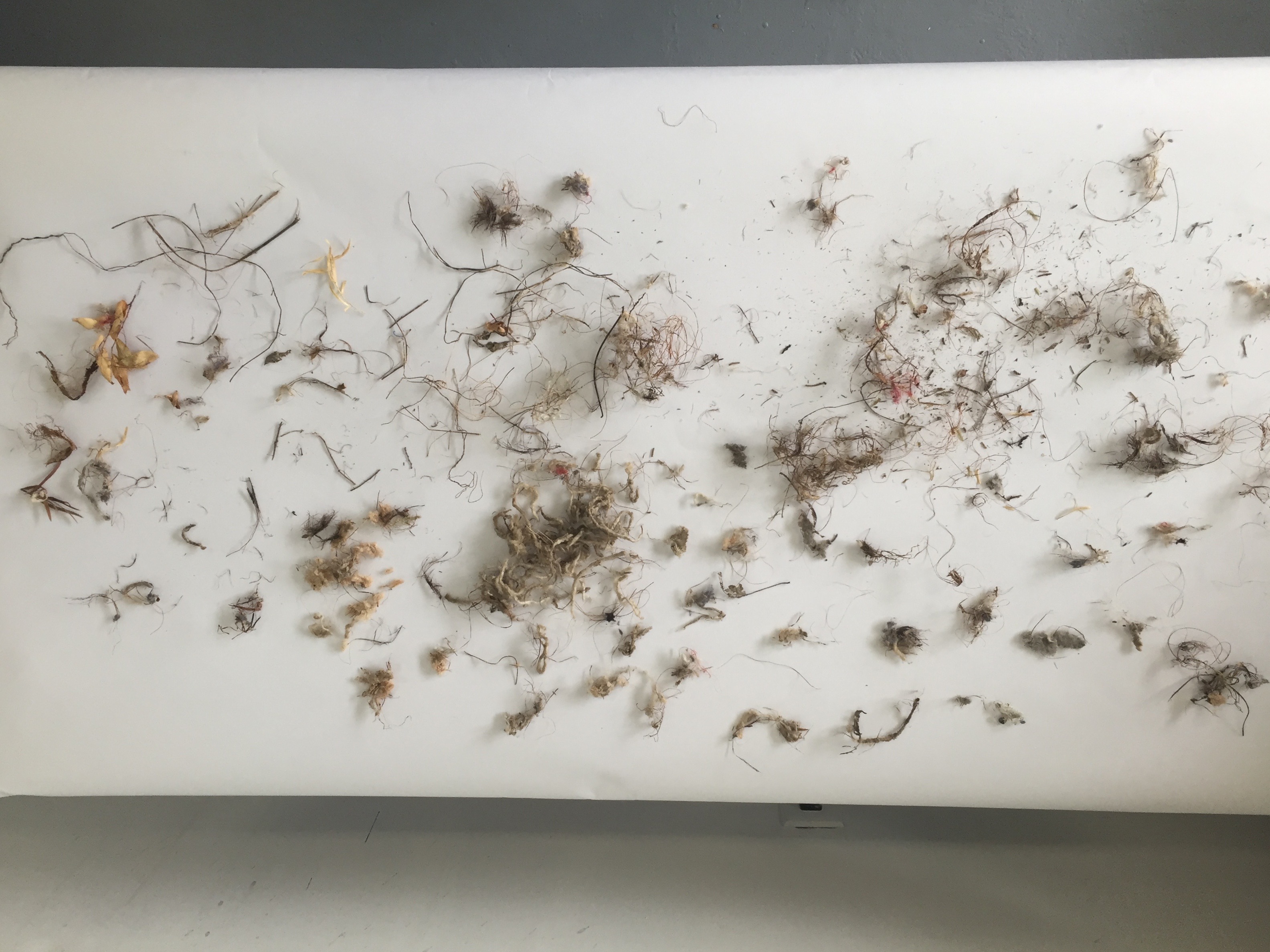
(A deconstructed bird nest for a new art project.)

When we turned the car west, the miles of snowy Sierra pines and stone pushed into greenly-wooded foothills and then into rolling brown scrub of the Pacific. Only a few birds can make a home in all three geographies, as most birds are specialists. As we flew along, something was being pulled from the middle of me, the fragmentation that occurs in the process of becoming not at home.

They would hold him there until I could arrive to say goodbye. Goodbye to who or what I am not sure, but we kept on driving because a monument was in the making.

This is what comes to mind right now as the fog is peeling back over my coastal mountains from which my plane is turning on the runway. East-bound, a one-way route.

John Berger says home is the vertical line between the gods and the buried dead. It’s one that can move along the horizontal of human mobility, but he admits some emigrations disconnect. Nomadic tribes know nothing of this. Home travels with them. Birds neither. They build the most tenuous nests for their most profound task.

I have written here before about needing to be at home in the state of unhousedness. When there is an ambiguous loss with nothing to bury, and no effable one to pray to. This of course means that there is so much glory here: laughter that stung my eyes, the epiphany of childbirth, improbable resonances with strangers, friends who are fixtures at every milestone, family there in an instant, and moments when the art came and made me disappear. Not to mention this light off the ocean. And it all is tied to this home.

I met a homelessness back in China several months before I knew of our move. It was there that I discovered something true that I still have no words for. And in this, I found myself lonely. In consolation, the thick bamboo forest offered me a dark and aching embrace, but there was nothing to hold on to. When will I learn that an attachment to loving moments quickly drains them. This resistance is the artist’s mischief and rebellion — to try to extend the present moment, to give presence, to still a nearing god.

That moment in China, as is happening on this plane, something fell undone into her pond with the splash of a thousand fish about to be dinner. She built a life story inside ten kilometers of that pond, and I was from ten thousand kilometers away. The epiphany of scaffolding, smothering beliefs, and cloying security falling away. And resulted in the terror of a new vulnerability and uncertainty. A deepening of the divine recognition of fragility.

I am making this goodbye a self-indulgent monument, lovingly constructed of the small numbers of my childhood address held by the eucalyptus and coastal sage in the evening breeze yesterday. Also the threshold of every door and every word through which I greeted you and you greeted me, in the company of language-less ghosts who don’t seem to age. It leads one to draft absurd postmortem directions for the body, a future tense when I am no longer present, long after the goodbye. Here also are the wounds of possibility.

IMG_3611.jpg

(Detail from my painting of cremated hummingbird, 2009)

“Inhabit vulnerability as a generous citizen of loss.” David Whyte.

“Only when we learn to transcend our earth-bound selves in love, learn to take ourselves not too seriously, do we begin to truly live.” — Karsten Harries

“Already the knowing animals are aware that we are not really at home in our interpreted world.” Rilke

30 Saturday Apr 2016

Posted by summermlee in Aesthetic philosophy, Art, Birds, Nature, Uncategorized

≈ 3 Comments

Tags

art, China, death, immigration, nature, Rilke, Summer Mei Ling Lee

IMG_1118

In the thicket of wild and obscure feelings, I want to have faith in the art of incantation.  Because I can’t but darken and over-organize the more luminous and playful energies in the inward privacy of a mind, I had stopped for so long.

But now there is so much uncertainty to invite me here.

The first impulse is to eulogize the land. To grieve the coastal mountains where I have lived all my life, now overlooking a sea-change, with only hazy constellations to navigate by.

Then the birds of my neighborhood, who will feed them now? Who will notice when Fox Sparrow arrives in the fall and leaves in the spring? Who will extoll how perilous and brave he is?

And then there are all my life-long loved ones…. And the ones who love my sons. The ones like me who don’t migrate and never have.

A few weeks ago, I was deep in the grand-mother land, under the green mountains jutting up like crowded tombstones in the fog of familiarly foreign languages. On one clear day I asked her about the lightening and thunder, and she said no, they are bombing the mountains to make way for roads.

I watched the locals prepare for Ching Ming, as I headed home. How it is that the snap of fireworks can cleanse the space of the afterlife. And yet the ways we keep the never-aging dead here with us. Along a new freeway — more of a battlefield than a road — I passed one ancient mountain where erosion had stripped the earth except for one gravestone. The simple tomb seemingly held up the core of stone and dirt and history. And the other unworldly mountains looked on and agreed. We had floated through those sentinels of ancient ink paintings on bamboo rafts. Our handsome raft-man says his family goes back 1500 years to that village, where now he can no longer survive on our one fare. So we helped him carry the raft upstream, and he let me miserably try to pole us as he so elegantly could. But I kept driving us into the riverbank where a lone woman kneeled among the rows of radishes over several lifetimes.

And they would apologize for being simple peasants, their words. And I begged them to know we dream their life. Except I know ours somehow has a deeper horizon — however unchartered, un-ventured and never satisfied. And our pastime of theorizing choices and opportunities when their doors open to another dark courtyard where the chickens scratch. But I sat by her fire and heard the pond language of traveling spring water and ate the fish they just took from there. All while the crickets and stranger frogs hummed oddities. I could place her here in my mind, like how one copes with an untouchable lover on a far-off continent. There I felt a new loneliness that lurked behind me in the bamboo forest, like a luxurious hotel room with no one to share the ache. And it has followed me home.

Because in the same day, I was driving down the street of my childhood home, firmly in an Americana that is iconic and unoriginal and unmoving. The same home that bore an insulated, however splintered child that never moved 30 miles from her birthplace. I arrived on that self-same street not by miracle of imagination but by dint of modernity and privilege and luck and post-human transportation and time changes. There are no words to describe that kind of return.

I cannot also romanticize that grand-mother-land — she is my fleeting sight of the glowing pheasant bird heralded in those ink paintings, digging through garbage behind the hastily-restored Great Wall.

Here is my love of grassy and vegetal air rising off the coastal scrub above the rough surf. The cliffs off which people much braver than I, with only fabric and string faith, jump into those circling updrafts. Here also are the voices of people droning on about sniveling inannities. Trying to escape from their own aching hotel rooms of life, like me.

Her migration was epic like Fox Sparrow’s. Not like ours to a new state. Maybe it is her cells flowing through me, carrying the trauma of torn roots that makes me feel otherwise. She came from so far to be buried here, now part of my mountain over this ocean, not one of those over his river. And I don’t want to go. God please don’t make me go. And I will go. I know and forget that all these minor heartbreaks are good practice for the final one, whichever mountain it will be.

IMG_0954

(That fish.)

“Ah, not to be cut off, not through the slightest partition shut out from the law of the stars. The inner — what is it? if not the intensified sky, hurled through with birds and deep with the winds of homecoming.” — Rilke

02 Sunday Nov 2014

Posted by summermlee in Uncategorized

≈ 5 Comments

The wistful sigh-song of the Golden Crowned sparrow in my twilight yard means it is mid-autumn, and they have returned. They usually bring a lift to my heart, otherwise sinking at the thought of another summer gone. The sounds of an inward ritual for the intuitive mourning of the fading daylight. But many haven’t returned to the feeder yet, I suspect because the neighbor’s fat, black cat, named Tater Tot by my son, hovers around their tree. The owner has stopped loving Tater Tot in the ways cats demand, so he saunters from his home to perch on our side of the street where our other neighbor feeds him, and where he apparently receives the necessary recognition, even if it is me yelling profanity at him.

Tai told me that tragedy was born when the individual came to be, when one voice was singled out from the chorus. And tragedy has a way of reminding us we are just a small particulate in a sea of uncontrollable tides. How we are both parts and the whole comprising the endless ocean of being.

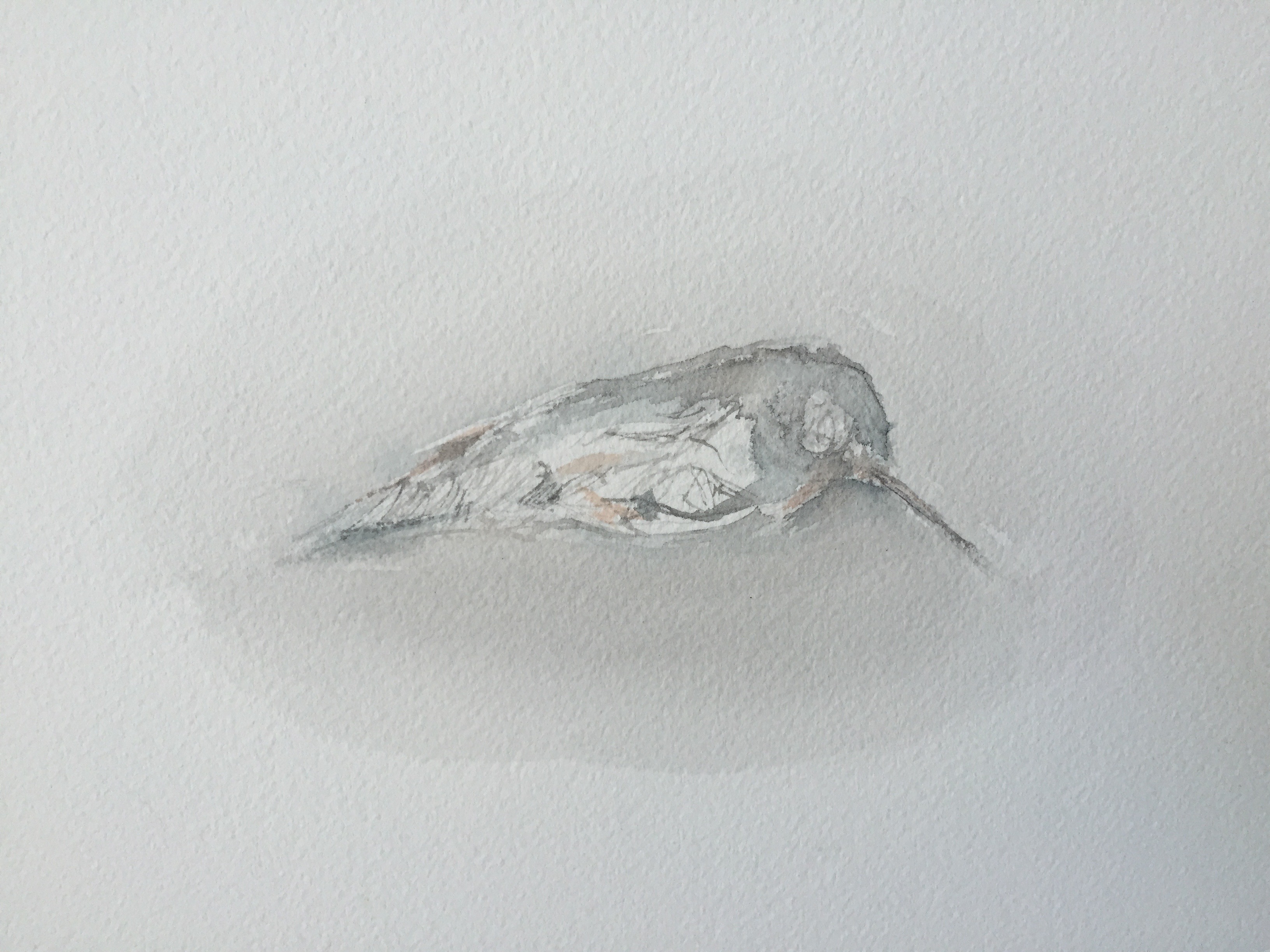
Watercolor by Summer Lee, 2014

(Detail of watercolor on paper, by Summer Lee, 2014)

By the undertow of that uncontrollable sea of humanity, I did not receive many belongings of my grandmother’s upon her death. Strangely though, I later discovered a journalist’s notepad, with pages upon pages of obsessive, penciled cursive. It was the travelogue of my grandfather when they joined a small church tour to China in the 1960’s to donate money to some organization. It becomes clear within a page or so that he would go to his notebook not only to document the logistics of their travel (poorly) but mostly to complain in a way that one does to self-congeal. He was born in the U.S. My grandmother had come here as a young girl. His writing is annoying in his superiority, as well as his utter lack of mention of my grandmother.

The only writing he grants her, though, is cinematic in my mind. In the Forbidden City, he observes quite tersely, almost with disdain, when my grandmother sees an impoverished mother and child and quietly leaves some money nearby for them, as she knows begging is illegal. What it was that echoed in my grandmother’s heart at that moment, I can only imagine.

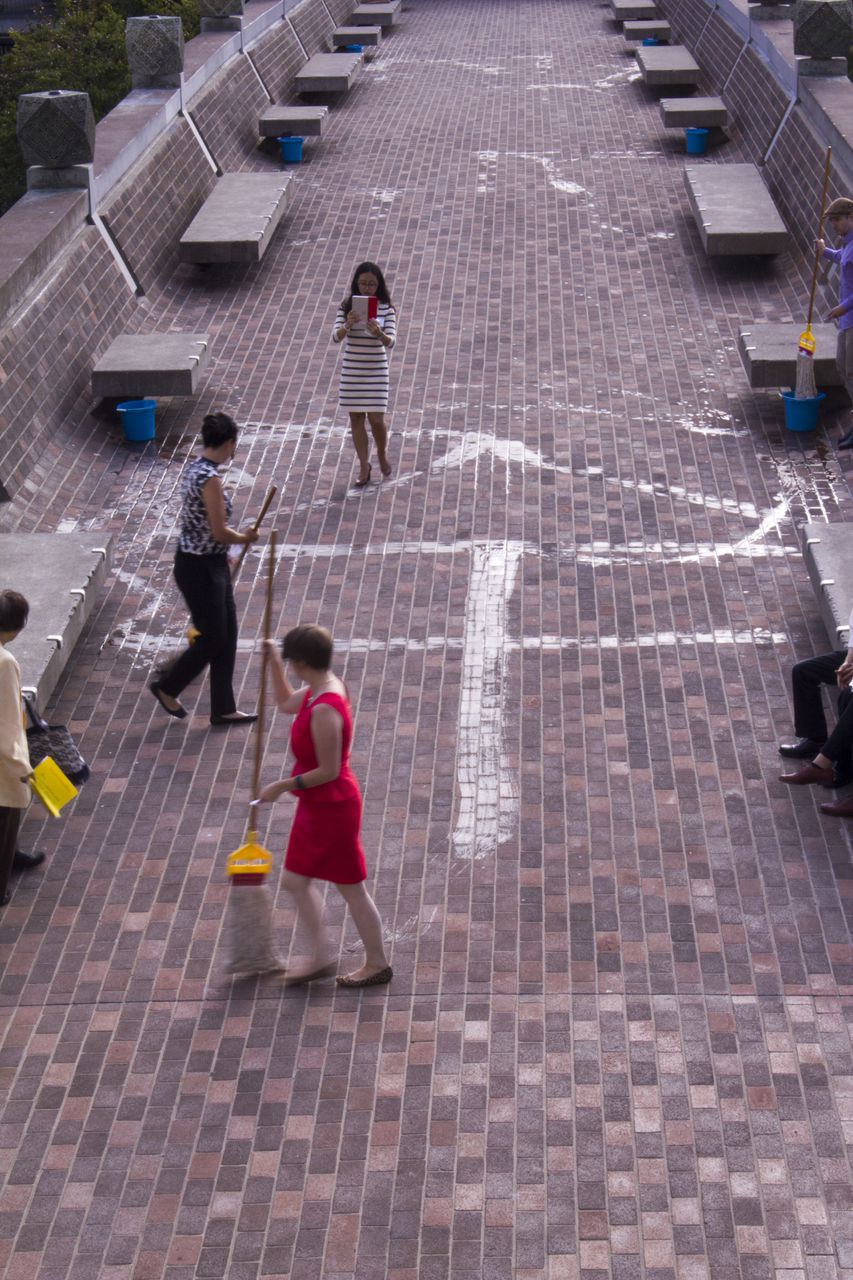
Performance with Karen Ficke and Adam Hathaway, 2014

(Art performance with Karen Ficke and Adam Hathaway, 2014. Writing my grandmother’s Chinese birthname with mops and water, on the bridge connecting Chinatown and the Chinese Culture Center. My grandfather was a janitor before going to school.)

At 12 years old, like many others, my grandmother had crossed our ocean. On her way, she spent time in Guangzhou, which has since then grown by 10 million people. As we pave over our luminous ruins, what darkens, what do we forget?

But he reminds me: tragedy does make us remember who we are. Tragedy is our homecoming to being. And so is art.

As I cross over what was once the endless horizon, over our oceans, to the place that was so tragic for my grandmother (why else leave one’s home) — I wonder what homecoming, hurled through with strange birds, she left there to find me. If what has been silenced can still echo in my own heart.

“Greek tragedy honors human freedom in that it allows its heroes to struggle against the superior, the exceeding power of destiny. … But man’s defeat crystallizes his freedom, the lucid compulsion to act, to act poetically, which determines the substance of the self.” George Steiner, Antigones

Breastmilk, by Summer Lee, 2014(

My China Breastmilk Fund, 2014. Pumped milk to feed my baby while I am gone.)

← Older posts
Newer posts →

Enter your email address to subscribe to this blog and receive notifications of new posts by email.

Join 619 other subscribers

Recent Posts

  • “Experimenters in the passages between worlds.” Vinciane Despret, Au Bonheur des Morts
  • “The terrifying groundlessness, the eradication of all violences. To be embraced by that which doesn’t know us and in that unknowing caresses us and truly loves us. We might become anything at all, something wildly other than what we are encountered by. A world that truly loves us by not presuming what we want or what shape we will take before we show up… We will be held when we are not known from the start.” — Dr. Marquis Bey
  • Images dream within us, a reverie is a world of expansion.
  • “For the natural world, the ethical responsibility is that being alive gives existence to others.” Vinciane Despret
  • “We meet in the freedoms of each other.” – Takeyoshi Nishiuchi

Archived Posts

Blog at WordPress.com.

  • Subscribe Subscribed
    • Unwanted Advice: Reflections from a Self-Appointed Life Counselor
    • Join 215 other subscribers
    • Already have a WordPress.com account? Log in now.
    • Unwanted Advice: Reflections from a Self-Appointed Life Counselor
    • Subscribe Subscribed
    • Sign up
    • Log in
    • Report this content
    • View site in Reader
    • Manage subscriptions
    • Collapse this bar
Loading Comments...