• About

Unwanted Advice: Reflections from a Self-Appointed Life Counselor

~ Caminante, no hay camino. Se hace camino al andar. Wayfarer, there is no way. You make a way as you go. (Antonio Machado)

Unwanted Advice: Reflections from a Self-Appointed Life Counselor

Category Archives: Birds

Aside

To discover one’s own absence is to discover one’s immortality…

20 Saturday Jul 2013

Posted by summermlee in Aesthetic philosophy, Art, Birds, Nature, philosophy, poetry, Uncategorized

≈ Leave a comment

Tags

Agnes Martin, art, birds, George Steiner, mystery, nature, poetry, San Pedro Valley

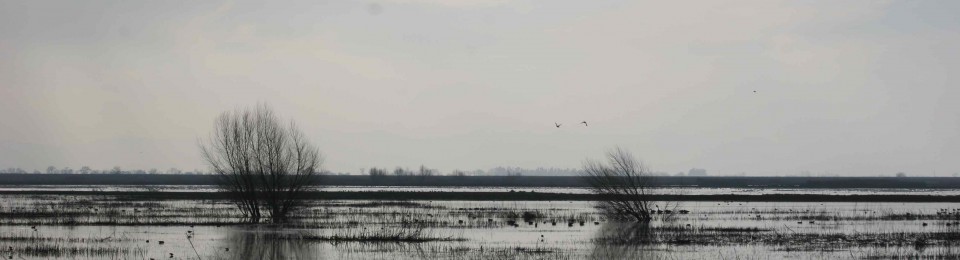
Another entry for my new project: Here is Where We Meet. http://thebirdsofsanpedrovalley.wordpress.com/2013/07/20/to-discover-ones-own-absence-is-to-discover-ones-immortality/ Photo, by Summer Lee

“Here is Where We Meet.” — John Berger

11 Thursday Jul 2013

Posted by summermlee in Art, Birds, Nature, philosophy, Uncategorized

≈ 1 Comment

Tags

art, birds, John Berger, nature, philosophy

I’ve started a new project, an off-shoot of this one. I thought it deserved its own place — since it is about my relationship to a meaningful place.

http://thebirdsofsanpedrovalley.wordpress.com/

Photo, by Summer Lee

“When a fox is fifty, it can take the form of a woman. When it is one hundred, it can take the form of a beautiful girl. When it is a thousand, it can speak to Heaven and will never die.” — Larissa Lai

08 Wednesday May 2013

Posted by summermlee in Art, Birds, Nature, philosophy, poetry

≈ 8 Comments

Tags

Adrienne Rich, art, artist's block, birds, Heidegger, Larissa Lai, May Sarton, poetry, The Fact of a Doorframe, When Fox is A Thousand

They left me last week, as was bound to happen.

But back in time, societies marked the first day of spring by the arrival of swallows, the same birds you might see outside your window right now. They cut through the air with imperceptible wing beats, more like the bugs they chase than bird-like. They sweep faster than my camera can focus, weaving invisible flight paths like loose braids in the ways my own memories criss-cross and become farther from truth, but in a way closer to me. And similar to memory, it’s as if one random clear day, they appear out of no where, just as likely as emergent from the ground underneath our feet than arriving from distant lands.

 IMG_1761 II

The same people believed that a fox could also be an immortal woman who prowls the night.

“When a fox is fifty, it can take the form of a woman. When it is one hundred, it can take the form of a beautiful girl. When it is a thousand, it can speak to Heaven and will never die.”

Our dear neighbor, Chuck (there is no better neighbor for warm mailbox conversation and handyman referrals and trinket-gifts to our scavenger son) has just spotted a fox traipsing along our backyards. Back there, the ceanothus is putting out snowballs of periwinkle blue, its branches forming undulating waves under which birds and snakes alike find refuge. And now this fox. I wonder what she wants to tell me.

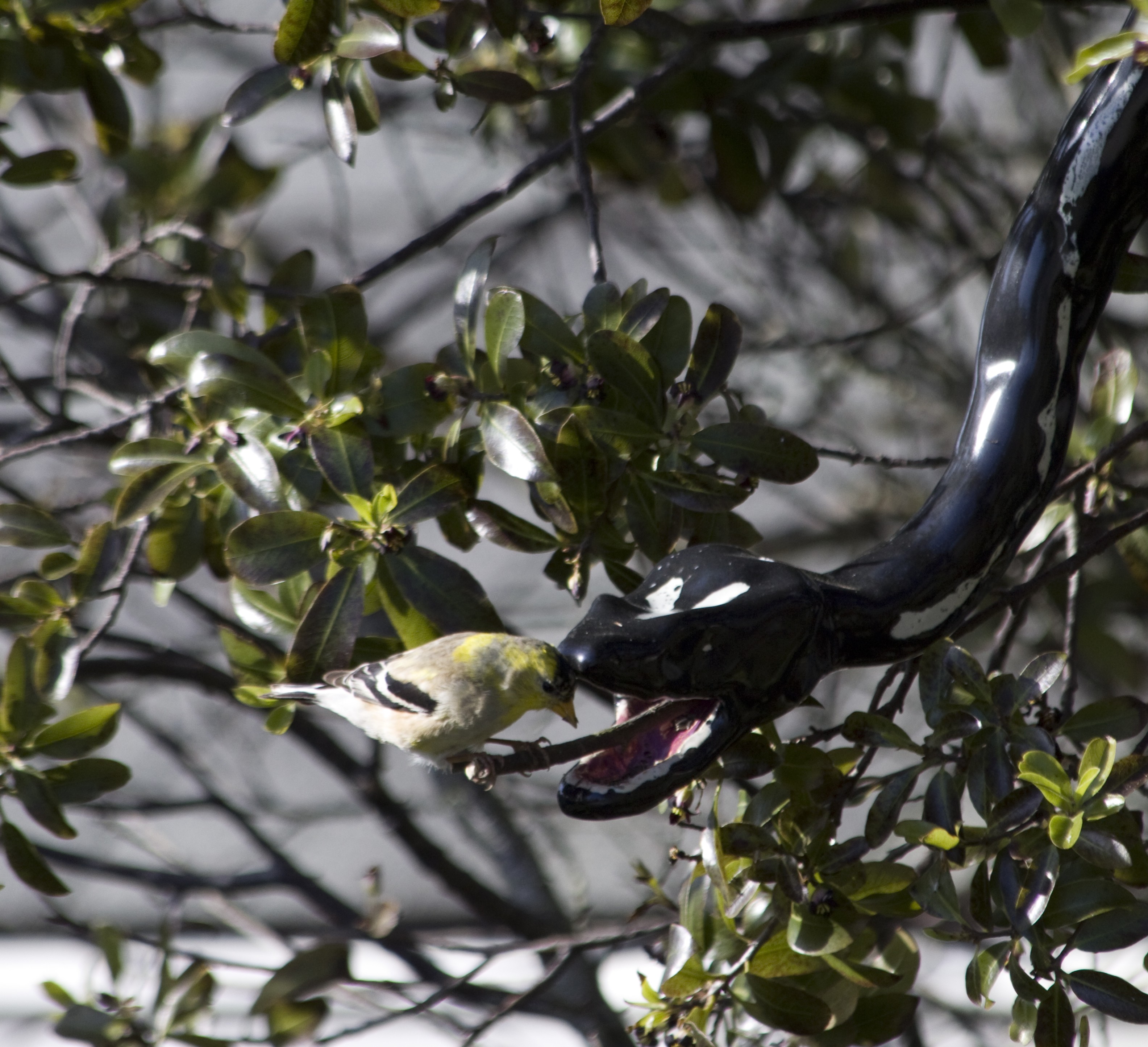
Ceramic birdfeeder and goldfinch from my frontyard, 2008

(Ceramic snake birdfeeder, by Summer Lee, 2008)

May Sarton has been speaking to me through her journals. She tells me to make an art of solitude, of which I have a lethal deprivation these days. Solitude is not for everyone, she seems to say through her doldrums and delights. You can get stuck with yourself there and self-berate endlessly. But beyond that, there is an expanse that wants to be explored with ink, words, light. Silence.

Heidegger says getting to that place begins with willing not to will. By intending not to intend — which for us humans, hungry for connection and to be special, anxious for security and accomplishment, is pretty fucking hard. And only after that little unlikely step, can an awakening to an inner releasement occur. A lettingness. Gelassenheit, he called it, borrowing from ancient, mystical German text. In turn, through Gelassenheit, we are let in. The most mundane glint of light through a swath of paint on a centuries-old, unknown painting brings me to my knees. Or the tiny yellow feathers of a pine siskin is a sign of god. Or, on the other hand, nothing happens. Like Adrienne Rich’s fact of a doorframe: we may go through, but it makes no promises.

And for good reason, since that mystery is the foundation of being. But I forget. Or as Heidegger says, I fall asleep thinking I am most awake. And during my restless slumber these clear spring nights, the fox wanders through the moon-glazed fields of my backyard, hoping I glimpse her and remember before she changes form again.

So, despite my circulation-squashing chokehold on all trivial things right now — whether to have another child, how to produce an acceptable art piece, how to be a good parent and partner, how to protect wildlife and destroy the gun lobby, how even to slow down bastard time as it mocks my appearance, my memory, my ability to get anything done — I accept that those tiny pine siskins have left my feeder and have gone north for several years, if they return at all. They are faithful to a rhythm older than time immemorial. Not to me. And I’m so grateful.

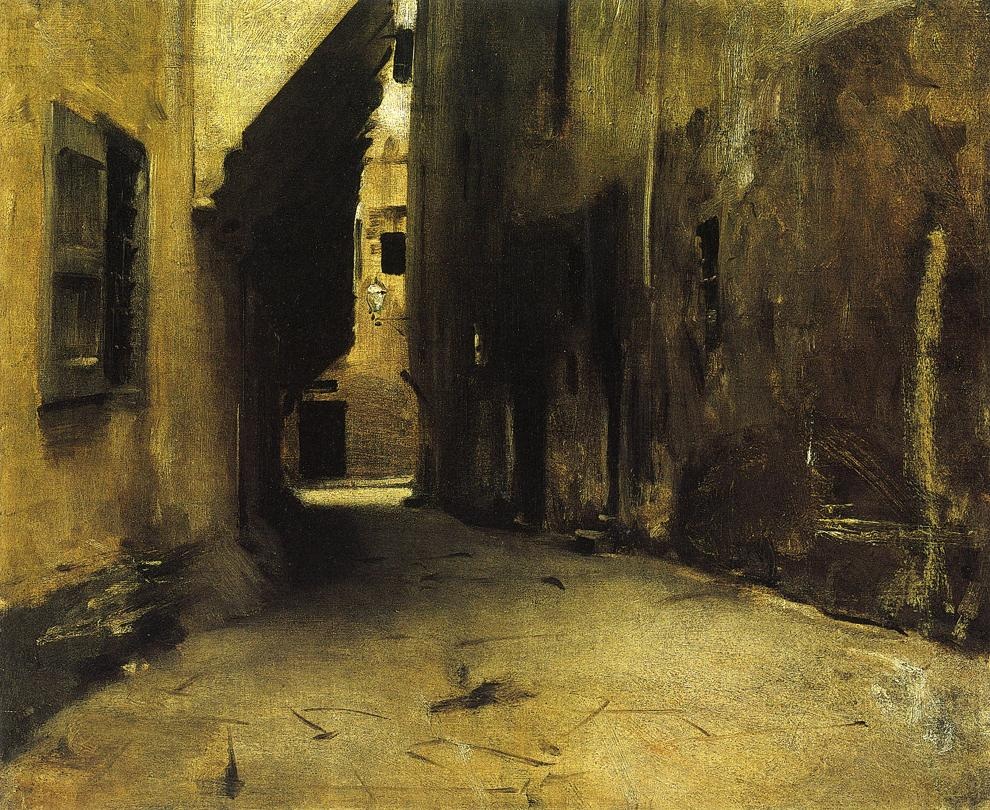
By John Singer Sargent

(Painting by John Singer Sargent)

“The shadow is a tight passage, a narrow door, whose painful constriction no one is spared who goes down to the deep well… For what comes after the door is surprisingly enough, a boundless expanse full of unprecedented uncertainty, with apparently no inside and no outside, no above and no below, no here and no there, no mine and no thine, no good and no bad… Where I am indivisible this and that; where I experience the other in myself and the other-than-myself experiences me.” — Mary Sarton, quoting Carl Jung.

“One can never pretend to comprehend completely –: that would disrespect in the face of the Unknown that inhabits — or comes to inhabit — the poet; that would be to forget that poetry is something that breathes; that poetry breathes you in.” Paul Celan to René Char

21 Sunday Apr 2013

Posted by summermlee in Aesthetic philosophy, Art, Birds, Nature, philosophy, poetry, Uncategorized

≈ 7 Comments

Tags

art, death, Leigh Hyams, painting, Paul Celan, poetry, San Miguel de Allende, Stephane Mallarme, teachers

Since I was the youngest by 3 or 4 decades, my traveling companions were relieved it was me who, drained from travel and the stifling heat (and a sip of the local margarita), interrupted pleasantries to declare that I might pass out. Our host for the week escorted me to the warm cement sidewalk of a dirt street outside the humble restaurant and waited until the cool breeze of the desert night revived me. She asked me polite questions, mostly trying to ease my embarrassment, but also to indirectly resolve how it is that at not even 30 years old, I had become close friends and travel companions with a cadre of women in their 60’s.

The babel of barking dogs woke me the next morning, which was after the night of dreaming she came to hold me. Somehow, the dark sensuality of this woman a half-century older did not alarm me.

In the morning painting session, I start with images and colors I have known before, but they don’t cooperate. As I paint canvases full of utterly conventional crap, I find myself at the edge of tears. There in the shade of her turquoise and pink adobe courtyard, tendrils of bougainvillea cling to the walls closing in on me, mocking my vulnerability and failure — like the stuffing has fallen out of my bra and the world sees me trying to put it back.

She sees the paintings and since I cannot dare the gracelessness needed to throw them over the fence,  I wish for once they could tell a lie. She moves like a dancer around them and critiques them with the fists of a boxer. I am politely mute, in turn, hating my own politeness. I want to hate her but she is just the conduit.

Painting. By Leigh Hyams(Painting by Leigh Hyams)

Plus, San Miguel de Allende overwhelms my sensitivity. I know why the dogs bark. All of them trying to simplify and drown out the brightly jarring colors, the incessant music from blocks away, the dead heat, the spirit voices, the craving for something other. The unreachable ocean.

The next night I dream that my neighbor’s contractor tears out my yard. All my cherished plants are missing, upturned soil exposes eviscerated roots. I experience an abyss where there once had been logic and rationality. Before hitting bottom, I wake to the pre-dawn storm of bird songs.

My dream is clear to her. She tells me in deep tones and direct terms that this unknown is the place where I want to be. Because of this and the buzz in her words, I start crying as she speaks, releasing all the tears that started bubbling in the courtyard. Tears that were neatly packaged screams against my mediocrity, my mundane banality, my safety. Tears that were cages holding a fearful but overgrown child wanting out into the wilderness. My painter friends look on tenderly, thinking it is because I’m sad. But I am beyond sad or happy, I am approaching otherness.

They think she is only speaking to me.

She says, this crying business, as if to be disdainful and compassionate at the same time, is something that only artists can understand.

I would return years later for an extended time considering the small city, my being in the midst of fertility treatment, and the lack of communication to my home from this gritty, foreign country. I was prisoner again to my own painting in her light-drenched studio, but she was a gentle and stern warden. We had many conversations here and there, aside a parade of indigenous costume-wearing tribes, over breakfasts in teeming gardens, after a dip in the local mineral springs, and hopping along the cobblestones incongruently filling the roads.

Sensing her increased frailty and watching her meticulous devotion to a series of sparsely charcoaled paintings of local ruins — to me obvious elegies to past magnanimous accomplishment — I asked if she was questioning her mortality. She, sitting in the improbably verdant backdrop of a sumptuous, water-filled courtyard garden gleaming in desert light and singing heat, answered with a smile, and maybe a slight disingenuousness: not anymore than I always have.
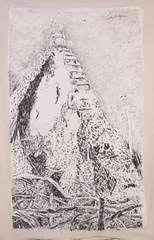
Painting by Leigh Hyams
(Painting by Leigh Hyams)

Some mornings new art books would appear at my breakfast table, always with unspoken pertinence. I loaned her my copy of Mary Oliver’s recent Evidence — a book of searching poems comprised of terse words around what cannot be buried, even spoken, after a loss, or death.

So I can imagine exactly how it was when she died a few weeks ago. Her bed is overlooking her wildly tended garden. She is arms-distance to her favorite art pieces ranging from profoundly poetic to those with playful certainty, and those, maybe her favorite, continually in serious questioning. I can see the washed out colors of early Mexican spring, feel the light-headed air of the high altitude aggressively dancing with the dust lifted and levitating in her richly alive, medieval Latin city. And I hear a liturgy from the birds of her neighborhood, of course, taking over the tinny brass horns droning from distant radios. The birds alone can accept that someone who loved life so much should have to leave it.  As a consolation, when dawn breaks leaving an emptiness for the rest of us, they send jewels of ephemeral birdsong down to earth to adorn her.

“Toute chose sacrée et qui veut demeurer sacrée s’enveloppe de mystère.” Stephane Mallarmé
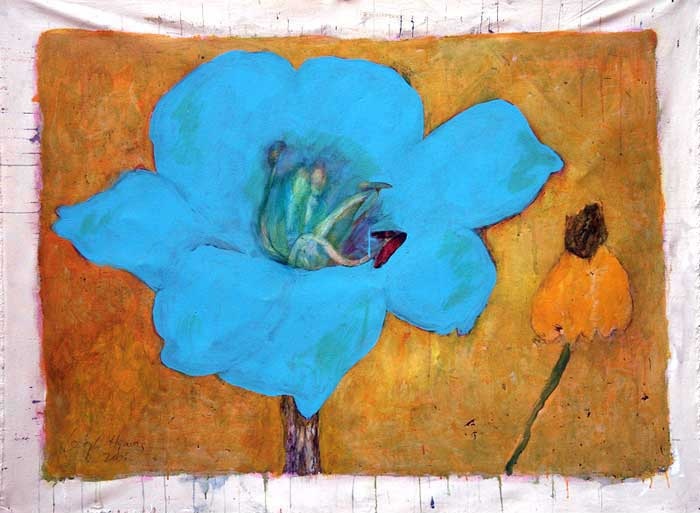
Painting, by Leigh Hyams

(Painting by Leigh Hyams)

“You’ll see how much your little bird has changed.” — Edith Piaf

03 Sunday Feb 2013

Posted by summermlee in Aesthetic philosophy, Art, Birds, music, philosophy, poetry

≈ 9 Comments

Tags

art, Edith Piaf, French, high school, Jacques Prevert, memoir, philosophy, teachers, Virginia Woolf

Not much taller than the desks, she stood unblinking in front of the students, hopping and gesticulating wildly to convey her lesson to her jaded audience. In this of her many dramatic monologues with occasional spittle, she introduced a new topic, rudiment to understanding French, and maybe even life: existentialism.

We thoroughly read Camus, en français, and over time she espoused to her sheltered and callow high school students that every choice one makes has a consequence, and the absurd man is one who acts out of habit, shirking responsibility and awareness for the events and choices that come to comprise one’s life. We listened to Edith Piaf, learning her lyrics by heart. Having heard no other voice so utterly pained, wretched even, but strong and moving, I was taken. She grabbed me at the end of class after the rest of the students had drained out of the room, and for whatever reason, recounted that during her first teaching job at an elementary school, an air force officer entered her classroom and in front of her 25 students, handed her an envelope. In it was a piece of paper describing in the most coldly succinct language that her husband’s plane had crashed on a training flight nearby and he was deceased. There also in the envelope was his metal wristwatch, the only personal item with him and recovered from the crash, cracked with hands frozen at the exact moment of his death. With a teacher’s salary and two young children, she said Edith Piaf’s tragic life and inextricably-linked music became anthem to the fact she had no other choice to move on.

Her philosophy must have been a double-edged sword for the ESL students also under her care at the high school — the dregs, the few brown and black kids bussed into an otherwise privileged school of white kids dropped off by luxury cars. But there was no less, if not more, passion for these kids as there was for her sniveling French students. When her Edith Piaf admirer became Senior Class President, she arranged a secret meeting, knowing my duties as student organizer of the school prom. She said she had a young couple in her ESL class who wanted to go to the prom but could not pay the price of ticket, exorbitant even for today’s standards. She wanted to broker an arrangement for them, and they must never know. Loyal to her, I offered to comp them in, no one would notice in the shabby accounting. Slightly offended, she interjected to say the boyfriend had agreed to work the coat check before and after the dance to earn his way. I added their names to the paid list and other than her catching my eye at the entryway of the dance hall while she stood next to her couple, there was no word of it after.

She also introduced us to a book of poetry by Jacques Prevert, someone also familiar with war and loss. She had to have known I never returned my copy back to the school repository, and from time to time I still find a guilty joy in reading a poem or two from it — a treasured contraband. It was, of course, easy to tell her I was coming out as gay. She might have even said she had some gay friends or a gay son, I don’t remember. But after that, she took to meeting me at the town’s bookstore cafe, and we sat together as an unlikely duo of a middle-aged, manically energetic, short woman, and a gangly, wide-eyed, attentive girl — my hair getting shorter by the week as my shoes grew more militant. I don’t remember much of what we talked about, but I can smell the bitter coffee-filled air, and see the tome of pages from Antigone she xeroxed in French (another petty crime) and brought me to read over the summer. It was also there that she asked me to be President of the school French Club. I had no duties except to bring a piece of brie to the school club fair, where she also hosted an escargot-eating contest, and in turn it was something to add to my padded Stanford-bound resume. When our senior yearbook came out weeks before the end of school, she curiously asked to hold mine for a day or so. When she returned it to me, there adhered strongly to the inside the front page was an engraved, stately metal plaque. It read my name, the title of French Club President, and underneath, “Honni soit, qui mal y pense.” An ancient motto of chivalry, it means something to the effect of, evil to those who think evil, or shame to those who think shame of it.

The last week of school, she made me promise that I would let her be the last teacher I would say goodbye to. So, after gathering my things and finishing some tearful thank you’s to a few of my other teachers, I found her waiting for me in her classroom. As we walked down the hallway to one of the school’s exits out to the parking lot, she explained to me that there at the doorway was a threshold and it was marked by a strip of metal. She said that it was a milestone, a marker, this line. She would go on the other side and she was going to watch me cross. So I did: I unceremoniously stepped over the line, tears welling in my eyes, and there on the outside of the school she jumped to hug me. As she grasped me in her embrace she whispered in my ear, though it seemed louder and permanent: You have crossed the line and you must go, and I want you to remember, she clenched more tightly, you can’t go back.

Ladder, by Summer Lee
(An image from an art performance I did with Jesse Schmidt, 2008)

“I wish that once & for all I could put down in this wretched handwriting how this country impresses me — how great I feel the stony-hard flatness & monotony of the plain. Every time I write in this book I find myself drifting into the attractive but impossible task of describing the Fens — till I grow heartily sick of so much feeble word painting; & long for one expressive quotation that should signify in its solitary compass all the glories of earth air & Heaven. Nevertheless I own it is a joy to me to be set down with such a vast never ending picture to reproduce — reproduction is out of the question — but to gaze at, nibble at & scratch at.

After all we are a world of imitations; all the Arts that is to say imitate as far as they can the one great truth that all can see. Such is the eternal instinct in the human beast, to try & reproduce something of that majesty in paint marble or ink. Somehow ink tonight seems to me the least effectual method of all — & music the nearest to truth.” –Virginia Woolf

“Poets became the true accountants, and their ledgers contained the un-profitability of the human soul.” Michael Marsh

31 Monday Dec 2012

Posted by summermlee in Art, Birds, Nature, philosophy, poetry

≈ 2 Comments

Tags

"Anyone can sing", bird watching, birds, birdwatching, Michael March, poetry, Thoreau, Walden, William Ayot, writing

“…the fine print, the small type, of a meadow mouse.” — Thoreau

Behind my eyes is a geometric pattern, the dark blue lines zig zagging and dotting in that 1970’s way around white, repeated ad infinitum on the wall of my grandmother’s breakfast nook I haven’t been in for almost 15 years. It’s there when I rub my eyes in fatigue, who knows why.

On the other side of my eyes, you might see fibers of dark grey, green and ochre around a black circle.

But around the black center of a white-crowned sparrow’s eye is a dark mahogany-red. Inside the abyss of his eye, I can only imagine he is terrified as his heart races in my hand, little short breaths heaving his feathery chest. With the most delicate of touch, I run my finger up and down his body and make promises I can’t keep, still horrified by the thump of his body against the car window. His eyes blink fear and innocence straight into my eyes, but he has no control of his body, which has collapsed belly-up into my palm.

Minutes later, I declare it a minor miracle that he hops out of my makeshift hospital box and is gone. The next day he is returned to the glorious flock of 50 birds working over my now-expensive winter feeder.

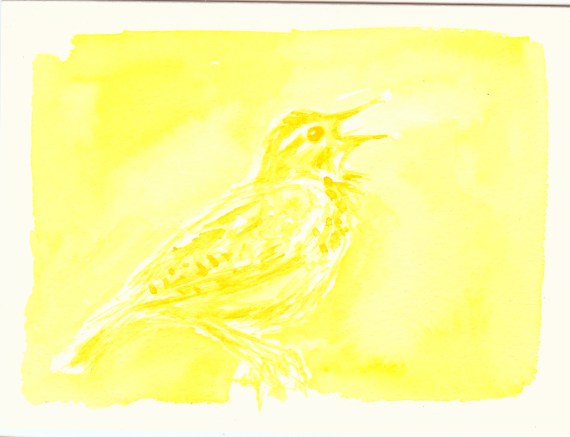
Meadowlark by Summer Lee, 2012. watercolor on paper

(A recent watercolor: Yellow happens to be the precise spot where the eye tunes into the sequence of color frequency — it has the same vibration that stimulates the retinal nerve-ends and causes the phenomenon we call light)

Obviously, these birds are my favorite words, my favorite swath of paint — and I am ever envious of those musicians who have such mastery over the wild flocks of notes and melodies, every single beat tamed at the same moment they are also alate.

— and yet, among the most rigorous creators, there is a holy acknowledgment of the not-coincidentally aleatoric. Who knows to where those wings will fly.

After 8 years of minding this winter feeder, I know every resident from migrant as I welcome new offspring and pray for the missing. They are a light, a moment of solitude along my bustling path in and out of my home in this dark time of year. Their hearty feeding is proof of a cold darkness stretching longer than what daylight allows for warmth and food. And maybe my dedication to their feeder is an understanding of these fickle and insufferable days.

Anyone can sing, but there is astonishment that the wonder of words still visits me, like the small group of diminutive, navy-blue and chestnut nuthatches, who for some reason are eagerly taking my sunflower seeds for the first time this winter. They dive into the top of the bare tree, then climb with their powerful claws head-down along the branches like woodpeckers, whom they are always adjacent to in field guides. At the feeder, they grab a singular seed into the tips of their needle-tipped beaks and with a few nasally yank-calls, fly out of sight along a bobbing flight path, into the mysterious.

The next day my son playfully repeats, “dammit” as I scurry out of the car to grieve the little brown body lying below the same car window next door. He also says I am going to eat this bird after watching me consider its life, its body, photograph it, then gently wrap it into the freezer — not an absurd conclusion on his part. I don’t tell him that this bird had not yet developed golden plumage along his crown, being this sparrow’s first winter. He was born last spring in a forever-unknown location on the western coast of Alaska and followed his flock over a thousand miles, maybe two, to our feeder. Probably just like his genetic ancestors have done since time immemorial. But even so, my son asks me if the bird cries. No, but the song says it all.

http://macaulaylibrary.org/audio/49913/play

The loving details of this bird life in my mind’s eye are already fading — I’m no master at this — but I can hear his song and his eyes have gone dark.

“…to face the possibility
that your innermost core may hold nothing at all,
and to sing from that – to fill the void
with every hurt, every harm, every hard-won joy
that staves off death yet honours its coming,
to sing both full and utterly empty,
alone and conjoined, exiled and at home,
to sing what people feel most keenly
yet never acknowledge until you sing it.
Anyone can sing. Yes. Anyone can sing.”

— William Ayot

Newer posts →

Enter your email address to subscribe to this blog and receive notifications of new posts by email.

Join 619 other subscribers

Recent Posts

  • “Experimenters in the passages between worlds.” Vinciane Despret, Au Bonheur des Morts
  • “The terrifying groundlessness, the eradication of all violences. To be embraced by that which doesn’t know us and in that unknowing caresses us and truly loves us. We might become anything at all, something wildly other than what we are encountered by. A world that truly loves us by not presuming what we want or what shape we will take before we show up… We will be held when we are not known from the start.” — Dr. Marquis Bey
  • Images dream within us, a reverie is a world of expansion.
  • “For the natural world, the ethical responsibility is that being alive gives existence to others.” Vinciane Despret
  • “We meet in the freedoms of each other.” – Takeyoshi Nishiuchi

Archived Posts

Blog at WordPress.com.

  • Subscribe Subscribed
    Unwanted Advice: Reflections from a Self-Appointed Life Counselor
    Join 215 other subscribers

    Have a WordPress.com account? Log in now.

  • Unwanted Advice: Reflections from a Self-Appointed Life Counselor
    View site in Reader
    Manage subscriptionsSign upLog in
    Report this content
    Collapse this bar
Loading Comments...