• About

Unwanted Advice: Reflections from a Self-Appointed Life Counselor

~ Caminante, no hay camino. Se hace camino al andar. Wayfarer, there is no way. You make a way as you go. (Antonio Machado)

Unwanted Advice: Reflections from a Self-Appointed Life Counselor

Category Archives: Art

“The grammars of creation are, in the final analysis, those of the erotic, of shaping intellect and psyche in a condition of Eros (the Logos, in the arms of love…).” George Steiner

15 Sunday Jul 2012

Posted by summermlee in Aesthetic philosophy, Art, Nature, philosophy, poetry

≈ 2 Comments

Tags

Anne Sexton, art, Clement Greenberg, creation, creativity, George Steiner, poetry, Professor Alice Bach, Tarkovsky, words

This entry wrote itself this morning on my jog, in the valley tucked away from the ocean shore. There in the chapparal valley are my kindred birds, families of quail fused together. One adult male is always vigilantly poised atop a signpost or garbage can, alertly standing guard over the small herd of fuzzy fledglings and their preoccupied surrogates pecking in the dry grass. I always regret that I must pass through them, causing them to scatter like field mice into the brambles that line the creek. The brambles where I know lurks a chubby, yet insatiated bobcat.

Despite being worn, I chose to heave myself up from the valley floor, along the switchbacks that ascend the side of a sun-lit mountain. Along the way, as predictable, I become anxious of whether I am able to reach the summit, that it is always longer and farther than I remembered. I try to recall that if I just attend to what is going on around me, go inward into my thoughts, even the burning in my legs, I will be less aware of the draining heaviness of the future tense.

Such is using any medium to create. A self-consciousness of one’s tools can turn them into the bars of a prison. We have developed bars around these lights of vulnerable creativity, sometimes so ornamental that others approve of them so much as to make us invest more and more in them. Yet the bars restrict and the air is stagnant therein, allowing only precarious involvement on the thin breath of things.

They amount to a gilded cage, polished to a mirror surface enclosing the songbird. This is the self-image of Narcissus, the trap of self-congealing. Even if it might provide both protection and adoration from the Crowd, the illusion of a subsistent self does not allow ephemeral song to take wing.

(Scene of the Bellmaker, from the film, Andrei Rublev, by Tarkovsky)

I sensed a predictable relief when I reached the top of the summit this morning, because yet again, I got to where I didn’t think I could go, and even more, I was yet surprised by the expansive view of the valley floor below extending to the sea. It occurred to me that there are summits that are exponentially harder to reach than my little hill of this blog, arriving upon its first birthday. How I curb my vulnerabilities and borrow from convention throughout is damning. And the more arduous and improbable to overcome this, the more solitary it might be to reach it — and the less likely anyone else can confirm it. Even the parasitic and invulnerable art critic Clement Greenberg said, “All profoundly original work looks ugly at first.” I have not the courage for this freedom to be ugly, nor the freedom to not be anything at all.

But it stands that I am grateful for my tribe of friends who stand guard over this endeavor, as it works its way through its awkwardness and conventional shortcomings.

I am profoundly in the arms of love.

(This poem was sent from Alice Bach, the first ever to stand guard over my writing)

Words, by Anne Sexton

Be careful of words, even the miraculous ones.

For the miraculous we do our best,

sometimes they swarm like insects

and leave not a sting but a kiss.

They can be as good as fingers.

They can be as trusty as the rock

you stick your bottom on.

But they can be both daisies and bruises.

Yet I am in love with words.

They are doves falling out of the ceiling.

They are six holy oranges sitting in my lap.

They are the trees, the legs of summer,

and the sun, its passionate face.

Yet often they fail me.

I have so much I want to say,

so many stories, images, proverbs, etc.

But the words aren’t good enough,

the wrong ones kiss me.

Sometimes I fly like an eagle

but with the wings of a wren.

But I try to take care

and be gentle to them.

Words and eggs must be handled with care.

Once broken they are impossible

things to repair.
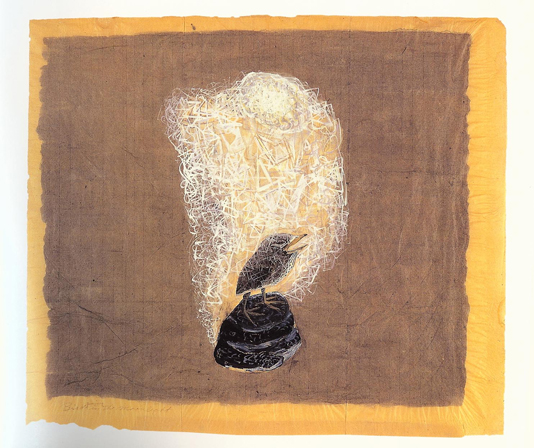
“All our heart’s courage is the echoing response to the first call of Being which gathers our thinking into the play of the world.” Heidegger

09 Monday Jul 2012

Posted by summermlee in Aesthetic philosophy, Art, Nature, philosophy, poetry

≈ 9 Comments

Tags

birds, Morris Graves, poetry, Saigyo, suffering, the moon, the muse

It is funny how the muse works. Even as I am distracted by the art-killing, mundane requirements of life, something persists to whisper to me. Thankfully. Even if those whispers are drowned out by the storm-like babel of Rilke’s crowd, they emerge almost imperceptibly like fragile threads of lace woven by frail hands into the dwindled still moments of my life. Little by little, something clearer and compelling forms itself together. Like a glimpse of Virginia Woolf’s pattern. And then I wonder regretfully what art could compose itself had I been able to listen more.

Tonight there is something about the moon. Except that it is so foggy here I cannot actually see it.

Last week at the shelter support group, we presented education on domestic violence to the women who are living there, escaping it. We try to instill a framework of what they experienced, perhaps so they can avoid it in the future, but also to reassure them that what they experienced was real, and that many, far too many, have experienced it also. As has become routine, we end this session with asking them what is a healthy relationship — a question most have not considered, nonetheless those who have wrangled with an almost lethally unhealthy one. But this evening, some of the women had definite ideas.

It came time to go around the group for their closing thoughts. One woman, the newest to the household, had been stone-silent the entire group. Just when I thought she would pass her turn, she began slowly to speak. She glared into my eyes and said that our discussion had been hard. It made her feel hurt, but also ignited an anger towards the person who had hurt her. She wanted vengeance even. She wondered how could someone begin to consider healthy relationships when they are mired in a bad one. To the point where it is no longer clear what is healthy and what is not. That we begin to become unhealthy too, starting to do abusive things ourselves because of what we experienced, over and over. How can we even hope for a good relationship, she asked, in a way that embarrassed me in the philosophically-flawed notion of future-tensed hope. She pleaded, but not in a way that warranted an answer, other than the tears welling all around the table. All I could do was put my hand on her arm and say that I was so happy she had responded.

That night driving home, the moon was so low and radiant in my horizon so as to be a guiding beacon for my car. And perhaps because I was tired and raw, the moon conjured something romantic, melancholy, poetic. At first I wanted to explore an annoying litany of philosopher ideas to articulate my connection to this strange, glowing disk hovering incredulously over the skyline. But what most came to mind, to the part of me that wants to translate these moments, is that simply, the creme-lit, distant landscape is a place I will never visit. Completely unreachable. Yet it persists in my darkening sky so predictably that civilizations could measure their time by it, more accurately than by the sun.

The next day, a friend wrote me an incredibly poetic email from her artist retreat in the countryside. It was correspondence tending to the heartening and savory details of nature available to only those who know true and enviable solitude. And of course it was full of Birdness. In it, she mentioned that I might like a talk that her Zen Buddhist teacher gave on suffering, as it is my relentless theme of late. As I listened to his illuminating talk, I received a hint sewn into the pattern. Her teacher read the poetry of the medieval poet, Saigyo — a poet almost obsessively concerned with the moon. A symbol of enlightenment, the beauty in the breath-taking and indescribable culmination of accepting the painfully ephemeral and suffering nature of being human. Always there, but practically unreachable.

Winter has withered

Everything in this mountain place:

Dignity is in

Its desolation now, and beauty

In the cold clarity of its moon.

This is what the muse left me this week. I know it’s not my job (nor am I able) to weave it so tightly together with meaning and language that it would suck the air out of the atmosphere and extinguish the moon one might see tonight, the moon throughout one’s entire life. But I am astonished that somehow a poet, from across the divide of 1,000 years and immeasurable distance, reaches to me through the chatter and knows intimately the miraculous moon that guided me home that withered night.

(Bird Singing in Moonlight, 1938, by Morris Graves)The rest of the poem is here:

http://ladynyo.wordpress.com/2012/04/12/mirror-for-the-moon-a-little-poetry-of-saigyo/

“When he walks out into the rising dawn or looks out into the event-filled evening and when he feels what is happening there, all situations drop from him as if from a dead man, though he stands in the midst of pure life.” Rilke

17 Sunday Jun 2012

Posted by summermlee in Aesthetic philosophy, Art, philosophy

≈ 3 Comments

Tags

Araya Rasdjarmrearnsook, art, death, Father's Day, Heidegger, phantoms of Asia, Rilke

Rilke says it best that without solitude, the meditative place for the fostering of one’s inner life, there can be no art. No love, either. Love, he writes, is standing guard over another’s solitude.

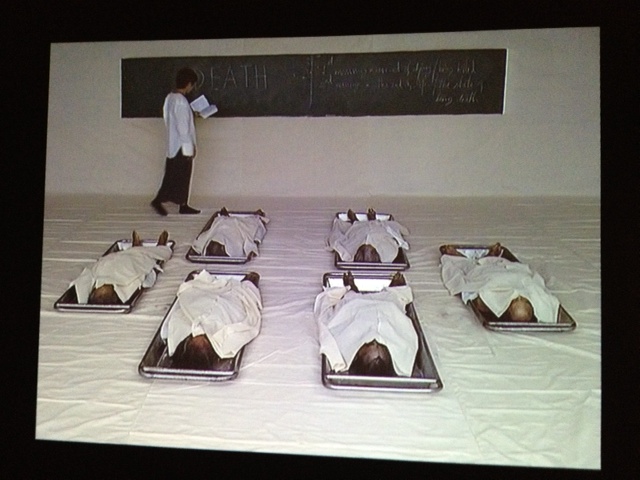
I found a moment to go to the Phantoms of Asia exhibition in the Asian Art Museum, where I encountered this video, entitled, The Class, by Araya Rasdjarmrearnsook. The artist is in essence, lecturing the six dead bodies on death. It is no accident that from where we sit, we are in the same audience as the dead people. At some point, my body will be that corpse lying on a tray. And it is there that I sat uncomfortably energized, feeling that anxiety, or Angst as Heidegger put it, that I am a being-toward-death.

While there is a dark humor pervading this piece, like when the artist asks a cadaver, What was that you said?, it is only a small bit of the profundity that this video reckons with. For me, the fact that the artist, a stand-in for the living, is teaching the dead about death — those who know deeply about it but cannot say —  hits on a facet of human nature that is confounding and all too ubiquitous. The living, in their attempt to colonize and conquer death, deaden and dull life itself.  As Steiner summarizing Heidegger says, those who rob us of the anxiety of death alienate us from life. Because, afterall, “the taking upon oneself, through Angst, of this existential ‘terminality’ is the absolute condition for human freedom.”

My friend, sitting next to me in front of this video, said plainly that she wished she had chosen to see her dead father’s body when she was given the chance, to have closure with his death. I responded carelessly that when she had had the opportunity, her father might have been dead too long and maybe the body was too removed from who he was when alive.

Two weeks later, last night, my undigested subconscious regurgitated before bed, filling my mind with thoughts about my own father. Yes, it’s Father’s Day today, but I haven’t thought of him on the past 3 or 4 such occasions. As some of you know, my ending with my father was not fairytale, but instead riddled with anger, doubt and a feeling of homelessness. But I did have meaningful time with him after he died. Although I was policed and hurried out of my vigil by his new vulturous step-family, I had a moment of loving contemplation over his peaceful body.

I realized last night that this time with him was one in which I could reflect on his life and in those incredibly condensed minutes, to feel the totality of him part from my totality. But last night I also realized that in those moments I worried about him as he faced his abyss. That I heard how he was anxious moments before he died. And I wish something or someone was with him, that he wasn’t totally alone in his leaving. Because it is a leaving that is utterly alone, and utterly into the unknown. And because of all that he was to me, for better or for worse, and because he faced this unspeakable time alone, probably doubting love, like we all might, I wish someone stood guard over him. I wish him love.

And maybe that’s all we can do for the dying — and we are all dying — because to do anything else is to rob one of life: “The inalienability of death — the plain but overwhelming fact that each must die for himself, that death is one existential potentiality which no enslavement, no promise, no power of ‘theyness’ can take away from individual man — is the fundamental truth of the meaning of being.”

In solitude, most critically felt at death, we experience freedom. Rilke’s artists and lovers of the everyday seem to know that freedom is contingent on an acceptance of our mortality and a quotidian comfort with the unknown — and even to let go enough to stand guard over someone else’s solitude. A constant homecoming, if we are brave enough. I’m not sure my father was brave enough until he was forced to be, and god knows I am not either.

“‘The wandering, the peregrination toward that which is worthy of being questioned, is not adventure but homecoming.’ Man, in his dignity, comes home to the unanswerable.” (Steiner on Heidegger)

“To all and to none.” Heidegger

31 Thursday May 2012

Posted by summermlee in Aesthetic philosophy, Art, Nature

≈ 4 Comments

Tags

Being, Catherine Fairbanks, empathy, Film, George Steiner, Hiedegger, injured animals, nature

Yesterday, I found myself singing Twinkle Twinkle Little Star with my family just as we have done many times over, but this time our tone was gentle and elegiac because our intended audience was a dying rabbit in a cardboard box, wrapped in my jacket. I know, for those who know me, that yes, it seems like injured and dying animals flock to me, but it might just be that this is the condition we all are in: living in the borderlands where a dominating human presence presses up against nature’s tenuous domain.

The bunny, who happened to be lying in the dirt path on our routine evening walk, seemed to have a leg injury and a scratch on the nose, perhaps a result of predation by a cat, a coyote, a raptor, a bicyclist, who knows.

As occurred to me when a bloodied raven worked his way out of my green Whole Foods bag onto the front seat of my car, I again had a fear of driving off the road if the bunny might leap from the box into my lap. But I reasoned that it was more likely this bunny, lying awkwardly in such bad shape and with an inherent fragile heart, was dead.

A few miles into the drive, wondering if indeed Bunny was still alive and finding my NPR show jarring, I decided to peel back the fabric to see what Bunny was doing. And there suddenly was a fur-lined, big, black, round eye staring straight up at me — and a look of fright and curiosity and concern exchanged between us. I quickly covered Bunny back up.

I immediately recalled the image of another big, round, animal eye that had also poignantly looked up at me. An adult pelican, with an injured wing wrapped in a towel, sat on my lap as my friend drove us to the same shelter. En route, feeling the bird’s heart rate progressively calm, I peeled back the warm, wet towel to glimpse Pelican. Pelican’s eye was questioning and fearful, and I decided the darkness of the towel was more comforting than my own questioning, strange, and incredulous face.

So it seems fitting that I have been thinking about an amazingly beautiful film recently screened at the Experimental Film Festival in Portland, by a friend and colleague, Catherine Fairbanks. You can watch it for yourself here.

http://catherinefairbanks.com/artwork/2397516_Transference_is_a_Tough_Row_to_Hoe.html

"Transference is a tough row to how."

Catherine wonders whether attempts at empathy reach an impasse or dead end; the failure to completely reach another.  And yet her beautiful imagery and wistful narrative embodies a transcendent poetics of the human condition. As Heidegger writes about this impasse, there is something about a thing that cannot be appropriated by us. Like walking out towards a horizon. We occupy that horizon, yet there is an out there that remains away from us. Likewise, a horizon, or object or thing, has a thereness that precedes our cognition of it. But he also describes those moments where we glimpse something otherwise, when a thing things itself. For example when the presence of his Van Gogh painting, beyond its pigment and canvas and brushstrokes, reaches into our being. Or when the culmination of instruments, rhythm, and tones arrives in an untranslatable and indescribable music that stirs something within. Steiner says we experience this presence “‘[i]n moments of great despair when things lose all their weight and all meaning becomes obscured,’ or in flashes of vital brilliance.”

“We feel, we know, urges Heidegger, that there is something else there, something utterly decisive. But when we seek to articulate it, ‘it is always as though we were reaching into the void.'” It is the possibility that the horizon, the impasse between two beings, is only the something we know — the consciousness of objects. Because also therein we are offered (and it almost always feels like a gift) “an opening to what is beyond the horizon of such knowing.”

The felt love between the two mythological entities in the lake surrounded by a loving voice; the moment of knowingness between the birds and animals and myself; and a lighting that occurs between a passage of painting and the viewer. Indeed, says Heidegger, without these moments, we forget to be astonished.

“The world’s darkening never reaches to the light of Being.” Heidegger

“Art is not for.” Sam Hamill about Morris Graves

12 Saturday May 2012

Posted by summermlee in Aesthetic philosophy, Art, Nature, poetry, Uncategorized

≈ Leave a comment

Tags

George Kahumoku Jr., Hawaii, Hi'ilawe, memoir, nature, poetry, Sam Hamill, slack key guitar

Tonight, the poor bloke handsomely dressed in traditional Hawaiian cloth and lei, as it is every night, blows a conch to the delight of the hotel guests and their cameras and then runs with his burning torch from tiki lamp to tiki lamp across the expansive plantation style grounds. My incredulous son and other children giddily in tow. Every night it has been a new person, always Hawaiian though, and some are more obliging in this cultural fetish performance than others. But each one has warmly facilitated my son in lighting at least two tikis (because he demands more than one), bless their hearts.

Stunning is the island landscape, illuminated by torchlight flickering in the tradewinds.

Such are the moments of artistry in Hawaii, never untangled from its colonial past and its current economic conundrum as tourist industry.

In any given hotel and restaurant catering to this particular area, there is almost certainly to be incredibly talented live musicians, plucking away at a slack key guitar, soulfully singing the Hawaiian traditional opus, mostly written to keep names of places, plants, fishes, birds and cultural knowledge — a dying language — alive.

20120512-211359.jpg

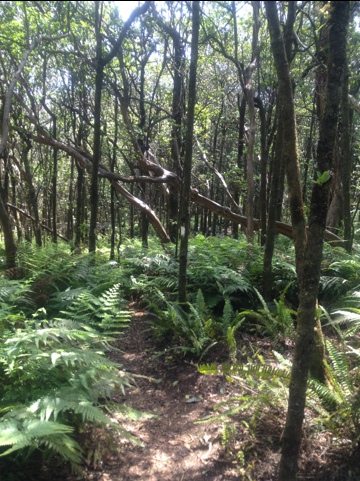
(Kalopa State Park, nature preserve)

I was already bruised after just hearing the wistful “Me ke aloha ku’u home o Kahalu’u,” (with love for my home Kahalu’u). Kahalu’u is a gorgeous beach almost smothered by concrete hotels and hordes of sunscreened waders, food trucks, and signs saying please do not step on the coral, please do not feed the fish. Even as I am counted among the island’s outsiders, I stopped to listen to these two men sing delicately and lovingly their version of ku’u home. Who isn’t bereaved of changes to the land?  They sang this elegy in an empty restaurant, empty besides a handful of waiters chatting amongst themselves, one sunburned couple watching basketball on the bar TV, and sentimental me in my bathing suit waiting for my to-go order.

Later when I entered the lobby of our hotel, where I’ve been annoyed by the constant presence of people since we arrived, a pang of a familiar melody filled me as it filled the architecture. The lobby lanai, full of well-dressed, shiny guests enjoying a cocktail and chatting amongst themselves, frames a view across the ocean where a faint silhouette of Maui dissolves into cloud. But what made me stop was yet again, another vulnerably sincere, Hawaiian slack key performer there in the skyline. He was playing not for the sake of the distracted guests unaware that this particular song, Hi’ilawe, extolls a site they probably snapped a photo of today; not for what is probably a paltry salary; and not for me mouthing what words I knew in appreciation for his performance, for the artful moment.

I hid in the adjacent stairwell hearing the last bits of the song until he transitioned to his next (I imagine to avoid the awkward silence between songs), and then I exited underneath the patio out to the courtyard. As I walked away, the musician ignored his audience as they ignored him and turned out over the balcony, looking for me below. I looked up at him and put my hand on my heart. As he strummed out the beginning of his next song, he smiled knowingly and nodded his head — a private, unseen gesture in a place of all places to be seen. Our eyes were on Hi’ilawe — an artful moment because it was completely gratuitous.

Hi’ilawe

George Kahumoku Jr.’s version of the song on YouTube, and its hula:

http://www.youtube.com/watch?v=u8kpNAIBRIw

Translation:

All eyes are on Hi’ilawe
In the sparkling lowlands of Maukele.

I escape all the birds
Chattering everywhere in Waipiʻo.

I am not caught
For I am the mist of the mountains.

I am the darling (a toy) of the parents
And a lei for the necks of grandparents.

The fragrance is wafted from Puna
And lives at Hi’ilawe waterfall.

Tell the refrain
All eyes are on Hi’ilawe.

“We are creatures of a great thirst. Bent on coming home to a place we have never known.” George Steiner

10 Thursday May 2012

Posted by summermlee in Art, Nature, poetry, Uncategorized

≈ Leave a comment

Tags

George Steiner, Hawaii, history, Kealekekua Bay, Manini Beach, memoir, nature, post-colonialism, Wordworth

A kitchen oven structure, a plastic outlet plate, and other remnants of a home are a haunting sight on the bottom of the ocean floor of Kealakekua Bay. Ke ala ke kua, the pathway to God. The wreckage lies off the shore of Manini Kapahukapu beach, a sacred gathering place for ancient Hawaiians. They deemed the site a place of healing, and it seems since time immemorial this place has been in need of healing.

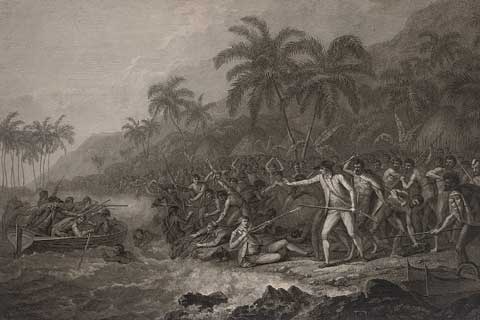
Hard to find, the beach’s grassy flat is surrounded by lush foliage, and its ocean shore is crusted over with almost black, unforgivingly sharp lava rock. Across the calm bay, an odd white, stone beacon of a monument commemorates Captain Cook, who landed at this Hawaiian village amicably at first. But after the entanglements of disease and colonial politics and cultural misunderstandings, he was murdered at that spot, in plain sight across from Manini.

Of course it is odd that there is no monument there to honor the dead Hawaiians that once occupied the present day ghost village and Heiau, now overgrown by bird-filled plants and trees, the true natives of the area. Besides the monument and a plaque now in the tide waters of a rising ocean stating, “Near this spot Captain Cook met his death,” there are only loads of snorkelers by boat and kayak swimming among luminescent coral forests. The reef is growing less and less pristine, inversely to its popularity. On an unmarked spot there in the turbidity of ocean water lurks one of our wedding rings, a frightful loss at first, but now a fitting, romantic homage.

Behind Manini lies a lava field, now filled with a rural grouping of homes, the impoverished ones belonging to native Hawaiians, the gentrified ones belonging to outsiders who either own them as rentals to outsiders, or who visit there just as transiently as would-be renters. I can’t help but want one myself. But that area feels heavy, and when figuring out why, I learned that before there were homes there, the lava field was the site of historical bloodshed. A faction of Hawaiians hoping to gain control over all the islands overpowered a group supporting the disinherited. The Battle of Mokuahai, in 1781, was savage as even women took up arms for their territory and were among the losers, killed by bludgeoning instruments, or forced over cliffs into the lava strewn ocean.

In the center of the bay, a large pod of spinner dolphins rest, swimming easy circuits with their calves. One year we swam out to them. They, being the more fit for sea, and either cautious or curious, found us first. I dove into the depths of the bay as a group passed me, and for the length of a held breath I swam with them, tears filling my swim mask, my hand holding my heart hurting for the beauty still left in pockets of this contested earth. But after a little research, my heart hurt more to know that my presence was detrimental to their rest, to their impending survival outside the bay where they are forced to return earlier than necessary because of swimmers like me, wanting to experience their glory.

Today, I stayed at Manini, and resisted the coral reef at the monument, and the pod of dolphins splashing and spinning on the other side of the Bay. And there is where I found the modern day ruins of a shipwrecked home, dragged into the sea by the reach of a tsunami that just over a year ago, swept tens of thousands of people in Japan out to sea. The same grandmother working there three years ago with her infant grandson, already adept at the ocean, my son then only a shrimp in my belly, was also there today as she is everyday under her umbrella. Folks stop by regularly to hear of what news, I’m not sure. While our sprouted kids played in Manini’s one sandy opening to the surf, she explained to me the recovery taking place in the area. In the eddy where pristine waters meet the machinations of savage American imperialism and colonialism, I hope Manini prevails for all of us.

20120510-070741.jpg

Glad sight wherever new with old
Is joined through some dear homeborn tie;
The life of all that we behold
Depends upon that mystery.
Vain is the glory of the sky,
The beauty vain of field and grove
Unless, while with admiring eye
We gaze, we also learn to love.
— Williams Wordsworth

“The premeditation of death is nothing less than the forethinking of freedom.” Simon Critchley

02 Wednesday May 2012

Posted by summermlee in Aesthetic philosophy, Art, poetry, Uncategorized

≈ 2 Comments

Tags

anna akmatova, censorship, chen guangcheng, dissident, philosophy, poetry, politics

Sitting here at my desk in North America, surrounded by meaningless words flung about in luxury and distracting waste, it is hard to imagine that the act of creating words could bring an endangerment to your life. How could words be lethal to your children, your spouse, to anyone that helped you, even when these words speak for the welfare of others? When words crafted as acts of love fall upon deaf and murderous ears.

I won’t bore you with the details of the current news story of a blind dissident in China, Chen Guangcheng, who made an improbable escape over the walls into the US Embassy in Beijing, amid Sec. Of State Clinton’s precarious diplomatic visit — you probably know more than I of it. But I read that in the last few hours, only after threats against his wife and family and the imprisonment of a man who helped him, did he acquiesce to the idea of leaving China. Until then, he refused to become any one of the numerous political dissidents who are harbored in friendly, yet stranger, countries.

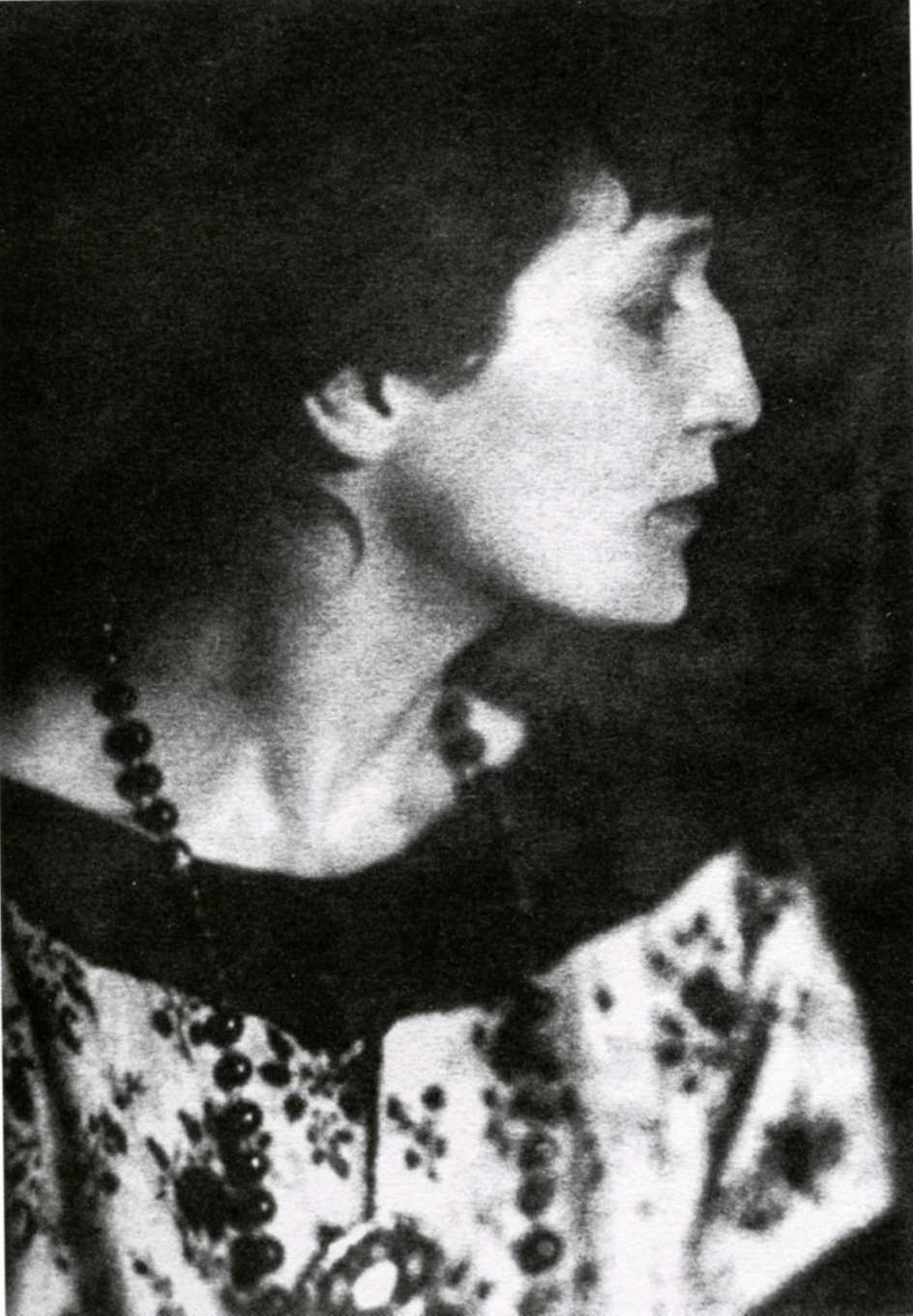
I thought instantly to Anna Akhmatova, who suffered immeasurably during the Russian Revolution for her poetry. Her literary friends and colleagues were systematically killed, starved, exiled. Several took their own lives. Her husband was executed by firing squad. Her son spent years emaciating in prison camps. For words. Even when in poetry, words reveal themselves to be words.

Yet, while others moved to Western Europe and beyond, she remained a steadfast resident of her homeland, despite censorship and slander (the grammars of war), dedicating herself to promote a golden age of Russian poetry.

To The Many

I — am your voice, the warmth of your breath,
I — am the reflection of your face,
The futile trembling of futile wings,
I am with you to the end, in any case.

That’s why you so fervently love
Me in my weakness and in my sin;
That’s why you impulsively gave
Me the best of your sons;
That’s why you never even asked
Me for any word of him
And blackened my forever-deserted home
With fumes of praise.
And they’d say — it’s impossible to fuse more closely,
Impossible to love more abandonedly…

As the shadow from my body wants to part,
As the flesh from the soul wants to separate,
So I want now — to be forgotten.

Anna Akhmatova (1922)

“What is ultimately required of us with respect to our love of beings?” Henry Bugbee

30 Monday Apr 2012

Posted by summermlee in Aesthetic philosophy, Art, Nature

≈ 4 Comments

Tags

birdwatching, George Steiner, Henry Bugbee, lazuli bunting, meaning, Mortality, nature, Pacific Slope Flycatcher, writing

This weekend, I sympathized with my dear friend who writes an amazingly tender and delicious food blog, www.themooninmykitchen.blogspot.com, that like art, meditation, and any endeavor necessitating commitment, writing these entries can be a mundane practice. There are days when the flow is not there to deliver rivers of insightful revelation, clever words flipping off the tongue, or sparks of delightful references and analogies.  But one starts about anyway, hoping the force of pushing through it doesn’t also run right over the grace of creativity, leaving a corpse of tired, ever-embarrassing, revealing remnants of a self that cannot transcend self.

The same weekend, for a friend’s 70th birthday, a group of us went birdwatching in some of the most beautiful land in the Bay Area. There on the same, short jaunt, one can easily traverse through lemon-green meadows, water-logged swales, arid oak chaparral, and fern-laden woodlands with sentinel sequoias.

Our stout and serious group leader, a veritable General of birdwatchers, started the walk with what amounts to a Holy proclamation of a birder’s Grail: In the same territory she had just spotted Lazuli Buntings on their migratory way through the area. I knew by the reaction of oohs and ahs that none of us seasoned birders had that bird on our life list.

So it was with this exotic expectation burning lazuli blue in my mind that a frustration began to foment as the General took us around every inch of perimeter of a concrete parking lot, bordered by cyclone fence.  She would call out, “Junco at one-o-clock!” as if we should align our bayonets. “Straight ahead is a Robin.” I pretended to take a picture so as to not appear bird-snobby about these usual, tedious suspects. But at one point I couldn’t cork a chuckle as she declared militantly the presence of a dawdling mourning dove ducking into the weeds.

The walk finally ventured away from cars and concrete and chain-link barriers, though we never left a paved trail and the evidence of man’s obtuse intrusions on nature. It was clear that our General was carrying out a warfare not concerned with an immersion in wilderness, but the sniper-like calculation of species of birds sighted — however mundane the species, however bleak the context. My friend even whispered to me (so as to not get chastised again by the General for distracting her from bird calls) that she sees more birds in her frontyard.

With only a few minutes left on the hike, I resigned to an unremarkable, albeit lovely day robbed of solitude (as we were in a bustling group), void of an escape into nature (cite the parking lot above), deplete of silence (hear the General’s commands?) and amiss of a rare and exotic bird sighting (the buntings are undoubtedly in Canada by now).

I was returning to the car when a Pacific Slope Flycatcher overcame its usual shyness to flit from a tree, snatch a meal of unsuspecting moth, and bravely perch a few feet in front of me. We both took pause in the time that Celan calls a breath-turn. A beady black eye gazed unabashedly into mine – and we greeted each other knowingly.

This tiny Flycatcher has made perilous trips from Mexico to its breeding grounds somewhere in Canada, while I am sheltered in my disdain of the predictable. Perhaps the Flycather has crossed paths with the Lazuli Buntings I might never meet, who knows.

And so it seems fitting that along this trip I learned the pair of eagles who began a nest along my hometown reservoir has abandoned their purpose. They disappeared on Earth Day, which leaves a note of irony hanging in the air, along with the humility I imagine their watchers leave behind as they fold up their scopes and head home. I hear George Steiner describe this unfolding of events:

“As if the music played… could turn on its composer and ask: Why did you make me?”

Surely, something beyond us is needed when we question the meaning of coming to be and passing away. At the end of such vigils, whether of writing or birding, one can only surrender a respectful adieu. À dieu.

Today’s Advice: And so put, we must acknowledge an answer to it with which life is inescapably haunted, namely, some kind of parting.” Henry Bugbee

“Whereof one cannot speak, thereof one must be silent. Wittgenstein, “Tractatus.”

21 Saturday Apr 2012

Posted by summermlee in Aesthetic philosophy, Art, Nature

≈ 7 Comments

Tags

art, Hawaii, Kilauea, Mortality, philosophy, poetry, silence, Stanley Cavell, Wittgenstein

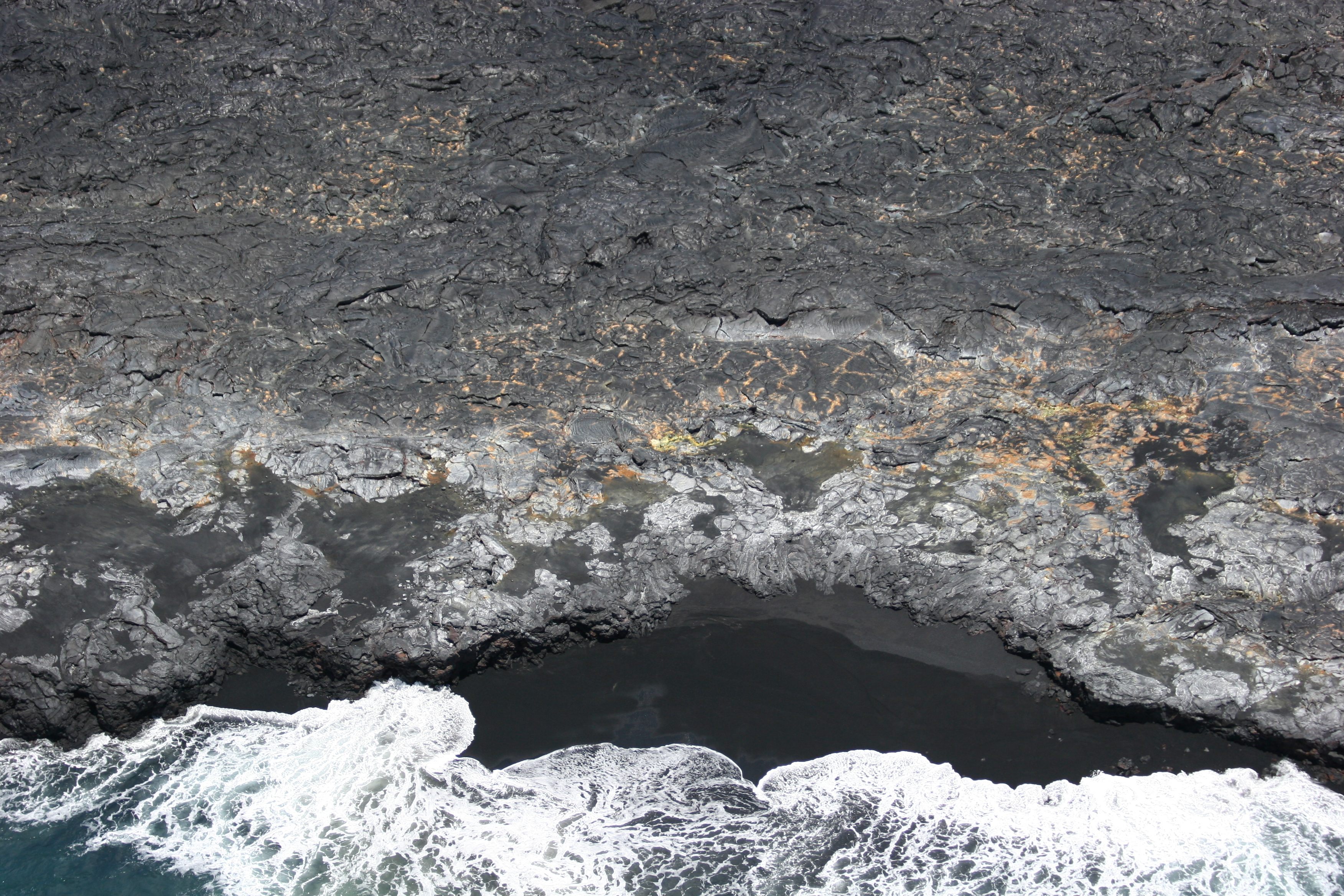
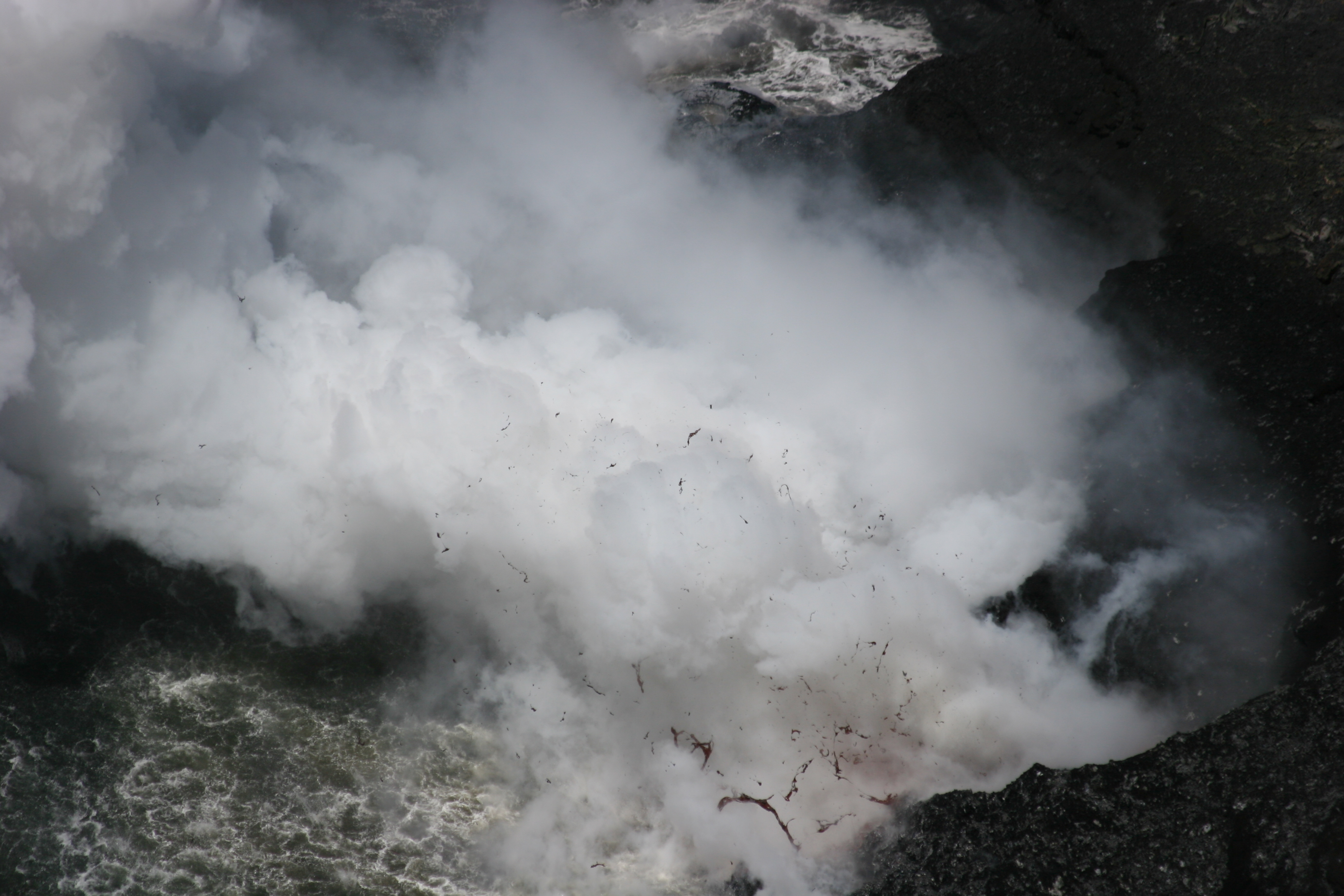
Almost at the ocean edge, I look back up the hill, over the martian landscape to see the miles of frozen stone rivulets, overlapping and intertwining upon themselves, blanketing anything that ever had been there. It is dark, hardened lava which was at one point molten and seeping from wounds in the earth, crawling down the topography according to gravity, until it slipped into the ocean with a burst of steam cloud.

I cried unspeakably when I first saw this, at Kilauea. At first I thought I was responding to the experience of primeval vastness – a meeting with an uncompromising, prehistoric force. Or maybe because it was humbling to be in the presence of the beginning of land, the birth of earth.

For some reason, this is the image that comes to mind as I ponder why I have inexplicably taken a break from writing here.

At some point my philosophy mentor mentioned to me that it is best not to overwhelm the writings or artworks of others with my own subjectivity. It is a balancing act to read the work of others and engage in dialogue, to make comparative study without projecting too much of my own material and subsequently dampening them. To listen without talking over them.

In the last few weeks I have been reading hyperactively, but in a way also bordering on attention-deficit disorder. From Kierkegaard’s crowd of untruth to Anna Akhmatova’s poetry of personal truth amidst a  crowd of censors. And there is George Steiner’s grammars of creation, eruditely nostalgic for the messianic, and Wittgenstein’s language games of lost faith. I have let the writings of these thinkers run over me, perhaps not unlike the rivers of the slow moving, but nihilistic lava, making its way to a border of another prehistoric vastness – my ocean of ignorance. While the writings have been resonant, elegantly constructed and provocative, they are opaque. And maybe it is best to let them do their work before I attempt to crash in with my callow response, my impediments, my convictions.

In short, to let answerability take the form of silence.  However, for those of us who know the therapy office, the dead end of a conflict, or know the time in front of one’s own intransigent painting or sculpture, there is a silence that is laden with an almost perceivable din, however healing it may be. And then there is a silence of a higher order, of untranslatability.

Schopenhhauer said, “Were the universe to perish, music would endure.” And in the moment of pondering the lava field, where seedlings somehow sprout in rock, and liquid rock in its extension of earth annihilates life — creation meets destruction. Artists and writers might want more to be mediators of where sound meets silence, and form meets formless. Paul Celan’s breath-turn. In the end, if I were in that lava field, facing the force that we all perish by, I may be trivial and sentimental, but I would want to hear Olomanu’s plaintive slack key guitar and the lyrics of a homecoming: “Last night I dreamt I was returning. And my heart called out to you: To please accept me as you’ll find me. Me ke aloha ku’u home o Kahulu’u.”

Today’s Advice: “It is through words that words are to be overcome. (Silence may only be the tying of the tongue, not relinquishing words, but gagging on them. True silence is the untying of the tongue, letting its words go.).” – Stanley Cavell

“…those two or three great and simple images in whose presence his heart first opened.” Albert Camus

28 Wednesday Mar 2012

Posted by summermlee in Aesthetic philosophy, Art, Nature

≈ 1 Comment

Tags

Absurdity, Annette Messenger, art, birthing story, Camus, eagles, Kierkegaard, memoir, philosophy

It was clear to everyone at the hospital I was a mess. Because of indescribable back pain, I received an epidural before I was dilated past a centimeter, and therefore my labor progressed at a crippled and wayward snail’s pace. Sometime through the night, I began to shake uncontrollably and a wave of general anxiety overcame me, which I attributed to the drugs; but the nurse on duty said it was mental. The next day, my friends and family took turns rubbing my legs because after a day on an epidural my lower half felt irritatingly restless and paralyzed at the same time. One of the labor and delivery nurses struck up conversation with me, probably because she saw I was floundering. The more we talked, the more my labor picked up, and my dilation progressed.  She seemed to recognize this, too, and felt a sense of ownership over her “project.” It began as chit chat, but at some point it became, as my friends kidded, unsurprisingly philosophical. And I don’t remember how, but it turned to Kierkegaard, as I blurted out to the nurse that during my pregnancy I had struggled with faith — a faith that everything in my pregnancy would be ok. I don’t remember exactly what she said, but she said something exactly wise, and it implored my confession of a previous  miscarriage – and that I would never know why it happened. That unanswerability undermined my willingness to “leap to faith,” even though I knew my faith, or lack thereof, had no bearing on how the Fates would knit together the outcome of my current pregnancy. Something so utterly close to me so as to be part of me, indeed sharing my blood, was outside of my control. This realization seared me like the pain that both rends and joins, and the nurse feeling her own limits looked out the window as I wiped a tear away. But she came back from her momentary distance and said, I bet you just reached the transition stage of labor – every woman I know has a revelation when she reaches the utmost extent of dilation. Exertion.

—

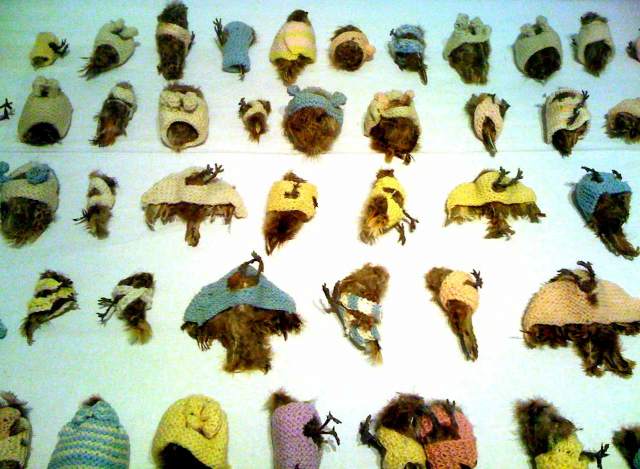
Over this past weekend in a light conversation with my studio mate, I threw around the word absurd to describe similar artworks from two artists, both who crochet and knit onto their treasured but precarious subjects. After hearing my studio mate’s response that she liked absurdity in art, I realized, despite my sophomoric passion for philosophy, that I was using the word unnecessarily in a negative way.

(Annette Messenger, “Les Repos de Pensionnaires,” aka “The Boarders.” 1971-72)

Both Camus and Kierkegaard philosophize about the absurdity that every human being faces – that we sense our life has some significance, some meaning; but as Camus put it, we are met with a cold, uncaring universe. We are saddled with the paradox that we are called to care with all of our might for the most vulnerable amongst us (especially ourselves) — yet we have in the end a limited bearing on what becomes of our fledglings.  (And somehow an acceptance of this allows our circle of caring to expand.)

Yesterday my mother, my son and I reach the spot where from across my hometown reservoir, we could see the faint outline of a large, dark bird with a tell-tale, beacon of a white head and tail, perched on a dead pine. Nearby, we could barely make out a nest occupied by his mate, mid-story in a moss-laden pine.  But the small smudge in our binoculars amounted to an extraordinary image in our minds. Thought never to emerge from the point of decimation by DDT, it is a nesting pair of bald eagles — the first in the Bay Area in 100 years.  We joined a small group of other enthusiasts, all sharing an inexplicably warm communion as witnesses to this scene. Somehow we are the faithful because we know doubt, tragedy even. And it makes these little glimpses like this, of heart-warming good in the world, seem precious in this painfully but poetically absurd world.

Today’s Advice: “[D]oubt is conquered by faith, just as it is faith which has brought doubt into the world.” Kierkegaard

← Older posts
Newer posts →

Enter your email address to subscribe to this blog and receive notifications of new posts by email.

Join 619 other subscribers

Recent Posts

  • “Experimenters in the passages between worlds.” Vinciane Despret, Au Bonheur des Morts
  • “The terrifying groundlessness, the eradication of all violences. To be embraced by that which doesn’t know us and in that unknowing caresses us and truly loves us. We might become anything at all, something wildly other than what we are encountered by. A world that truly loves us by not presuming what we want or what shape we will take before we show up… We will be held when we are not known from the start.” — Dr. Marquis Bey
  • Images dream within us, a reverie is a world of expansion.
  • “For the natural world, the ethical responsibility is that being alive gives existence to others.” Vinciane Despret
  • “We meet in the freedoms of each other.” – Takeyoshi Nishiuchi

Archived Posts

Blog at WordPress.com.

  • Subscribe Subscribed
    Unwanted Advice: Reflections from a Self-Appointed Life Counselor
    Join 215 other subscribers

    Have a WordPress.com account? Log in now.

  • Unwanted Advice: Reflections from a Self-Appointed Life Counselor
    View site in Reader
    Manage subscriptionsSign upLog in
    Report this content
    Collapse this bar
Loading Comments...