• About

Unwanted Advice: Reflections from a Self-Appointed Life Counselor

~ Caminante, no hay camino. Se hace camino al andar. Wayfarer, there is no way. You make a way as you go. (Antonio Machado)

Unwanted Advice: Reflections from a Self-Appointed Life Counselor

Tag Archives: philosophy

Welcome home to un-home.

20 Saturday May 2017

Posted by summermlee in Aesthetic philosophy, Art, Birds, Nature, philosophy, poetry

≈ 3 Comments

Tags

art, birds, Chicago, Chinese Bone Repatriation, death, Fra Angelico, Home, immigration, Marie Howe, migration, philosophy, poetry, Summer Lee, Summer Mei Ling Lee, The Annunciation

Non Omnis Moriar

The first bird I met here was half-dead. A Cape May Warbler, my first ever. It had collided with a Chicago building like thousands that do every year. It stood frozen still on the rooftop as I toured the 11-story, urban school for my son, as if warning me of the impending experience there. The Cape May is one of five million migrants and dwindling, but in this season, they still show up as clouds on weather radars every evening as they take into the darkness and as they rest to feed by sunlight.

They must survive the buildings, but also the endless Midwest miles of recently invading soy and corn fields, where there is ironically no food for them. They trace along the lakefront, which is where I found my cathedral among the starving and vulnerable. This church is simple, and the faithful are sensitive souls as they gently but enthusiastically ask me, did I see the black-throated blue warbler over there?

It’s true that in the end love is why. And also, as she crystallized in fragile words, nothing brings so much pain as love.

A third of the first shipment of bone boxes from the United States back to China were empty. Most immigrants back then wanted to be buried in their ancestral homes. They were also not welcomed here. Despite vast impoverishment, the family associations made arrangements to clean the bones and ship them on a 30-day ocean journey via Hong Kong, from where they would be delivered into China. The empty ones were soul-summoning boxes, when their were only names, when bodies could not be located. Something had to migrate home.

Some never made it back. Some are stuck in transit, in boxes in a storage house in Hong Kong, where they opened an empty one for me. When I saw it, I cried uncontrollably. And when I came to, I remembered Faure’s requiem.

Some are still waiting in my hometown, like my great grandmother. And here I had thought the Chinese village name on her tombstone was for biographical purposes only. When in fact, like so many others, it is an unkept promise of a more final return home.  No matter how many children they birthed and raised on this soil, the burial here is temporary. Address labels with no postage, the stone mark of their villages is a question mark of an eternally unanswered request, beseeching unwitting visitors, please take me home. The village name, possibly of a village that doesn’t exist anymore, is a way the dead stay alive. Yes, never dead if your progeny visits and honors you. After all, if someone remembers you, you still exist. But here it is not ancestral worship either, just an endless restlessness for homecoming.
6500294f6f1bc41c81d2bdba49049b3e
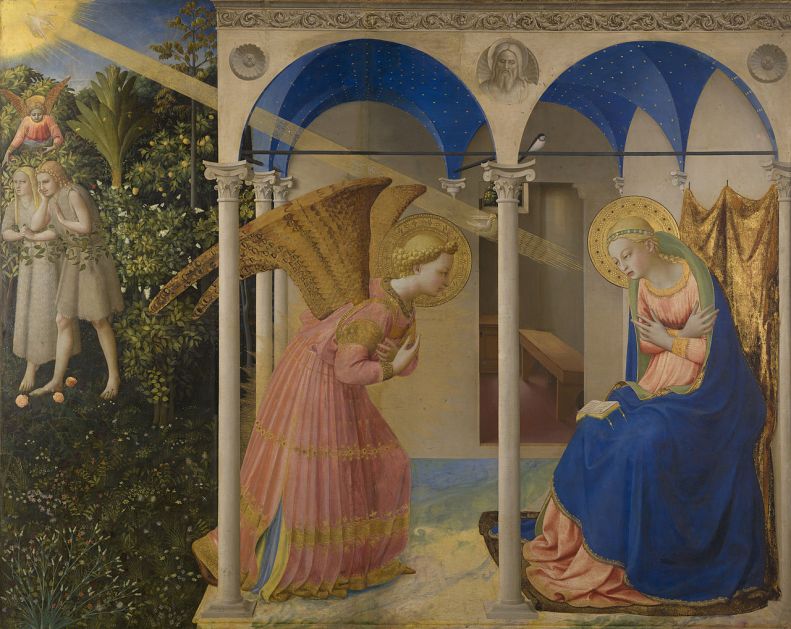
(The Annunciation, Fra Angelico, 1425-6)

The neighbor in Chicago to the right voted for Trump and the grumpy one on the left asked to take down my bird feeder because it was bringing woodpeckers to her yard. I never saw a woodpecker at my feeder in California, who knows why not, but there are four kinds here. You wouldn’t understand what it is to stop feeding the birds of my home. There is no one now to track their yearly changes as well as their disappearances. To no longer hear their version of truths about migrations and the space they know between heaven and earth. So I set out to ask the strange birds of my new home.

It is cold and rainy as I hold my camera up to these birds. We join together in the hopeful uplift of these visitors, knowing also they won’t be here much longer. And I realized maybe this is the reason I was brought here, and why I must now live between two homes.

It was also cold and rainy when I found him at the nearby cemetery in an unmarked grave. The Hong Kong assignment led me to review my grandmother’s INS interrogation from 1925. In it, her father describes burning the documents of her oldest brother at his gravesite. To erase any reminder that he had died in Chicago, the year before in 1924, at the age of 21 of a sudden illness that is of poverty. The confused clerk looked at me strangely, the white lady who presented his romanized Chinese name, but soon enough they found him on a hand-written map. Minutes later, the groundsmen took me to a field and paced off the coordinates — and there in the middle of fucking Chicago, I had found his bones.

She said, it’s as if I had to become displaced to find my family.

(In my imagination my grandmother’s family experienced one Chicago winter because thank you god they quickly moved to San Francisco.)

And if you have ever uttered a word thinking your dead would hear, you understand the birds. And you also know that all real happiness sets you on the edge of loss. As Judith and I ended our two hour phone call, a Cerulean Warbler flitted across my driveway. It was here and gone so quickly, it exists in the realm of doubt. But somehow my grandmother knows I am listening.

____________________________________

ANNUNCIATION

Even if I don’t see it again – Nor ever feel it
I know it is — and that if once it hailed me
it ever does–

and so it is myself I want to turn in that direction
not as toward a place, but it was a tilting within
myself, as one turns a mirror to flash the light to where it isn’t — I was blinded like that — and swam
in what shone at me

only able to endure it by being no one and so specifically myself I thought I’d die
from being loved like that.

— Marie Howe

“Here is Where We Meet.” — John Berger

11 Thursday Jul 2013

Posted by summermlee in Art, Birds, Nature, philosophy, Uncategorized

≈ 1 Comment

Tags

art, birds, John Berger, nature, philosophy

I’ve started a new project, an off-shoot of this one. I thought it deserved its own place — since it is about my relationship to a meaningful place.

http://thebirdsofsanpedrovalley.wordpress.com/

Photo, by Summer Lee

“You’ll see how much your little bird has changed.” — Edith Piaf

03 Sunday Feb 2013

Posted by summermlee in Aesthetic philosophy, Art, Birds, music, philosophy, poetry

≈ 9 Comments

Tags

art, Edith Piaf, French, high school, Jacques Prevert, memoir, philosophy, teachers, Virginia Woolf

Not much taller than the desks, she stood unblinking in front of the students, hopping and gesticulating wildly to convey her lesson to her jaded audience. In this of her many dramatic monologues with occasional spittle, she introduced a new topic, rudiment to understanding French, and maybe even life: existentialism.

We thoroughly read Camus, en français, and over time she espoused to her sheltered and callow high school students that every choice one makes has a consequence, and the absurd man is one who acts out of habit, shirking responsibility and awareness for the events and choices that come to comprise one’s life. We listened to Edith Piaf, learning her lyrics by heart. Having heard no other voice so utterly pained, wretched even, but strong and moving, I was taken. She grabbed me at the end of class after the rest of the students had drained out of the room, and for whatever reason, recounted that during her first teaching job at an elementary school, an air force officer entered her classroom and in front of her 25 students, handed her an envelope. In it was a piece of paper describing in the most coldly succinct language that her husband’s plane had crashed on a training flight nearby and he was deceased. There also in the envelope was his metal wristwatch, the only personal item with him and recovered from the crash, cracked with hands frozen at the exact moment of his death. With a teacher’s salary and two young children, she said Edith Piaf’s tragic life and inextricably-linked music became anthem to the fact she had no other choice to move on.

Her philosophy must have been a double-edged sword for the ESL students also under her care at the high school — the dregs, the few brown and black kids bussed into an otherwise privileged school of white kids dropped off by luxury cars. But there was no less, if not more, passion for these kids as there was for her sniveling French students. When her Edith Piaf admirer became Senior Class President, she arranged a secret meeting, knowing my duties as student organizer of the school prom. She said she had a young couple in her ESL class who wanted to go to the prom but could not pay the price of ticket, exorbitant even for today’s standards. She wanted to broker an arrangement for them, and they must never know. Loyal to her, I offered to comp them in, no one would notice in the shabby accounting. Slightly offended, she interjected to say the boyfriend had agreed to work the coat check before and after the dance to earn his way. I added their names to the paid list and other than her catching my eye at the entryway of the dance hall while she stood next to her couple, there was no word of it after.

She also introduced us to a book of poetry by Jacques Prevert, someone also familiar with war and loss. She had to have known I never returned my copy back to the school repository, and from time to time I still find a guilty joy in reading a poem or two from it — a treasured contraband. It was, of course, easy to tell her I was coming out as gay. She might have even said she had some gay friends or a gay son, I don’t remember. But after that, she took to meeting me at the town’s bookstore cafe, and we sat together as an unlikely duo of a middle-aged, manically energetic, short woman, and a gangly, wide-eyed, attentive girl — my hair getting shorter by the week as my shoes grew more militant. I don’t remember much of what we talked about, but I can smell the bitter coffee-filled air, and see the tome of pages from Antigone she xeroxed in French (another petty crime) and brought me to read over the summer. It was also there that she asked me to be President of the school French Club. I had no duties except to bring a piece of brie to the school club fair, where she also hosted an escargot-eating contest, and in turn it was something to add to my padded Stanford-bound resume. When our senior yearbook came out weeks before the end of school, she curiously asked to hold mine for a day or so. When she returned it to me, there adhered strongly to the inside the front page was an engraved, stately metal plaque. It read my name, the title of French Club President, and underneath, “Honni soit, qui mal y pense.” An ancient motto of chivalry, it means something to the effect of, evil to those who think evil, or shame to those who think shame of it.

The last week of school, she made me promise that I would let her be the last teacher I would say goodbye to. So, after gathering my things and finishing some tearful thank you’s to a few of my other teachers, I found her waiting for me in her classroom. As we walked down the hallway to one of the school’s exits out to the parking lot, she explained to me that there at the doorway was a threshold and it was marked by a strip of metal. She said that it was a milestone, a marker, this line. She would go on the other side and she was going to watch me cross. So I did: I unceremoniously stepped over the line, tears welling in my eyes, and there on the outside of the school she jumped to hug me. As she grasped me in her embrace she whispered in my ear, though it seemed louder and permanent: You have crossed the line and you must go, and I want you to remember, she clenched more tightly, you can’t go back.

Ladder, by Summer Lee
(An image from an art performance I did with Jesse Schmidt, 2008)

“I wish that once & for all I could put down in this wretched handwriting how this country impresses me — how great I feel the stony-hard flatness & monotony of the plain. Every time I write in this book I find myself drifting into the attractive but impossible task of describing the Fens — till I grow heartily sick of so much feeble word painting; & long for one expressive quotation that should signify in its solitary compass all the glories of earth air & Heaven. Nevertheless I own it is a joy to me to be set down with such a vast never ending picture to reproduce — reproduction is out of the question — but to gaze at, nibble at & scratch at.

After all we are a world of imitations; all the Arts that is to say imitate as far as they can the one great truth that all can see. Such is the eternal instinct in the human beast, to try & reproduce something of that majesty in paint marble or ink. Somehow ink tonight seems to me the least effectual method of all — & music the nearest to truth.” –Virginia Woolf

“Everything that can be thought at all can be thought clearly. Everything that can be said at all can be said clearly. But not everything that can be thought can be said.” — Wittgenstein

01 Saturday Sep 2012

Posted by summermlee in Aesthetic philosophy, Art, Nature, philosophy

≈ 3 Comments

Tags

art, Being, dead birds, memoir, painting, philosophy, silence, susan Sontag, Wittgenstein

In the yard of my childhood home, a robin drunk from devouring over-ripe cherries on our tree, flew into our bay window that must have held an attractive illusory world, so much so that more than a few birds met that hard, bludgeoning reality. And after struggling for air on the ground below, it became still and lifeless. My mother, sensitive to the meekest of life forms, gathered the corpse and her two fledgling daughters for a funeral. A hole was dug, and as I watched the corpse of the bird descend into the dirt void, my mom said words, words of ritual, wishing that this bird would be in peace.

That robin’s life, unlike the other carcasses of animals on roadsides or worse, was made sacred to me, and the abyss into which some part of this bird, the part besides feathers and flesh, inhabited when it was into the ground became the eternal question mark.

My mentor describes the pre-classical Chinese pictogram of sacred as a person standing on earth, on one’s toes, reaching for the sky, the heavens. The sacred cannot be without the earth, the mundane requirements of being human, but it also has the urge for beyond such knowing.

Eventually and logically, that became the case for those beings lying unceremoniously in rotting ditches who by my eyes were not made sacred. And a moment of heightened attention in a car passing by was, and continues to be, my attempt to sacralize, because it feels necessary that we would all be given the mere gift of attention as we disappear.

Finally this week, it was this scene that appeared to me in my own ritualized space of art-making in my studio, where I stared upon the flocks of quiet, often dissolving, single, little dead birds I’ve painted over and over for the last 7 years. After enduring the dissonant if not polite questioning and dismissal from others and myself — amidst a cultural popularization of cute birds on every sundry item available (“put a bird on it”) — I was partially decoded.

And luckily, also this week, I read an essay by Susan Sontag, who fully understands the impulse to make art “towards the ever-receding horizon of silence.”:

“One result is a type of art which many people characterize pejoratively as dumb, depressed, acquiescent, cold. But these privative qualities exist in a context of the artist’s objective intention, which is always discernible. To cultivate the metaphoric silence that’s suggested by conventionally lifeless subjects (as in much of Pop Art) and to construct “minimal” forms which seem to lack emotional resonance are in themselves vigorous, often tonic choices.”


(My painting: “Bird Elegy #1″ (detail), 2012.  14″ x 19” Watercolor on Paper)

But my recent writing/searching has drawn my attention to the fact that all things, especially the experience of love, are of a continual parting. Perhaps that impossible constant attention to that coming and going, the making sacred of every moment and every thing that makes a heartbeat, that presences and reaches into us, and then dissolves into silence — Heidegger’s clearing and gathering and clearing — that is a  glimpse into the untranslatable state of Being.

For now, I can only handle my little birds.

“It seems unlikely that the possibilities of continually undermining one’s assumptions can go on unfolding indefinitely into the future, without being eventually checked by despair or by a laugh that leaves one without any breath at all.” Susan Sontag

“The premeditation of death is nothing less than the forethinking of freedom.” Simon Critchley

02 Wednesday May 2012

Posted by summermlee in Aesthetic philosophy, Art, poetry, Uncategorized

≈ 2 Comments

Tags

anna akmatova, censorship, chen guangcheng, dissident, philosophy, poetry, politics

Sitting here at my desk in North America, surrounded by meaningless words flung about in luxury and distracting waste, it is hard to imagine that the act of creating words could bring an endangerment to your life. How could words be lethal to your children, your spouse, to anyone that helped you, even when these words speak for the welfare of others? When words crafted as acts of love fall upon deaf and murderous ears.

I won’t bore you with the details of the current news story of a blind dissident in China, Chen Guangcheng, who made an improbable escape over the walls into the US Embassy in Beijing, amid Sec. Of State Clinton’s precarious diplomatic visit — you probably know more than I of it. But I read that in the last few hours, only after threats against his wife and family and the imprisonment of a man who helped him, did he acquiesce to the idea of leaving China. Until then, he refused to become any one of the numerous political dissidents who are harbored in friendly, yet stranger, countries.

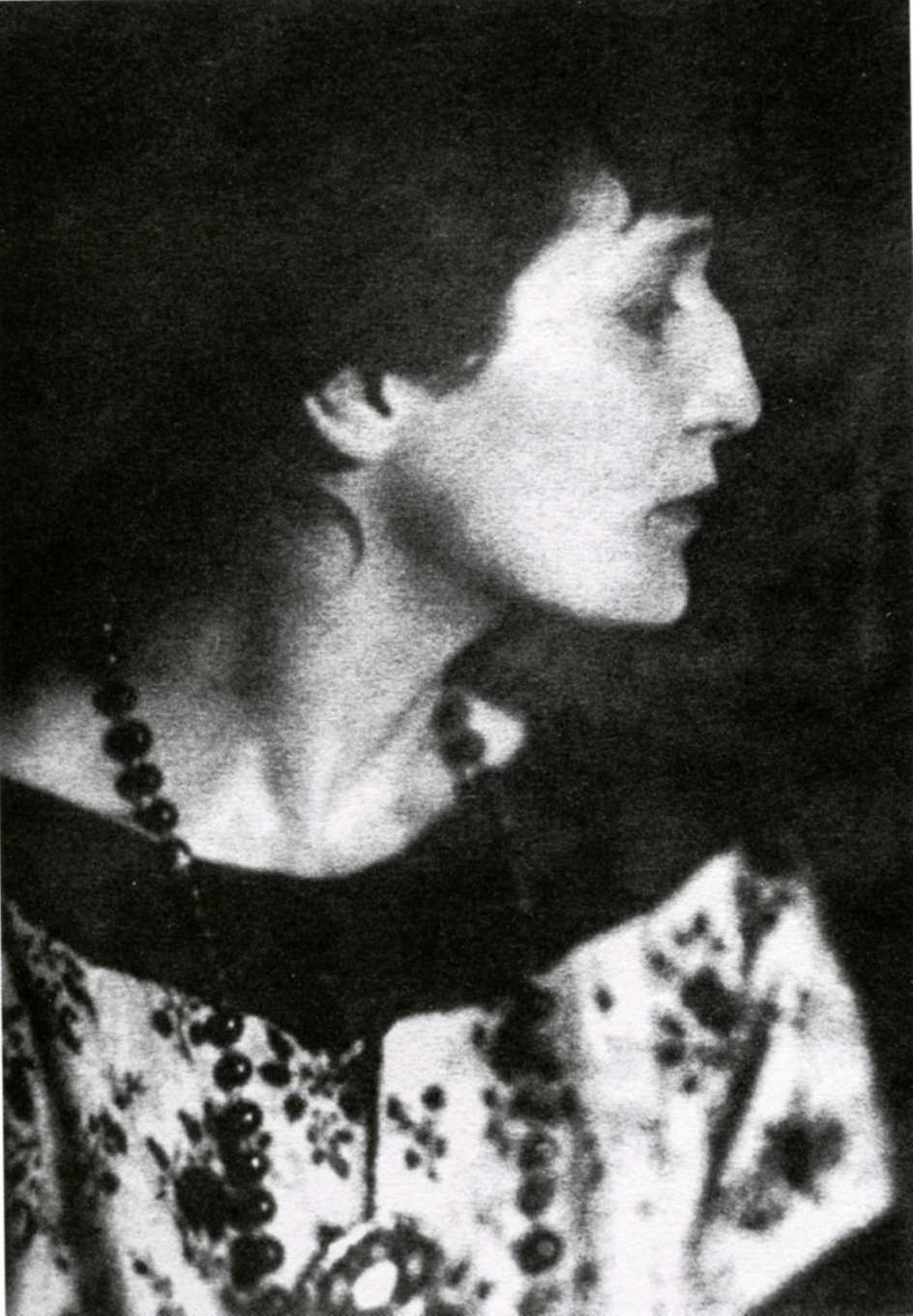
I thought instantly to Anna Akhmatova, who suffered immeasurably during the Russian Revolution for her poetry. Her literary friends and colleagues were systematically killed, starved, exiled. Several took their own lives. Her husband was executed by firing squad. Her son spent years emaciating in prison camps. For words. Even when in poetry, words reveal themselves to be words.

Yet, while others moved to Western Europe and beyond, she remained a steadfast resident of her homeland, despite censorship and slander (the grammars of war), dedicating herself to promote a golden age of Russian poetry.

To The Many

I — am your voice, the warmth of your breath,
I — am the reflection of your face,
The futile trembling of futile wings,
I am with you to the end, in any case.

That’s why you so fervently love
Me in my weakness and in my sin;
That’s why you impulsively gave
Me the best of your sons;
That’s why you never even asked
Me for any word of him
And blackened my forever-deserted home
With fumes of praise.
And they’d say — it’s impossible to fuse more closely,
Impossible to love more abandonedly…

As the shadow from my body wants to part,
As the flesh from the soul wants to separate,
So I want now — to be forgotten.

Anna Akhmatova (1922)

“Whereof one cannot speak, thereof one must be silent. Wittgenstein, “Tractatus.”

21 Saturday Apr 2012

Posted by summermlee in Aesthetic philosophy, Art, Nature

≈ 7 Comments

Tags

art, Hawaii, Kilauea, Mortality, philosophy, poetry, silence, Stanley Cavell, Wittgenstein

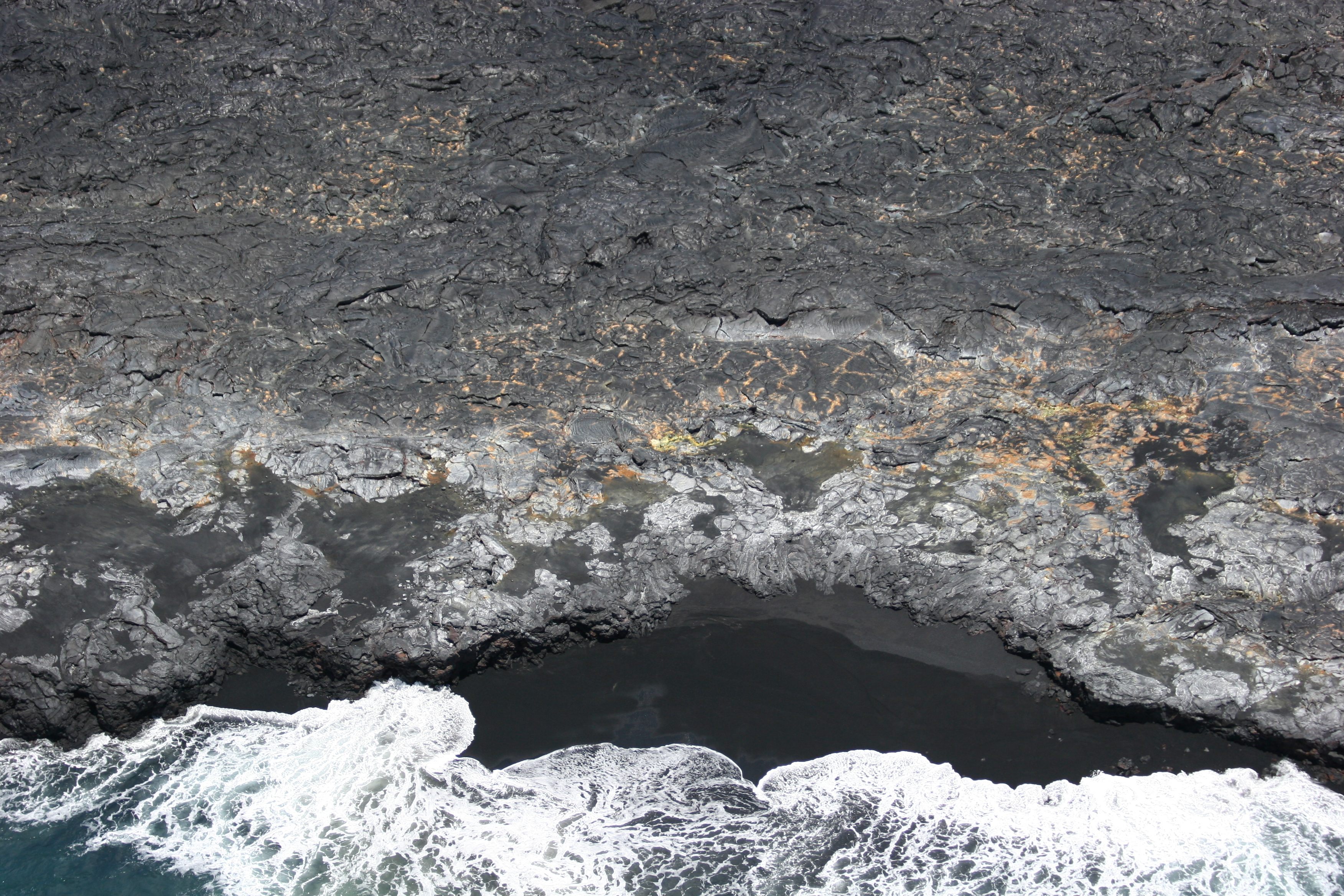
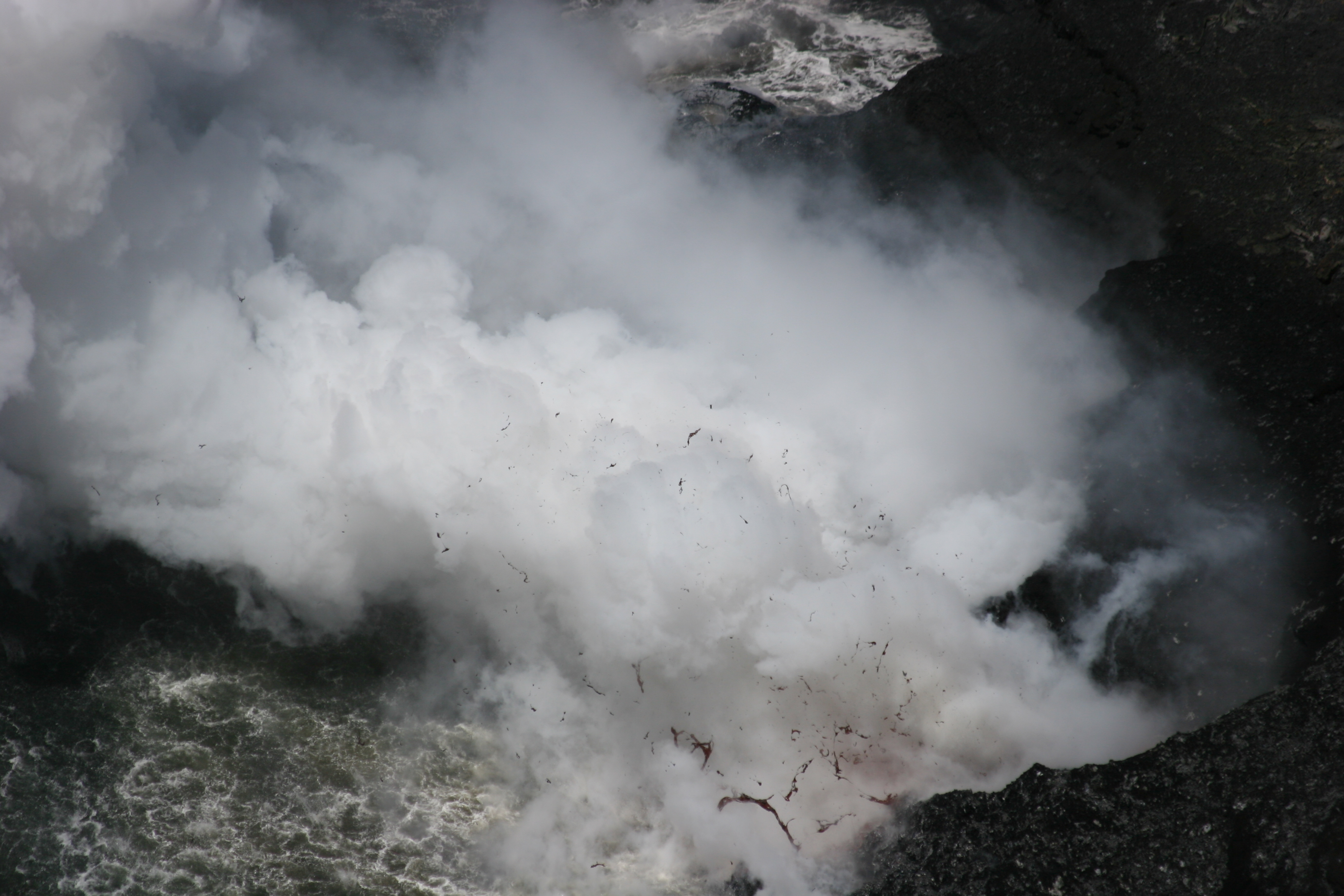
Almost at the ocean edge, I look back up the hill, over the martian landscape to see the miles of frozen stone rivulets, overlapping and intertwining upon themselves, blanketing anything that ever had been there. It is dark, hardened lava which was at one point molten and seeping from wounds in the earth, crawling down the topography according to gravity, until it slipped into the ocean with a burst of steam cloud.

I cried unspeakably when I first saw this, at Kilauea. At first I thought I was responding to the experience of primeval vastness – a meeting with an uncompromising, prehistoric force. Or maybe because it was humbling to be in the presence of the beginning of land, the birth of earth.

For some reason, this is the image that comes to mind as I ponder why I have inexplicably taken a break from writing here.

At some point my philosophy mentor mentioned to me that it is best not to overwhelm the writings or artworks of others with my own subjectivity. It is a balancing act to read the work of others and engage in dialogue, to make comparative study without projecting too much of my own material and subsequently dampening them. To listen without talking over them.

In the last few weeks I have been reading hyperactively, but in a way also bordering on attention-deficit disorder. From Kierkegaard’s crowd of untruth to Anna Akhmatova’s poetry of personal truth amidst a  crowd of censors. And there is George Steiner’s grammars of creation, eruditely nostalgic for the messianic, and Wittgenstein’s language games of lost faith. I have let the writings of these thinkers run over me, perhaps not unlike the rivers of the slow moving, but nihilistic lava, making its way to a border of another prehistoric vastness – my ocean of ignorance. While the writings have been resonant, elegantly constructed and provocative, they are opaque. And maybe it is best to let them do their work before I attempt to crash in with my callow response, my impediments, my convictions.

In short, to let answerability take the form of silence.  However, for those of us who know the therapy office, the dead end of a conflict, or know the time in front of one’s own intransigent painting or sculpture, there is a silence that is laden with an almost perceivable din, however healing it may be. And then there is a silence of a higher order, of untranslatability.

Schopenhhauer said, “Were the universe to perish, music would endure.” And in the moment of pondering the lava field, where seedlings somehow sprout in rock, and liquid rock in its extension of earth annihilates life — creation meets destruction. Artists and writers might want more to be mediators of where sound meets silence, and form meets formless. Paul Celan’s breath-turn. In the end, if I were in that lava field, facing the force that we all perish by, I may be trivial and sentimental, but I would want to hear Olomanu’s plaintive slack key guitar and the lyrics of a homecoming: “Last night I dreamt I was returning. And my heart called out to you: To please accept me as you’ll find me. Me ke aloha ku’u home o Kahulu’u.”

Today’s Advice: “It is through words that words are to be overcome. (Silence may only be the tying of the tongue, not relinquishing words, but gagging on them. True silence is the untying of the tongue, letting its words go.).” – Stanley Cavell

“…those two or three great and simple images in whose presence his heart first opened.” Albert Camus

28 Wednesday Mar 2012

Posted by summermlee in Aesthetic philosophy, Art, Nature

≈ 1 Comment

Tags

Absurdity, Annette Messenger, art, birthing story, Camus, eagles, Kierkegaard, memoir, philosophy

It was clear to everyone at the hospital I was a mess. Because of indescribable back pain, I received an epidural before I was dilated past a centimeter, and therefore my labor progressed at a crippled and wayward snail’s pace. Sometime through the night, I began to shake uncontrollably and a wave of general anxiety overcame me, which I attributed to the drugs; but the nurse on duty said it was mental. The next day, my friends and family took turns rubbing my legs because after a day on an epidural my lower half felt irritatingly restless and paralyzed at the same time. One of the labor and delivery nurses struck up conversation with me, probably because she saw I was floundering. The more we talked, the more my labor picked up, and my dilation progressed.  She seemed to recognize this, too, and felt a sense of ownership over her “project.” It began as chit chat, but at some point it became, as my friends kidded, unsurprisingly philosophical. And I don’t remember how, but it turned to Kierkegaard, as I blurted out to the nurse that during my pregnancy I had struggled with faith — a faith that everything in my pregnancy would be ok. I don’t remember exactly what she said, but she said something exactly wise, and it implored my confession of a previous  miscarriage – and that I would never know why it happened. That unanswerability undermined my willingness to “leap to faith,” even though I knew my faith, or lack thereof, had no bearing on how the Fates would knit together the outcome of my current pregnancy. Something so utterly close to me so as to be part of me, indeed sharing my blood, was outside of my control. This realization seared me like the pain that both rends and joins, and the nurse feeling her own limits looked out the window as I wiped a tear away. But she came back from her momentary distance and said, I bet you just reached the transition stage of labor – every woman I know has a revelation when she reaches the utmost extent of dilation. Exertion.

—

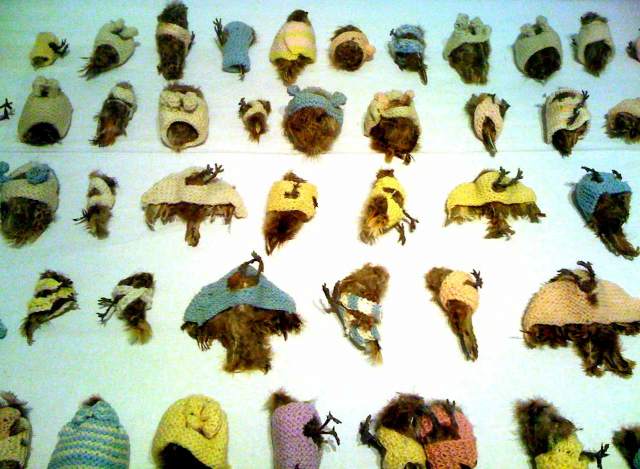
Over this past weekend in a light conversation with my studio mate, I threw around the word absurd to describe similar artworks from two artists, both who crochet and knit onto their treasured but precarious subjects. After hearing my studio mate’s response that she liked absurdity in art, I realized, despite my sophomoric passion for philosophy, that I was using the word unnecessarily in a negative way.

(Annette Messenger, “Les Repos de Pensionnaires,” aka “The Boarders.” 1971-72)

Both Camus and Kierkegaard philosophize about the absurdity that every human being faces – that we sense our life has some significance, some meaning; but as Camus put it, we are met with a cold, uncaring universe. We are saddled with the paradox that we are called to care with all of our might for the most vulnerable amongst us (especially ourselves) — yet we have in the end a limited bearing on what becomes of our fledglings.  (And somehow an acceptance of this allows our circle of caring to expand.)

Yesterday my mother, my son and I reach the spot where from across my hometown reservoir, we could see the faint outline of a large, dark bird with a tell-tale, beacon of a white head and tail, perched on a dead pine. Nearby, we could barely make out a nest occupied by his mate, mid-story in a moss-laden pine.  But the small smudge in our binoculars amounted to an extraordinary image in our minds. Thought never to emerge from the point of decimation by DDT, it is a nesting pair of bald eagles — the first in the Bay Area in 100 years.  We joined a small group of other enthusiasts, all sharing an inexplicably warm communion as witnesses to this scene. Somehow we are the faithful because we know doubt, tragedy even. And it makes these little glimpses like this, of heart-warming good in the world, seem precious in this painfully but poetically absurd world.

Today’s Advice: “[D]oubt is conquered by faith, just as it is faith which has brought doubt into the world.” Kierkegaard

“Let it dazzle and confound you.” Ionesco, Exit the King

08 Wednesday Feb 2012

Posted by summermlee in Uncategorized

≈ Leave a comment

Tags

art, Ionesco, Mortality, philosophy, poetry, semiotics, tragedy, Wislawa Szymborska

I confessed to my philosophy mentor last week that I am not interested in painting or sculpture right now — just words. He responded by saying that he himself left making for writing many years ago, but maybe he would return to drawing, who knows. Words, he said are so close to us, you just say the word elephant and in a moment the image is there. And words can also in a moment reveal themselves as just words. They are only a thin veil between us and the abyss of meaning and meaninglessness below.

A scene lurked in my mind. A few years back, I was traipsing through San Miguel De Allende, uncoincidentally on a painting retreat. On a break from the studio, I wandered to a cobbled churchyard, where from a humble, wooden bench in the shade, I saw an epic tree, unusual for the area. In its wrangled branches were surrealist swaths of pure white, which to my delight were tussling and preening and honking — egrets. As I moved under the tree, I said good morning to the weathered, bent, workman washing the stones in the nearby driveway. This welcomed him to stop his toil and commune in the sight of hundreds of birds and their nestlings crowded onto this one tree, this cathedral of bird life, hymnal bird hums, and unreal feathery white light.

On the ground at my feet was a grey lump, a dead baby egret whose coarse feathers were just emerging from fluffy down, with a twisted neck terminating at a beak open in an eternal gasp. The man saw my tragic discovery, and since Spanish is unavailable to me, I uttered impotently, “bébé mort.” With eyes that have understood much more about life than mine, he faced me and offered plainly, “Que vida.” Not quite sure what it meant, I answered him, but now know I will never fully comprehend it: que vida.

And though I tried to paint the pathetic little creature back at the studio, perhaps because of my technical shortcomings, it never matched the man, the tone in his foreign words, the moment, the elusiveness of “que vida.”

A somewhat well-known, poet, Wislawa Szymborska, dedicated to “que vida,” left life itself this week, and I am on the trail of her lifelong attempt to put it all to word. In her 1996 Nobel Prize Speech, she paradoxically leaves me with a striking image:

“The world — whatever we might think when we’re terrified by its vastness and our own impotence or when we’re embittered by its indifference to individual suffering, of people, animals, and perhaps even plants (for why are we so sure that plants feel no pain); whatever we might think of its expanses pierced by the rays of stars surrounded by planets we’ve just begun to discover, planets dead, still dead, we just don’t know; whatever we might think of this measureless theater to which we’ve got reserved tickets, but tickets whose life span is laughably short, bounded as it is by two arbitrary dates; whatever else we might think of this world — it is astonishing.”

Somehow she tells me it doesn’t matter what tool or tongue I use to insert an image or two of my own into this “measureless theatre.” I don’t know the ending: Just enjoy the show.

Today’s Advice: “The next day
Promises to be sunny,
Although those still living
Should bring umbrellas.”
– Wislawa Szymborska, “The Day After –Without Us”

Newer posts →

Enter your email address to subscribe to this blog and receive notifications of new posts by email.

Join 619 other subscribers

Recent Posts

  • “Experimenters in the passages between worlds.” Vinciane Despret, Au Bonheur des Morts
  • “The terrifying groundlessness, the eradication of all violences. To be embraced by that which doesn’t know us and in that unknowing caresses us and truly loves us. We might become anything at all, something wildly other than what we are encountered by. A world that truly loves us by not presuming what we want or what shape we will take before we show up… We will be held when we are not known from the start.” — Dr. Marquis Bey
  • Images dream within us, a reverie is a world of expansion.
  • “For the natural world, the ethical responsibility is that being alive gives existence to others.” Vinciane Despret
  • “We meet in the freedoms of each other.” – Takeyoshi Nishiuchi

Archived Posts

Blog at WordPress.com.

  • Subscribe Subscribed
    Unwanted Advice: Reflections from a Self-Appointed Life Counselor
    Join 215 other subscribers

    Have a WordPress.com account? Log in now.

  • Unwanted Advice: Reflections from a Self-Appointed Life Counselor
    View site in Reader
    Manage subscriptionsSign upLog in
    Report this content
    Collapse this bar
Loading Comments...