• About

Unwanted Advice: Reflections from a Self-Appointed Life Counselor

~ Caminante, no hay camino. Se hace camino al andar. Wayfarer, there is no way. You make a way as you go. (Antonio Machado)

Unwanted Advice: Reflections from a Self-Appointed Life Counselor

Tag Archives: death

Welcome home to un-home.

20 Saturday May 2017

Posted by summermlee in Aesthetic philosophy, Art, Birds, Nature, philosophy, poetry

≈ 3 Comments

Tags

art, birds, Chicago, Chinese Bone Repatriation, death, Fra Angelico, Home, immigration, Marie Howe, migration, philosophy, poetry, Summer Lee, Summer Mei Ling Lee, The Annunciation

Non Omnis Moriar

The first bird I met here was half-dead. A Cape May Warbler, my first ever. It had collided with a Chicago building like thousands that do every year. It stood frozen still on the rooftop as I toured the 11-story, urban school for my son, as if warning me of the impending experience there. The Cape May is one of five million migrants and dwindling, but in this season, they still show up as clouds on weather radars every evening as they take into the darkness and as they rest to feed by sunlight.

They must survive the buildings, but also the endless Midwest miles of recently invading soy and corn fields, where there is ironically no food for them. They trace along the lakefront, which is where I found my cathedral among the starving and vulnerable. This church is simple, and the faithful are sensitive souls as they gently but enthusiastically ask me, did I see the black-throated blue warbler over there?

It’s true that in the end love is why. And also, as she crystallized in fragile words, nothing brings so much pain as love.

A third of the first shipment of bone boxes from the United States back to China were empty. Most immigrants back then wanted to be buried in their ancestral homes. They were also not welcomed here. Despite vast impoverishment, the family associations made arrangements to clean the bones and ship them on a 30-day ocean journey via Hong Kong, from where they would be delivered into China. The empty ones were soul-summoning boxes, when their were only names, when bodies could not be located. Something had to migrate home.

Some never made it back. Some are stuck in transit, in boxes in a storage house in Hong Kong, where they opened an empty one for me. When I saw it, I cried uncontrollably. And when I came to, I remembered Faure’s requiem.

Some are still waiting in my hometown, like my great grandmother. And here I had thought the Chinese village name on her tombstone was for biographical purposes only. When in fact, like so many others, it is an unkept promise of a more final return home.  No matter how many children they birthed and raised on this soil, the burial here is temporary. Address labels with no postage, the stone mark of their villages is a question mark of an eternally unanswered request, beseeching unwitting visitors, please take me home. The village name, possibly of a village that doesn’t exist anymore, is a way the dead stay alive. Yes, never dead if your progeny visits and honors you. After all, if someone remembers you, you still exist. But here it is not ancestral worship either, just an endless restlessness for homecoming.
6500294f6f1bc41c81d2bdba49049b3e
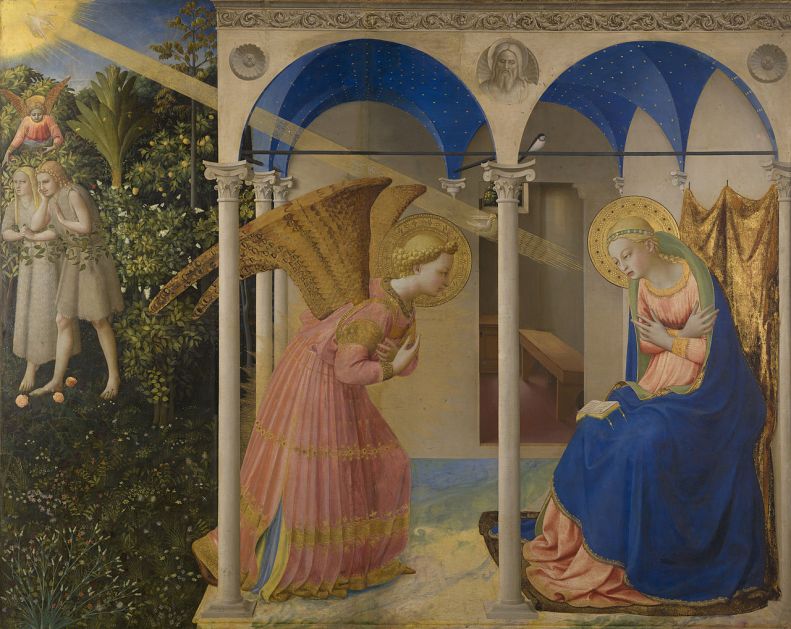
(The Annunciation, Fra Angelico, 1425-6)

The neighbor in Chicago to the right voted for Trump and the grumpy one on the left asked to take down my bird feeder because it was bringing woodpeckers to her yard. I never saw a woodpecker at my feeder in California, who knows why not, but there are four kinds here. You wouldn’t understand what it is to stop feeding the birds of my home. There is no one now to track their yearly changes as well as their disappearances. To no longer hear their version of truths about migrations and the space they know between heaven and earth. So I set out to ask the strange birds of my new home.

It is cold and rainy as I hold my camera up to these birds. We join together in the hopeful uplift of these visitors, knowing also they won’t be here much longer. And I realized maybe this is the reason I was brought here, and why I must now live between two homes.

It was also cold and rainy when I found him at the nearby cemetery in an unmarked grave. The Hong Kong assignment led me to review my grandmother’s INS interrogation from 1925. In it, her father describes burning the documents of her oldest brother at his gravesite. To erase any reminder that he had died in Chicago, the year before in 1924, at the age of 21 of a sudden illness that is of poverty. The confused clerk looked at me strangely, the white lady who presented his romanized Chinese name, but soon enough they found him on a hand-written map. Minutes later, the groundsmen took me to a field and paced off the coordinates — and there in the middle of fucking Chicago, I had found his bones.

She said, it’s as if I had to become displaced to find my family.

(In my imagination my grandmother’s family experienced one Chicago winter because thank you god they quickly moved to San Francisco.)

And if you have ever uttered a word thinking your dead would hear, you understand the birds. And you also know that all real happiness sets you on the edge of loss. As Judith and I ended our two hour phone call, a Cerulean Warbler flitted across my driveway. It was here and gone so quickly, it exists in the realm of doubt. But somehow my grandmother knows I am listening.

____________________________________

ANNUNCIATION

Even if I don’t see it again – Nor ever feel it
I know it is — and that if once it hailed me
it ever does–

and so it is myself I want to turn in that direction
not as toward a place, but it was a tilting within
myself, as one turns a mirror to flash the light to where it isn’t — I was blinded like that — and swam
in what shone at me

only able to endure it by being no one and so specifically myself I thought I’d die
from being loved like that.

— Marie Howe
“Already the knowing animals are aware that we are not really at home in our interpreted world.” Rilke

30 Saturday Apr 2016

Posted by summermlee in Aesthetic philosophy, Art, Birds, Nature, Uncategorized

≈ 3 Comments

Tags

art, China, death, immigration, nature, Rilke, Summer Mei Ling Lee

IMG_1118

In the thicket of wild and obscure feelings, I want to have faith in the art of incantation.  Because I can’t but darken and over-organize the more luminous and playful energies in the inward privacy of a mind, I had stopped for so long.

But now there is so much uncertainty to invite me here.

The first impulse is to eulogize the land. To grieve the coastal mountains where I have lived all my life, now overlooking a sea-change, with only hazy constellations to navigate by.

Then the birds of my neighborhood, who will feed them now? Who will notice when Fox Sparrow arrives in the fall and leaves in the spring? Who will extoll how perilous and brave he is?

And then there are all my life-long loved ones…. And the ones who love my sons. The ones like me who don’t migrate and never have.

A few weeks ago, I was deep in the grand-mother land, under the green mountains jutting up like crowded tombstones in the fog of familiarly foreign languages. On one clear day I asked her about the lightening and thunder, and she said no, they are bombing the mountains to make way for roads.

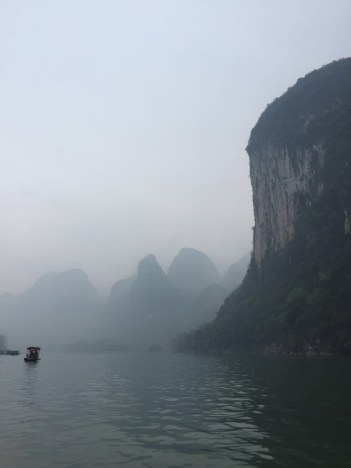
I watched the locals prepare for Ching Ming, as I headed home. How it is that the snap of fireworks can cleanse the space of the afterlife. And yet the ways we keep the never-aging dead here with us. Along a new freeway — more of a battlefield than a road — I passed one ancient mountain where erosion had stripped the earth except for one gravestone. The simple tomb seemingly held up the core of stone and dirt and history. And the other unworldly mountains looked on and agreed. We had floated through those sentinels of ancient ink paintings on bamboo rafts. Our handsome raft-man says his family goes back 1500 years to that village, where now he can no longer survive on our one fare. So we helped him carry the raft upstream, and he let me miserably try to pole us as he so elegantly could. But I kept driving us into the riverbank where a lone woman kneeled among the rows of radishes over several lifetimes.

And they would apologize for being simple peasants, their words. And I begged them to know we dream their life. Except I know ours somehow has a deeper horizon — however unchartered, un-ventured and never satisfied. And our pastime of theorizing choices and opportunities when their doors open to another dark courtyard where the chickens scratch. But I sat by her fire and heard the pond language of traveling spring water and ate the fish they just took from there. All while the crickets and stranger frogs hummed oddities. I could place her here in my mind, like how one copes with an untouchable lover on a far-off continent. There I felt a new loneliness that lurked behind me in the bamboo forest, like a luxurious hotel room with no one to share the ache. And it has followed me home.

Because in the same day, I was driving down the street of my childhood home, firmly in an Americana that is iconic and unoriginal and unmoving. The same home that bore an insulated, however splintered child that never moved 30 miles from her birthplace. I arrived on that self-same street not by miracle of imagination but by dint of modernity and privilege and luck and post-human transportation and time changes. There are no words to describe that kind of return.

I cannot also romanticize that grand-mother-land — she is my fleeting sight of the glowing pheasant bird heralded in those ink paintings, digging through garbage behind the hastily-restored Great Wall.

Here is my love of grassy and vegetal air rising off the coastal scrub above the rough surf. The cliffs off which people much braver than I, with only fabric and string faith, jump into those circling updrafts. Here also are the voices of people droning on about sniveling inannities. Trying to escape from their own aching hotel rooms of life, like me.

Her migration was epic like Fox Sparrow’s. Not like ours to a new state. Maybe it is her cells flowing through me, carrying the trauma of torn roots that makes me feel otherwise. She came from so far to be buried here, now part of my mountain over this ocean, not one of those over his river. And I don’t want to go. God please don’t make me go. And I will go. I know and forget that all these minor heartbreaks are good practice for the final one, whichever mountain it will be.

IMG_0954

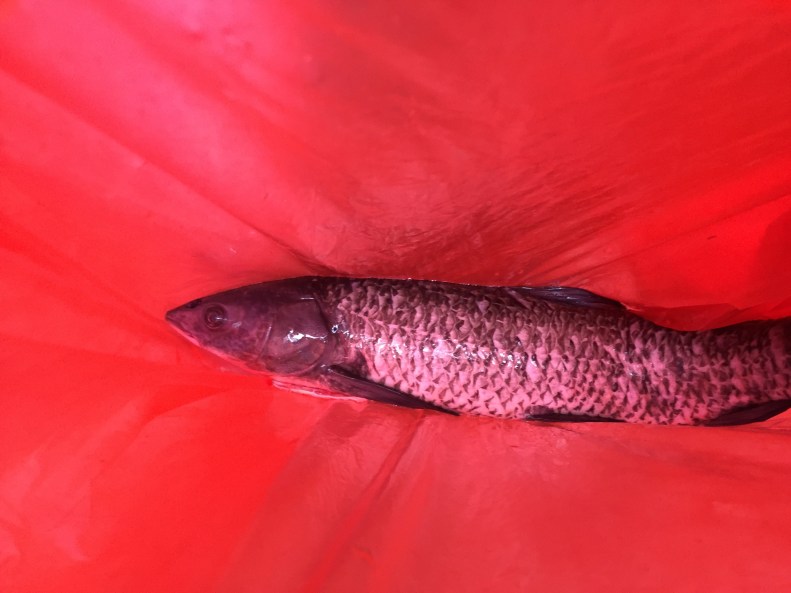
(That fish.)

“We are in the midst of reality, responding with joy.” — Agnes Martin

23 Sunday Jun 2013

Posted by summermlee in Aesthetic philosophy, Art, music, Nature, philosophy

≈ 8 Comments

Tags

Agnes Martin, art, chapel of the chimes, death, Garden of Memory, George Steiner, Heidegger, painting, summer solstice

A year later and I am back visiting the dead, this time questioning the responsibility of putting new life into the world.

Weaving in and out of the crypts and private chapels, the walls are lined with vessels holding ashes, shelves holding caskets, and the letters of names. It takes a strain of my imagination to fill-in the entire arc of a life that now sits in mostly forgotten urns, placeholders. Once behind the names were fleshes of personality, interactions that effected causality, relational change, consequences in the environment, impressions on the psyches of others — and then they were gone. Except for a spot in a tiny little box aside thousands of others, now also mere words.

Painting by Agnes Martin

(Painting, “Tremolo,” by Agnes Martin, 1967.)

This year, it struck me that the cast of musicians performing here and there among the dead were stand-ins, intermediaries. They attracted hordes of the living into this solemn place on the longest day of the year to challenge the human aloofness towards the dead, to weigh the untranslatable meanings behind those words. With mixed success. Even though evidence of death towers on all sides, our finite narratives and rehearsed terminal endings at the end of every sentence — we remain distracted from our own dying.

We committed to one dark grotto of those born in the early 1800’s. A professional cellist sat inside with her laptop and synthesizer. Sometime while she was tuning her cello and tapping on her laptop, it dawned on us that she was in high performance. The ambiguous noises were experiments against the classical instrument’s boundaries: a stutter and screech here, a falling note there, a computer’s response, and the cellist’s retort. When she finished her “tuning” performance and nodded her head to applause, we understood that the provisional and dissonant duet between cellist and computer highlighted the aleatory relationship between existence and not-existence — and was indeed beautiful music. As Steiner says, art reminds us that there is something rather than nothing, only by virtue of grace.

The scene seared into my heart the ruminating words I had read that day of my dear friend’s husband having only days to live. They were going down their road until a few weeks ago, their life was sideswiped by illness and overturned into a tragic twilight. At home in hospice care, they are surrounded by friends and family who improvise themselves into a blanket of love and support for his last moments. There is no score or predictable soundtrack here. Nor, as Pamela says, is this life a dress rehearsal. But at best we merely hear the music at all.

Painting by Agnes Martin

(Painting, “Trumpet,” by Agnes Martin, 1967)

My friend this evening and I jest that it is just as much the beauty of the performer as it is the melodic tunes (amidst many dissonant-sounding experimental musicians) that has drawn a thick crowd into side room of the columbarium. Sitting on the stone floor in vulnerable elegance, she plays odd, unrecognizable instruments in classical improvisations. And we, the living, over a trickling fountain lined with pertly pink and red impatiens, “watch” her fill the space of the eternally invisible with unseen timbres and undulating wavelengths of passionate percussion. When she breathes into a bamboo flute with an electronic lung holding a previous refrain to which she responds in turn, a strange but pleasing chorus emerges into a rhythm of labored breath, a futile and yet beautiful resuscitation.

(In the stairwell from one chapel to another, we overhear a woman remark that this is what people from the rest of the country think Californians do everyday.)

But the true entrance into me does not occur by that willful anticipation of art, just as much as predicted words here do not alight, but sink. Instead it happened when an unexpected noise entered the back of our music-filled worship. It announced the entrance of a young, disabled girl with the cognition of a child ten years younger. She burst into this delicate space, hugging a 3-foot Barney and two teddy bears, and proceeded to march directly to within inches of the musician. The performer was startled but without missing a note, welcomed her softly with her eyes. And the girl of a strange grammar, much to my held breath’s relief, plopped herself front and center with no further histrionics. While the music pulsed along, the girl’s father sat down in the back, occasionally waving a connective hello to his girl. But she is now entranced by the familiarly foreign music, playing seriously with one of the bear’s ears — because afterall, this is about our ears.

And I, the helicopter parent, who constantly restricts my exuberant son in a cloying distrust and tiresome fear of violating the perceived comfort of everyone around me, orchestrating him here and there so as to fit who-knows-what expectations, I succumbed to this scene. Yes, a carnival of existence among the backdrop of non-existence, of Nothingness — but mostly of trusting surrender. There in front of the dead, the distracted living, too — and because of the little bit of life under my domain that is there despite me — my heart busted itself into tears.

“As the shrine of Nothing, death is the shelter of Being.” — Heidegger

Painting by Agnes Martin(Agnes Martin’s last painting, “Untitled,” 2004)

“One can never pretend to comprehend completely –: that would disrespect in the face of the Unknown that inhabits — or comes to inhabit — the poet; that would be to forget that poetry is something that breathes; that poetry breathes you in.” Paul Celan to René Char

21 Sunday Apr 2013

Posted by summermlee in Aesthetic philosophy, Art, Birds, Nature, philosophy, poetry, Uncategorized

≈ 7 Comments

Tags

art, death, Leigh Hyams, painting, Paul Celan, poetry, San Miguel de Allende, Stephane Mallarme, teachers

Since I was the youngest by 3 or 4 decades, my traveling companions were relieved it was me who, drained from travel and the stifling heat (and a sip of the local margarita), interrupted pleasantries to declare that I might pass out. Our host for the week escorted me to the warm cement sidewalk of a dirt street outside the humble restaurant and waited until the cool breeze of the desert night revived me. She asked me polite questions, mostly trying to ease my embarrassment, but also to indirectly resolve how it is that at not even 30 years old, I had become close friends and travel companions with a cadre of women in their 60’s.

The babel of barking dogs woke me the next morning, which was after the night of dreaming she came to hold me. Somehow, the dark sensuality of this woman a half-century older did not alarm me.

In the morning painting session, I start with images and colors I have known before, but they don’t cooperate. As I paint canvases full of utterly conventional crap, I find myself at the edge of tears. There in the shade of her turquoise and pink adobe courtyard, tendrils of bougainvillea cling to the walls closing in on me, mocking my vulnerability and failure — like the stuffing has fallen out of my bra and the world sees me trying to put it back.

She sees the paintings and since I cannot dare the gracelessness needed to throw them over the fence,  I wish for once they could tell a lie. She moves like a dancer around them and critiques them with the fists of a boxer. I am politely mute, in turn, hating my own politeness. I want to hate her but she is just the conduit.

Painting. By Leigh Hyams(Painting by Leigh Hyams)

Plus, San Miguel de Allende overwhelms my sensitivity. I know why the dogs bark. All of them trying to simplify and drown out the brightly jarring colors, the incessant music from blocks away, the dead heat, the spirit voices, the craving for something other. The unreachable ocean.

The next night I dream that my neighbor’s contractor tears out my yard. All my cherished plants are missing, upturned soil exposes eviscerated roots. I experience an abyss where there once had been logic and rationality. Before hitting bottom, I wake to the pre-dawn storm of bird songs.

My dream is clear to her. She tells me in deep tones and direct terms that this unknown is the place where I want to be. Because of this and the buzz in her words, I start crying as she speaks, releasing all the tears that started bubbling in the courtyard. Tears that were neatly packaged screams against my mediocrity, my mundane banality, my safety. Tears that were cages holding a fearful but overgrown child wanting out into the wilderness. My painter friends look on tenderly, thinking it is because I’m sad. But I am beyond sad or happy, I am approaching otherness.

They think she is only speaking to me.

She says, this crying business, as if to be disdainful and compassionate at the same time, is something that only artists can understand.

I would return years later for an extended time considering the small city, my being in the midst of fertility treatment, and the lack of communication to my home from this gritty, foreign country. I was prisoner again to my own painting in her light-drenched studio, but she was a gentle and stern warden. We had many conversations here and there, aside a parade of indigenous costume-wearing tribes, over breakfasts in teeming gardens, after a dip in the local mineral springs, and hopping along the cobblestones incongruently filling the roads.

Sensing her increased frailty and watching her meticulous devotion to a series of sparsely charcoaled paintings of local ruins — to me obvious elegies to past magnanimous accomplishment — I asked if she was questioning her mortality. She, sitting in the improbably verdant backdrop of a sumptuous, water-filled courtyard garden gleaming in desert light and singing heat, answered with a smile, and maybe a slight disingenuousness: not anymore than I always have.

Painting by Leigh Hyams
(Painting by Leigh Hyams)

Some mornings new art books would appear at my breakfast table, always with unspoken pertinence. I loaned her my copy of Mary Oliver’s recent Evidence — a book of searching poems comprised of terse words around what cannot be buried, even spoken, after a loss, or death.

So I can imagine exactly how it was when she died a few weeks ago. Her bed is overlooking her wildly tended garden. She is arms-distance to her favorite art pieces ranging from profoundly poetic to those with playful certainty, and those, maybe her favorite, continually in serious questioning. I can see the washed out colors of early Mexican spring, feel the light-headed air of the high altitude aggressively dancing with the dust lifted and levitating in her richly alive, medieval Latin city. And I hear a liturgy from the birds of her neighborhood, of course, taking over the tinny brass horns droning from distant radios. The birds alone can accept that someone who loved life so much should have to leave it.  As a consolation, when dawn breaks leaving an emptiness for the rest of us, they send jewels of ephemeral birdsong down to earth to adorn her.

“Toute chose sacrée et qui veut demeurer sacrée s’enveloppe de mystère.” Stephane Mallarmé

Painting, by Leigh Hyams

(Painting by Leigh Hyams)

“Threadsuns / Above the grayblack wastes. / A tree- / high thought / grasps the light-tone: there are / still songs to sing beyond / mankind.” – Paul Celan

08 Friday Mar 2013

Posted by summermlee in Aesthetic philosophy, Art, philosophy, poetry

≈ 6 Comments

Tags

A Portrait of the Artist, Ancestors, art, death, James Joyce, Paul Celan, poetry, The Last Poems, There are still songs to sing beyond humankind, war

Despite some eccentricities in his presentation on the phone and his ardent refusal to use any technology, the elderly gentleman asks nothing and offers to help so today I go meet him in a restaurant in a suburb north of the City.

I anticipate that my art is ill-suited for his services, which mostly consist of lining up restaurants and businesses to display art with ungainly price tags. And when I see the Italian restaurant’s orange stucco walls with a range of some-accomplishment to beginner pieces, I remind myself to just see what the man has to offer.

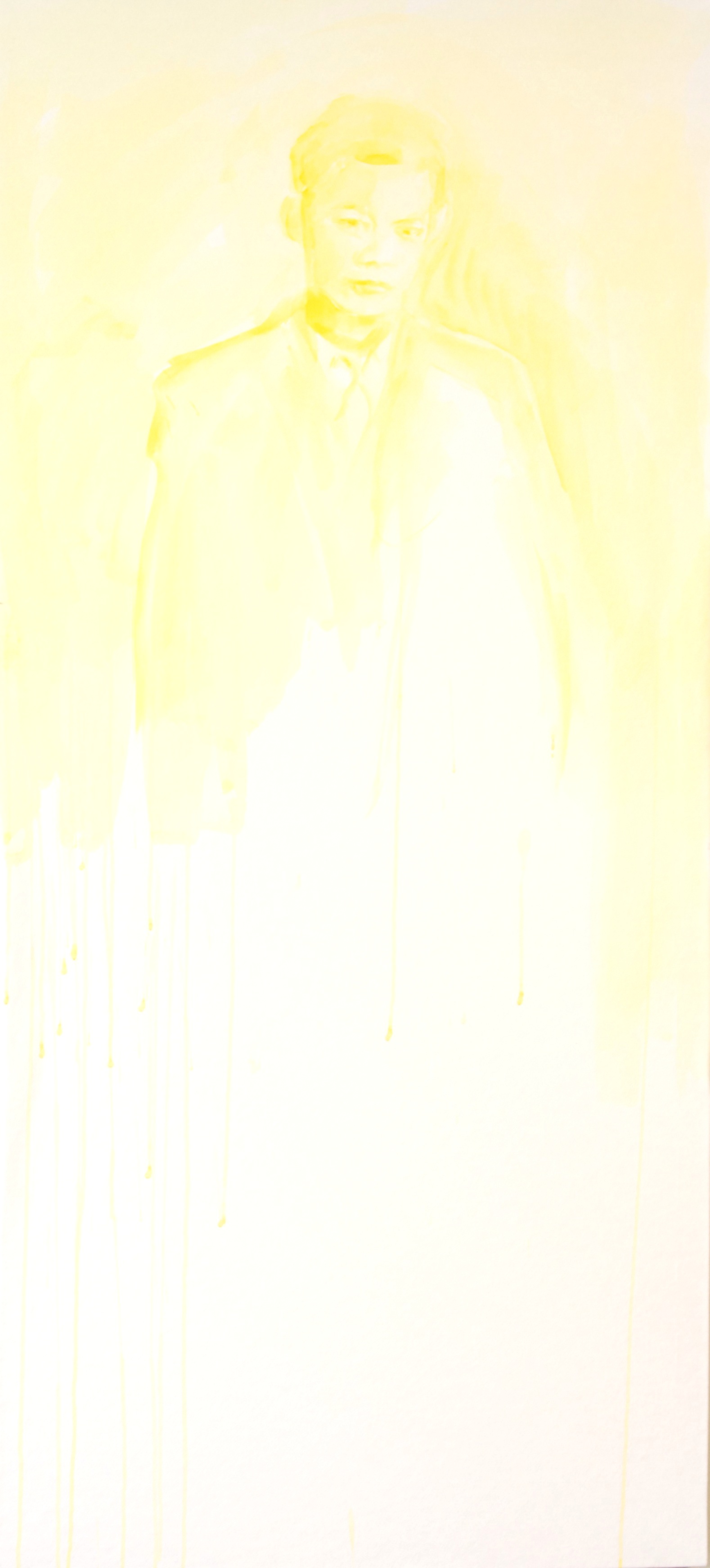
He is sitting in the corner, with a feminine, white, bob haircut coiffed neatly, a large Nordic nose over a receding chin. He is incredibly tall even hinging on his aged frame. He looks straight at me with a pale, wrinkled face holding ice blue eyes. He hands me a form listing the opportunities he gives to artists. I politely decline all of them and tell him that my work in my experience has not been palatable for the average “civilian” (his term not mine). In turn, he explains that society needs art and that an artist does no service hiding out making art privately. Art’s service is to move and connect to other people. I retort saying art is about solitude and that the optimum experience is to stand guard over someone else’s solitude. I am not interested in converting people to a state of interest. Besides my art would be taken as freaky (my word) in the milieu in which he works. He asks why. I explain that lately my work consists of 6-foot, yellow watercolor portraits that are hard to look at. I explain how these works are about my ancestors, being haunted by them but the impossibility of knowing them. And of course it is also about their death, but I admit I have more questions than answers about that part, and art is the place for unanswerable questions. It is not of the stuff that people want to fill their homes with.

Then he argues simply, “But you have the knowledge of who your ancestors are inside you.” And I say, no, the mystery is more important. He agrees and asks if I have time for a story.

He tells me that he was born on a dining table in Copenhagen to a gypsy-blooded mother. He said he was five years old when he was first interrogated by the Gestapo. That year his family under pressure set out to leave Copenhagen to stay with his grandparents who lived in the countryside outside the city. All Danes at that time ride bicycles, he disdains. And they would have to pass on bicycle an SS checkpoint with machine guns pointed over the road.

I said I don’t like where this is going. He paused for me but continued.

He said his father told him he would go first, then his sister, his mother, then finally his father, all in one line. His father told them all to keep bicycling past the checkpoint at least 50 meters before stopping. His voice starts to shake and I realize my hope of a happy ending is dead. My eyes immediately well up. He apologizes. He says this is very difficult to talk about. I say it is very difficult to hear. He slowly continues. He utters that he rode across, then he chokes again and clears his throat. He heard gunfire behind him and he kept going. He is sniffling now and I am weeping openly. He says he rode to his grandparents’ house, familiar with it from previous visits, and arrived to what he calls his friendly oak tree. One, he adds, that has a chimney. I nod in complete recognition, ungracefully smudging tears off my face. He says he stayed for a longtime there at the oak tree until at some point he received a message. He was told that he is now on his own, an orphan of the universe, and that he was also now a genetic placeholder for his ancestors.

—

Encumbered lately by the difficult poems of Paul Celan, I sense in his poetry the excruciating search for the impossible understanding to his parents murder, their lives cut off not far from the place and time of my own storyteller. Celan’s life’s work (and resultant suicide) was the existential failure to make sense of life mediated by language, using that same language in a means to what he describes as becoming silent. Silent like all those he survived. He was tormented, like Hegel, by the fact that words have a way of removing themselves from their meanings. That one day someone could utter genocide and it would be far from what he experienced. His collection of poems is therefore entitled, The Last Poems.

—

Back in this beautiful Italian restaurant adorned with the hopes of artists wanting to touch others and be touched, our artwork — an offering for his family — hung in a silence that was awkward to all but us. He finally breaks it and says to me gently, humbly: I lived it — I know what war means. And at that moment, I glimpsed the entirety of the word myself.

Still Frame from Ancestors on Rice Video, Summer Lee
(A still from a recent video, A family portrait projected on falling rice. 2013. See the whole video here. http://youtu.be/IoGln7tNyGo

“Terror is the feeling which arrests the mind in the presence of whatsoever is grave and constant in human sufferings and unites it with the secret cause.” – James Joyce, A Portrait of the Artist.

“…a collector of silences and solitudes.” George Steiner on Ludwig Hohl

17 Saturday Nov 2012

Posted by summermlee in Aesthetic philosophy, Art, Nature, philosophy, poetry

≈ 2 Comments

Tags

Andre Chénier, art, death, George Steiner, Orpheus, poetry, rainy day poetry, solitude

As the sun’s last flashing ray,
As the last cool breeze from the shore,
Cheer the close of a dying day,
Thus I strike my lyre once more.
As now by the scaffold I wait,
Each moment of time seems the last,
For the clock, like a finger of fate,
Points onward and onward fast.

— Andre Chénier, 1794


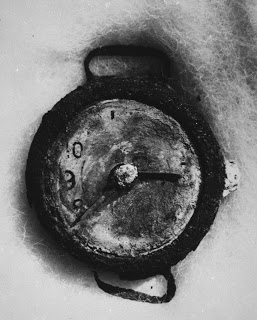
(Hiroshima watch, 8:15 a.m. August 6th, 1945)

A rainy day in the Bay Area is perfect for poetry that celebrates the precious solitude lacking from my life these days. I don’t need to blame the mundane circumstances of my life, or the lasting hangover from “art” school. Or the fact that I am trying to write this in a car whose turns are twisting my stomach into nausea all while from the backseat my son repeatedly sings a preciously off-tune version of the Abc’s. Because even so, anything less than what Steiner describes as a writing at “the edge of itself,” anything that falls short of being itself but also “speaking on behalf of the other,” is not a moment of true solitude. Art and writing necessitate a “self-summons” but also a “state of nothingness,” of which I am not capable of right now.

And what analogy is more apt than of a man awaiting guillotine in the last days of Revolutionary France, relying on his art to guide him to the imminent underworld. Again, I hear Orpheus calling on music to forge a path into the unknown. But somehow, thankfully, the situation need not be so dramatic, so dire, nor as politically charged, as to understand that what Chenier describes in his last moments is the human condition we all find ourselves in.

“The Young Captive”
The budding shoot ripens unharmed by the scythe,
Without fear of the press, on vine branches lithe,
Through spring-tide the green clusters bloom.
Is’t strange, then, that I in my life’s morning hour,
Though troubles like clouds on the dark present lower,
Half-frighted shrink back from my doom ?
Let the stern-hearted stoic run boldly on death!
I — I weep and I hope; to the north wind’s chill breath
I bend, — then erect is my form!
If days there are bitter, there are days also sweet,
Enjoyment unmixed where on earth may we meet?
What ocean has never a storm?
Illusions the fairest assuage half my pain,
The walls of a prison enclose me in vain,
The strong wings of hope bear me far;
So escapes from the net of the fowler the bird,
So darts he through ether, while his music is heard
Like showers of sweet sound from a star.
Comes Death unto me? I sleep tranquil and calm.
And Peace when I waken stands by with her balm.
Remorse is the offspring of crimes;
My welcome each morning smiles forth in all eyes,
My presence is here, to sad brows, a surprise
Which kindles to pleasure at times.
The end of my journey seemed so far to my view;
Of the elm-trees which border the long avenue,
The nearest are only past by;
At the banquet of life I have barely sat down.
My lips have but pressed the bright foaming crown
Of the wine in my cup bubbling high.
I am only in spring, — the harvest I’d see,
From season to season like the sun I would be
Intent on completing my round;
Shining bright in the garden, — its honour and queen;
As yet but the beams of the morning I’ve seen,
I wait for eve’s stillness profound.
O Death, thou canst wait; leave, leave me to dream,
And strike at the hearts where Despair is supreme,
And Shame hails thy dart as a boon!
For me, Pales has arbours unknown to the throngs,
The world has delights, the Muses have songs,
I wish not to perish too soon.
A prisoner myself, broken-hearted and crushed,
From my heart to my lips all my sympathies rushed,
And my lyre from its slumbers awoke;
At these sorrows, these wishes, of a captive, I heard,
And to rhyme and to measure I married each word
As softly and simply she spoke.
Should this song of my prison hereafter inspire
Some student with leisure her name to inquire,
This answer at least may be given, —
That grace marked her figure, her action, her speech,
And such as lived near her, blameless might teach

That life is the best gift of heaven.

(A recent watercolor of an unknown relative, 72 x 33 inches)

“You were my death / you all I could hold / when all fell away from me.” Paul Celan

27 Saturday Oct 2012

Posted by summermlee in Aesthetic philosophy, Art, philosophy, poetry

≈ 5 Comments

Tags

"The Gaze of Orpheus", "The Instant of My Death", art, death, Derrida, George Steiner, language, Maurice Blanchot, Paul Celan, poetry, Summer Mei Ling Lee, World War II

It is hard to know what this thread is, as it weaves through my recent travels. The only way to understand it more is to start about here.

Because, Blanchot says, in order to write, one must be already writing. “One can only write if one arrives at the instant towards which one can only move through space opened up by the movement of writing.” He writes this in reference to Orpheus, and that Orpheus needed music to descend to the underworld to rescue his love, a precise metaphorical homage to artistic creation. As it happens in tragedy, the moment he gazes at his beloved, he loses her, but experiences perhaps a moment of freedom: “[He] frees the work of his concern, frees the sacred contained in the work, gives the sacred to itself, to the freedom of its essence, to its essence which is freedom (for this reason, inspiration is the greatest gift).”

That is why a particularly masterful work of art recalls the fact that it could not have been — if we are vulnerable enough to let our art be art, let our hearts be touched, and to sense the present moment. Steiner is particularly fascinated with art’s ability to give presence to that which is absent and profoundly otherwise: “The arts, and music above all, give to man the freedom from his otherwise mortal city.” It is where humans can “surpass their condition.”

Blanchot, as with Paul Celan, knew Orpheus’ gaze in his own life, and both had stood within the “breath-turn” between absence and presence. Towards the end of his life, Blanchot wrote this letter to Derrida, who deeply understood occupied France:

“July 20. Fifty years ago, I knew the happiness of nearly being shot to death.”

As Blanchot was removed from his home by soldiers and placed in front of a firing squad, he experienced a “feeling of extraordinary lightness.”

Blanchot writes of the man who experienced this moment, “He was perhaps suddenly invincible. Dead — immortal. Perhaps ecstasy. Rather the feeling of compassion for suffering humanity, the happiness of not being immortal or eternal. Henceforth, he was bound to death by a surreptitious friendship.”

Blanchot, a stand-in for Orpheus, penned this “Instant of My Death” from the stance of a young man’s testimony, a fiction that is the leap of literature, one step removed from his own life. Perhaps he did so because it had been posited since classical Greece that the image of the thing is more beautiful than the thing it represents. But likely more so because he used his art to go to the depths of this underworld experience, the shadow-side of being human.  So at the moment of writing his death — as if Orpheus might describe it in 3rd person narration — at the moment he gazes back at Eurydice, he is free.

Tonight, I sit in my midnight bed, reading-lamp dim, and I hear the the approach of husky breathing that is my son, who turns his inhalations to exhalations without self-consciousness yet, who has ambled out of his bed and his room, guided by slivered lines drawn through sleep-puffed eyes, one hand viced to his blanket. He is just awake enough to know the path to my bed, and he is asleep before I have finished picking his warm, softly surrendered body up into the bed next to me. His breathing returns to the quieter rhythms of sleep and I wonder what impulse wakes him and directs him to my company. Years ago, during a particular grueling time (though there would be worse yet), I woke myself yelling for my mom. Calling for her as if she was down the hallway, like a child needing rescue from a bad dream. The impulse for words that call out for salvation is deep, even as I know that my faith in words, in salvation also, is constantly asunder.

“(At every turn, language traps us within the labyrinth which we are calling on language to elucidate).” George Steiner, Grammars of Creation.

(My recent installation, “Saigyo’s Moon.” Projection of flying birds on eggshells.)

“The narrow bridge of art…” – Virginia Woolf

22 Friday Jun 2012

Posted by summermlee in Aesthetic philosophy, music, philosophy

≈ 4 Comments

Tags

chapel of the chimes, Columbarium, death, Garden of Memory, Laurie Amat, music, Oakland, summer solstice, Virginia Woolf

On the day with the longest daylight of the year, the Northern Solstice, I found myself surrounded by thousands of dead people. Yes, I am probably over-working the mortality theme of late into an insipid pulp, what with all of its depressing seriousness. But at the columbarium in Oakland tonight, the chapels,  cloisters, and crypts filled with the remains of the dead carried the very alive music of more than 30 musicians, as apparently happens every solstice.

In following our ears to the next musician around each corner, we worked our way through the names of bookended lives lining the niches, hallways and courtyards built almost as an ascending and descending gothic maze. Corners and alcoved places exist for the bereaved to experience a meditative solitude away from others, while the constant light through open ceilings and skylights reminds of an other place, and of human smallness. Tonight, the meditators, the remembering, were music-makers.

Among the more recently interred, an accordionist sat on a metal folding chair in a marble alcove and played accomplished polkas and waltzes and even a French classic — the same song I heard on a lively street behind the Notre Dame of Paris. Then, I sat looking at candy colored tulips in the sunny, cathedral garden, while couples cooed at the river, tourists gawked at the sentinel and soaring architecture, and locals ambled on their itinerant paths to bakeries, friendly meetings, work duties. Such aspirating and pumping accordion music is of a buzzing life, even as it was played tonight among the dead. The borderline absurdity of this accordion music in what is usually a solemn and silent, heart-heavy and self-reflective space was almost sublime. Like the last scene of Life is Beautiful, when the parade of humanity, and a boy full of life, marches out of a death camp.

And there was an incredibly serious experimental piano player, in a long hallway of glass-enclosed rows of urns, pounding and trilling her piano in utter dissonant refrains. Our toddler son was fascinating himself in the gurgling, concrete memorial fountain situated a few feet in front of her, and during a particular dark and howling section of her work, he crooned his neck up to the opening in the ceiling, and sang, Bubbles, Bubbles, Buuuuuuubbbbbbles, as if to commune with the alienating musician and her intentionally awful and emotionally grueling composition.

And of course, the moment of Being. I ducked into a light-filled crypt, where written passages of St. Luke adorn the stacks of shelved lives reduced to a plaque of name and date, a date far enough in antiquity that nothing is remembered of them except their grave marker. There, a welcoming, professionally-attired woman, Laurie Amat, gracefully filled the space of the dead with her operatic voice, lilting and trembling and belting and reverberating against the stone architecture. Her melodic voice ushered me in, but as she faced the places that contained the dead, her audience, I knew that I was superfluous. Her talents were refreshment for those who cannot sing or listen anymore. She was an instrument upon which an aliveness came home to acknowledge, to reach even, the realm of the unalive. It was a remembrance for the forgotten. And it was a reminder that I, like the thousands surrounding me who are reduced to ashes, urns, plaques and one or two mementos left by a dwindling number of adoring survivors, last for just a second on this earth — just like one of her perfectly pitched, honeyed notes as it disappears into the ethers, like the note before it. At first it hurt to let go of all that my self thinks is important, those empirical requirements of the everyday. And yet, the more I disappeared into the moment, I didn’t care that I was gone, forgotten. In fact, I relished it.

“If again we should find if we took a walk with our friend that he is alive to everything — to ugliness, sordidity, beauty, amusement. He follows every thought careless where it may lead him. He discusses openly what used never to be mentioned privately. And this very freedom and curiosity are perhaps the cause of what appears to be his most marked characteristic — the strange way in which things that have no apparent connection are associated in his mind. Feelings which used to come single and separate do so no longer. Beauty is part ugliness; amusement part disgust; pleasure part pain. Emotions which used to enter the mind whole are now broken up on the threshold.” Virginia Woolf

“When he walks out into the rising dawn or looks out into the event-filled evening and when he feels what is happening there, all situations drop from him as if from a dead man, though he stands in the midst of pure life.” Rilke

17 Sunday Jun 2012

Posted by summermlee in Aesthetic philosophy, Art, philosophy

≈ 3 Comments

Tags

Araya Rasdjarmrearnsook, art, death, Father's Day, Heidegger, phantoms of Asia, Rilke

Rilke says it best that without solitude, the meditative place for the fostering of one’s inner life, there can be no art. No love, either. Love, he writes, is standing guard over another’s solitude.

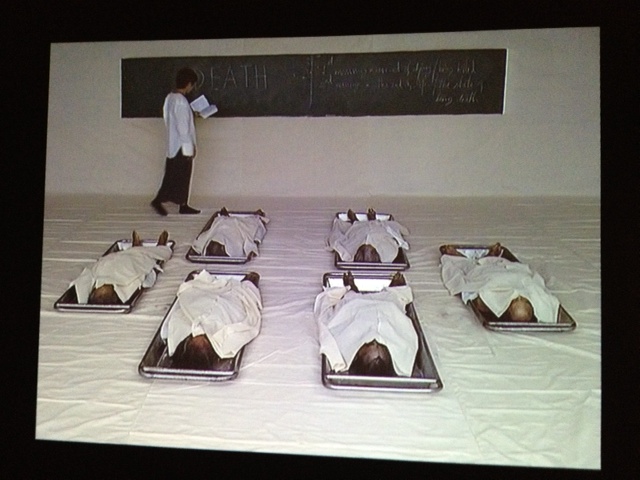
I found a moment to go to the Phantoms of Asia exhibition in the Asian Art Museum, where I encountered this video, entitled, The Class, by Araya Rasdjarmrearnsook. The artist is in essence, lecturing the six dead bodies on death. It is no accident that from where we sit, we are in the same audience as the dead people. At some point, my body will be that corpse lying on a tray. And it is there that I sat uncomfortably energized, feeling that anxiety, or Angst as Heidegger put it, that I am a being-toward-death.

While there is a dark humor pervading this piece, like when the artist asks a cadaver, What was that you said?, it is only a small bit of the profundity that this video reckons with. For me, the fact that the artist, a stand-in for the living, is teaching the dead about death — those who know deeply about it but cannot say —  hits on a facet of human nature that is confounding and all too ubiquitous. The living, in their attempt to colonize and conquer death, deaden and dull life itself.  As Steiner summarizing Heidegger says, those who rob us of the anxiety of death alienate us from life. Because, afterall, “the taking upon oneself, through Angst, of this existential ‘terminality’ is the absolute condition for human freedom.”

My friend, sitting next to me in front of this video, said plainly that she wished she had chosen to see her dead father’s body when she was given the chance, to have closure with his death. I responded carelessly that when she had had the opportunity, her father might have been dead too long and maybe the body was too removed from who he was when alive.

Two weeks later, last night, my undigested subconscious regurgitated before bed, filling my mind with thoughts about my own father. Yes, it’s Father’s Day today, but I haven’t thought of him on the past 3 or 4 such occasions. As some of you know, my ending with my father was not fairytale, but instead riddled with anger, doubt and a feeling of homelessness. But I did have meaningful time with him after he died. Although I was policed and hurried out of my vigil by his new vulturous step-family, I had a moment of loving contemplation over his peaceful body.

I realized last night that this time with him was one in which I could reflect on his life and in those incredibly condensed minutes, to feel the totality of him part from my totality. But last night I also realized that in those moments I worried about him as he faced his abyss. That I heard how he was anxious moments before he died. And I wish something or someone was with him, that he wasn’t totally alone in his leaving. Because it is a leaving that is utterly alone, and utterly into the unknown. And because of all that he was to me, for better or for worse, and because he faced this unspeakable time alone, probably doubting love, like we all might, I wish someone stood guard over him. I wish him love.

And maybe that’s all we can do for the dying — and we are all dying — because to do anything else is to rob one of life: “The inalienability of death — the plain but overwhelming fact that each must die for himself, that death is one existential potentiality which no enslavement, no promise, no power of ‘theyness’ can take away from individual man — is the fundamental truth of the meaning of being.”

In solitude, most critically felt at death, we experience freedom. Rilke’s artists and lovers of the everyday seem to know that freedom is contingent on an acceptance of our mortality and a quotidian comfort with the unknown — and even to let go enough to stand guard over someone else’s solitude. A constant homecoming, if we are brave enough. I’m not sure my father was brave enough until he was forced to be, and god knows I am not either.

“‘The wandering, the peregrination toward that which is worthy of being questioned, is not adventure but homecoming.’ Man, in his dignity, comes home to the unanswerable.” (Steiner on Heidegger)

Newer posts →

Enter your email address to subscribe to this blog and receive notifications of new posts by email.

Join 619 other subscribers

Recent Posts

  • “Experimenters in the passages between worlds.” Vinciane Despret, Au Bonheur des Morts
  • “The terrifying groundlessness, the eradication of all violences. To be embraced by that which doesn’t know us and in that unknowing caresses us and truly loves us. We might become anything at all, something wildly other than what we are encountered by. A world that truly loves us by not presuming what we want or what shape we will take before we show up… We will be held when we are not known from the start.” — Dr. Marquis Bey
  • Images dream within us, a reverie is a world of expansion.
  • “For the natural world, the ethical responsibility is that being alive gives existence to others.” Vinciane Despret
  • “We meet in the freedoms of each other.” – Takeyoshi Nishiuchi

Archived Posts

Blog at WordPress.com.

  • Subscribe Subscribed
    Unwanted Advice: Reflections from a Self-Appointed Life Counselor
    Join 215 other subscribers

    Have a WordPress.com account? Log in now.

  • Unwanted Advice: Reflections from a Self-Appointed Life Counselor
    View site in Reader
    Manage subscriptionsSign upLog in
    Report this content
    Collapse this bar
Loading Comments...