• About

Unwanted Advice: Reflections from a Self-Appointed Life Counselor

~ Caminante, no hay camino. Se hace camino al andar. Wayfarer, there is no way. You make a way as you go. (Antonio Machado)

Unwanted Advice: Reflections from a Self-Appointed Life Counselor

Tag Archives: art

“When a fox is fifty, it can take the form of a woman. When it is one hundred, it can take the form of a beautiful girl. When it is a thousand, it can speak to Heaven and will never die.” — Larissa Lai

08 Wednesday May 2013

Posted by summermlee in Art, Birds, Nature, philosophy, poetry

≈ 8 Comments

Tags

Adrienne Rich, art, artist's block, birds, Heidegger, Larissa Lai, May Sarton, poetry, The Fact of a Doorframe, When Fox is A Thousand

They left me last week, as was bound to happen.

But back in time, societies marked the first day of spring by the arrival of swallows, the same birds you might see outside your window right now. They cut through the air with imperceptible wing beats, more like the bugs they chase than bird-like. They sweep faster than my camera can focus, weaving invisible flight paths like loose braids in the ways my own memories criss-cross and become farther from truth, but in a way closer to me. And similar to memory, it’s as if one random clear day, they appear out of no where, just as likely as emergent from the ground underneath our feet than arriving from distant lands.

 IMG_1761 II

The same people believed that a fox could also be an immortal woman who prowls the night.

“When a fox is fifty, it can take the form of a woman. When it is one hundred, it can take the form of a beautiful girl. When it is a thousand, it can speak to Heaven and will never die.”

Our dear neighbor, Chuck (there is no better neighbor for warm mailbox conversation and handyman referrals and trinket-gifts to our scavenger son) has just spotted a fox traipsing along our backyards. Back there, the ceanothus is putting out snowballs of periwinkle blue, its branches forming undulating waves under which birds and snakes alike find refuge. And now this fox. I wonder what she wants to tell me.
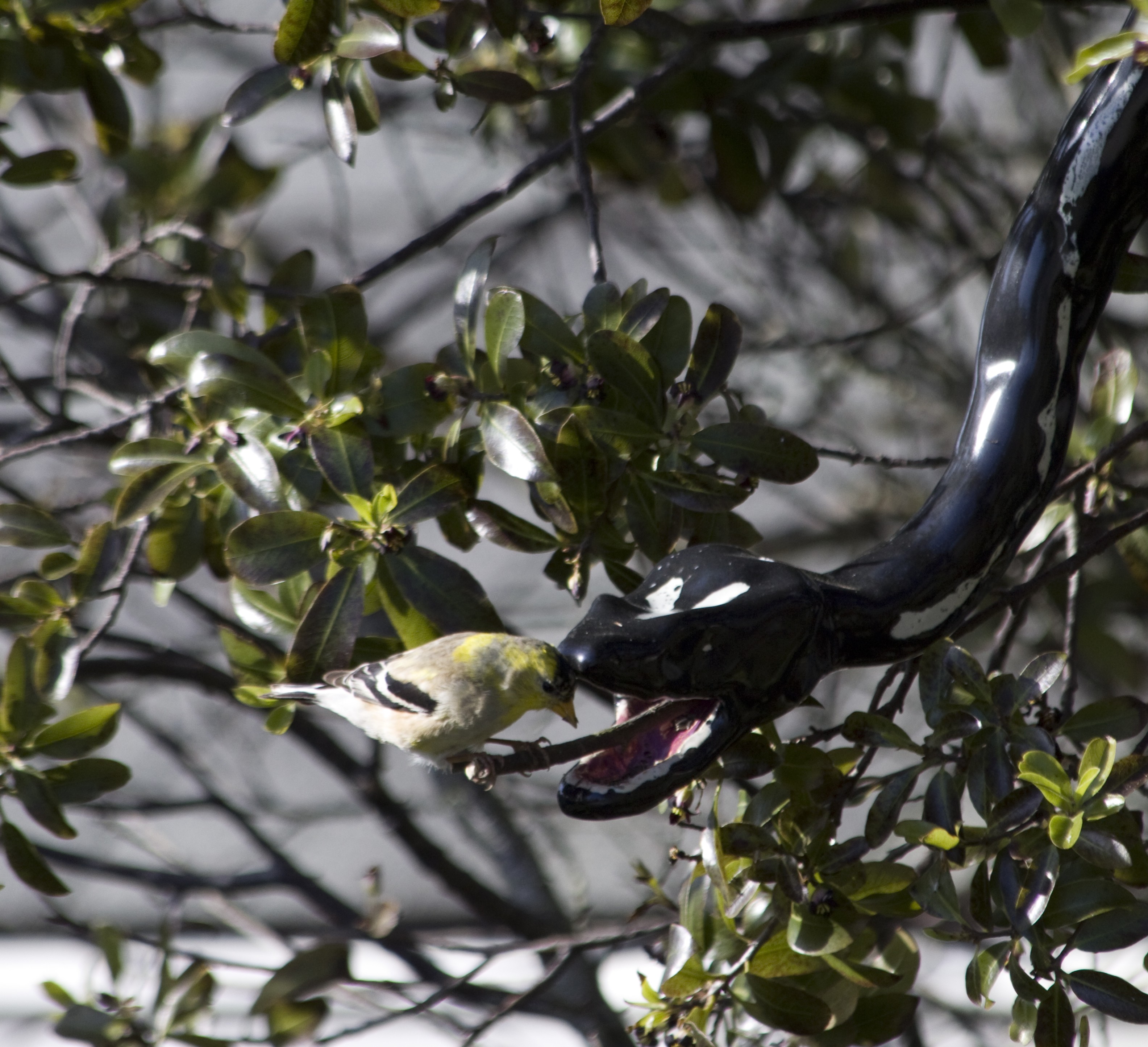
Ceramic birdfeeder and goldfinch from my frontyard, 2008

(Ceramic snake birdfeeder, by Summer Lee, 2008)

May Sarton has been speaking to me through her journals. She tells me to make an art of solitude, of which I have a lethal deprivation these days. Solitude is not for everyone, she seems to say through her doldrums and delights. You can get stuck with yourself there and self-berate endlessly. But beyond that, there is an expanse that wants to be explored with ink, words, light. Silence.

Heidegger says getting to that place begins with willing not to will. By intending not to intend — which for us humans, hungry for connection and to be special, anxious for security and accomplishment, is pretty fucking hard. And only after that little unlikely step, can an awakening to an inner releasement occur. A lettingness. Gelassenheit, he called it, borrowing from ancient, mystical German text. In turn, through Gelassenheit, we are let in. The most mundane glint of light through a swath of paint on a centuries-old, unknown painting brings me to my knees. Or the tiny yellow feathers of a pine siskin is a sign of god. Or, on the other hand, nothing happens. Like Adrienne Rich’s fact of a doorframe: we may go through, but it makes no promises.

And for good reason, since that mystery is the foundation of being. But I forget. Or as Heidegger says, I fall asleep thinking I am most awake. And during my restless slumber these clear spring nights, the fox wanders through the moon-glazed fields of my backyard, hoping I glimpse her and remember before she changes form again.

So, despite my circulation-squashing chokehold on all trivial things right now — whether to have another child, how to produce an acceptable art piece, how to be a good parent and partner, how to protect wildlife and destroy the gun lobby, how even to slow down bastard time as it mocks my appearance, my memory, my ability to get anything done — I accept that those tiny pine siskins have left my feeder and have gone north for several years, if they return at all. They are faithful to a rhythm older than time immemorial. Not to me. And I’m so grateful.
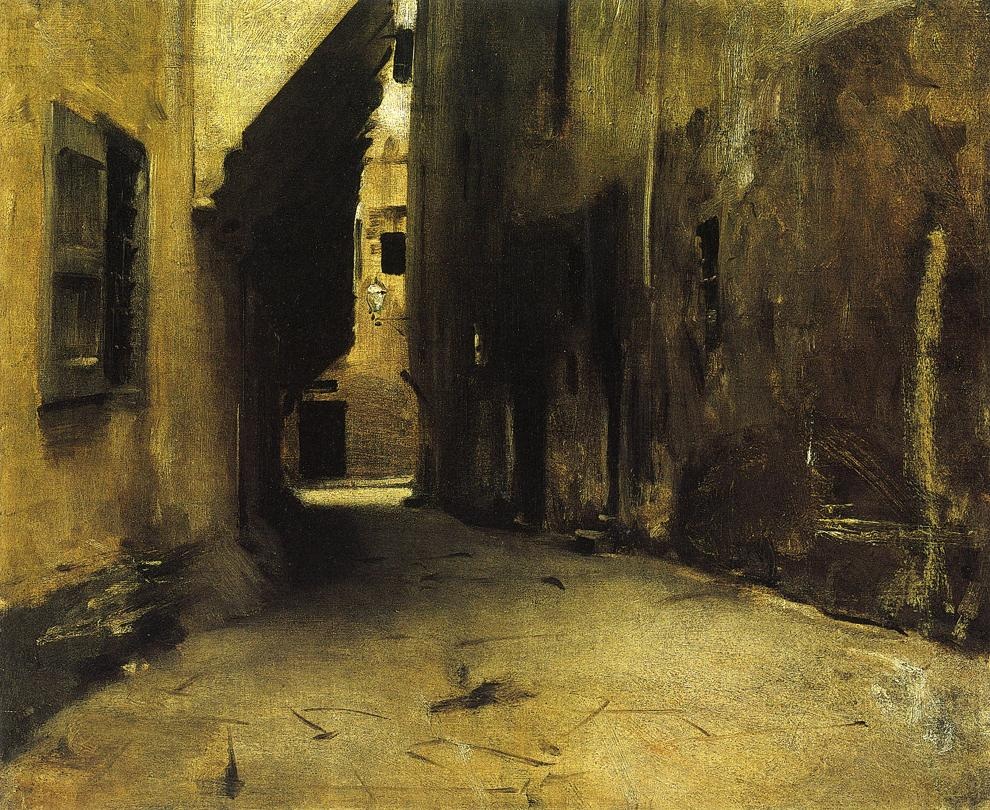
By John Singer Sargent

(Painting by John Singer Sargent)

“The shadow is a tight passage, a narrow door, whose painful constriction no one is spared who goes down to the deep well… For what comes after the door is surprisingly enough, a boundless expanse full of unprecedented uncertainty, with apparently no inside and no outside, no above and no below, no here and no there, no mine and no thine, no good and no bad… Where I am indivisible this and that; where I experience the other in myself and the other-than-myself experiences me.” — Mary Sarton, quoting Carl Jung.

“One can never pretend to comprehend completely –: that would disrespect in the face of the Unknown that inhabits — or comes to inhabit — the poet; that would be to forget that poetry is something that breathes; that poetry breathes you in.” Paul Celan to René Char

21 Sunday Apr 2013

Posted by summermlee in Aesthetic philosophy, Art, Birds, Nature, philosophy, poetry, Uncategorized

≈ 7 Comments

Tags

art, death, Leigh Hyams, painting, Paul Celan, poetry, San Miguel de Allende, Stephane Mallarme, teachers

Since I was the youngest by 3 or 4 decades, my traveling companions were relieved it was me who, drained from travel and the stifling heat (and a sip of the local margarita), interrupted pleasantries to declare that I might pass out. Our host for the week escorted me to the warm cement sidewalk of a dirt street outside the humble restaurant and waited until the cool breeze of the desert night revived me. She asked me polite questions, mostly trying to ease my embarrassment, but also to indirectly resolve how it is that at not even 30 years old, I had become close friends and travel companions with a cadre of women in their 60’s.

The babel of barking dogs woke me the next morning, which was after the night of dreaming she came to hold me. Somehow, the dark sensuality of this woman a half-century older did not alarm me.

In the morning painting session, I start with images and colors I have known before, but they don’t cooperate. As I paint canvases full of utterly conventional crap, I find myself at the edge of tears. There in the shade of her turquoise and pink adobe courtyard, tendrils of bougainvillea cling to the walls closing in on me, mocking my vulnerability and failure — like the stuffing has fallen out of my bra and the world sees me trying to put it back.

She sees the paintings and since I cannot dare the gracelessness needed to throw them over the fence,  I wish for once they could tell a lie. She moves like a dancer around them and critiques them with the fists of a boxer. I am politely mute, in turn, hating my own politeness. I want to hate her but she is just the conduit.

Painting. By Leigh Hyams(Painting by Leigh Hyams)

Plus, San Miguel de Allende overwhelms my sensitivity. I know why the dogs bark. All of them trying to simplify and drown out the brightly jarring colors, the incessant music from blocks away, the dead heat, the spirit voices, the craving for something other. The unreachable ocean.

The next night I dream that my neighbor’s contractor tears out my yard. All my cherished plants are missing, upturned soil exposes eviscerated roots. I experience an abyss where there once had been logic and rationality. Before hitting bottom, I wake to the pre-dawn storm of bird songs.

My dream is clear to her. She tells me in deep tones and direct terms that this unknown is the place where I want to be. Because of this and the buzz in her words, I start crying as she speaks, releasing all the tears that started bubbling in the courtyard. Tears that were neatly packaged screams against my mediocrity, my mundane banality, my safety. Tears that were cages holding a fearful but overgrown child wanting out into the wilderness. My painter friends look on tenderly, thinking it is because I’m sad. But I am beyond sad or happy, I am approaching otherness.

They think she is only speaking to me.

She says, this crying business, as if to be disdainful and compassionate at the same time, is something that only artists can understand.

I would return years later for an extended time considering the small city, my being in the midst of fertility treatment, and the lack of communication to my home from this gritty, foreign country. I was prisoner again to my own painting in her light-drenched studio, but she was a gentle and stern warden. We had many conversations here and there, aside a parade of indigenous costume-wearing tribes, over breakfasts in teeming gardens, after a dip in the local mineral springs, and hopping along the cobblestones incongruently filling the roads.

Sensing her increased frailty and watching her meticulous devotion to a series of sparsely charcoaled paintings of local ruins — to me obvious elegies to past magnanimous accomplishment — I asked if she was questioning her mortality. She, sitting in the improbably verdant backdrop of a sumptuous, water-filled courtyard garden gleaming in desert light and singing heat, answered with a smile, and maybe a slight disingenuousness: not anymore than I always have.

Painting by Leigh Hyams
(Painting by Leigh Hyams)

Some mornings new art books would appear at my breakfast table, always with unspoken pertinence. I loaned her my copy of Mary Oliver’s recent Evidence — a book of searching poems comprised of terse words around what cannot be buried, even spoken, after a loss, or death.

So I can imagine exactly how it was when she died a few weeks ago. Her bed is overlooking her wildly tended garden. She is arms-distance to her favorite art pieces ranging from profoundly poetic to those with playful certainty, and those, maybe her favorite, continually in serious questioning. I can see the washed out colors of early Mexican spring, feel the light-headed air of the high altitude aggressively dancing with the dust lifted and levitating in her richly alive, medieval Latin city. And I hear a liturgy from the birds of her neighborhood, of course, taking over the tinny brass horns droning from distant radios. The birds alone can accept that someone who loved life so much should have to leave it.  As a consolation, when dawn breaks leaving an emptiness for the rest of us, they send jewels of ephemeral birdsong down to earth to adorn her.

“Toute chose sacrée et qui veut demeurer sacrée s’enveloppe de mystère.” Stephane Mallarmé

Painting, by Leigh Hyams

(Painting by Leigh Hyams)

“Threadsuns / Above the grayblack wastes. / A tree- / high thought / grasps the light-tone: there are / still songs to sing beyond / mankind.” – Paul Celan

08 Friday Mar 2013

Posted by summermlee in Aesthetic philosophy, Art, philosophy, poetry

≈ 6 Comments

Tags

A Portrait of the Artist, Ancestors, art, death, James Joyce, Paul Celan, poetry, The Last Poems, There are still songs to sing beyond humankind, war

Despite some eccentricities in his presentation on the phone and his ardent refusal to use any technology, the elderly gentleman asks nothing and offers to help so today I go meet him in a restaurant in a suburb north of the City.

I anticipate that my art is ill-suited for his services, which mostly consist of lining up restaurants and businesses to display art with ungainly price tags. And when I see the Italian restaurant’s orange stucco walls with a range of some-accomplishment to beginner pieces, I remind myself to just see what the man has to offer.

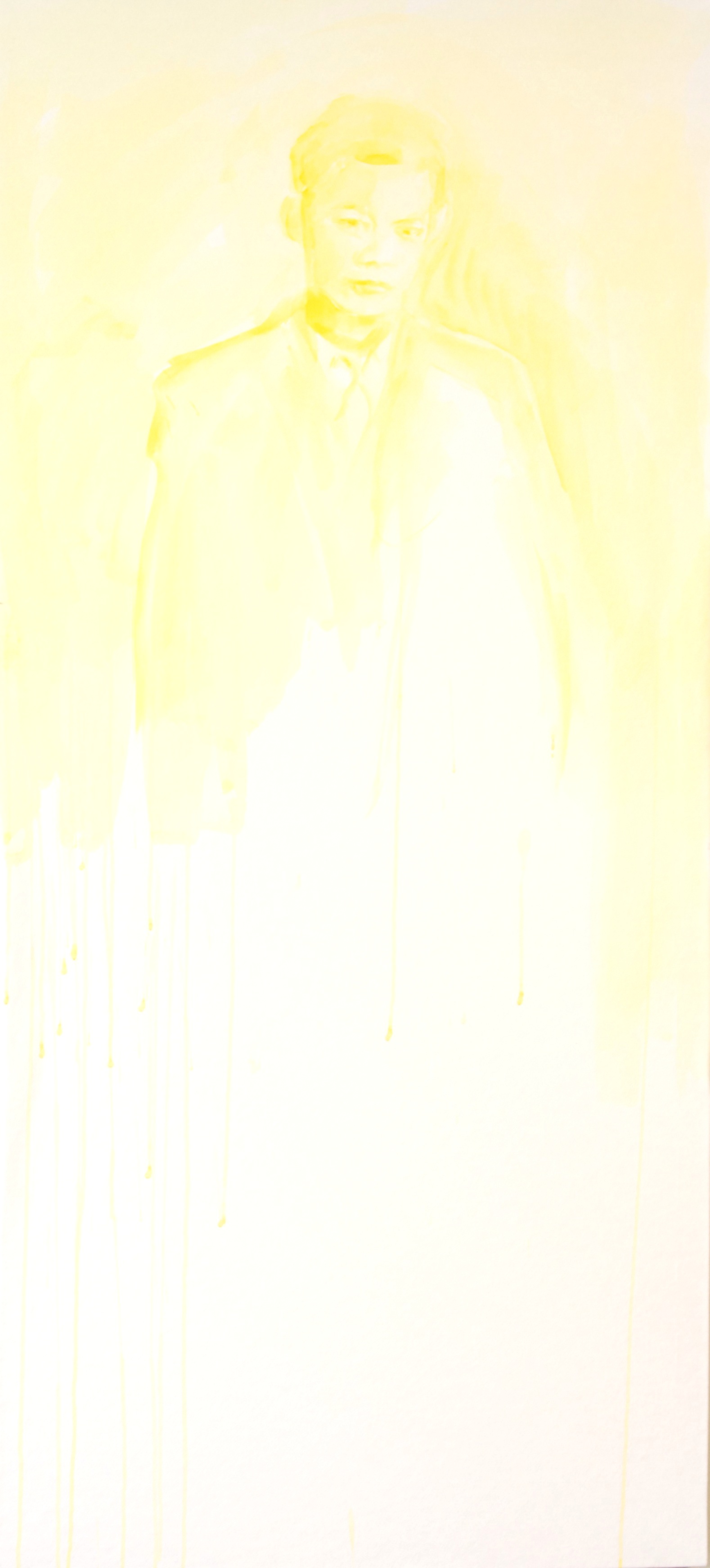
He is sitting in the corner, with a feminine, white, bob haircut coiffed neatly, a large Nordic nose over a receding chin. He is incredibly tall even hinging on his aged frame. He looks straight at me with a pale, wrinkled face holding ice blue eyes. He hands me a form listing the opportunities he gives to artists. I politely decline all of them and tell him that my work in my experience has not been palatable for the average “civilian” (his term not mine). In turn, he explains that society needs art and that an artist does no service hiding out making art privately. Art’s service is to move and connect to other people. I retort saying art is about solitude and that the optimum experience is to stand guard over someone else’s solitude. I am not interested in converting people to a state of interest. Besides my art would be taken as freaky (my word) in the milieu in which he works. He asks why. I explain that lately my work consists of 6-foot, yellow watercolor portraits that are hard to look at. I explain how these works are about my ancestors, being haunted by them but the impossibility of knowing them. And of course it is also about their death, but I admit I have more questions than answers about that part, and art is the place for unanswerable questions. It is not of the stuff that people want to fill their homes with.

Then he argues simply, “But you have the knowledge of who your ancestors are inside you.” And I say, no, the mystery is more important. He agrees and asks if I have time for a story.

He tells me that he was born on a dining table in Copenhagen to a gypsy-blooded mother. He said he was five years old when he was first interrogated by the Gestapo. That year his family under pressure set out to leave Copenhagen to stay with his grandparents who lived in the countryside outside the city. All Danes at that time ride bicycles, he disdains. And they would have to pass on bicycle an SS checkpoint with machine guns pointed over the road.

I said I don’t like where this is going. He paused for me but continued.

He said his father told him he would go first, then his sister, his mother, then finally his father, all in one line. His father told them all to keep bicycling past the checkpoint at least 50 meters before stopping. His voice starts to shake and I realize my hope of a happy ending is dead. My eyes immediately well up. He apologizes. He says this is very difficult to talk about. I say it is very difficult to hear. He slowly continues. He utters that he rode across, then he chokes again and clears his throat. He heard gunfire behind him and he kept going. He is sniffling now and I am weeping openly. He says he rode to his grandparents’ house, familiar with it from previous visits, and arrived to what he calls his friendly oak tree. One, he adds, that has a chimney. I nod in complete recognition, ungracefully smudging tears off my face. He says he stayed for a longtime there at the oak tree until at some point he received a message. He was told that he is now on his own, an orphan of the universe, and that he was also now a genetic placeholder for his ancestors.

—

Encumbered lately by the difficult poems of Paul Celan, I sense in his poetry the excruciating search for the impossible understanding to his parents murder, their lives cut off not far from the place and time of my own storyteller. Celan’s life’s work (and resultant suicide) was the existential failure to make sense of life mediated by language, using that same language in a means to what he describes as becoming silent. Silent like all those he survived. He was tormented, like Hegel, by the fact that words have a way of removing themselves from their meanings. That one day someone could utter genocide and it would be far from what he experienced. His collection of poems is therefore entitled, The Last Poems.

—

Back in this beautiful Italian restaurant adorned with the hopes of artists wanting to touch others and be touched, our artwork — an offering for his family — hung in a silence that was awkward to all but us. He finally breaks it and says to me gently, humbly: I lived it — I know what war means. And at that moment, I glimpsed the entirety of the word myself.

Still Frame from Ancestors on Rice Video, Summer Lee
(A still from a recent video, A family portrait projected on falling rice. 2013. See the whole video here. http://youtu.be/IoGln7tNyGo

“Terror is the feeling which arrests the mind in the presence of whatsoever is grave and constant in human sufferings and unites it with the secret cause.” – James Joyce, A Portrait of the Artist.

“Things I cannot speak of are not for the ear.” — Monsieur de Sainte Colombe, “Tous Les Matins du Monde.”

20 Wednesday Feb 2013

Posted by summermlee in Aesthetic philosophy, Art, music, philosophy, Uncategorized

≈ 4 Comments

Tags

art, healing, Itzhak Perlman, language, music, Tous Les Matins Du Monde, violin

As children we sometimes rode in his vintage BMW. There was often silence in the presence of my reclusive, stoic father, but his car was always filled with classical music, teeming with the lilt of violins played by ghost-like hands on imaginary stages only alive in the mind’s eye.

But tonight I sit in the intimate presence of an expert and his violin. Without wires and speakers and road noise, nor the dynamics of a vast symphony hall, by luck (privilege is also luck) I am inches away from the source. Unmediated.

The result of animal hair vibrating against metal strings over the opening of a lacquered, wooden box, it is also the most complicated of unspoken languages, the full range of human emotions and unarticulated impulses, all coming through a man who has painstakingly practiced his craft for over 50 years. Neurons, muscles, the electricity of infinitesimal choices of movement, invisible wavelengths and the receptive ear. Music. And like the best art, it is much more than that.

It is the ultimate of hubris that I might try to write about this experience. As Marin Marais utters in the culmination of Tous Les Matins du Monde, this violinist’s playing is “A refreshment for those who have run out of words.”

But among my people are silent musicians who had no such openings during war, invasions, immigration, mundane necessity, to sit where I am tonight.

The performer himself has been crippled by polio, and so easily could not be sitting where he is tonight. In the perfection of interpreting for composers hundreds of years dead, there lies the unmistaken inflection of his own living voice, informed by the circumstances that make their mark onto one’s life. Like the unique gesture made by a painter’s hand. His talents are undoubtedly mending the frays of pain, those tears in the fabric of human survival, passed down to him by his own people.

Because I know this is a healing and that it is in the realm of the miraculous. Music, as well as miracles, come to life on the necessity of the present moment. For over two hours, I am tethered to present tenses by unpredictable sounds and melodies, by the sight of his hands dancing impossibly up and down the strings. I am tied there until the end of his last performance, a composition he knows by heart and displays the utmost limit of his skill, of all human ability.

When he finishes I break inside and experience a pronounced loss because it is over, as are all the circumstances that culminated into this one evening — there with my mother weeping at the greatness of it all, our backs to the thousands of other audience members behind us, their wounds closing even if they don’t know it. I am greeted by an acceptance that this will never happen again. Even more, all of this could so easily, more likely even, not have been at all.

As it turns out, the night of this impossible recital happened to fall on my father’s unrealized birthday. If alive, he would have turned 80 years-old. And in his quiet way, he would’ve been healed most of all.

“Music exists to say things that words cannot say. Which is why it is not entirely human.” — Monsieur de Saint Colombe, Tous Les Matins du Monde

“You’ll see how much your little bird has changed.” — Edith Piaf

03 Sunday Feb 2013

Posted by summermlee in Aesthetic philosophy, Art, Birds, music, philosophy, poetry

≈ 9 Comments

Tags

art, Edith Piaf, French, high school, Jacques Prevert, memoir, philosophy, teachers, Virginia Woolf

Not much taller than the desks, she stood unblinking in front of the students, hopping and gesticulating wildly to convey her lesson to her jaded audience. In this of her many dramatic monologues with occasional spittle, she introduced a new topic, rudiment to understanding French, and maybe even life: existentialism.

We thoroughly read Camus, en français, and over time she espoused to her sheltered and callow high school students that every choice one makes has a consequence, and the absurd man is one who acts out of habit, shirking responsibility and awareness for the events and choices that come to comprise one’s life. We listened to Edith Piaf, learning her lyrics by heart. Having heard no other voice so utterly pained, wretched even, but strong and moving, I was taken. She grabbed me at the end of class after the rest of the students had drained out of the room, and for whatever reason, recounted that during her first teaching job at an elementary school, an air force officer entered her classroom and in front of her 25 students, handed her an envelope. In it was a piece of paper describing in the most coldly succinct language that her husband’s plane had crashed on a training flight nearby and he was deceased. There also in the envelope was his metal wristwatch, the only personal item with him and recovered from the crash, cracked with hands frozen at the exact moment of his death. With a teacher’s salary and two young children, she said Edith Piaf’s tragic life and inextricably-linked music became anthem to the fact she had no other choice to move on.

Her philosophy must have been a double-edged sword for the ESL students also under her care at the high school — the dregs, the few brown and black kids bussed into an otherwise privileged school of white kids dropped off by luxury cars. But there was no less, if not more, passion for these kids as there was for her sniveling French students. When her Edith Piaf admirer became Senior Class President, she arranged a secret meeting, knowing my duties as student organizer of the school prom. She said she had a young couple in her ESL class who wanted to go to the prom but could not pay the price of ticket, exorbitant even for today’s standards. She wanted to broker an arrangement for them, and they must never know. Loyal to her, I offered to comp them in, no one would notice in the shabby accounting. Slightly offended, she interjected to say the boyfriend had agreed to work the coat check before and after the dance to earn his way. I added their names to the paid list and other than her catching my eye at the entryway of the dance hall while she stood next to her couple, there was no word of it after.

She also introduced us to a book of poetry by Jacques Prevert, someone also familiar with war and loss. She had to have known I never returned my copy back to the school repository, and from time to time I still find a guilty joy in reading a poem or two from it — a treasured contraband. It was, of course, easy to tell her I was coming out as gay. She might have even said she had some gay friends or a gay son, I don’t remember. But after that, she took to meeting me at the town’s bookstore cafe, and we sat together as an unlikely duo of a middle-aged, manically energetic, short woman, and a gangly, wide-eyed, attentive girl — my hair getting shorter by the week as my shoes grew more militant. I don’t remember much of what we talked about, but I can smell the bitter coffee-filled air, and see the tome of pages from Antigone she xeroxed in French (another petty crime) and brought me to read over the summer. It was also there that she asked me to be President of the school French Club. I had no duties except to bring a piece of brie to the school club fair, where she also hosted an escargot-eating contest, and in turn it was something to add to my padded Stanford-bound resume. When our senior yearbook came out weeks before the end of school, she curiously asked to hold mine for a day or so. When she returned it to me, there adhered strongly to the inside the front page was an engraved, stately metal plaque. It read my name, the title of French Club President, and underneath, “Honni soit, qui mal y pense.” An ancient motto of chivalry, it means something to the effect of, evil to those who think evil, or shame to those who think shame of it.

The last week of school, she made me promise that I would let her be the last teacher I would say goodbye to. So, after gathering my things and finishing some tearful thank you’s to a few of my other teachers, I found her waiting for me in her classroom. As we walked down the hallway to one of the school’s exits out to the parking lot, she explained to me that there at the doorway was a threshold and it was marked by a strip of metal. She said that it was a milestone, a marker, this line. She would go on the other side and she was going to watch me cross. So I did: I unceremoniously stepped over the line, tears welling in my eyes, and there on the outside of the school she jumped to hug me. As she grasped me in her embrace she whispered in my ear, though it seemed louder and permanent: You have crossed the line and you must go, and I want you to remember, she clenched more tightly, you can’t go back.

Ladder, by Summer Lee
(An image from an art performance I did with Jesse Schmidt, 2008)

“I wish that once & for all I could put down in this wretched handwriting how this country impresses me — how great I feel the stony-hard flatness & monotony of the plain. Every time I write in this book I find myself drifting into the attractive but impossible task of describing the Fens — till I grow heartily sick of so much feeble word painting; & long for one expressive quotation that should signify in its solitary compass all the glories of earth air & Heaven. Nevertheless I own it is a joy to me to be set down with such a vast never ending picture to reproduce — reproduction is out of the question — but to gaze at, nibble at & scratch at.

After all we are a world of imitations; all the Arts that is to say imitate as far as they can the one great truth that all can see. Such is the eternal instinct in the human beast, to try & reproduce something of that majesty in paint marble or ink. Somehow ink tonight seems to me the least effectual method of all — & music the nearest to truth.” –Virginia Woolf

“Why then do we not despair?” — Anna Akhmatova

17 Monday Dec 2012

Posted by summermlee in Aesthetic philosophy, Art, philosophy, poetry

≈ 2 Comments

Tags

anna Akhmatova, art, funeral, Jay DeFeo, painting, poetry, The Rose, Women

The incense burns itself into the sinuses and forms a memory of her passing and these funerary rituals, so that for at least a few days, the smoky smell is a remembrance of a being who is no longer with us. The fading smell is the inevitable process of honoring a person we eventually can’t remember often enough. Indeed, memory is one way to ease the constant anxiety we future-oriented, unsatiated beings live with. We just can’t hold on.

So instead another image wants to write itself here in the space opened up by writing, by memory.

20121217-155808.jpg

(Painting, “Dove One,” by Jay DeFeo, in the SFMOMA retrospective)

In an orange jumpsuit, he sits across from me in a dingy jail interview cell. He is young, tall, strong, and mentally quite unstable. So in my callow role as his caseworker I make sure to stay arms length from the emergency call button, and closest to the door. It doesn’t help that his movements are abrupt, his voice loud, and he can only speak of fighting others, sometimes even aliens. Ju-Jitsu moves, karate techniques, kicking and punching and more threats of violence. Not towards me, though. He just wants me to hear him, I begin to understand, but attempts towards conversation provide only bizarre digressions that stubbornly return to more Ju-Jitsu talk.

It’s our third such meeting, and I bring my colleague, for safety, yes, but also because I want a witness to his instability and any insight as to why I was making no real progress with him. This time, I decide to just listen, leave my intentions and fears with my colleague sitting in quiet interest next to me.

As usual, he begins his intense litany of karate stories, of people he once punched and kicked. But suddenly, in a moment I’ve only since experienced as artistic inspiration, in a moment of self-forgetting, I have joined him. His language appears to me as a simple story-telling code. And just as I am about to weep at his stories of years in foster care and institutions, at his outpouring of traumatic recall, my colleague breaks her silence to remind him that violence is not ok. It is then I realize I had slipped into his world without her and she does not understand the code. Her words transport me back to where he is that man so strange, intimidating and inaccessible to me. To everyone.

Like the moment I stopped planting seeds in the shelter garden because a Korean resident wants to show me using gestures how she and her family had crouched under tents on their farmland in the rain, when they lost their home to war. And how our gardening together healed something, I will never know.

And how it is that a vast canvas holding 1500 pounds of gobs of oil paint and the aura of 8 years of creative toil, can also yet contain in a breath-turn the most fragile, most unearthly of passages. The same fragility that recalls the image of a woman finding refuge from military invasion inside a temple. She is mortally injured, parts of her body are missing, and it is there she nurses her baby.

In my mind she will stay there like the sentinel that is Jay DeFeo’s Rose standing guard over us. Because if you have followed me this far, you also understand she must, no matter how painful it is.

In the metaphor of gift-giving, there exists no stronger, no more difficult example.

Fortunately, there are easier exchanges, like the smiles of my friends, my fellow colleagues, as we chant together in the incense cloud hovering over Tu-Minh’s mother’s funeral. These are the same faces that appear to me in memories of my own family funerals. That some people are so indelibly present, heart-burstingly present, in the reel turning out life events.

Such is the mark of women drawn to a certain kind of work, how to describe it, I’m not sure. Yes here I’ve made some words for it, but they don’t hold, like the leaves of paper money falling behind our funeral procession into the winter wind.

And the miraculous comes so close
to the ruined, dirty houses —
something not known to anyone at all,
but wild in our breast for centuries.
— Anna Akhmatova

20121217-155835.jpgP

“I am moved by fancies that are curled / Around these images, and cling: / The notion of some infinitely gentle / Infinitely suffering thing.” T.S. Eliot

01 Saturday Dec 2012

Posted by summermlee in Aesthetic philosophy, Art, philosophy, poetry

≈ 4 Comments

Tags

A3, art, Georg Trakl, Heidegger, installation art, pain, Pamela Belknap, poetry, T.S. Eliot, threshold


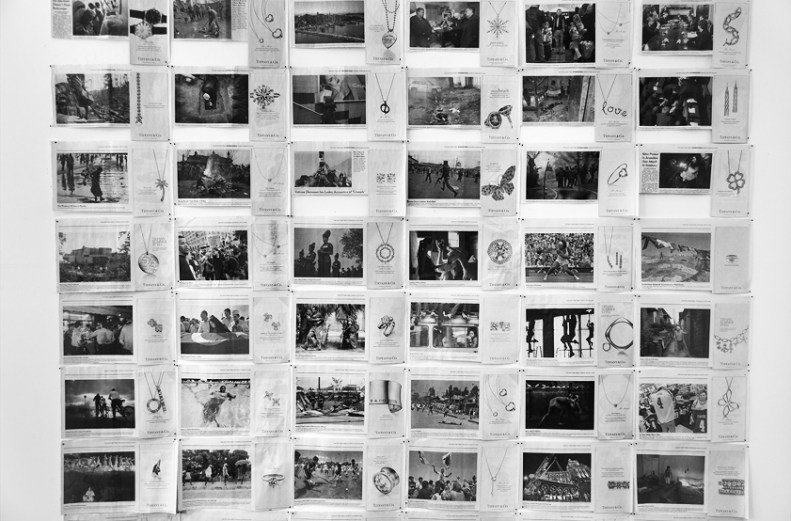
A3 by Pamela Belknap(A3 Installation, by Pamela Belknap. More can be found here)

A Winter Evening, by Georg Trakl

Window with falling snow is arrayed,
Long tolls the vesper bell,
The house is provided well,
The table is for many laid.

Wandering ones, more than a few,
Come to the door on darksome courses.
Golden blooms the tree of graces
Drawing up the earth’s cool dew.

Wanderer quietly steps within;
Pain has turned the threshold to stone.
There lie, in limpid brightness shown,
Upon the table bread and wine.

—

This is going to be a difficult one, not just because it is about pain, but also because it involves Heidegger philosophizing about pain and this “Winter Evening” poem. And Heidegger’s thinking is very abstract, even if, and almost necessarily because, it hits on something so true about being.

Heidegger holds that pain is not just the experience of Trakl’s wanderer (and we are all wanderers). Instead, pain itself has turned the threshold to stone.

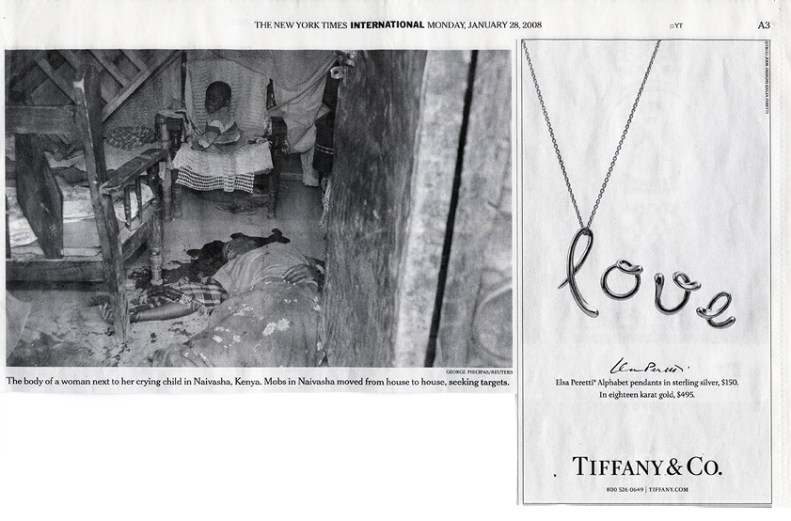
A3 by Pamela Belknap

Last night, I was standing in front of these images that comprise my friend’s brilliant installation at her open studio event, and I could not help think about, and feel, this threshold.

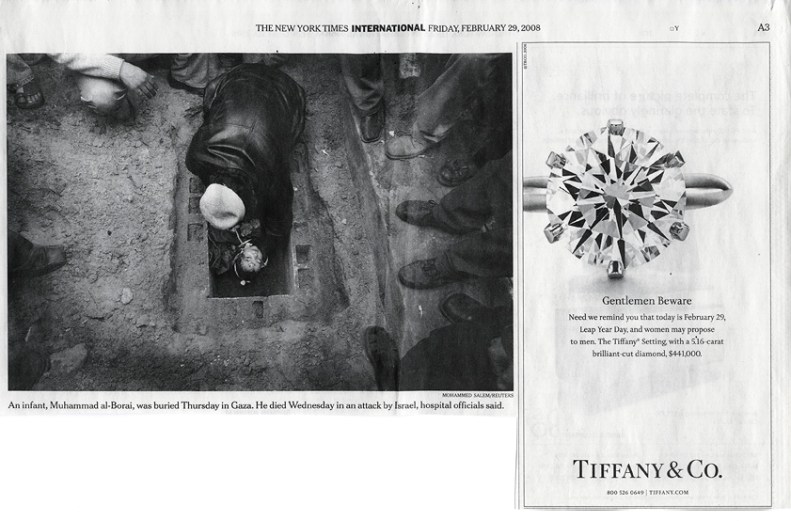
Yes, there is a threshold between the two images from the A3 section of the New York Times, almost always of an “infinitely suffering thing” captured by some journalist, and that of the Tiffany jewelry advertisement, almost always of an ostentatious, absurdly valuable and useless piece of metal, plastic or stone. These images together (and the over 800 others Pamela has collected), bear evidence of our interminable extremes of human subsistence and materialist glut, and the endlessly and unjustly paradoxical nature of being human. They are painful.

A3 by Pamela Belknap

Which side of Pamela’s image do we participate in? As I stood in front of this image, I heard the whisper of Heidegger telling me it was one and both at the same time.

Heidegger writes that pain can tear us asunder, separate us, in a way that can also join and draw together. It is pain found in the winter of Trakl’s scene, dividing “outside from inside, darkness from light, cold from warmth, hunger from nourishment, wandering from rest” – and in the case of Pamela’s artwork our participation in suffering and our painful attempt to elude it. It is pain that institutes the whole of it. The world grants these things as things, according to Heideggerian John Caputo, and “the joining of their intertwining is pain.”

Leonard Lawlor summarizes it more clearly: The fates we all are subject to cannot be simply planned and calculated; the harvest of wheat and grapes that make up Trakl’s table, of diamonds and precious metals even, are dependent on grace. “They are the fruits of the heaven and earth, gifts from the divinities to the mortals.” BUT, “grace can be withheld, and that is painful, even deadly.” Pain is the “grace of essential being in everything that comes to presence.” Without the threshold made stone by pain, it would all disappear  — “like a line drawn in the dirt.”

Somehow, though, we catch these glimpses of the threshold disappearing altogether. It is the same unspeakable mechanism that allows for one to feel most alive at the moment of instability and despair, like Blanchot’s happiness at nearly being shot to death, and the freedom at the instant of Orpheus’ loss. It is also the astonishing wonder found in the moment of receiving or giving a gift — or of love. Of a genuine act to reach and give to a fellow human.  It’s the tragedy inherent in Pamela’s A3.

Unexpected and not for anything – undivided and alive to everything.

(And it is not lost on me that even language, these words right here, cuts and divides, but at the same time gathers its skins towards itself into a scar.)

“Out of the meaningless practical shapes of all that is living or lifeless
Joined with the artist’s eye, new life, new form, new colour.
Out of the sea of sound the life of music,
Out of the slimy mud of words, out of the sleet and hail of verbal imprecisions,
Approximate thoughts and feelings, words that have taken the place of thoughts and feelings,
There spring the perfect order of speech, and the beauty of incantation.”

— T.S. Eliot, The Rock, 1934

“…a collector of silences and solitudes.” George Steiner on Ludwig Hohl

17 Saturday Nov 2012

Posted by summermlee in Aesthetic philosophy, Art, Nature, philosophy, poetry

≈ 2 Comments

Tags

Andre Chénier, art, death, George Steiner, Orpheus, poetry, rainy day poetry, solitude

As the sun’s last flashing ray,
As the last cool breeze from the shore,
Cheer the close of a dying day,
Thus I strike my lyre once more.
As now by the scaffold I wait,
Each moment of time seems the last,
For the clock, like a finger of fate,
Points onward and onward fast.

— Andre Chénier, 1794


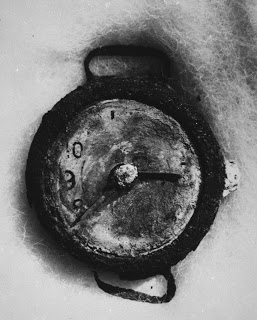
(Hiroshima watch, 8:15 a.m. August 6th, 1945)

A rainy day in the Bay Area is perfect for poetry that celebrates the precious solitude lacking from my life these days. I don’t need to blame the mundane circumstances of my life, or the lasting hangover from “art” school. Or the fact that I am trying to write this in a car whose turns are twisting my stomach into nausea all while from the backseat my son repeatedly sings a preciously off-tune version of the Abc’s. Because even so, anything less than what Steiner describes as a writing at “the edge of itself,” anything that falls short of being itself but also “speaking on behalf of the other,” is not a moment of true solitude. Art and writing necessitate a “self-summons” but also a “state of nothingness,” of which I am not capable of right now.

And what analogy is more apt than of a man awaiting guillotine in the last days of Revolutionary France, relying on his art to guide him to the imminent underworld. Again, I hear Orpheus calling on music to forge a path into the unknown. But somehow, thankfully, the situation need not be so dramatic, so dire, nor as politically charged, as to understand that what Chenier describes in his last moments is the human condition we all find ourselves in.

“The Young Captive”
The budding shoot ripens unharmed by the scythe,
Without fear of the press, on vine branches lithe,
Through spring-tide the green clusters bloom.
Is’t strange, then, that I in my life’s morning hour,
Though troubles like clouds on the dark present lower,
Half-frighted shrink back from my doom ?
Let the stern-hearted stoic run boldly on death!
I — I weep and I hope; to the north wind’s chill breath
I bend, — then erect is my form!
If days there are bitter, there are days also sweet,
Enjoyment unmixed where on earth may we meet?
What ocean has never a storm?
Illusions the fairest assuage half my pain,
The walls of a prison enclose me in vain,
The strong wings of hope bear me far;
So escapes from the net of the fowler the bird,
So darts he through ether, while his music is heard
Like showers of sweet sound from a star.
Comes Death unto me? I sleep tranquil and calm.
And Peace when I waken stands by with her balm.
Remorse is the offspring of crimes;
My welcome each morning smiles forth in all eyes,
My presence is here, to sad brows, a surprise
Which kindles to pleasure at times.
The end of my journey seemed so far to my view;
Of the elm-trees which border the long avenue,
The nearest are only past by;
At the banquet of life I have barely sat down.
My lips have but pressed the bright foaming crown
Of the wine in my cup bubbling high.
I am only in spring, — the harvest I’d see,
From season to season like the sun I would be
Intent on completing my round;
Shining bright in the garden, — its honour and queen;
As yet but the beams of the morning I’ve seen,
I wait for eve’s stillness profound.
O Death, thou canst wait; leave, leave me to dream,
And strike at the hearts where Despair is supreme,
And Shame hails thy dart as a boon!
For me, Pales has arbours unknown to the throngs,
The world has delights, the Muses have songs,
I wish not to perish too soon.
A prisoner myself, broken-hearted and crushed,
From my heart to my lips all my sympathies rushed,
And my lyre from its slumbers awoke;
At these sorrows, these wishes, of a captive, I heard,
And to rhyme and to measure I married each word
As softly and simply she spoke.
Should this song of my prison hereafter inspire
Some student with leisure her name to inquire,
This answer at least may be given, —
That grace marked her figure, her action, her speech,
And such as lived near her, blameless might teach

That life is the best gift of heaven.

(A recent watercolor of an unknown relative, 72 x 33 inches)

“You were my death / you all I could hold / when all fell away from me.” Paul Celan

27 Saturday Oct 2012

Posted by summermlee in Aesthetic philosophy, Art, philosophy, poetry

≈ 5 Comments

Tags

"The Gaze of Orpheus", "The Instant of My Death", art, death, Derrida, George Steiner, language, Maurice Blanchot, Paul Celan, poetry, Summer Mei Ling Lee, World War II

It is hard to know what this thread is, as it weaves through my recent travels. The only way to understand it more is to start about here.

Because, Blanchot says, in order to write, one must be already writing. “One can only write if one arrives at the instant towards which one can only move through space opened up by the movement of writing.” He writes this in reference to Orpheus, and that Orpheus needed music to descend to the underworld to rescue his love, a precise metaphorical homage to artistic creation. As it happens in tragedy, the moment he gazes at his beloved, he loses her, but experiences perhaps a moment of freedom: “[He] frees the work of his concern, frees the sacred contained in the work, gives the sacred to itself, to the freedom of its essence, to its essence which is freedom (for this reason, inspiration is the greatest gift).”

That is why a particularly masterful work of art recalls the fact that it could not have been — if we are vulnerable enough to let our art be art, let our hearts be touched, and to sense the present moment. Steiner is particularly fascinated with art’s ability to give presence to that which is absent and profoundly otherwise: “The arts, and music above all, give to man the freedom from his otherwise mortal city.” It is where humans can “surpass their condition.”

Blanchot, as with Paul Celan, knew Orpheus’ gaze in his own life, and both had stood within the “breath-turn” between absence and presence. Towards the end of his life, Blanchot wrote this letter to Derrida, who deeply understood occupied France:

“July 20. Fifty years ago, I knew the happiness of nearly being shot to death.”

As Blanchot was removed from his home by soldiers and placed in front of a firing squad, he experienced a “feeling of extraordinary lightness.”

Blanchot writes of the man who experienced this moment, “He was perhaps suddenly invincible. Dead — immortal. Perhaps ecstasy. Rather the feeling of compassion for suffering humanity, the happiness of not being immortal or eternal. Henceforth, he was bound to death by a surreptitious friendship.”

Blanchot, a stand-in for Orpheus, penned this “Instant of My Death” from the stance of a young man’s testimony, a fiction that is the leap of literature, one step removed from his own life. Perhaps he did so because it had been posited since classical Greece that the image of the thing is more beautiful than the thing it represents. But likely more so because he used his art to go to the depths of this underworld experience, the shadow-side of being human.  So at the moment of writing his death — as if Orpheus might describe it in 3rd person narration — at the moment he gazes back at Eurydice, he is free.

Tonight, I sit in my midnight bed, reading-lamp dim, and I hear the the approach of husky breathing that is my son, who turns his inhalations to exhalations without self-consciousness yet, who has ambled out of his bed and his room, guided by slivered lines drawn through sleep-puffed eyes, one hand viced to his blanket. He is just awake enough to know the path to my bed, and he is asleep before I have finished picking his warm, softly surrendered body up into the bed next to me. His breathing returns to the quieter rhythms of sleep and I wonder what impulse wakes him and directs him to my company. Years ago, during a particular grueling time (though there would be worse yet), I woke myself yelling for my mom. Calling for her as if she was down the hallway, like a child needing rescue from a bad dream. The impulse for words that call out for salvation is deep, even as I know that my faith in words, in salvation also, is constantly asunder.

“(At every turn, language traps us within the labyrinth which we are calling on language to elucidate).” George Steiner, Grammars of Creation.

(My recent installation, “Saigyo’s Moon.” Projection of flying birds on eggshells.)

“Believe in the holy contour of life.” Jack Kerouac

05 Friday Oct 2012

Posted by summermlee in Aesthetic philosophy, Art, Nature, philosophy, poetry, Uncategorized

≈ 5 Comments

Tags

art, Heidegger, Jacques Prevert, painting, poetry, To Paint a Portrait of a Bird

Pour faire le portrait d’un oiseau

— Jacques Prévert

Peindre d’abord une cage
avec une porte ouverte
peindre ensuite
quelque chose de joli
quelque chose de simple
quelque chose de beau
quelque chose d’utile
pour l’oiseau
placer ensuite la toile contre un arbre
dans un jardin
dans un bois
ou dans une forêt
se cacher derrière l’arbre
sans rien dire
sans bouger…
Parfois l’oiseau arrive vite
mais il peut aussi bien mettre de longues années
avant de se décider
Ne pas se décourager
attendre
attendre s’il faut pendant des années
la vitesse ou la lenteur de l’arrivée de l’oiseau
n’ayant aucun rapport
avec la réussite du tableau
Quand l’oiseau arrive
s’il arrive
observer le plus profond silence
attendre que l’oiseau entre dans la cage
et quand il est entré
fermer doucement la porte avec le pinceau
puis
effacer un à un tous les barreaux
en ayant soin de ne toucher aucune des plumes de l’oiseau
Faire ensuite le portrait de l’arbre
en choisissant la plus belle de ses branches
pour l’oiseau
peindre aussi le vert feuillage et la fraîcheur du vent
la poussière du soleil
et le bruit des bêtes de l’herbe dans la chaleur de l’été
et puis attendre que l’oiseau se décide à chanter
Si l’oiseau ne chante pas
c’est mauvais signe
signe que le tableau est mauvais
mais s’il chante c’est bon signe
signe que vous pouvez signer
Alors vous arrachez tout doucement
une des plumes de l’oiseau
et vous écrivez votre nom dans un coin du tableau.

——–

To Paint a Picture of a Bird

First you paint a cage
With its door open
Then paint
Something nice
Something simple
Something lovely
Something useful
For the bird
Then set the canvas against a tree
In a garden
In a grove
Or in a forest
Hide behind the tree
Without speaking
Or moving…
Sometimes a bird arrives quickly
But equally it may take many years
Before it chooses to
Don’t be discouraged
Wait
Wait many years if needed
The speed or tardiness of its arrival
Has nothing to do
With the success of the picture
When the bird arrives
If it arrives
Observe the most profound silence
Wait till the bird enters the cage
And when it has
Gently close the door with your brush
Then
Erase all the bars one by one
Taking care not to touch a feather of the bird
Then paint a picture of the tree
Choosing the loveliest branches
For the bird
Paint the green leaves too and the wind’s coolness
The dust in the sunlight
The sound of insects, in the grass, in the summer heat
Then wait for the bird to choose to sing
If the bird won’t sing
That’s an adverse sign
A sign that the painting is bad
But if it sings it’s a good sign
A sign you can sign your name
Then very gently you’ll detach
A feather from the bird
And write your name in a corner of the painting.

“We never come to thoughts. They come to us.” Heidegger
← Older posts
Newer posts →

Enter your email address to subscribe to this blog and receive notifications of new posts by email.

Join 619 other subscribers

Recent Posts

  • “Experimenters in the passages between worlds.” Vinciane Despret, Au Bonheur des Morts
  • “The terrifying groundlessness, the eradication of all violences. To be embraced by that which doesn’t know us and in that unknowing caresses us and truly loves us. We might become anything at all, something wildly other than what we are encountered by. A world that truly loves us by not presuming what we want or what shape we will take before we show up… We will be held when we are not known from the start.” — Dr. Marquis Bey
  • Images dream within us, a reverie is a world of expansion.
  • “For the natural world, the ethical responsibility is that being alive gives existence to others.” Vinciane Despret
  • “We meet in the freedoms of each other.” – Takeyoshi Nishiuchi

Archived Posts

Blog at WordPress.com.

  • Subscribe Subscribed
    Unwanted Advice: Reflections from a Self-Appointed Life Counselor
    Join 215 other subscribers

    Have a WordPress.com account? Log in now.

  • Unwanted Advice: Reflections from a Self-Appointed Life Counselor
    View site in Reader
    Manage subscriptionsSign upLog in
    Report this content
    Collapse this bar
Loading Comments...