• About

Unwanted Advice: Reflections from a Self-Appointed Life Counselor

~ Caminante, no hay camino. Se hace camino al andar. Wayfarer, there is no way. You make a way as you go. (Antonio Machado)

Unwanted Advice: Reflections from a Self-Appointed Life Counselor

Category Archives: philosophy

“All our heart’s courage is the echoing response to the first call of Being which gathers our thinking into the play of the world.” Heidegger

09 Monday Jul 2012

Posted by summermlee in Aesthetic philosophy, Art, Nature, philosophy, poetry

≈ 9 Comments

Tags

birds, Morris Graves, poetry, Saigyo, suffering, the moon, the muse

It is funny how the muse works. Even as I am distracted by the art-killing, mundane requirements of life, something persists to whisper to me. Thankfully. Even if those whispers are drowned out by the storm-like babel of Rilke’s crowd, they emerge almost imperceptibly like fragile threads of lace woven by frail hands into the dwindled still moments of my life. Little by little, something clearer and compelling forms itself together. Like a glimpse of Virginia Woolf’s pattern. And then I wonder regretfully what art could compose itself had I been able to listen more.

Tonight there is something about the moon. Except that it is so foggy here I cannot actually see it.

Last week at the shelter support group, we presented education on domestic violence to the women who are living there, escaping it. We try to instill a framework of what they experienced, perhaps so they can avoid it in the future, but also to reassure them that what they experienced was real, and that many, far too many, have experienced it also. As has become routine, we end this session with asking them what is a healthy relationship — a question most have not considered, nonetheless those who have wrangled with an almost lethally unhealthy one. But this evening, some of the women had definite ideas.

It came time to go around the group for their closing thoughts. One woman, the newest to the household, had been stone-silent the entire group. Just when I thought she would pass her turn, she began slowly to speak. She glared into my eyes and said that our discussion had been hard. It made her feel hurt, but also ignited an anger towards the person who had hurt her. She wanted vengeance even. She wondered how could someone begin to consider healthy relationships when they are mired in a bad one. To the point where it is no longer clear what is healthy and what is not. That we begin to become unhealthy too, starting to do abusive things ourselves because of what we experienced, over and over. How can we even hope for a good relationship, she asked, in a way that embarrassed me in the philosophically-flawed notion of future-tensed hope. She pleaded, but not in a way that warranted an answer, other than the tears welling all around the table. All I could do was put my hand on her arm and say that I was so happy she had responded.

That night driving home, the moon was so low and radiant in my horizon so as to be a guiding beacon for my car. And perhaps because I was tired and raw, the moon conjured something romantic, melancholy, poetic. At first I wanted to explore an annoying litany of philosopher ideas to articulate my connection to this strange, glowing disk hovering incredulously over the skyline. But what most came to mind, to the part of me that wants to translate these moments, is that simply, the creme-lit, distant landscape is a place I will never visit. Completely unreachable. Yet it persists in my darkening sky so predictably that civilizations could measure their time by it, more accurately than by the sun.

The next day, a friend wrote me an incredibly poetic email from her artist retreat in the countryside. It was correspondence tending to the heartening and savory details of nature available to only those who know true and enviable solitude. And of course it was full of Birdness. In it, she mentioned that I might like a talk that her Zen Buddhist teacher gave on suffering, as it is my relentless theme of late. As I listened to his illuminating talk, I received a hint sewn into the pattern. Her teacher read the poetry of the medieval poet, Saigyo — a poet almost obsessively concerned with the moon. A symbol of enlightenment, the beauty in the breath-taking and indescribable culmination of accepting the painfully ephemeral and suffering nature of being human. Always there, but practically unreachable.

Winter has withered

Everything in this mountain place:

Dignity is in

Its desolation now, and beauty

In the cold clarity of its moon.

This is what the muse left me this week. I know it’s not my job (nor am I able) to weave it so tightly together with meaning and language that it would suck the air out of the atmosphere and extinguish the moon one might see tonight, the moon throughout one’s entire life. But I am astonished that somehow a poet, from across the divide of 1,000 years and immeasurable distance, reaches to me through the chatter and knows intimately the miraculous moon that guided me home that withered night.
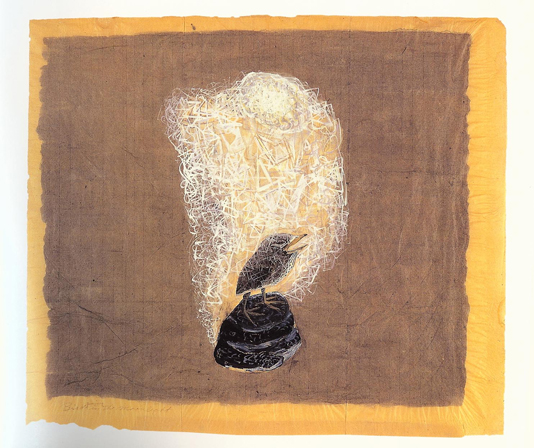
(Bird Singing in Moonlight, 1938, by Morris Graves)The rest of the poem is here:

http://ladynyo.wordpress.com/2012/04/12/mirror-for-the-moon-a-little-poetry-of-saigyo/

“The narrow bridge of art…” – Virginia Woolf

22 Friday Jun 2012

Posted by summermlee in Aesthetic philosophy, music, philosophy

≈ 4 Comments

Tags

chapel of the chimes, Columbarium, death, Garden of Memory, Laurie Amat, music, Oakland, summer solstice, Virginia Woolf

On the day with the longest daylight of the year, the Northern Solstice, I found myself surrounded by thousands of dead people. Yes, I am probably over-working the mortality theme of late into an insipid pulp, what with all of its depressing seriousness. But at the columbarium in Oakland tonight, the chapels,  cloisters, and crypts filled with the remains of the dead carried the very alive music of more than 30 musicians, as apparently happens every solstice.

In following our ears to the next musician around each corner, we worked our way through the names of bookended lives lining the niches, hallways and courtyards built almost as an ascending and descending gothic maze. Corners and alcoved places exist for the bereaved to experience a meditative solitude away from others, while the constant light through open ceilings and skylights reminds of an other place, and of human smallness. Tonight, the meditators, the remembering, were music-makers.

Among the more recently interred, an accordionist sat on a metal folding chair in a marble alcove and played accomplished polkas and waltzes and even a French classic — the same song I heard on a lively street behind the Notre Dame of Paris. Then, I sat looking at candy colored tulips in the sunny, cathedral garden, while couples cooed at the river, tourists gawked at the sentinel and soaring architecture, and locals ambled on their itinerant paths to bakeries, friendly meetings, work duties. Such aspirating and pumping accordion music is of a buzzing life, even as it was played tonight among the dead. The borderline absurdity of this accordion music in what is usually a solemn and silent, heart-heavy and self-reflective space was almost sublime. Like the last scene of Life is Beautiful, when the parade of humanity, and a boy full of life, marches out of a death camp.

And there was an incredibly serious experimental piano player, in a long hallway of glass-enclosed rows of urns, pounding and trilling her piano in utter dissonant refrains. Our toddler son was fascinating himself in the gurgling, concrete memorial fountain situated a few feet in front of her, and during a particular dark and howling section of her work, he crooned his neck up to the opening in the ceiling, and sang, Bubbles, Bubbles, Buuuuuuubbbbbbles, as if to commune with the alienating musician and her intentionally awful and emotionally grueling composition.

And of course, the moment of Being. I ducked into a light-filled crypt, where written passages of St. Luke adorn the stacks of shelved lives reduced to a plaque of name and date, a date far enough in antiquity that nothing is remembered of them except their grave marker. There, a welcoming, professionally-attired woman, Laurie Amat, gracefully filled the space of the dead with her operatic voice, lilting and trembling and belting and reverberating against the stone architecture. Her melodic voice ushered me in, but as she faced the places that contained the dead, her audience, I knew that I was superfluous. Her talents were refreshment for those who cannot sing or listen anymore. She was an instrument upon which an aliveness came home to acknowledge, to reach even, the realm of the unalive. It was a remembrance for the forgotten. And it was a reminder that I, like the thousands surrounding me who are reduced to ashes, urns, plaques and one or two mementos left by a dwindling number of adoring survivors, last for just a second on this earth — just like one of her perfectly pitched, honeyed notes as it disappears into the ethers, like the note before it. At first it hurt to let go of all that my self thinks is important, those empirical requirements of the everyday. And yet, the more I disappeared into the moment, I didn’t care that I was gone, forgotten. In fact, I relished it.

“If again we should find if we took a walk with our friend that he is alive to everything — to ugliness, sordidity, beauty, amusement. He follows every thought careless where it may lead him. He discusses openly what used never to be mentioned privately. And this very freedom and curiosity are perhaps the cause of what appears to be his most marked characteristic — the strange way in which things that have no apparent connection are associated in his mind. Feelings which used to come single and separate do so no longer. Beauty is part ugliness; amusement part disgust; pleasure part pain. Emotions which used to enter the mind whole are now broken up on the threshold.” Virginia Woolf

“When he walks out into the rising dawn or looks out into the event-filled evening and when he feels what is happening there, all situations drop from him as if from a dead man, though he stands in the midst of pure life.” Rilke

17 Sunday Jun 2012

Posted by summermlee in Aesthetic philosophy, Art, philosophy

≈ 3 Comments

Tags

Araya Rasdjarmrearnsook, art, death, Father's Day, Heidegger, phantoms of Asia, Rilke

Rilke says it best that without solitude, the meditative place for the fostering of one’s inner life, there can be no art. No love, either. Love, he writes, is standing guard over another’s solitude.

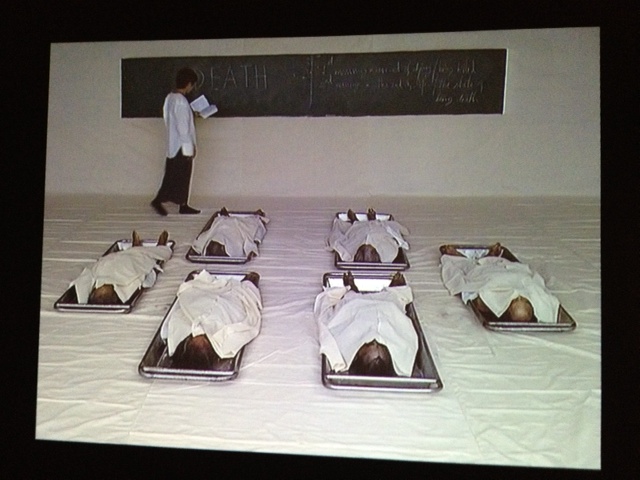
I found a moment to go to the Phantoms of Asia exhibition in the Asian Art Museum, where I encountered this video, entitled, The Class, by Araya Rasdjarmrearnsook. The artist is in essence, lecturing the six dead bodies on death. It is no accident that from where we sit, we are in the same audience as the dead people. At some point, my body will be that corpse lying on a tray. And it is there that I sat uncomfortably energized, feeling that anxiety, or Angst as Heidegger put it, that I am a being-toward-death.

While there is a dark humor pervading this piece, like when the artist asks a cadaver, What was that you said?, it is only a small bit of the profundity that this video reckons with. For me, the fact that the artist, a stand-in for the living, is teaching the dead about death — those who know deeply about it but cannot say —  hits on a facet of human nature that is confounding and all too ubiquitous. The living, in their attempt to colonize and conquer death, deaden and dull life itself.  As Steiner summarizing Heidegger says, those who rob us of the anxiety of death alienate us from life. Because, afterall, “the taking upon oneself, through Angst, of this existential ‘terminality’ is the absolute condition for human freedom.”

My friend, sitting next to me in front of this video, said plainly that she wished she had chosen to see her dead father’s body when she was given the chance, to have closure with his death. I responded carelessly that when she had had the opportunity, her father might have been dead too long and maybe the body was too removed from who he was when alive.

Two weeks later, last night, my undigested subconscious regurgitated before bed, filling my mind with thoughts about my own father. Yes, it’s Father’s Day today, but I haven’t thought of him on the past 3 or 4 such occasions. As some of you know, my ending with my father was not fairytale, but instead riddled with anger, doubt and a feeling of homelessness. But I did have meaningful time with him after he died. Although I was policed and hurried out of my vigil by his new vulturous step-family, I had a moment of loving contemplation over his peaceful body.

I realized last night that this time with him was one in which I could reflect on his life and in those incredibly condensed minutes, to feel the totality of him part from my totality. But last night I also realized that in those moments I worried about him as he faced his abyss. That I heard how he was anxious moments before he died. And I wish something or someone was with him, that he wasn’t totally alone in his leaving. Because it is a leaving that is utterly alone, and utterly into the unknown. And because of all that he was to me, for better or for worse, and because he faced this unspeakable time alone, probably doubting love, like we all might, I wish someone stood guard over him. I wish him love.

And maybe that’s all we can do for the dying — and we are all dying — because to do anything else is to rob one of life: “The inalienability of death — the plain but overwhelming fact that each must die for himself, that death is one existential potentiality which no enslavement, no promise, no power of ‘theyness’ can take away from individual man — is the fundamental truth of the meaning of being.”

In solitude, most critically felt at death, we experience freedom. Rilke’s artists and lovers of the everyday seem to know that freedom is contingent on an acceptance of our mortality and a quotidian comfort with the unknown — and even to let go enough to stand guard over someone else’s solitude. A constant homecoming, if we are brave enough. I’m not sure my father was brave enough until he was forced to be, and god knows I am not either.

“‘The wandering, the peregrination toward that which is worthy of being questioned, is not adventure but homecoming.’ Man, in his dignity, comes home to the unanswerable.” (Steiner on Heidegger)

Newer posts →

Enter your email address to subscribe to this blog and receive notifications of new posts by email.

Join 619 other subscribers

Recent Posts

  • “Experimenters in the passages between worlds.” Vinciane Despret, Au Bonheur des Morts
  • “The terrifying groundlessness, the eradication of all violences. To be embraced by that which doesn’t know us and in that unknowing caresses us and truly loves us. We might become anything at all, something wildly other than what we are encountered by. A world that truly loves us by not presuming what we want or what shape we will take before we show up… We will be held when we are not known from the start.” — Dr. Marquis Bey
  • Images dream within us, a reverie is a world of expansion.
  • “For the natural world, the ethical responsibility is that being alive gives existence to others.” Vinciane Despret
  • “We meet in the freedoms of each other.” – Takeyoshi Nishiuchi

Archived Posts

Blog at WordPress.com.

  • Subscribe Subscribed
    Unwanted Advice: Reflections from a Self-Appointed Life Counselor
    Join 215 other subscribers

    Have a WordPress.com account? Log in now.

  • Unwanted Advice: Reflections from a Self-Appointed Life Counselor
    View site in Reader
    Manage subscriptionsSign upLog in
    Report this content
    Collapse this bar
Loading Comments...